Fully wheelchair accessible via underground entrance
Best season
Spring (April–May) or Autumn (September–October)
Exactly 673 glass panes make up the Louvre Pyramid in Paris, France — not the devilish 666 that Dan Brown's novel burned into popular imagination. This matters, because the real story behind I.M. Pei's crystalline structure is stranger and more human than any conspiracy: a Chinese-American architect, a Socialist president with pharaonic ambitions, and a nation that nearly rioted over geometry. Stand beneath it on a clear morning and watch the 17th-century façades of the Cour Napoléon fracture and reassemble through the glass, and you'll understand why the controversy died.
The Pyramid serves as the main entrance to the Louvre, but calling it a doorway undersells the engineering. It's the glass lid on a vast underground lobby — the Hall Napoléon — that finally connected the museum's three sprawling wings and gave visitors something the old Louvre never had: functioning bathrooms, a coat check, and a ticket hall that didn't feel like a cattle pen. Before 1989, the Louvre was a logistical disaster dressed in gilding.
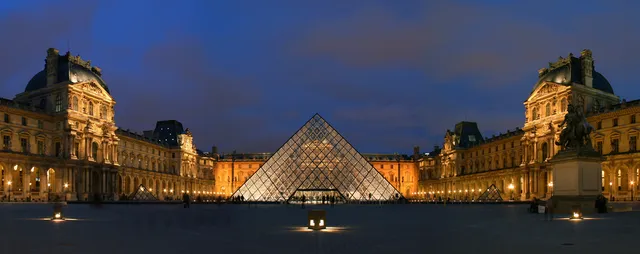
What strikes you first isn't the shape. It's the light. Pei specified extra-clear laminated glass, rejecting the greenish tint of standard panels, so that the historic stone around you stays warm and legible through the surface. At 21.6 meters tall — roughly the height of a seven-storey building — the main pyramid is flanked by three smaller ones that funnel daylight into the underground spaces, plus an inverted pyramid that hangs from the ceiling of the Carrousel du Louvre shopping concourse below.
The Pyramid sits on the same optical axis as the Eiffel Tower and the Grande Arche de la Défense, part of a line of monuments that cuts through Paris like a spine. It's one of those places where the 12th century and the 21st century press against each other so tightly you can feel the friction.
Researched by the Audiala editorial team from historical records, architectural archives, and local expertise.
What to see
The Main Pyramid and Cour Napoléon
You'd think a 21.6-meter glass pyramid dropped into a 17th-century courtyard would look absurd. It doesn't. I.M. Pei's structure — 673 panes of extra-clear laminated glass held together by 105 tonnes of aluminum and 95 tonnes of steel — manages something almost paradoxical: it commands the entire Cour Napoléon while appearing to dissolve into whatever sky sits above it. On overcast days the glass turns the color of wet slate; under summer sun it throws sharp geometric shadows across the paving stones like a sundial built for giants.
The angle of the pyramid's faces, roughly 51.5 degrees, nearly matches the Great Pyramid of Giza — a detail Pei never denied but never explained either. Stand at the center of the courtyard and look west through the glass: you'll see a perfect alignment with the Place de la Concorde, the Champs-Élysées, and the Arc de Triomphe along the Axe Historique, a sightline stretching over 3 kilometers. Most visitors miss this entirely because they're queuing with their backs to it. Turn around.
The Hall Napoléon Underground Lobby
The real trick of the pyramid isn't what you see from outside — it's what happens when you descend. Escalators carry you below the courtyard into the Hall Napoléon, a subterranean atrium roughly the size of a football pitch, where the chaos of the surface world simply stops. The acoustic shift is immediate and physical: traffic, pigeons, selfie-stick vendors all replaced by the soft, cathedral-like hum of footsteps on polished stone. Light pours down through the pyramid overhead in clean, angular shafts that move across the floor as the hours pass.
Pei designed this space to solve a blunt logistical problem — before 1989, the Louvre had no central entrance, and visitors wandered a labyrinth of disconnected wings. The Hall Napoléon became the hub connecting Denon, Richelieu, and Sully, turning a medieval-to-Baroque palace into something you could actually figure out. Look up from the center of the lobby. The underside of the pyramid, a lattice of aluminum ribs converging to a single point, is one of the most satisfying pieces of structural geometry in Paris.
The Inverted Pyramid and the Quiet Way In
Skip the main entrance queue entirely. Walk underground through the Carrousel du Louvre shopping concourse — accessible from the Palais Royal–Musée du Louvre metro station — and you'll find two rewards waiting. The first is the Pyramide Inversée, a downward-pointing glass structure that hangs from the ceiling like a frozen stalactite, its tip hovering just above a small stone pyramid rising from the floor. The gap between them is barely a hand's width. Dan Brown made it famous, but the real pleasure is watching natural light funnel through 7 meters of inverted glass into a space most people rush past on their way to buy a sandwich.
The second reward is practical: the Carrousel entrance feeds directly into the museum with dramatically shorter waits, especially on Wednesday and Friday evenings when the Louvre stays open until 9 PM. If even that line looks grim, the Porte des Lions entrance on the Seine side of the Denon wing is quieter still — though it only operates Monday, Thursday, Saturday, and Sunday. Knowing these back doors changes the entire experience from endurance test to something approaching pleasure.
Plan your visit
Getting There
Take Metro Line 1 or 7 to Palais-Royal / Musée du Louvre — the station exits directly into the Carrousel du Louvre underground complex, so you surface right beside the pyramid. Line 14 to Pyramides station works too, about a 5-minute walk east along Rue de Rivoli. If you're coming from the Eiffel Tower, the RER C to Musée d'Orsay gets you across the Seine for a pleasant 10-minute stroll through the Tuileries.
Opening Hours
As of 2026, the Louvre is open daily from 9:00 AM to 6:00 PM, except Fridays when it stays open until 9:00 PM — those Friday evenings are genuinely less crowded and the pyramid glows beautifully after dark. Closed every Tuesday, plus January 1, May 1, and December 25. Last entry is one hour before closing, and staff begin clearing rooms 30 minutes before the doors shut.
Time Needed
If you're here purely for the pyramid and the underground lobby — Pei's cathedral of light — give yourself 30 to 45 minutes to take it in from every angle across the Cour Napoléon. A focused museum visit hitting the major works (Mona Lisa, Winged Victory, Venus de Milo) runs 2–3 hours. The full museum sprawls across 92,000 square meters — roughly 13 football pitches — so a thorough exploration demands a full day or multiple visits.
Tickets
As of 2026, standard admission is €32. Holders of European passports may qualify for a reduced rate of €22 with supporting documentation. EU residents under 26 and disabled visitors (plus one companion) enter free — book a timed slot online regardless, because the museum regularly hits capacity and walk-ups risk being turned away.
Accessibility
The pyramid entrance has lifts providing full wheelchair access down to the underground lobby. The museum loans wheelchairs free of charge at the information desk, and elevators (look for banks D and E) connect all levels from -2 to 1. The sheer scale of the place is the real challenge — even with elevators, expect significant distances between wings.
Tickets & tours.
These are guided options from our partners — same price as booking direct.
Prices are indicative — final pricing and availability are confirmed at checkout. Audiala may earn a commission from bookings made through these links.
Photo Gallery
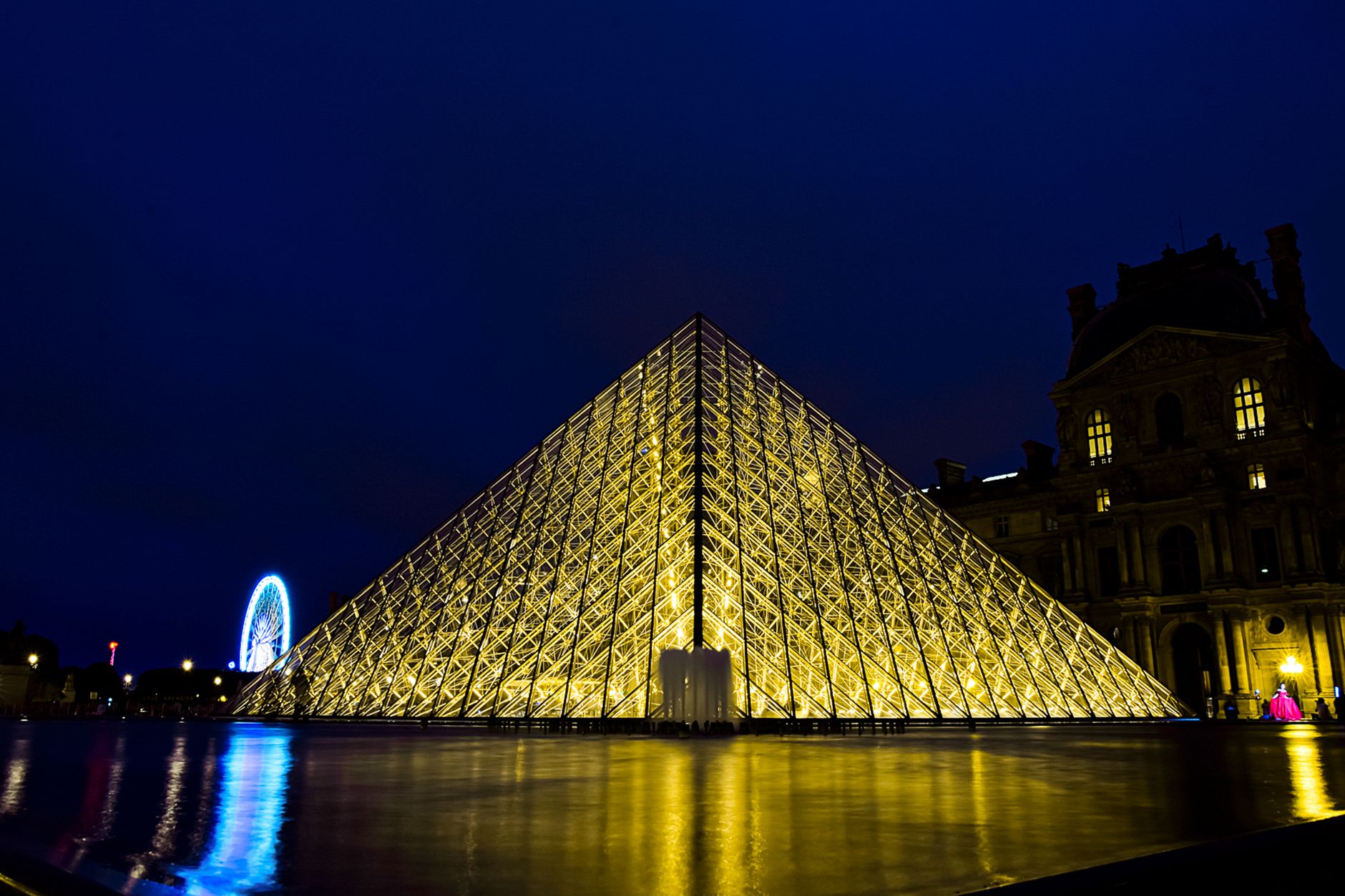
The iconic glass Louvre Pyramid glows brilliantly against the night sky in Paris, France, reflected in the surrounding water. · bassel zaki on PexelsThe modern glass Louvre Pyramid creates a striking contrast against the historic classical architecture of the Louvre Museum in Paris. · Gianluca Pugliese on PexelsThe modern glass Louvre Pyramid creates a striking contrast against the historic Renaissance architecture of the Louvre Museum in Paris. · Kadir Avşar on PexelsThe stunning glass Louvre Pyramid serves as the main entrance to the world-renowned Louvre Museum in Paris, France. · Mehmet Turgut Kirkgoz on PexelsThe modern glass Louvre Pyramid creates a striking contrast against the historic architecture of the Louvre Museum in Paris. · Jarod Barton on PexelsThe modern glass Louvre Pyramid creates a striking contrast against the historic architecture of the Louvre Museum in Paris. · Ludovic Delot on PexelsThe Louvre Pyramid glows brilliantly against the dark Parisian sky, contrasting modern glass architecture with the historic palace of the Louvre Museum. · Kadir Avşar on Pexels
History
A Pharaoh, a Foreigner, and 673 Panes of Glass
The Louvre's site has been contested ground for over eight centuries. A defensive fortress built around 1190 by Philip II to guard against Viking incursions became a royal palace, then a revolutionary museum in 1793. By the 1980s, the building was beloved but broken — overcrowded galleries, no central entrance, and the entire Richelieu wing occupied by the French Ministry of Finance since 1871. Something had to give.
On September 26, 1981, President François Mitterrand announced the "Grand Louvre" project: the Finance Ministry would be evicted, the museum would double its exhibition space, and a new entrance would be built in the Cour Napoléon. He chose I.M. Pei for the job on July 27, 1983. What followed was one of the most vicious architectural controversies in modern French history.
The turning point
I.M. Pei vs. an Entire Nation
Ieoh Ming Pei was 66 years old when he presented his pyramid design to the Commission supérieure des monuments historiques on January 23, 1984. The reception was hostile. Traditionalist critics called the glass form a "sacrilege," a "house of the dead" — the Egyptian pyramid's association with tombs was weaponized against him. Newspapers mocked Mitterrand as "Pharaoh François." The fact that Pei was not French, and not European, sharpened the attacks into something uglier.
Pei's personal stakes were enormous. He had spent months studying French history, walking the Louvre's corridors, absorbing the proportions of the Cour Napoléon before he drew a single line. His design philosophy was self-effacing: a transparent form that would serve the palace rather than compete with it, using geometry old enough — the pyramid's 51.52° angle nearly mirrors the Great Pyramid of Giza — to feel timeless rather than trendy. But the public wasn't reading blueprints. They were reading headlines.
The turning point came from politics, not persuasion. In 1986, the right won legislative elections and Finance Minister Édouard Balladur attempted to move his office back into the Louvre, hoping to kill the project by reclaiming the building. He failed. Construction had its own momentum — 105 tonnes of aluminum framing and 95 tonnes of steel were already being assembled. On March 29, 1989, the Pyramid was officially inaugurated. Within a decade, the same critics who had called it a travesty were calling it indispensable.
The President's Secret Muse
According to multiple biographers, Mitterrand's commitment to the Grand Louvre was shaped by Anne Pingeot, a curator at the Musée d'Orsay and the president's secret companion for over three decades. Pingeot's deep knowledge of French art and her proximity to the museum world reportedly helped convince Mitterrand that the Louvre's modernization was not just politically useful but culturally urgent. Their relationship remained hidden from the public until after Mitterrand's death in 1996.
The 666 Myth That Won't Die
Dan Brown's 2003 novel The Da Vinci Code claims the Pyramid contains exactly 666 glass panes — the Number of the Beast. The Louvre has repeatedly corrected this: the actual count is 673 (603 rhombus-shaped and 70 triangular). The myth predates Brown, circulating in French tabloids since the 1980s as part of broader conspiracy theories linking Mitterrand to Freemasonry. It remains the single most-asked question at the Pyramid's information desk, a testament to fiction's grip on fact.
Tips for visitors
Watch Your Pockets
The Cour Napoléon around the pyramid is one of Paris's worst pickpocket hotspots. Keep bags zipped and in front of you, and ignore anyone approaching with clipboards, petitions, or friendship bracelets — these are classic distraction scams.
Buy Tickets Official Only
Third-party ticket sellers near the entrance frequently sell fraudulent or massively marked-up tickets. Only purchase through the official Louvre website or at the museum itself — there's no legitimate "skip-the-line" upgrade since everyone passes through the same pyramid security.
Photography Rules
Personal photos and video are allowed throughout the permanent collection, but flash, tripods, and selfie sticks are all banned inside. Drones are strictly prohibited over all of central Paris without special government authorization.
Friday Evenings Are Magic
The Friday late opening until 9:00 PM thins the crowds dramatically after 6:00 PM, and the pyramid's glass catches the golden-hour light in a way that makes the whole courtyard feel like it's been dipped in honey. Arrive around 5:30 PM for the best of both worlds — quieter galleries and a luminous exterior.
Eat Off the Beaten Path
Skip the overpriced tourist menus facing the Louvre. Walk 5 minutes to Rue Saint-Honoré for solid boulangeries selling jambon-beurre sandwiches for under €6, or treat yourself to Angelina's legendary thick hot chocolate on Rue de Rivoli — rich enough to count as dessert.
Don't Miss the Inverted Pyramid
Below the Carrousel du Louvre shopping area hangs a lesser-known fifth pyramid — an inverted glass structure pointing downward like a stalactite of light. It's free to see without a museum ticket, and fans of The Da Vinci Code will recognize it immediately.
Where to Eat
local_dining
Don't Leave Without Trying
Croissant au beurre—the real thing, laminated to perfectionPain au chocolat—flaky pastry with dark chocolate barsSoupe à l'oignon gratinée—caramelized onion soup with Gruyère crustEscargots en cazolette—snails in garlic-parsley butterTartare de saumon or boeuf—finely minced raw fish or beef with shallots and capersCroque-monsieur—ham and cheese sandwich, pressed and griddled (avoid cellophane-wrapped tourist versions)Mont-Blanc—chestnut dessert with meringue and whipped creamVins naturels—natural wines, a specialty of the 1st arrondissement
Comptoir Denon & Richelieu
quick bite
Bakery & Quick Bites€€star4.7(13)directions_walk0m (directly under the Pyramid)
Order: Fresh croissants au beurre, pain au chocolat, and seasonal sandwiches—this is where museum-goers grab authentic Parisian bakery without leaving the Louvre grounds.
Located literally beneath the Pyramid itself, this is the real deal: a proper French comptoir serving locals and visitors alike. No tourist markup, just honest pastries and coffee.
Specialty Coffee€€star4.5(125)directions_walk~300m from Pyramid
Order: Single-origin espresso or pour-over—% Arabica is serious about their beans, not about Instagram aesthetics. The coffee speaks for itself.
This isn't a tourist trap cafe; it's a specialty coffee destination where baristas actually know what they're doing. A rare find in the Louvre area where most places serve mediocre brew to crowds.
Cafe & Light Fare€€star4.9(9)directions_walk~400m from Pyramid
Order: Fresh salads, tartines, and their house-made pastries. Cojean sources quality ingredients—you taste the difference immediately.
Tiny, quiet, and beloved by locals who work nearby. This is where Parisians actually eat lunch, not where tour groups queue. Perfect for a genuine neighborhood vibe steps from the Palais-Royal.
Chocolate & Pastry€€star4.5(169)directions_walk~300m from Pyramid
Order: Dark chocolate ganache, macarons, and their signature hot chocolate—this is haute pâtisserie, not mass-produced confection.
A Parisian institution for chocolate lovers. The craftsmanship is evident in every bite, and the setting in Carrousel du Louvre makes it an easy stop between galleries.
checkThe 1st arrondissement around the Louvre is a natural wine hub—seek out wine bars serving natural and biodynamic bottles if you're interested in authentic Parisian drinking culture.
checkParisians eat lunch between noon and 2 PM, dinner around 8 PM. Plan accordingly to avoid crowds and find tables more easily.
checkAvoid restaurants with laminated menus and picture boards directly facing the Louvre—they're almost always overpriced tourist traps.
checkCafes in Paris typically charge less if you stand at the counter (comptoir) versus sitting at a table (terrasse). Budget accordingly.
Food districts:Palais-Royal area—quiet, elegant, with local-favorite bistros and wine bars favored by office workersCarrousel du Louvre—convenient for quick bites and specialty shops between museum visitsRue Saint-Honoré—walking distance, known for its mix of casual cafes and higher-end dining
Restaurant data powered by Google
Watch & Explore Louvre Pyramid.
Explore Paris
INSIDE the LOUVRE | Exclusive Tour Inside This World Famous Museum 🇫🇷 Full Ep. 1
Artrageous with Nate14 min78K
Glass Pyramid at Louvre Museum
The Better Vacation2 min11K
Explore Paris
We Ranked Every Paris Attraction After 5 Years Living Here (The Truth)
Les Frenchies27 min555K
Frequently asked
Is the Louvre Pyramid worth visiting?
Absolutely — and not just as a doorway to the museum. The pyramid itself is a 21.6-meter-tall glass-and-steel structure that reflects the surrounding 17th-century Baroque facades like a geometric mirror, and descending into the Hall Napoléon beneath it is one of the great spatial transitions in Paris: the noise of the Cour Napoléon fades into a soft, cavernous hum as natural light pours through 673 glass panes above you. Even if you never set foot in the galleries, standing inside and looking up through the structure toward the historic Axe Historique — the sightline that runs from the pyramid through the Tuileries, past the Place de la Concorde, up the Champs-Élysées to the Grande Arche de la Défense — is worth the trip alone.
How long do you need at the Louvre Pyramid?
For the pyramid and its underground lobby alone, 20–30 minutes is plenty. If you're visiting the Louvre museum proper, plan for a minimum of 2–3 hours for the highlights, or a full day if you want to wander the 92,000 square meters of gallery space — roughly the area of 13 football pitches. Don't forget to duck into the Carrousel du Louvre underground mall to find the often-overlooked Inverted Pyramid, a downward-pointing glass structure that brings daylight into the subterranean concourse.
How do I get to the Louvre Pyramid from Paris?
The easiest route is Metro Line 1 or Line 7 to the Palais-Royal / Musée du Louvre station, which drops you a two-minute walk from the Cour Napoléon. Line 14 to Pyramides station also works. If you're coming from the Left Bank, RER Line C to Musée d'Orsay gets you across the Seine with a short walk over the Pont du Carrousel.
What is the best time to visit the Louvre Pyramid?
Friday evenings, when the museum stays open until 9:00 PM, are your best bet — the crowds thin dramatically after 6:00 PM and the pyramid glows like a lantern against the darkening courtyard. Early mornings right at 9:00 AM on weekdays (except Tuesday, when the museum is closed) are also quieter. For photography, visit just after sunset: the interior lights switch on while the sky still holds some color, and the reflection pools around the pyramid create near-perfect symmetry shots.
Can you visit the Louvre Pyramid for free?
You can admire and photograph the pyramid from the Cour Napoléon at any time without a ticket — it's a public courtyard. Entering the museum beneath it costs €32 as of 2026, though EU residents under 26 and disabled visitors with a companion get in free with valid ID. A reduced rate of €22 may apply for European passport holders with supporting documentation.
What should I not miss at the Louvre Pyramid?
Three things most people walk right past. First, the Inverted Pyramid in the underground Carrousel du Louvre — a glass structure that hangs from the ceiling like a stalactite of light, made famous by Dan Brown but genuinely striking in person. Second, the deliberate alignment: stand at the center of the lobby and look westward through the glass toward the Arc de Triomphe — I.M. Pei placed the pyramid precisely on this centuries-old royal axis. Third, the three smaller pyramids flanking the main one in the courtyard, which serve as skylights flooding the underground spaces with natural light.
Does the Louvre Pyramid really have 666 glass panes?
No — this is a debunked urban legend popularized by Dan Brown's The Da Vinci Code. The pyramid contains 673 glass panes: 603 rhombus-shaped and 70 triangular, supported by 105 tonnes of aluminum and 95 tonnes of steel. The myth has been around since the 1980s, when critics of President Mitterrand's project were looking for any ammunition against what they called "Pharaoh François' Pyramid."
Who designed the Louvre Pyramid and why was it controversial?
Chinese-American architect I.M. Pei designed it, selected personally by President François Mitterrand in 1983 as part of the Grand Louvre modernization project. The backlash was ferocious — traditionalists called it a sacrilege against French heritage, critics attacked Mitterrand's "monarchical" ambitions, and the fact that a non-French architect was reshaping the country's most iconic palace added xenophobic fuel to the fire. What most people don't realize is that the pyramid was never primarily an aesthetic statement: the Louvre desperately lacked basic infrastructure like bathrooms, ticket offices, and cloakrooms, and the pyramid was essentially the elegant lid on a massive, urgently needed underground lobby connecting the museum's three wings.
Sources & attribution24
Researched and written by the Audiala editorial team from historical records, architectural archives, and local expertise. Last updated April 2026.
Louvre Museum Paris – Pyramid — Detailed history, dimensions, glass pane count, construction timeline, and controversy surrounding the Louvre Pyramid.
Rost Architects – The Louvre — Historical context of the Louvre site from fortress to museum, Mitterrand's 1981 announcement, and Pei's design philosophy.
Wikipedia – Grand Louvre — Key dates including Pei's 1983 commission, the Ministry of Finance's removal, Anne Pingeot's influence, and Balladur's attempted reversal.
Louvre Official – A Pyramid for a Symbol — Official account of the pyramid's inauguration (March 29, 1989), the five pyramids, the Louis XIV alignment, and the functional purpose of the underground lobby.
Turnipseed Travel – Secrets of the Louvre — Practical tips including the Porte des Lions entrance, Carrousel du Louvre ticket purchase, and guided tour recommendations.
The Local France – Louvre Pyramid — Local reception history and critical nicknames given to the pyramid during the 1980s controversy.
Saved and recently read places — kept on this device only.
Photo credits (12)
Louvre Museum Wikimedia Commons — Benh LIEU SONG (Flickr) — CC BY-SA 3.0 (https://creativecommons.org/licenses/by-sa/3.0/) — Source: https://commons.wikimedia.org/wiki/File:Louvre_Museum_Wikimedia_Commons.jpg
Strictly necessary cookies keep the site working. Analytics (PostHog, Google Analytics) measures how each visitor uses our pages. Marketing loads YouTube videos and walking-route maps without a tap and lets Google Analytics set advertising cookies. We never sell your data. You can change this any time from the footer.
Privacy
Cookie preferences
Pick what you're okay with. You can change this any time from the footer.
Strictly necessary
Always on
Sign-in, language, navigation. Always on.
Product analytics
PostHog (EU) and Google Analytics record which pages you view and how you use them, under a random identifier stored in your browser. Helps us see which pages work and which need fixing. Google's ad personalisation stays off. No selling.
Marketing
Loads YouTube videos and the walking-route maps (OpenFreeMap) without a tap; without it, they load only when you tap them. If analytics is also on, Google Analytics may set advertising cookies. Ad personalisation stays off.