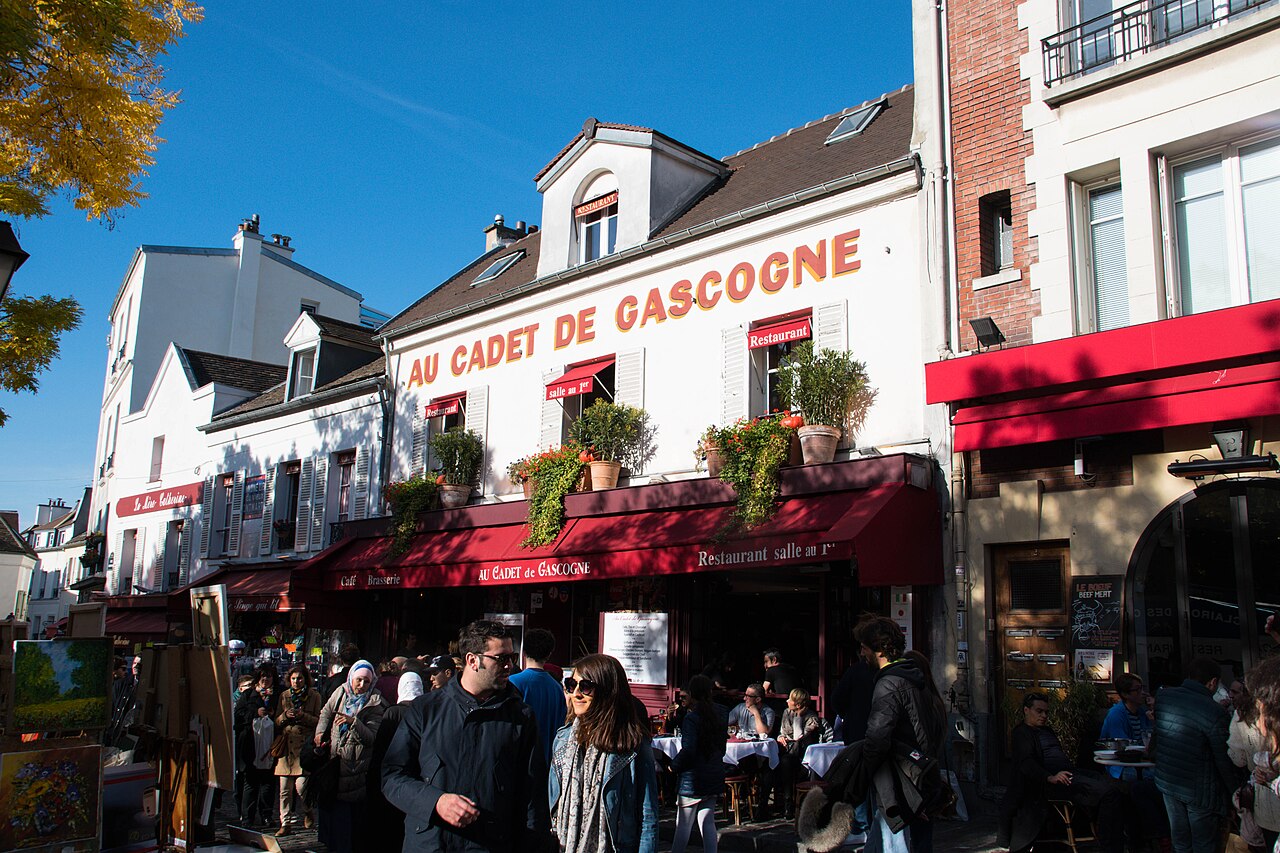
A square famous for easels and espresso once watched executions, revolutionary crowds, and one of France's first motorcars clawing up the hill. Place du Tertre, in Paris, France, is worth visiting because it still feels like Montmartre's old village nerve center, not just a backdrop for portraits. A few steps from Sacre-Coeur and Saint-Pierre-de-Montmartre, it gives you the rare Paris thrill of hearing souvenir chatter, clinking glasses, and eight centuries of argument on the same patch of stone.
Most visitors come for the painters. Fair enough. But the square makes more sense when you notice where you are: on the summit of the Butte, beside one of Paris's oldest churches, where the abbey lands of Montmartre slowly turned into a village center and then into a stage set for the world.
Records and later plans show that by the 17th century this was already functioning as Montmartre's public square, and by 1790 No. 3 held the first mairie of the independent commune. That changes the mood. You're not standing in an artists' fantasy but in the old administrative heart of a hill that once sat outside Paris proper.
And the square still has grit under the varnish. Look past the portrait stalls and restaurant awnings and you find a place where local memory keeps colliding with legend, from the disputed birth of the word "bistro" at La Mere Catherine to the plaque claiming Louis Renault drove a petrol car here on 24 December 1898, a machine arriving where donkeys once hauled cabbages uphill.
Researched by the Audiala editorial team from historical records, architectural archives, and local expertise.
What to see
The Artists' Square
Place du Tertre looks less like a plaza than a stage set that never quite stops performing. Along the edges, portraitists and caricaturists work inside tiny licensed pitches said to measure about 1 square meter each, roughly the size of a shower tray, while waiters thread between easels and café tables with the clink of glasses behind them; charcoal dust, coffee, and, in colder months, roasted chestnuts hang in the air together. Come early, before the square turns into a human traffic jam, and you notice the older truth of the place: this was the village center of Montmartre long before the souvenir racks arrived, with the hilltop still feeling faintly separate from the rest of Paris.
Saint-Pierre and the Old Montmartre Core
A few steps from the square, Saint-Pierre-de-Montmartre changes the mood in an instant. Records tie the abbey here to 1133, and the church's main fabric to the 12th century, so after all the chatter outside you walk into stone that has outlasted kingdoms; the air turns cool, footsteps soften, and the light falls in pale strips instead of neon restaurant glow. This is the part many people miss because Sacré-Cœur pulls the eye, but Saint-Pierre explains why the hill mattered in the first place: before Montmartre became a postcard, it was a religious settlement with memory packed into walls older than Notre-Dame's flying-buttress fame.
Do the Montmartre Triangle
Don't stay pinned to the square. Start at Place du Tertre when the artists are setting up, slip north-west toward Rue des Saules for La Maison Rose and the quieter folds of old Montmartre, then finish in the gardens of the Musée de Montmartre, where the noise drops away and the hill feels almost rural again. The route is short, barely more than a few hundred meters, about the length of two Paris Metro platforms end to end, yet it fixes the square in your mind: not a cute accident, but the surviving center of a village that art, tourism, and stubborn topography have never fully managed to flatten.
Plan your visit
Getting There
From Abbesses on Metro line 12, walk uphill 8 to 10 minutes via rue Yvonne-Le-Tac and rue Norvins; the last stretch is steep and cobbled. From Anvers on line 2, take the Montmartre funicular up toward Sacre-Coeur, then walk about 4 to 5 minutes west; by car, expect slow access and limited parking because the Butte has seen more pedestrianization and fewer parking spaces since 2025.
Opening Hours
As of 2026, Place du Tertre itself is a public square and stays open all day and all night. The real timetable belongs to the artists, cafes, and nearby churches: portrait stands and terraces usually build from late morning into the evening, while Saint-Pierre-de-Montmartre and Sacre-Coeur keep their own hours and may limit access during services or bad weather.
Time Needed
Give the square 20 to 30 minutes if you only want the view, the painters, and that first hit of Montmartre theater. Stay 60 to 90 minutes for a coffee or portrait, and 2 to 3 hours if you fold in Saint-Pierre, Sacre-Coeur, and a slow walk down toward Abbesses.
Accessibility
The square sits on the summit of the Butte, and the ground is uneven old stone with tight gaps between easels and terrace chairs. The easiest low-climb approach is usually a taxi drop-off near rue du Mont-Cenis or the funicular from the south, but even then you should expect slopes, crowding, and a surface that can feel as bumpy as a dried riverbed.
Cost and Tickets
As of 2026, Place du Tertre has no entry fee. The spending starts when you sit down: portraits and caricatures are priced by each artist, restaurant bills rise fast on the square, and the funicular uses standard Paris public transport fares rather than a separate sightseeing ticket.
Tickets & tours.
These are guided options from our partners — same price as booking direct.
Prices are indicative — final pricing and availability are confirmed at checkout. Audiala may earn a commission from bookings made through these links.
Also on GetYourGuide
More tours for Place Du Tertre
Curated from GetYourGuide. Same price as official, free cancellation on most.
Prices shown are indicative — final pricing and availability are confirmed at checkout. Audiala may receive a commission from bookings made via these links.
Photo Gallery
The iconic La Mère Catherine restaurant stands on the historic cobblestone streets of Place Du Tertre in Paris, France. · madras91This historical plaque in Place Du Tertre marks the site where the first town hall of the Montmartre commune was established in 1790. · ho visto nina volare from ItalyArtists work at their easels in the historic Place Du Tertre in Paris, surrounded by charming architecture and vibrant market umbrellas. · Michal GorskiArtists display their paintings and sketches in the historic Place Du Tertre, a famous square in the Montmartre district of Paris, France. · KimonBerlinThe charming Au Cadet de Gascogne restaurant sits in the heart of the historic Place Du Tertre in Paris, France, bustling with locals and tourists. · Maria EklindA vibrant display of classic Belle Époque posters adorns an exterior wall in the historic Place Du Tertre, a famous artistic hub in Paris, France. · Britchi MirelaA classic car sits parked amidst the iconic open-air art market at Place Du Tertre in the heart of Montmartre, Paris. · FOTO:Fortepan — ID 87487: Adományozó/Donor: Urbán Tamás. archive copy at the Wayback Machine
History
From Abbey Ground to Painted Myth
Place du Tertre began as something harder and stranger than the postcard version. Documented history ties the square to the abbey of Montmartre, founded in 1133, and to Saint-Pierre-de-Montmartre, whose main fabric dates to the 12th century; together they made this summit a religious enclosure long before it became a painters' theatre.
By the 17th century, secondary sources agree, abbey land here had been opened into a public square, and by 1686 the abbey itself had shifted downhill toward the Abbesses quarter. The artists came much later. Before that, this was a village center, a political address, and on 18 March 1871 one of the ignition points of the Paris Commune.
The turning point
The Morning Command Broke
On 18 March 1871, before sunrise had properly reached the Butte, General Claude Lecomte arrived with troops to recover 171 cannons from Montmartre. That number matters because it was absurdly visible: a line of artillery spread across the hill like iron fence posts laid on their sides. For Lecomte, the stake was personal as well as political. If he restored control, he served the government in Versailles; if he failed, his authority dissolved in public.
Documented accounts describe the turning point with brutal simplicity: the crowd thickened, women and National Guards pressed in, and Lecomte's soldiers refused the order to fire. Everything changed in that refusal. A routine military operation became a revolutionary break, and the hill that had once answered to abbesses and mayors now helped set Paris on the road to the Commune.
Standing in Place du Tertre today, you hear cutlery and sketch pencils. That morning, people heard shouted commands, boots on slope-worn stone, and then something rarer than gunfire: obedience failing all at once.
The Village Before Paris
Documented and partially documented sources place Montmartre's first civic life right here. In 1790, during the Revolution, No. 3 Place du Tertre became the mairie of the new commune, with Nicolas-Felix Desportes as its first mayor according to local municipal records and later histories. Montmartre would not be absorbed into Paris until 1860, which means this tidy square was once the center of a separate town perched above the capital, near enough to see Paris and far enough to govern itself.
Artists, Rules, and a Good Deal of Theater
People love to imagine the square as an eternal bohemian republic. More accurate, and more interesting: Place du Tertre became an artists' symbol in the late 19th and 20th centuries, then the city regulated that image with remarkable precision. A Conseil d'Etat decision from 11 February 1998 confirmed the framework for the square's artist pitches: 140 spaces of 1 square meter each, each one about the size of a shower tray, rented on public ground. Even Montmartre's spontaneity, it turns out, comes with measurements.
Tips for visitors
Church Etiquette
If you step into Saint-Pierre-de-Montmartre or Sacre-Coeur after the square, dress with a little restraint: shoulders, torso, and thighs covered works best, and men should remove hats indoors. Keep your voice low; the mood changes fast once you leave the clatter of plates and sketchpads.
Photo Rules
Casual photography on the square is generally fine, but tripods, organized shoots, and any drone use move into permit territory with the City of Paris; drones need an AGATE application. Also ask before photographing an artist's work up close, unless you enjoy starting a tiny diplomatic incident before lunch.
Scam Watch
The busiest approaches near Sacre-Coeur and the stairs below Montmartre draw pickpockets and bracelet-scam operators. Keep your phone and wallet in zipped front compartments, and do not stop for petitions, friendship bracelets, or anyone trying to grab your wrist.
Eat Selectively
For a quick, lighter stop, Carette at 7 Place du Tertre works well for pastries and coffee; for a fuller mid-range meal, Le Relais Gascon is a better bet off the main square. La Mere Catherine at 6 Place du Tertre has the history and the old-bistro aura, but check the menu before you sit because the romance arrives with Paris prices.
Beat The Crowds
Come before 10:30 a.m. if you want to hear chair legs on stone instead of a wall of restaurant chatter and selfie instructions. Late afternoon can also be good in cooler months, when the light turns the facades honey-colored and the square feels less like a queue with easels.
Pair It Well
Do the square with Saint-Pierre and Sacre-Coeur in one sweep, then leave quickly through the side streets toward Abbesses if you want Montmartre to feel like a neighborhood again. Place du Tertre is the stage set; two streets away, the set starts to crack, which is where the place gets more interesting.
Where to Eat
local_dining
Don't Leave Without Trying
Baguette or jambon-beurreSoupe à l’oignonCroque-monsieurParis-BrestBrie de Meaux
La Crèmerie du 35
local favorite
Traditional French Crèmerie€€star5.0(50)
Order: The fresh cheese platters and artisanal butter—perfect for a light, authentic Montmartre snack.
A tiny, beloved crèmerie serving local cheeses and charcuterie in a no-frills setting. Locals love it for its simplicity and quality.
checkTry Le Grenier à Pain for the best baguette in Montmartre.
checkFor a classic French bistro experience, order the onion soup or duck confit.
checkAvoid restaurants with menus only in English—locals eat where the signs are in French.
Food districts:Rue des Trois Frères for casual local spotsPlace du Tertre for historic dining
Restaurant data powered by Google
Frequently asked
Is Place du Tertre worth visiting?
Yes, if you want Montmartre's theater rather than a quiet square. Place du Tertre works best when you treat it as the old village heart of the hill: portrait artists working in public, cafe trays rattling over the paving, and Saint-Pierre-de-Montmartre a few steps away reminding you this was a religious and civic center long before it became postcard Paris.
How long do you need at Place du Tertre?
Plan on 30 to 60 minutes for the square itself. Stay longer if you want a portrait, a drink on the edge of the square, or a short detour to Saint-Pierre, the Musee de Montmartre, or the lanes around Rue Norvins and Rue des Saules where the crowd thins and old Montmartre starts to show through.
How do I get to Place du Tertre from Paris?
The easiest way is to take the Metro to Abbesses or Anvers, then walk uphill into Montmartre. Abbesses gives you the shorter climb through neighborhood streets; Anvers gives you the classic ascent toward Sacre-Coeur, with more crowds and more opportunists working the stairs.
What is the best time to visit Place du Tertre?
Early morning is best if you want the square before it turns into a shoulder-to-shoulder performance. Late afternoon also works well: the light warms the facades, artists are still out, and the place feels less like a funnel than it does around midday.
Can you visit Place du Tertre for free?
Yes, the square itself is free and always open. You only pay if you sit at a terrace, commission a sketch, or add nearby sights such as the Musee de Montmartre; the real cost here is patience, because the busiest hours can feel packed.
What should I not miss at Place du Tertre?
Don't miss the contrast between the square's artist spectacle and the older layers hiding in plain sight. Look for Saint-Pierre-de-Montmartre beside the square, No. 3 where Montmartre's first mairie stood during the Revolution, and the Renault plaque recalling the 24 December 1898 climb by automobile; it changes the place from a caricature market into a site with a long memory.
Sources & attribution64
Researched and written by the Audiala editorial team from historical records, architectural archives, and local expertise. Last updated April 2026.
POP Culture - Abbaye de Montmartre — Official heritage notice used for the 1133 abbey foundation context and historic setting around Place du Tertre.
Saved and recently read places — kept on this device only.
Photo credits (16)
Place du Tertre Paris 18è — Nasreddine Nas'h — CC BY-SA 4.0 (https://creativecommons.org/licenses/by-sa/4.0/) — Source: https://commons.wikimedia.org/wiki/File:Place_du_Tertre_Paris_18è.jpg
Street artist on the Place du Tertre (31098873785) — Maria Eklind — CC BY-SA 2.0 (https://creativecommons.org/licenses/by-sa/2.0/) — Source: https://commons.wikimedia.org/wiki/File:Street_artist_on_the_Place_du_Tertre_(31098873785).jpg
Paris 75018 Place du Tertre 20160907 Café Restaurant — Hop Phan from Vancouver, Canada — CC BY 2.0 (https://creativecommons.org/licenses/by/2.0/) — Source: https://commons.wikimedia.org/wiki/File:Paris_75018_Place_du_Tertre_20160907_Café_Restaurant.jpg
Place du Tertre (47547425902) — Armand — CC BY 2.0 (https://creativecommons.org/licenses/by/2.0/) — Source: https://commons.wikimedia.org/wiki/File:Place_du_Tertre_(47547425902).jpg
Alone on the Place du Tertre ! (49943648498) — madras91 — CC BY 2.0 (https://creativecommons.org/licenses/by/2.0/) — Source: https://commons.wikimedia.org/wiki/File:Alone_on_the_Place_du_Tertre_!_(49943648498).jpg
Commune de Montmartre plaque, place du Tertre, Paris May 2014 — ho visto nina volare from Italy — CC BY-SA 2.0 (https://creativecommons.org/licenses/by-sa/2.0/) — Source: https://commons.wikimedia.org/wiki/File:Commune_de_Montmartre_plaque,_place_du_Tertre,_Paris_May_2014.jpg
Artistes-peintres de la Place du Tertre (3) — Michal Gorski — CC BY-SA 3.0 (https://creativecommons.org/licenses/by-sa/3.0/) — Source: https://commons.wikimedia.org/wiki/File:Artistes-peintres_de_la_Place_du_Tertre_(3).jpg
Chez Eugène, Place du Tertre, Paris 15 March 2010 — KimonBerlin — CC BY-SA 2.0 (https://creativecommons.org/licenses/by-sa/2.0/) — Source: https://commons.wikimedia.org/wiki/File:Chez_Eugène,_Place_du_Tertre,_Paris_15_March_2010.jpg
Au Cadet de Gascogne, Paris 30 October 2016 — Maria Eklind — CC BY-SA 2.0 (https://creativecommons.org/licenses/by-sa/2.0/) — Source: https://commons.wikimedia.org/wiki/File:Au_Cadet_de_Gascogne,_Paris_30_October_2016.jpg
Butte Montmartre, Place du Tertre, Paris — Britchi Mirela — CC BY-SA 3.0 (https://creativecommons.org/licenses/by-sa/3.0/) — Source: https://commons.wikimedia.org/wiki/File:Butte_Montmartre,_Place_du_Tertre,_Paris.jpg
Montmartre, Place du Tertre. Fortepan 87487 — FOTO:Fortepan — ID 87487: Adományozó/Donor: Urbán Tamás. archive copy at the Wayback Machine — CC BY-SA 3.0 (https://creativecommons.org/licenses/by-sa/3.0/) — Source: https://commons.wikimedia.org/wiki/File:Montmartre,_Place_du_Tertre._Fortepan_87487.jpg
Paris 1971, Place du Tertre, painting, easel - Fortepan 87504 — FOTO:Fortepan — ID 87504: Adományozó/Donor: Urbán Tamás. archive copy at the Wayback Machine — CC BY-SA 3.0 (https://creativecommons.org/licenses/by-sa/3.0/) — Source: https://commons.wikimedia.org/wiki/File:Paris_1971,_Place_du_Tertre,_painting,_easel_-_Fortepan_87504.jpg
Montmartre, Place du Tertre. Fortepan 69849 — FOTO:Fortepan — ID 69849: Adományozó/Donor: A R. — CC BY-SA 3.0 (https://creativecommons.org/licenses/by-sa/3.0/) — Source: https://commons.wikimedia.org/wiki/File:Montmartre,_Place_du_Tertre._Fortepan_69849.jpg
Paris 1971, Place du Tertre, painting, easel Fortepan 87502 — FOTO:Fortepan — ID 87502: Adományozó/Donor: Urbán Tamás. archive copy at the Wayback Machine — CC BY-SA 3.0 (https://creativecommons.org/licenses/by-sa/3.0/) — Source: https://commons.wikimedia.org/wiki/File:Paris_1971,_Place_du_Tertre,_painting,_easel_Fortepan_87502.jpg
Devantures de restaurants de la place du Tertre (Paris) (PTX1643) — Lucas Tabary-Maujean — CC BY-SA 4.0 (https://creativecommons.org/licenses/by-sa/4.0/) — Source: https://commons.wikimedia.org/wiki/File:Devantures_de_restaurants_de_la_place_du_Tertre_(Paris)_(PTX1643).jpg
Paris 1971, Place du Tertre, painting, easel - Fortepan 87503 — FOTO:Fortepan — ID 87503: Adományozó/Donor: Urbán Tamás. archive copy at the Wayback Machine — CC BY-SA 3.0 (https://creativecommons.org/licenses/by-sa/3.0/) — Source: https://commons.wikimedia.org/wiki/File:Paris_1971,_Place_du_Tertre,_painting,_easel_-_Fortepan_87503.jpg
Strictly necessary cookies keep the site working. Analytics (PostHog, Google Analytics) measures how each visitor uses our pages. Marketing loads YouTube videos and walking-route maps without a tap and lets Google Analytics set advertising cookies. We never sell your data. You can change this any time from the footer.
Analytics and marketing cookies are optional and only load if you agree. Details under Customize.
Privacy
Cookie preferences
Pick what you're okay with. You can change this any time from the footer.
Strictly necessary
Always on
Sign-in, language, navigation. Always on.
Product analytics
PostHog (EU) and Google Analytics record which pages you view and how you use them, under a random identifier stored in your browser. Helps us see which pages work and which need fixing. Google's ad personalisation stays off. No selling.
Marketing
Loads YouTube videos and the walking-route maps (OpenFreeMap) without a tap; without it, they load only when you tap them. If analytics is also on, Google Analytics may set advertising cookies. Ad personalisation stays off.