Type 2+ letters to search all countries, cities, and places
/Ctrl KEsc
travel_explore
Type 2+ letters to search all countries, cities, and places
Press Enter to open the top result
Austrian National Library
Vienna·Austria·48° N · 16° E·Updated Apr 2026
The world's only Globe Museum lives here. Vienna's Baroque State Hall holds 200,000 volumes under a 30-metre frescoed dome — and it's a working library.
Elevator access available for strollers and mobility aids
Best season
Autumn–Winter (Oct–Feb) for smaller crowds
The architect who designed the most beautiful library room in Europe died the same year construction began — and never saw a single shelf installed. The Austrian National Library in Vienna, Austria, is that rare place where imperial ego, Baroque excess, and genuine intellectual ambition fused into something that still stops visitors mid-step. Its State Hall alone holds 200,000 volumes beneath a 30-meter dome painted to convince you that a Habsburg emperor was essentially a god.
Housed within the sprawling Hofburg Palace complex, the library began as a royal obsession in the 14th century and grew into one of the largest collections on the continent — over 12 million items today, from 3,000-year-old papyri to the world's only dedicated Globe Museum. But the real draw is the Prunksaal, the Baroque State Hall, where dark walnut bookshelves climb toward frescoed ceilings and four massive Venetian globes anchor the room like celestial punctuation marks.
This is not a place that asks you to be quiet and reverent. It demands you look up, crane your neck, and wonder who had the audacity to build a room this extravagant for books. The answer involves a dynasty, a dead architect, and a ceiling full of political propaganda disguised as heaven.
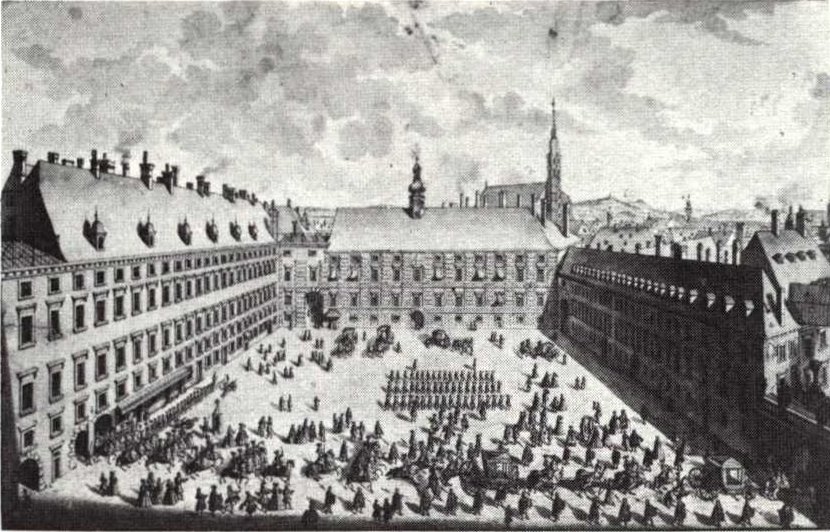
The library sits at Josefsplatz 1, a short walk from the Imperial Treasury and deep inside the old imperial quarter of Vienna. Nearest U-Bahn stops are Herrengasse and Stephansplatz — either puts you within five minutes on foot.
Researched by the Audiala editorial team from historical records, architectural archives, and local expertise.
What to see
The State Hall (Prunksaal)
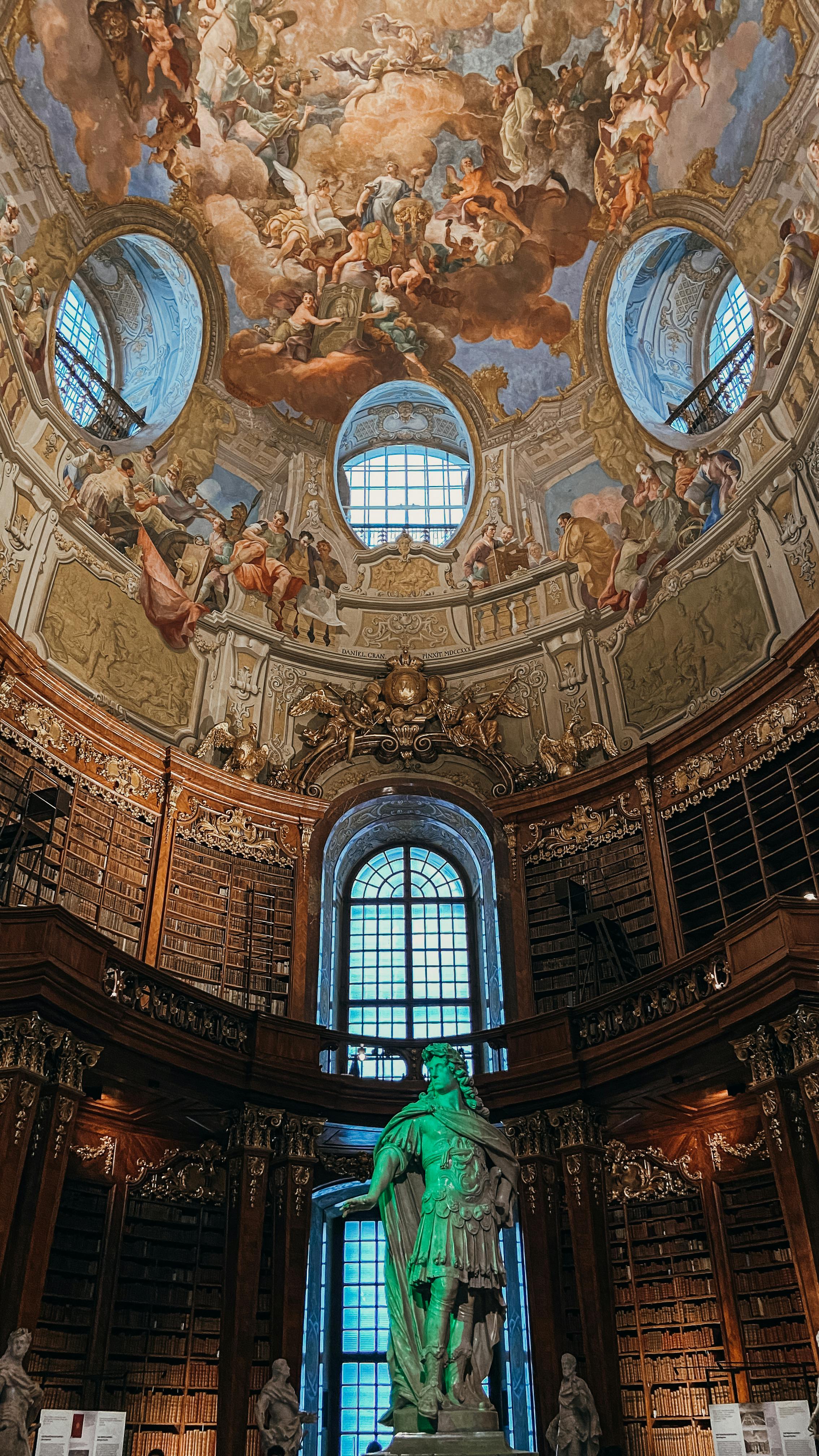
You walk through a modest doorway on Josefsplatz and then — 80 meters of Baroque excess opens before you like a hallucination. Johann Bernhard Fischer von Erlach designed this hall in 1723, and his son Joseph Emanuel finished it, though neither lived to see Daniel Gran complete the dome frescoes in the mid-1730s. The oval cupola rises 30 meters overhead — roughly the height of a ten-story building — and Gran painted Charles VI ascending into heaven across its entire surface, surrounded by allegorical figures representing the virtues of Habsburg rule. Modest, it is not.
The air hits you first: cool, climate-controlled, carrying the faint sweetness of old paper and leather from 200,000 volumes lining the walls in dark walnut cases. Gold leaf catches light differently depending on the season — in winter, low afternoon sun slants through the windows and turns the whole space amber, while summer light is flatter, more even. A 2021 lighting renovation added precision fixtures that pick out the spiral staircases and marble busts without touching the historic fabric, and most visitors never notice the engineering. Stand directly beneath the dome's center, near the marble statue of Charles VI, and look straight up. The fresco resolves into a single narrative about knowledge conquering ignorance — which is exactly what a man who built a library this extravagant would want you to believe.
The Library of Prince Eugene of Savoy
In the middle oval of the State Hall sits the personal collection of Prince Eugene of Savoy — 15,000 volumes bound in red, blue, and yellow Morocco leather, arranged with the chromatic precision of a textile merchant's showroom. Eugene was the military genius who broke the Ottoman siege of Vienna in 1683 and then spent his fortune on art, architecture, and books. When he died in 1736, Charles VI purchased the entire library and installed it here as a centerpiece.
What strikes you isn't the rarity of any single volume but the visual impact of the whole: three bold colors repeating across shelf after shelf, each spine tooled in gold. The leather has darkened over nearly three centuries, but the reds still glow. This is a collection that was always meant to be seen as much as read — a general's trophies rebound as scholarship. If you've visited the Imperial Treasury and marveled at the Habsburgs' appetite for accumulation, Eugene's library is the intellectual equivalent: power expressed through the sheer act of gathering.
Beyond the State Hall: Globe Museum and Papyrus Collection
Most visitors see the Prunksaal and leave. That's a mistake. The Austrian National Library runs four smaller museums, and two of them are genuinely strange in the best way. The Globe Museum, housed in the Palais Mollard-Clary on Herrengasse, is the only museum on earth dedicated entirely to globes — terrestrial, celestial, and planetary, spanning from the 16th century to the modern era. Some are barely larger than a grapefruit; others stand over a meter in diameter, their surfaces showing coastlines that European cartographers were still guessing at. The four monumental Venetian globes in the State Hall itself are a preview, but the dedicated museum lets you trace how humanity's picture of the world literally took shape.
Then there's the Papyrus Museum, where fragments over 3,000 years old sit behind glass — tax receipts, love letters, religious texts, the mundane paperwork of ancient Egypt preserved by desert air. The contrast with the Baroque grandeur upstairs is the point: knowledge doesn't always arrive in gold-tooled leather. Sometimes it's a scrap of reed paper that someone forgot to throw away. Both museums are accessible with combination tickets from the library's service desk or online shop, and they rarely draw crowds. Go on a Thursday evening, when the State Hall stays open until 21:00, and you can have the papyri almost to yourself.
Plan your visit
Getting There
The State Hall entrance sits at Josefsplatz 1, tucked inside the Hofburg complex. Take the U3 to Herrengasse (5-minute walk) or the U1/U4 to Karlsplatz (10-minute walk through the Burggarten). Trams 1, 2, and 71 stop nearby along the Ringstraße — from there you're threading through courtyards that haven't changed much since the 1720s. No dedicated parking exists; leave the car behind.
Opening Hours
As of 2026, the State Hall is open Tuesday–Wednesday and Friday–Sunday from 9:00 a.m. to 6:00 p.m., and Thursday until 9:00 p.m. Closed Mondays from October through May. Summer hours (June–September) can shift, so check the official ONB calendar before you go.
Time Needed
A focused walk through the State Hall takes 30–45 minutes — enough to absorb the frescoes, the four giant Venetian globes, and Prince Eugene's leather-bound library. If you add the Globe Museum (the only one of its kind worldwide) or the Papyrus Museum, budget 1 to 1.5 hours total.
Accessibility
The State Hall is barrier-free. Wheelchair users and visitors with strollers should ring the bell beside the left gate at Josefsplatz — staff will open an accessible entrance and direct you to the elevator. The reading rooms at Heldenplatz are also fully accessible.
Tickets
As of 2026, standard admission is €12, reduced €10.50. The Vienna Pass gets you in free. Book online through the official ONB shop to skip the queue at the service desk — particularly smart on Thursday evenings and weekend mornings.
Tickets & tours.
These are guided options from our partners — same price as booking direct.
Prices are indicative — final pricing and availability are confirmed at checkout. Audiala may earn a commission from bookings made through these links.
Photo Gallery
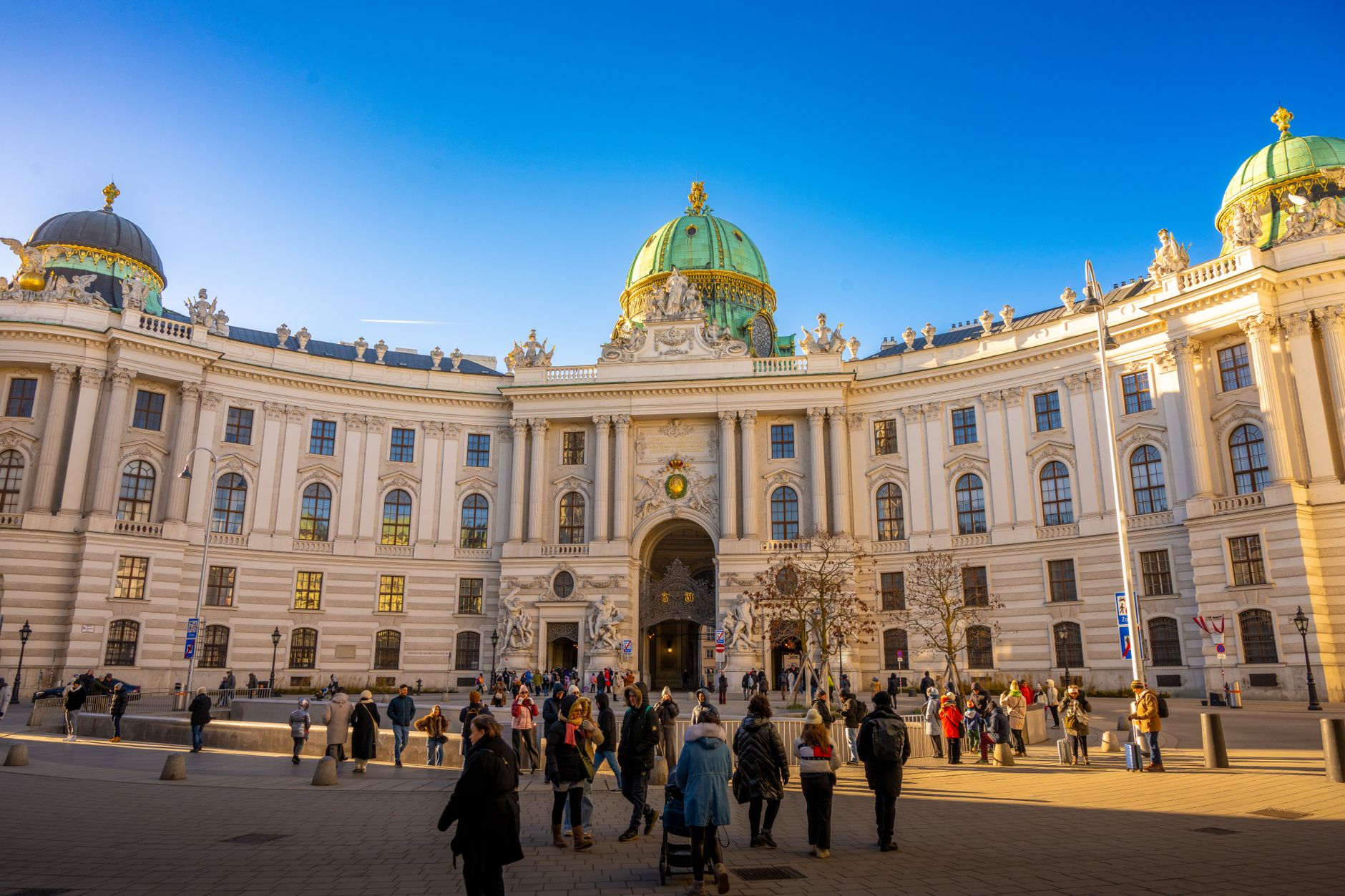
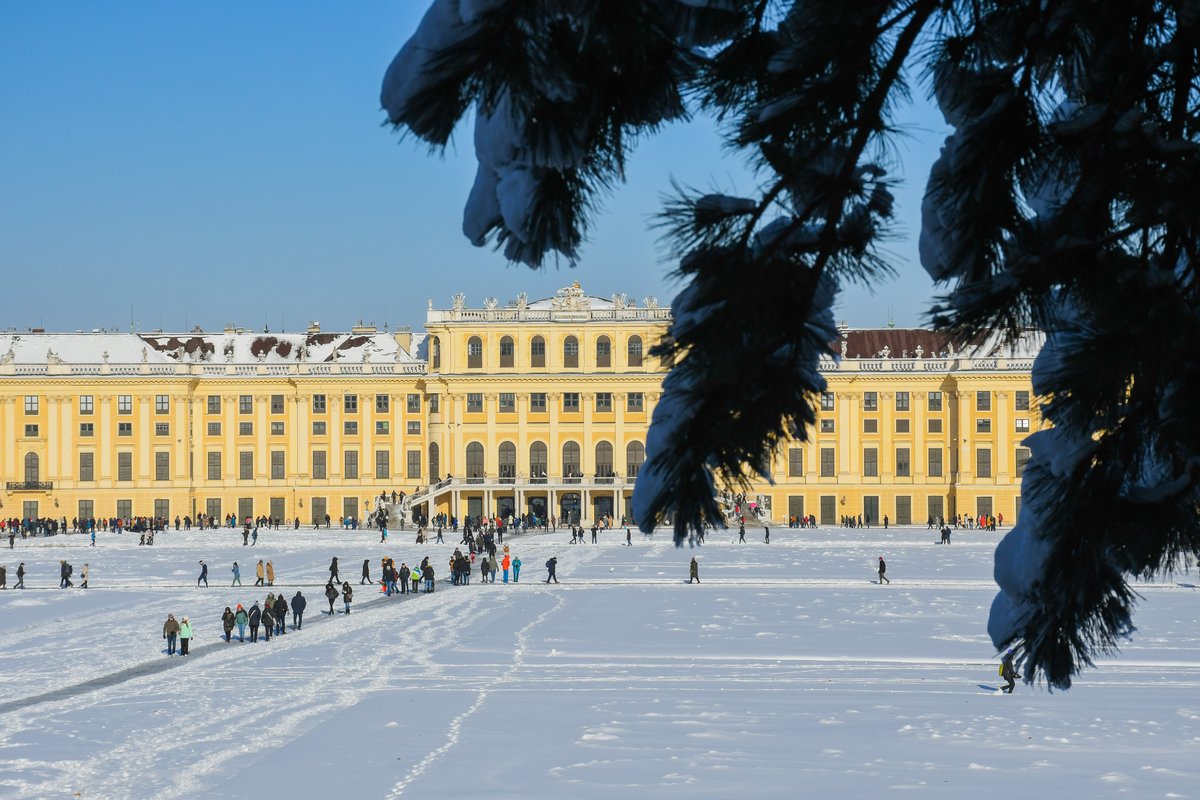
The breathtaking State Hall of the Austrian National Library in Vienna showcases magnificent Baroque architecture, intricate frescoes, and historic collections. · Jorge Urosa on PexelsThe magnificent Baroque architecture of the Austrian National Library stands prominently against a clear blue sky in Vienna. · ZAMMIT Richard on PexelsThe magnificent State Hall of the Austrian National Library in Vienna showcases breathtaking Baroque architecture and historic book collections. · Airam Dato-on on PexelsThe majestic facade and dome of the Austrian National Library in Vienna, captured on a bright, sunny day with visitors exploring the plaza. · Elijah Cobb on Pexels
History
A Dynasty's Shelf Life
The library's origin story is more legend than ledger. Records show the oldest book in the collection — the lavishly illuminated Holy Gospels by Johannes von Troppau — dates to 1368, and that year is conventionally treated as the founding date. But no charter exists, no ceremony was held. Duke Albert III of Habsburg simply began hoarding manuscripts, commissioning translations, and running a private scriptorium sometime in the late 14th century. The library grew because the Habsburgs kept acquiring things: territories, rivals' collections, entire monasteries' worth of books.
For two centuries, the collection migrated between rooms and residences, loosely cataloged at best. In 1575, Emperor Maximilian II appointed Hugo Blotius as the first official head librarian — a man tasked with imposing order on what had become a glorious mess. The library finally got a permanent, purpose-built home in the 1720s, when Charles VI decided that the world's greatest dynasty deserved the world's greatest room.
The turning point
The Architect Who Never Saw His Masterpiece
Johann Bernhard Fischer von Erlach was not merely an architect. He was an architectural philosopher — the author of a 1721 treatise that attempted to catalog every great building tradition from Egypt to China. By the time Charles VI commissioned him to design the new Imperial Court Library, Fischer von Erlach was in his late sixties, famous across Europe, and acutely aware this would be his final project. He had already designed Karlskirche across town. The library was his swan song, and he knew it.
He conceived a hall 77 meters long, centered on an oval dome that would flood the interior with natural light. The shelves would be dark walnut, the floors marble, the dome crowned with a fresco glorifying Charles VI as a near-divine patron of knowledge. Every detail — from the placement of marble statues by the Strudel brothers to the four towering Venetian globes — served a single argument: that Habsburg power and universal wisdom were the same thing. Fischer von Erlach died in April 1723, the very year construction began. He never saw a wall rise.
His son, Joseph Emanuel Fischer von Erlach, took over and completed the exterior by 1726. The painter Daniel Gran then spent years on the dome fresco, finishing around 1735 according to most sources, though the exact completion date remains debated among architectural historians. What Joseph Emanuel delivered was faithful to his father's vision — a room where the ceiling appears to open directly into the heavens, and where the scent of old leather and the amber glow through high windows make the 18th century feel closer than the street outside.
The Night the Books Were Carried Out
In November 1992, fire engulfed the Redoutensäle, the Hofburg's grand ballrooms, dangerously close to the library's collections. As flames lit the Vienna sky, police officers and library staff formed a human chain, physically passing thousands of irreplaceable historical volumes hand to hand through smoke-filled corridors to safety. The State Hall itself survived unscathed, but the event became a turning point — it forced Austria to confront how vulnerable centuries of accumulated knowledge remained to a single bad night. Modern fire suppression and climate control systems followed.
From Imperial Vanity to Public Trust
When the Habsburg monarchy collapsed in 1918, the Imperial Court Library — the Kaiserliche Hofbibliothek — suddenly belonged to no emperor. In 1920, the new Austrian Republic renamed it the Österreichische Nationalbibliothek, turning a private dynastic trophy case into a public institution. The transition was not seamless. During the Nazi annexation of 1938, the library became complicit in the confiscation of Jewish-owned books and collections. Today, the institution runs an active provenance research program, working to identify and return volumes looted during that period — a process that, eight decades later, is still far from complete.
Tips for visitors
Go Thursday Evening
The State Hall stays open until 9:00 p.m. on Thursdays. By 7:00 p.m. the tour groups have cleared out, and the late light through the high windows turns the walnut shelving almost amber. It's a different room.
Photography Rules
Personal photography is allowed, but no flash, no tripods, and no selfie sticks — staff enforce this actively to protect the 300-year-old frescoes and manuscripts. Keep your phone camera ready instead; the dome's natural light is generous enough.
Watch Your Pockets
The Hofburg complex and the surrounding Josefsplatz area are prime pickpocket territory, especially in the crowded entrance corridors. Keep bags zipped and in front of you, particularly during weekend midday rushes.
Eat Nearby
Trzesniewski on Dorotheergasse (3-minute walk) serves tiny open-faced sandwiches for about €1.50 each — a perfect budget lunch beloved by locals since 1902. For a splurge, Café Central inside Palais Ferstel is a 5-minute walk but expect a queue. Café Demel on Kohlmarkt splits the difference on price and patience.
Combine With Hofburg
You're already inside the palace complex, so pair the State Hall with the Imperial Treasury — it's a 4-minute walk across the courtyard and holds the Habsburg crown jewels. Together they make a complete morning without doubling back across Vienna.
Leave Large Bags
Backpacks and large bags aren't permitted in the State Hall. Lockers are available at the entrance, but they're small — travel light or stash your daypack at your hotel before visiting.
Where to Eat
local_dining
Don't Leave Without Trying
Wiener Schnitzel — breaded and fried veal cutlet, Vienna's most iconic dishTafelspitz — boiled beef, a traditional Viennese institutionSachertorte — chocolate cake with apricot jam, a Viennese classicApfelstrudel — warm apple strudel with vanilla sauce or whipped creamHausmannskost — hearty traditional home-style cooking with soups and meat dishesViennese Coffee — served with milk, cream, or as part of elaborate coffee house ritualWiener Melange — Vienna's answer to cappuccino, coffee with steamed milkKäsespätzle — cheese noodles, comfort food from the Alpine regions
Green Door Bistro
quick bite
Bistro / Lunch€€star4.9(259)directions_walkOn-site at the Austrian National Library
Order: The daily lunch specials—freshly prepared Hausmannskost and seasonal Austrian fare. Perfect for a quick, quality meal without leaving the library.
This is the library's own bistro, designed for readers and staff, so you're eating where scholars and researchers actually refuel. It's an insider's spot with genuine, unpretentious food.
Austrian Traditional€star4.5(3661)directions_walk5 min walk from the library
Order: The Wiener Schnitzel and traditional Hausmannskost—this is where locals come for honest, no-fuss Austrian comfort food at prices that won't shock you.
With over 3,600 reviews, this is a genuine neighborhood institution where you'll see Viennese regulars at the bar, not tour groups. Real food, real people, real Vienna.
Italian / Tuscan€€star4.8(378)directions_walk3 min walk from the library
Order: Authentic Tuscan pasta and risotto—this place doesn't do Vienna-fied Italian. The handmade pasta and seasonal specials reflect genuine Italian technique, not tourist compromise.
A sophisticated escape from Austrian fare with serious culinary credentials. The intimate space and thoughtful wine list make it ideal for a more refined lunch or dinner near the library.
Cafe / Austrian€€star4.7(67)directions_walkAdjacent to the library complex
Order: Viennese coffee and pastries—Sachertorte, Apfelstrudel, or fresh-baked seasonal cakes. This is the real Viennese coffee house experience, not a tourist trap.
Tucked inside the Hofburg Passage, this is where you experience the legendary Viennese coffee house culture in its proper context—intellectual, unhurried, and elegant.
checkVienna's coffee house culture is sacred—sit as long as you like with a single coffee. It's a social institution, not fast turnover.
checkVienna produces significant wine within the city limits; local Heuriger (wine taverns) serve fresh wine alongside traditional food.
checkNaschmarkt is Vienna's most famous market, offering international and local produce, cheeses, spices, and casual restaurants—worth a visit for food lovers.
checkThe 1st District (where the National Library sits) is compact and walkable; most restaurants listed are within 5 minutes on foot.
Food districts:Naschmarkt area — Vienna's premier food market with international vendors and casual diningHofburg Complex — where the National Library sits, surrounded by historic cafes and bistrosDorotheergasse — charming pedestrian street with galleries, antique shops, and quality restaurants
Restaurant data powered by Google
Frequently asked
Is the Austrian National Library worth visiting?
Absolutely — the State Hall alone is one of the most visually staggering rooms in Europe. You're walking into an 80-meter-long Baroque hall with 200,000 leather-bound volumes lining dark walnut shelves, a 30-meter-high dome painted with frescoes by Daniel Gran, and four enormous Venetian globes each over a meter across. It's less a library and more a Habsburg power statement disguised as one, and the sheer theatricality of the space rewards even a short visit.
How long do you need at the Austrian National Library?
A focused visit to the State Hall takes 30–45 minutes; allow 1–1.5 hours if you want to linger with the audio guide or catch a temporary exhibition. The audio guide is available in eight languages and adds real depth to what you're seeing — without it, you might miss that the entire fresco program is political propaganda glorifying Emperor Charles VI. If you also plan to visit the Globe Museum or Papyrus Museum in the nearby Palais Mollard-Clary, budget a full half-day.
How do I get to the Austrian National Library from Vienna city center?
The State Hall entrance is at Josefsplatz 1, right inside the Hofburg Palace complex — a 10-minute walk from Stephansplatz. By metro, take the U3 to Herrengasse or the U1/U4 to Karlsplatz, then walk about 5–8 minutes through the 1st District. There's no dedicated parking, so public transport is strongly recommended.
What is the best time to visit the Austrian National Library?
Go early on a Tuesday or Wednesday morning, right at 9:00 a.m., when the hall is at its quietest. Thursday evenings are another smart option — the State Hall stays open until 9:00 p.m. from October through May, and the late-afternoon light slanting through the windows gives the gold leaf and walnut shelves a completely different warmth than the flat midday sun.
Can you visit the Austrian National Library for free?
The State Hall charges a standard admission of €12 (€10.50 reduced), so it's not free. However, holders of the Vienna Pass get complimentary entry. The library's reading rooms at Heldenplatz are open to the public daily from 9:00 a.m. to 9:00 p.m. — those are free to enter, though they're working research spaces, not tourist attractions.
What should I not miss at the Austrian National Library?
Stand directly beneath the center of the oval dome and look up — Daniel Gran's fresco depicts Charles VI as a near-divine figure, and the allegorical story of the library's construction is woven into the scene. Then find the collection of Prince Eugene of Savoy in the middle oval: 15,000 volumes bound in red, blue, and yellow Morocco leather that glow like jewels against the dark shelves. On your way in, don't rush past the facade — there's a statue of Minerva triumphing over Envy and Ignorance, a pointed jab at the Habsburgs' political rivals that most visitors walk right under without noticing.
Can you take photos inside the Austrian National Library?
Yes, photography is allowed for personal, non-commercial use — but no flash, no tripods, and no selfie sticks. Staff actively enforce these rules to protect the centuries-old frescoes and manuscripts. If you're after the best shot, position yourself at the center of the hall and shoot toward either end to capture the full 80-meter sweep of the shelves.
Who built the Austrian National Library State Hall?
The architect Johann Bernhard Fischer von Erlach designed the State Hall, commissioned by Emperor Charles VI around 1723. Fischer von Erlach died that same year, never seeing a single wall rise — his son Joseph Emanuel completed the building and oversaw the interior, including the dome frescoes finished around 1735. Fischer von Erlach was no ordinary architect; his 1721 treatise on world architecture made him more of an intellectual-philosopher, and the State Hall was his final, unrealized vision, a fact that gives the whole place a bittersweet edge. He also designed Karlskirche, another of Vienna's Baroque landmarks.
Sources & attribution20
Researched and written by the Audiala editorial team from historical records, architectural archives, and local expertise. Last updated April 2026.
Strictly necessary cookies keep the site working. Analytics (PostHog, Google Analytics) measures how each visitor uses our pages. Marketing loads YouTube videos and walking-route maps without a tap and lets Google Analytics set advertising cookies. We never sell your data. You can change this any time from the footer.
Analytics and marketing cookies are optional and only load if you agree. Details under Customize.
Privacy
Cookie preferences
Pick what you're okay with. You can change this any time from the footer.
Strictly necessary
Always on
Sign-in, language, navigation. Always on.
Product analytics
PostHog (EU) and Google Analytics record which pages you view and how you use them, under a random identifier stored in your browser. Helps us see which pages work and which need fixing. Google's ad personalisation stays off. No selling.
Marketing
Loads YouTube videos and the walking-route maps (OpenFreeMap) without a tap; without it, they load only when you tap them. If analytics is also on, Google Analytics may set advertising cookies. Ad personalisation stays off.