MAK – Museum of Applied Arts
ViennaAustria 48° N · 16° E Updated Aug 2026
The world’s largest Wiener Werkstätte archive, Klimt’s Stoclet frieze cartoons, and artist-curated period rooms hide behind a neo-Renaissance Ringstraße facade.
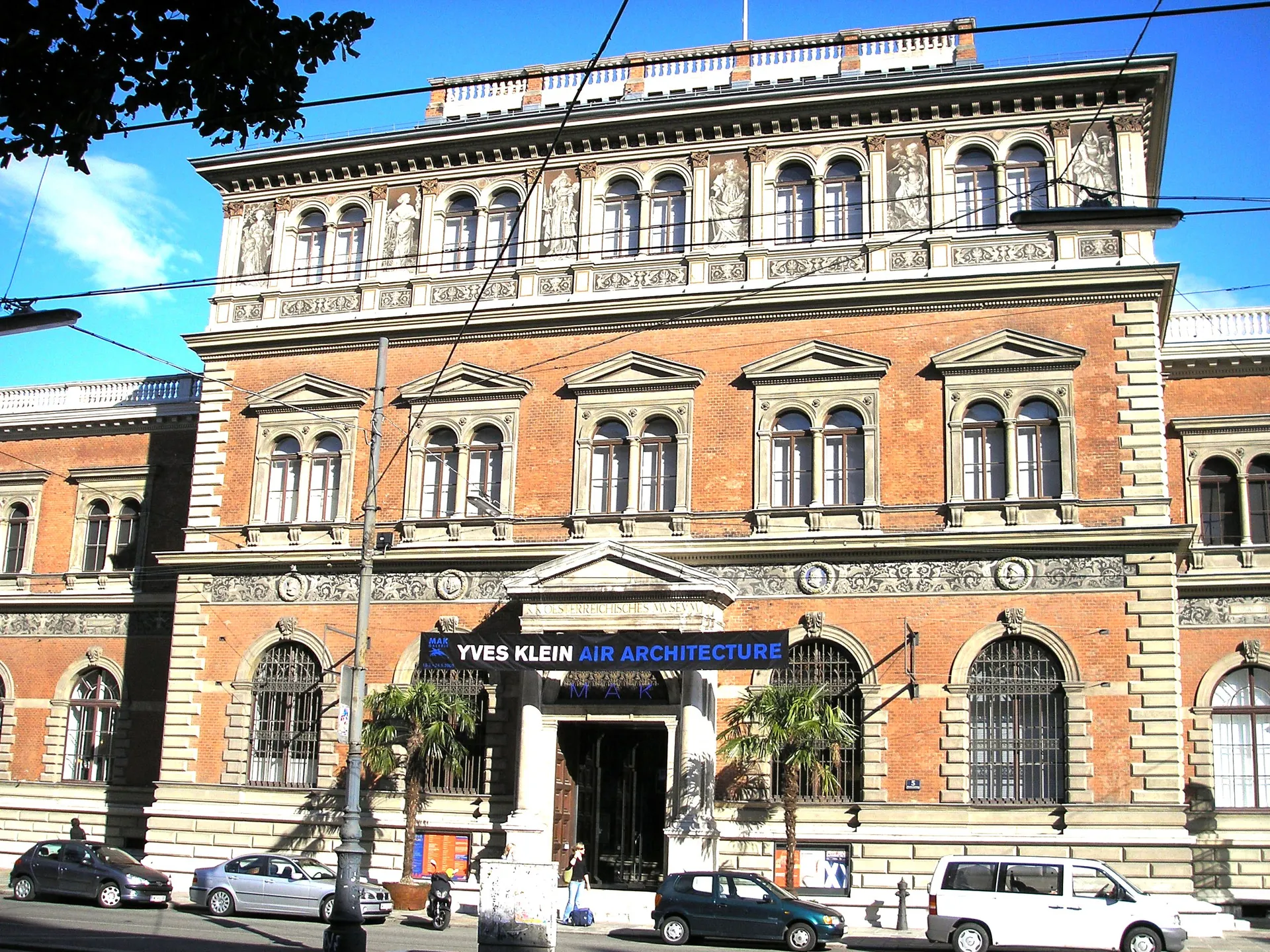 Photo: Gryffindor · CC BY 2.5
- Best season
- Autumn (September–November)
Why does a museum of old chairs and teacups sit on Vienna's Ringstraße like a manifesto? The MAK – Museum of Applied Arts at Stubenring 5 in Vienna, Austria, was never meant to be a polite cabinet of porcelain. It opened as an industrial survival plan, and it still rewards visitors who come for the design arguments, not just the objects.
Walk through the Säulenhalle at midday and the light lands on exposed brick, Slavonian oak, and glass cases holding everything from Wiener Werkstätte silver to Klimt's working cartoons for the Stoclet frieze. The air smells of old wood and stone, and the building itself feels less like a temple than a workshop with ambitions.
Upstairs, contemporary art interventions by Donald Judd and Jenny Holzer sit inside rooms from 1871. That clash is the point. The MAK was built to teach Austria how to make better things, and nearly two centuries later it still treats design as a survival skill rather than a museum label.
What to see
-
The Great Columned Atrium
Step through the Stubenring 5 doors and the ceiling lifts away. Heinrich von Ferstel — same architect behind Palais Ferstel — wrapped his 1871 neo-Renaissance courtyard in exposed brick and Leitha limestone, then stopped at the top in a web of iron ribs and glass. Sunlight moves across the stone floor like a slow tide, and your footsteps bounce off the balustrades twice before fading. Grab the polished railing on the first-floor loggia; straight down, the double tiers of arcades lock together with the symmetry of a Renaissance ledger. Ferstel's building was the first purpose-built museum completed on the Ringstraße, and it still feels like architecture arguing for its own relevance. -
Wien 1900: Klimt's Stoclet Frieze Cartoons
The Klimt room is the reason to come. Nine full-scale cartoons for the Palais Stoclet mosaic in Brussels hang in low light, gold leaf and metallic paint popping against near-black walls. Lean close to the paper edge and you'll catch pinholes where Klimt pinned sheets to his studio wall, plus pencilled notes telling mosaic workers where to lay coral, enamel, or marble. Around them, the 2026 Markus Schinwald rehang drops Otto Wagner's aluminum-riveted postal savings bank chairs and Josef Hoffmann's Sitzmaschine into crisp, filmic shadow. The room reads less like a gallery, more like a high-stakes argument about what Viennese modernism actually looked like. -
Basement kitchen, silent carpets, and the Turrell glow
Do the basement first, not last. Margarete Schütte-Lihotzky's 1926 Frankfurt Kitchen sits down there, its cast-aluminum bins for Mehl and Zucker worn smooth from a century of imagined meal prep. Then cut through the carpet galleries, where 15th-century Mamluk textiles swallow sound and your eyes need a minute to adjust. Finish outside around closing: James Turrell's MAKlite turns the Stubenring facade into a slow argument in cobalt, amber, and violet once dusk arrives after 4:30 p.m. in winter. The MAK's best moves happen at eye level and after hours.
Plan your visit
- Getting There
- U-Bahn U3 to Stubentor exits directly at the front entrance; tram 2 and bus 74A also stop at Stubentor. From the airport, take S7 or CAT to Wien Mitte/Landstraße and walk 400 meters. Driving means paid short-stay parking Monday–Friday; use Garage Georg-Coch-Platz (3-minute walk) or Parkgarage Wien Mitte (5-minute walk).
- Opening Hours
- As of 2026, the MAK is closed Mondays. Tuesday runs 10:00–21:00; Wednesday through Sunday 10:00–18:00. Most public holidays falling Tuesday–Sunday are open, but check the official calendar for December 24/25/31 adjustments.
- Time Needed
- Allow 1.5–2 hours for a highlight route: Vienna 1900 (Wiener Werkstätte, Hoffmann, Moser, Klimt's Stoclet cartoons) and the Thonet bentwood gallery. A full visit covering the Design Lab, Asian collections, carpets, and special exhibitions takes 3–4+ hours.
- Accessibility
- Step-free entry is via a ramp alongside the historic portal, and elevators connect all exhibition floors including the basement Design Lab. Wheelchairs and folding stools are free to borrow at the cloakroom; accessible restrooms are on the lower level and service dogs are permitted.
- Cost & Tickets
- As of 2026, standard admission is €18 online or €19 at the box office; reduced is €14.50 online or €15.50 on-site. Tuesday 18:00–21:00 entry drops to €8.50 online / €9.50 on-site. Under-19s and ICOM members enter free, and online tickets let you skip the desk queue.
Photo Gallery


History
The Laboratory on Stubenring
Vienna's grandest buildings tend to shout dynasty. The MAK, by contrast, speaks in bentwood chairs, blown glass, and textile samples — and that was the point. Emperor Franz Joseph I signed the institution into existence on 7 March 1863, not to showcase Habsburg treasures, but to rescue Austrian manufacturing after repeated humiliations at international expositions.
From the start, this was an argument rather than an archive. Its galleries have held everything from Renaissance Revival brickwork to Nazi-looted porcelain and James Turrell's neon. The collections changed; the original mission did not.
The turning point
Rudolf Eitelberger's Dangerous Idea
For most visitors, the MAK registers as exactly what its name suggests: a museum of applied arts, a polite holding pen for Austrian porcelain, Thonet chairs, and imperial clocks. It sits on the Ringstraße as a calmer companion to the Kunsthistorisches Museum's dynastic splendor.
But the dates don't support that reading. Austria's manufacturing economy had just been humiliated at the 1851 Great Exhibition in London and the 1855 Paris Exposition. Why would an emperor pour prime Ringstraße land into a collection of teapots? And why would a Renaissance Revival facade be built of naked brick rather than stucco?
Rudolf Eitelberger von Edelberg, Vienna's first professor of art history, had an alarming answer. He had seen British and French goods outclass Austrian ones in crystal, metal, and textiles. He gambled his reputation on convincing Franz Joseph I that the empire's economy would fall behind unless craftsmen, factory owners, and designers studied beauty side by side. The museum he fought for from 1863 and the Kunstgewerbeschule he attached to it in 1867 were not ornaments — they were a survival plan. The exposed brick was the curriculum: honest materials, visible construction.
Now look again at Stubenring 5. The raw terracotta and sgraffito stop being decorative touches. The museum's first exhibit was the building itself, a rebuke to stucco pretenders. And inside, the short walk from original 15th-century glass to a Hoffmann chair is the same loop Eitelberger built: study great craft, then go make better things.
Imperial Laboratory (1863–1918)
Modernism and the Nazi Shadow (1918–1998)
Radical Reboot (1986–Today)
Tips for visitors
Tuesday Evening Move
Go Tuesday after 18:00 for the cheapest entry and a local after-work crowd. Galleries stay open until 21:00, and the Columned Hall feels more like a design-school lounge than a tour-group stop.No Flash, No Sticks
Non-commercial photography without flash is allowed in permanent collection rooms. Tripods, monopods, and selfie sticks are banned; special exhibitions or loan objects may have their own photography bans marked by signage.Lockers Before Galleries
Bags larger than about 30 × 30 × 15 cm, backpacks, and umbrellas must stay out of galleries. Use the coin lockers (€1 or €2, refundable) or attended cloakroom on the lower lobby, and don't sit on collection furniture unless it's explicitly marked as visitor seating.Watch Transit Hubs
Pickpockets work the crowded U-Bahn stations at Stubentor and Wien Mitte/Landstraße. Buy tickets only at the MAK desk or official online portal, and ignore costumed sellers near Ringstraße monuments pushing overpriced concert tickets.Look Down at Stubentor
The U3 Stubentor exit surfaces beside preserved medieval city wall remnants in the open plaza. Pause there before entering—the contrast between those rough stones and Ferstel's 1871 neo-Renaissance brick shell is the whole MAK argument in one glance.
Frequently asked
Is the MAK Vienna worth visiting?
Yes, especially if design, Vienna 1900, or buildings that argue with their own past get you going. Founded in 1863 as an anti-elitist industrial design lab, the MAK still feels more like a provocative workshop than a trophy cabinet. Gustav Klimt's original full-scale Stoclet Frieze cartoons sit here, which beats fighting the Belvedere crowds for The Kiss.
How long do you need at the MAK Vienna?
Give it 1.5 to 2 hours for the high points, or 3 to 4 if you like to lose yourself in textiles and Japanese lacquer. The Vienna 1900 rooms, Wiener Werkstätte archive, and Klimt cartoons alone eat an hour. If you crack into the Asia collection and the basement Design Lab, easy half-day.
How do I get to the MAK Vienna from the city centre?
Take U-Bahn U3 to Stubentor; the museum entrance is steps from the station exit. From Stephansplatz, it's a 10-minute walk east along Wollzeile to Stubenring 5. Tram line 2 stops outside, and Wien Mitte/Landstraße is a 5-minute walk if you're coming from the airport train.
What is the best time to visit the MAK Vienna?
Tuesday after 6 pm is the sharpest move: entry drops to €8.50 online, crowds thin, and the museum stays open until 9 pm. In winter, the late opening also lets you catch James Turrell's MAKlite glowing across the facade after dark. Weekday mornings around 10 am are quieter if Tuesday suits you.
Can you visit the MAK Vienna for free?
Only if you're under 19, an ICOM or IAA member, or a registered assistant for a visitor with a disability. Everyone else pays, though the cheapest regular access is the Tuesday 6–9 pm slot at €8.50 online instead of the standard €18. A few nationwide free-admission days pop up each year, so check the official calendar before booking.
What should I not miss at the MAK Vienna?
Don't miss Gustav Klimt's nine full-scale Stoclet Frieze cartoons from 1905–1911; look close for his penciled measurements and color notes at the edges. The Wiener Werkstätte archive and Josef Hoffmann's geometric Sitzmaschine give you Vienna 1900 in three dimensions. Then duck into the basement Design Lab for Margarete Schütte-Lihotzky's 1926 Frankfurt Kitchen, whose aluminum bins still spell out Mehl, Zucker, and Salz.
Is the MAK Vienna open on Mondays?
No, the MAK closes every Monday. It opens Tuesday from 10 am to 9 pm and Wednesday through Sunday from 10 am to 6 pm. Double-check holiday exceptions on the official calendar, because some public holidays falling on weekends can shift the rhythm.
Sources & attribution 13
- MAK – Museum of Applied Arts Official Website — Official history, collection overview, and institutional identity for the MAK.
- MAK Visit & Opening Hours — Practical visitor details for opening hours, pricing, accessibility, and house rules.
- MAK Tickets — Online ticket prices, discounts, and Tuesday evening special admission rates.
- MAK Blog: 150 Jahre MAK — Timeline of the 1863 founding, 1871 building inauguration, and later institutional changes.
- MAK Exhibition: Wien 1900 — Details on the Vienna 1900 permanent display and Klimt's Stoclet Frieze cartoons.
- Vienna History Wiki: MAK — Verified dates for the building, expansions, and institutional name changes.
- Wiener Linien — Public transit routing for U3 Stubentor and nearby connections.
- Visiting Vienna: MAK Guide — Visitor-oriented background on the architecture and James Turrell's MAKlite installation.
- MAK Guide — Digital guide covering collection masterworks and the Frankfurt Kitchen.
- MAK Blog: 100th Birthday of Frankfurt Kitchen — Background on Margarete Schütte-Lihotzky's 1926 Frankfurt Kitchen displayed at the MAK.
- MAK Design Lab — Information on the basement design laboratory and interactive exhibitions.
- MAK Article Detail: Building & Architecture — Architectural details on Heinrich von Ferstel's building and artist-designed galleries.
- Wikipedia: Museum of Applied Arts, Vienna — Cross-reference for founding dates, early opening history, and institutional evolution.
Built from cited sources · see the method · How we make our guides →
More in Vienna.
507 places to discover — a few worth pairing.
Pick up where you left off
Saved and recently read places — kept on this device only.
Photo credits (10)
- M.A.K. Vienna June 2006 017 — Gryffindor — CC BY 2.5 (https://creativecommons.org/licenses/by/2.5/) — Source: https://commons.wikimedia.org/wiki/File:M.A.K._Vienna_June_2006_017.jpg
- Allegorie Keramik-Museum für angewandte Kunst Fassade ueber Eingang DSC 4999w — P e z i — CC BY-SA 3.0 (https://creativecommons.org/licenses/by-sa/3.0/) — Source: https://commons.wikimedia.org/wiki/File:Allegorie_Keramik-Museum_für_angewandte_Kunst_Fassade_ueber_Eingang_DSC_4999w.jpg
- Advertising column in Elisabethallee, Vienna — Herzi Pinki — CC BY-SA 4.0 (https://creativecommons.org/licenses/by-sa/4.0/) — Source: https://commons.wikimedia.org/wiki/File:Advertising_column_in_Elisabethallee,_Vienna.jpg
- Allegorie Erzgiesserei-Museum für angewandte Kunst Fassade ueber Eingang DSC 4990w — P e z i — CC BY-SA 3.0 (https://creativecommons.org/licenses/by-sa/3.0/) — Source: https://commons.wikimedia.org/wiki/File:Allegorie_Erzgiesserei-Museum_für_angewandte_Kunst_Fassade_ueber_Eingang_DSC_4990w.jpg
- Allegorie Goldschmiedekunst-Museum für angewandte Kunst Fassade ueber Eingang DSC 4992w — P e z i — CC BY-SA 3.0 (https://creativecommons.org/licenses/by-sa/3.0/) — Source: https://commons.wikimedia.org/wiki/File:Allegorie_Goldschmiedekunst-Museum_für_angewandte_Kunst_Fassade_ueber_Eingang_DSC_4992w.jpg
- Eckhaus Weißkirchnerstraße 1-Parkring, Wien 1, Österreich — Ermione 13 — CC BY-SA 4.0 (https://creativecommons.org/licenses/by-sa/4.0/) — Source: https://commons.wikimedia.org/wiki/File:Eckhaus_Weißkirchnerstraße_1-Parkring,_Wien_1,_Österreich.jpg
- Allegorie Malerei-Museum für angewandte Kunst Fassade ueber Eingang DSC 4994w — P e z i — CC BY-SA 3.0 (https://creativecommons.org/licenses/by-sa/3.0/) — Source: https://commons.wikimedia.org/wiki/File:Allegorie_Malerei-Museum_für_angewandte_Kunst_Fassade_ueber_Eingang_DSC_4994w.jpg
- Haus Ecke Weißkirchnerstraße 1-Parkring, Wien 1, 270119 - 01 — Ermione 13 — CC BY-SA 4.0 (https://creativecommons.org/licenses/by-sa/4.0/) — Source: https://commons.wikimedia.org/wiki/File:Haus_Ecke_Weißkirchnerstraße_1-Parkring,_Wien_1,_270119_-_01.jpg
- Allegorie Bildhauerei-Museum für angewandte Kunst Fassade ueber Eingang DSC 4998w — P e z i — CC BY-SA 3.0 (https://creativecommons.org/licenses/by-sa/3.0/) — Source: https://commons.wikimedia.org/wiki/File:Allegorie_Bildhauerei-Museum_für_angewandte_Kunst_Fassade_ueber_Eingang_DSC_4998w.jpg
- Fritz-Wotruba-Promenade 04 — Buchhändler — CC BY-SA 4.0 (https://creativecommons.org/licenses/by-sa/4.0/) — Source: https://commons.wikimedia.org/wiki/File:Fritz-Wotruba-Promenade_04.JPG
Photos may have been resized or cropped.