Type 2+ letters to search all countries, cities, and places
/Ctrl KEsc
travel_explore
Type 2+ letters to search all countries, cities, and places
Press Enter to open the top result
Jardín Del Arte Sullivan
Mexico City·Mexico·19° N · 99° W·Updated Apr 2026
Born in 1955 as an end run around gallery gatekeepers, Jardín del Arte Sullivan still turns a Mexico City park into a Sunday art market and tianguis ritual.
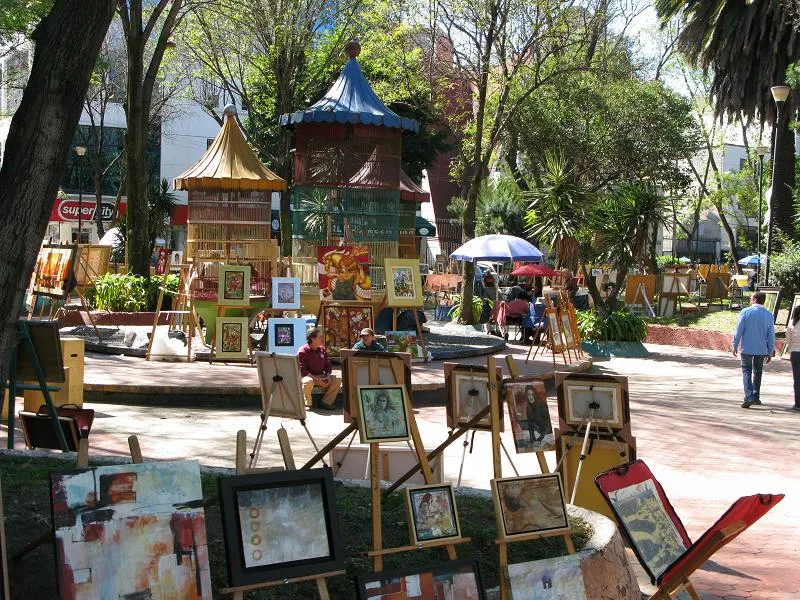
A Sunday art market at Jardín del Arte Sullivan in Mexico City, Mexico sits on ground shaped by trains, state mythmaking, and a very public argument about who gets to speak in stone. That clash is why you should come. You can browse paintings under the trees, then look up and realize this easygoing park has lived four different lives: rail terminal, civic monument, artists' rebellion, and protest site.
Most visitors arrive for the canvases. Fair enough. By late morning the park fills with easels, oil paint, chatter, and the dusty rustle of leaves, while the restored Monumento a la Madre watches from a few steps away like a witness who has seen too much.
But the real thrill is historical whiplash. Records show passenger trains once departed from Estación Colonia here, the old terminal dismantled between 1939 and 1940; by 23 January 1955, young artists shut out of formal galleries were hanging work in the open air instead.
That makes Jardín del Arte Sullivan more than a market. It is one of those Mexico City places where public space keeps changing its mind, and where culture escapes the frame and lands on the pavement.
Researched by the Audiala editorial team from historical records, architectural archives, and local expertise.
What to see
The Sunday Exhibition Walks
The surprise here is how little this feels like a market and how much it feels like a public conversation under trees. Since 23 January 1955, painters, printmakers, photographers, and sculptors have been setting up along the internal paths of Sullivan Park, and on a good Sunday you move from canvas to canvas with traffic murmuring beyond the leaves, paper lifting in the breeze, and the artist standing right there to tell you why that streak of cobalt ended up on the skyline. Come mid-morning. By then the aisles usually have their rhythm, the light is still kind to color, and you can spot work at every scale, from pieces small enough to carry under one arm to canvases wide as a dining table.
Monumento a la Madre and Its Stone Details
Most people use the Monumento a la Madre as a meeting point, then hurry past into the art fair. Slow down. The Art Deco ensemble, built between 1944 and 1949 with architecture by José Villagrán García and sculpture by Luis Ortiz Monasterio, has more bite than its postcard image suggests: cantera stone catching the pale Mexico City light, a mother and child at the center, then the details people miss, including the man writing, the woman holding an ear of corn, and the inscription, “A la que nos amó antes de conocernos.” After the 19 September 2017 earthquake damaged the monument, its restoration gave the whole threshold added weight, and you read the market behind it differently: less as a Sunday fair, more as a small act of civic stubbornness.
A Sunday Paseo from Reforma into the Garden
The best approach is on foot from Paseo de la Reforma, especially if you start near Glorieta De Las Mujeres Que Luchan and let the city shift register block by block. One minute you have traffic, protest memory, and office towers; a few minutes later you are behind the monument with painters bargaining over frames, children cutting across the paths, and the occasional scrape from the skate area reminding you this park never agreed to become a polite gallery. That contrast is the point. Mexico City keeps refusing tidy categories, and Jardín del Arte Sullivan is one of the places where it does so most convincingly.
Plan your visit
Getting There
Jardín del Arte Sullivan sits at Calz. Manuel Villalongín 46, behind Monumento a la Madre on the seam between San Rafael and Cuauhtémoc. As of 2026, the easiest public-transit approach is Metro Cuauhtémoc on Line 1, about 5-10 minutes on foot, or the Reforma II Metrobús stop, about 4 minutes away; if you drive, the Monumento a la Madre underground garage has 502 spaces and puts you almost at the stalls.
Opening Hours
As of 2026, the art market runs on Sundays only. The official cultural listing gives 8:00-16:00, while local coverage suggests the market feels fully alive from about 10:00 until 16:00; rain can thin the crowd or shorten the day because everything happens in the open air.
Time Needed
Give it 20-30 minutes for a quick loop, 45-90 minutes if you want to compare painters and talk to a few artists, and 1.5-3 hours if you plan to buy. That sounds generous until you realize the Sunday setup can stretch across hundreds of artists, more like a small village fair than a tidy gallery hall.
Accessibility
Ground level helps here. As of 2026, official site-specific accessibility details are thin, but the park paths appear paved and manageable for many wheelchair users and strollers, while nearby Cuauhtémoc station officially reports ramps and escalators; the main challenge is crowding when booths compress the walkways on Sunday.
Cost & Tickets
As of 2026, entry appears free and I found no booking system, timed ticket, or skip-the-line option. Bring cash anyway if you think you might buy art or eat in the wider Sullivan tianguis, because this place works best as direct exchange rather than polished retail.
History
From Train Platform to Easel Line
Jardín del Arte Sullivan rewards anyone who refuses the postcard version. Records show this patch of city behind the monument was once tied to the Porfirian rail network through Estación Colonia, a terminal whose passenger service ended in September 1937 before demolition dragged on into early 1940, as if the site resisted becoming modern on schedule.
Then the state gave the cleared ground a new script. The Monumento a la Madre, built between 1944 and 1949 and inaugurated on 10 May 1949, turned the plaza into a lesson about motherhood, national virtue, and civic order; six years later, young painters would hijack that respectable setting and make it gloriously less obedient.
The turning point
Jorge Contreras Takes Art Out of the Salon
The person who changes this place is Jorge Contreras, an architect tied to the circle known as Grupo 23 Escalones. According to La Jornada and the official city history, he saw what was at stake for young artists around the Academia de San Carlos: without gallery access, they stayed invisible and unsold, trapped behind a cultural velvet rope that was thinner than a paintbrush and just as sharp.
The turning point came in late 1954 and early 1955, when Contreras and David Marín Foucher pushed the idea from talk to paperwork and pavement. On 23 January 1955, artists began showing work in Sullivan Park itself. Everything changed there. Paintings were no longer waiting inside polite rooms for a few collectors; they were facing families, passersby, skeptics, and buyers under open sky.
That public gamble held. Records show the association was founded in 1958, and the model spread to San Ángel in 1962 before the groups formally fused in 1967. What started as a workaround became an institution, though it still feels best when it resembles a slight act of defiance.
The Station Beneath the Grass
Before the easels, steam and steel ran the show. Records from railway history place construction of the newer Estación Colonia in 1894, with the first passenger departure on 17 February 1896 and official inauguration in 1898 before Porfirio Díaz. The station's end came in stages, not one tidy farewell: passenger service stopped in 1937, workers resisted demolition on 4 November 1939, and dismantling continued into January 1940. Listen closely on a quiet morning and the site still feels like a place designed for departures.
A Monument That Learned to Argue Back
The monument beside the market never stayed ideologically still. Its original inscription, "A la que nos amó antes de conocernos," framed motherhood as sacred destiny; feminist activists later answered with "Porque su maternidad fue voluntaria," turning a civic tribute into a public dispute about consent and autonomy. The argument sharpened after the 19 September 2017 earthquake, when the central sculpture collapsed and restoration reopened old questions about what, exactly, should be restored: the bronze, the message, or both. If you have already seen Glorieta De Las Mujeres Que Luchan, the continuity in Mexico City's street-level politics is hard to miss.
Tips for visitors
Best Hours
Go between 10:00 and 15:30 on Sunday if you want the market at full volume. Earlier can feel like setup, and later the light goes flatter, the crowd thins, and some artists start packing before 16:00.
Ask First
Wide scene photos are usually fine, but ask before photographing a specific painting or an artist's stall up close. You're standing in somebody's workplace, not a museum where the walls signed the consent form for them.
Sunday Safe
Daytime Sunday is the right moment; late night is not. Sullivan has a long, well-documented connection with sex work and recent trafficking investigations, so keep your phone and wallet tight in the crowd and use rideshare if you're leaving after dark.
Eat Nearby
Don't stop at the paintings. The wider Sullivan tianguis is part of the ritual, with tlacoyos, mixiote tacos, cemitas poblanas, and seafood stalls at budget prices; if you want a sit-down break, Camino a Comala on Miguel E. Schultz 7-C is a good coffee stop and Benigna on Manuel María Contreras 35 works well for a slower lunch.
Buy Well
Compare a few stalls before you commit, then bargain gently if you bargain at all. This market was born in 1955 as a way for artists to sell outside gallery gatekeeping, and that independent streak still matters more than shaving off one last peso.
Make It A Walk
Pair the market with San Rafael's side streets instead of treating it like a single stop. The area makes more sense on foot: old theaters, Sunday market smells, and the rebuilt Monumento a la Madre all folding into one very chilango afternoon.
Where to Eat
local_dining
Don't Leave Without Trying
Tacos al pastorTacos de guisadoTlacoyosGorditas de nataCeviche and mariscosGaonera taco
Flow33 Café de Especialidad
cafe
Specialty Coffee€€star5.0(124)
Order: Try their pour-over coffees or signature espresso drinks for a rich, artisanal experience.
This cozy café is a local favorite for its high-quality, small-batch coffee roasted in-house. The vibe is relaxed but focused, perfect for a quiet afternoon.
Order: Their capirote (a traditional Mexican dessert) and fresh-baked pastries are must-tries.
A stylish spot with a mix of specialty coffee and indulgent pastries, this café stands out for its modern yet cozy atmosphere. It’s a great place for a midday treat.
Order: Fresh ceviche, shrimp cocktails, and seafood tostadas are the stars here.
This is a no-frills seafood stand where locals go for budget-friendly but high-quality seafood. The portions are generous, and the flavors are authentic.
checkTry the taco gaonera at Taquería El Califa de León — it's a Michelin-recommended dish.
checkLa Tonina is a great spot for northern Mexican cuisine, known for handmade flour tortillas and old-school guisos.
checkBoca del Río is a first-rate seafood cantina with a retro vibe, perfect for a sit-down meal.
checkCantina La Numantina offers a four-course meal with drinks, making it ideal for a relaxed evening.
Food districts:San Rafael for authentic Mexican taquerías and cantinasNear Jardín Del Arte Sullivan for casual street-food snacks and cafes
Restaurant data powered by Google
Frequently asked
Is Jardín del Arte Sullivan worth visiting?
Yes, if you go on a Sunday and want a more local Mexico City ritual than a polished museum stop. Since 23 January 1955, artists have been showing and selling work here in the open air, which means you can talk to painters, printmakers, and sculptors face to face instead of reading wall labels. The setting also matters: the market sits behind Monumento a la Madre, on ground that once held a railway station, so the place carries more history than its relaxed mood suggests.
How long do you need at Jardín del Arte Sullivan?
Most visitors need 45 to 90 minutes. Give it 20 to 30 minutes if you only want a quick loop, or up to 2 or 3 hours if you like comparing works, talking with artists, or buying something that has to fit on your wall back home. On a busy Sunday, the market can stretch to roughly 350 to 400 artists, which feels less like a single gallery and more like walking a green corridor of easels.
How do I get to Jardín del Arte Sullivan from Mexico City?
The easiest way is by Metro or Metrobús, then a short walk. Metro Cuauhtémoc on Line 1 is about 304 meters away, close enough to feel like one city block stretched three times over, and Reforma II on Metrobús is about 277 meters away. If you drive, the Monumento a la Madre garage next to the site is the practical choice, with 502 spaces and 24-hour access.
What is the best time to visit Jardín del Arte Sullivan?
Sunday between 10:00 a.m. and 3:30 p.m. is the safest bet. The official cultural listing gives Sundays from 8:00 a.m. to 4:00 p.m., but local reporting suggests the difference comes from setup time versus full browsing hours, and the market can thin out or close early in bad weather. Dry-season mornings usually give you the clearest light on the cantera monument and the fullest range of art on display.
Can you visit Jardín del Arte Sullivan for free?
Yes, entry appears to be free. This is a public park and open-air market rather than a ticketed museum, and I found no official booking system or paid entry gate. Bring cash anyway if you plan to buy art or eat from the surrounding Sunday stalls.
What should I not miss at Jardín del Arte Sullivan?
Don’t miss the Monumento a la Madre details before you drift into the market. Most people photograph the central figure and move on, but the flanking sculptures, the inscription "A la que nos amó antes de conocernos," and the site’s feminist afterlife tell a harder, more interesting story. Also stay long enough to speak with at least one artist and wander into the wider Sullivan tianguis, where the market shifts from paint and paper to tlacoyos, frames, and neighborhood Sunday noise.
Is Jardín del Arte Sullivan safe?
By day on Sunday, generally yes if you stay in the market flow and keep normal city awareness. The area changes after dark because Sullivan has a long link to sex work and more recent trafficking concerns, so this is a place to browse in daylight, keep your bag close, and leave the aimless nighttime wandering for another neighborhood. Think alert, not alarmed.
Sources & attribution72
Researched and written by the Audiala editorial team from historical records, architectural archives, and local expertise. Last updated April 2026.
Mirada Ferroviaria — History of Estación Colonia/Sullivan, including 1894 construction, 1896 first passenger service, 1898 inauguration, 1937 end of passenger service, and 1939-1940 demolition.
La Jornada — 50th-anniversary article confirming the 23 January 1955 launch of the open-air exhibitions and the role of Jorge Contreras and David Marín Foucher.
Mexico City Official Venue Page: Jardín del Arte — Official venue overview with address, 1955 launch, 1958 association date, 1962 San Ángel activity, and 1967 fusion into Asociación Jardín del Arte, A.C.
SEDUVI Restoration Note — Official note on the 2017 earthquake collapse, 2018 restoration delivery, and public-space rehabilitation details for Jardín del Arte and Monumento a la Madre.
Excélsior Collapse Report — News report confirming the collapse of Monumento a la Madre during the 19 September 2017 earthquake.
Excélsior Monument History — Background on Monumento a la Madre, including 1944 first stone, 1949 inauguration, sculptor Luis Ortiz Monasterio, materials, and inscription.
Local.mx — Interpretive history of Monumento a la Madre, including feminist interventions, contested plaque history, and the site’s shifting meaning.
Jardin del Arte Sullivan — Agustin valero — CC BY-SA 3.0 (https://creativecommons.org/licenses/by-sa/3.0/) — Source: https://commons.wikimedia.org/wiki/File:Jardin_del_Arte_Sullivan.JPG
Strictly necessary cookies keep the site working. Analytics (PostHog, Google Analytics) measures how each visitor uses our pages. Marketing loads YouTube videos and walking-route maps without a tap and lets Google Analytics set advertising cookies. We never sell your data. You can change this any time from the footer.
Privacy
Cookie preferences
Pick what you're okay with. You can change this any time from the footer.
Strictly necessary
Always on
Sign-in, language, navigation. Always on.
Product analytics
PostHog (EU) and Google Analytics record which pages you view and how you use them, under a random identifier stored in your browser. Helps us see which pages work and which need fixing. Google's ad personalisation stays off. No selling.
Marketing
Loads YouTube videos and the walking-route maps (OpenFreeMap) without a tap; without it, they load only when you tap them. If analytics is also on, Google Analytics may set advertising cookies. Ad personalisation stays off.