Type 2+ letters to search all countries, cities, and places
/Ctrl KEsc
travel_explore
Type 2+ letters to search all countries, cities, and places
Press Enter to open the top result
Maiden'S Tower
Istanbul·Turkey·41° N · 29° E·Updated Apr 2026
Once a quarantine station, a lighthouse, and a 'Republic of Poetry,' this Bosphorus islet has reinvented itself more times than any city landmark in Istanbul.
Free with Museum Pass Türkiye (boat transfer fee applies, approx. 110 TL)
Best season
Year-round; sunset visits most atmospheric
Istanbul's most romantic landmark spent a decade storing cyanide. The Maiden's Tower — Kız Kulesi — sits on a tiny islet roughly 200 meters off the Asian shore of the Bosphorus, a stone sentinel that has watched the strait for over two millennia. Come for the 360-degree panorama of minarets and tankers and seabirds skimming the current, but stay for the story: a building that has been taxman, jailer, plague ward, lighthouse, poison locker, and poetry republic, all without moving an inch.
The islet itself covers about 1,800 square meters — smaller than half a football pitch — yet it has absorbed more history per square meter than most neighborhoods in Turkey. A boat from Üsküdar or Galataport drops you at a structure that looks deceptively simple: a squat stone tower topped with a lead-covered cupola and a lantern gallery. The current form dates to 1832, but the bones beneath are far older.
What makes the Maiden's Tower worth the short crossing isn't the architecture alone. It's the compression. Quarantine victims, Byzantine chain-keepers, Ottoman watchmen, Cold War radar operators — they all occupied the same rooms, stared at the same water. The tower's most recent restoration, completed in 2023, stripped away decades of concrete additions to reveal the original masonry, and the result feels less like a museum and more like a palimpsest you can walk through.
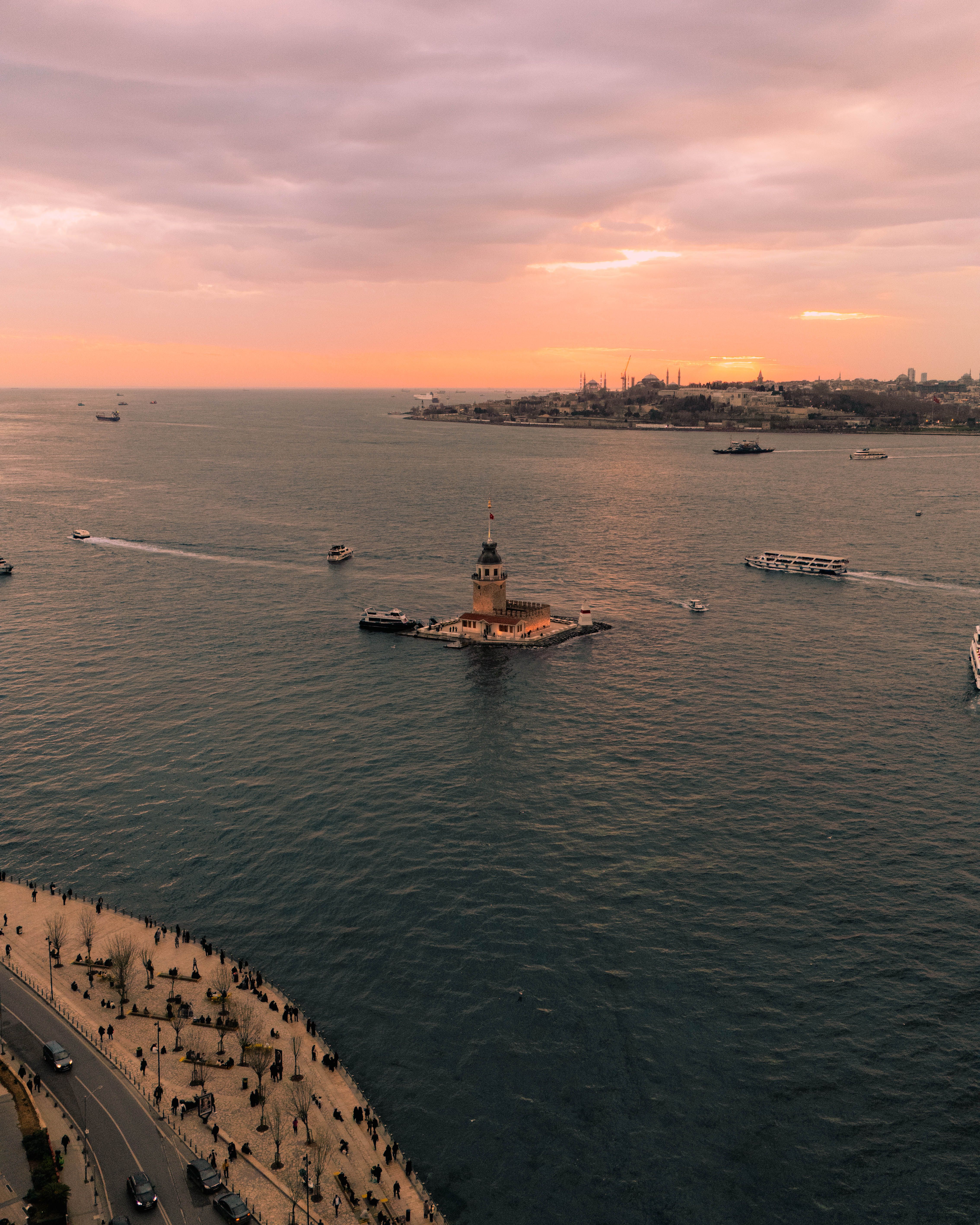
Sunset is when the tower earns its reputation. The light turns the Bosphorus copper, the silhouette of the Sultanahmet skyline sharpens against the west, and for a few minutes the café tables on the islet become the best seats in Istanbul. Not the cheapest. But the best.
Researched by the Audiala editorial team from historical records, architectural archives, and local expertise.
What to see
The Observation Gallery and Panoramic Views
The top gallery of the Maiden's Tower delivers something rare: a 360-degree view of Istanbul that belongs to neither Europe nor Asia, but to the water between them. You stand roughly 200 meters off the Üsküdar shore — about two football pitches — suspended in the middle of the Bosphorus, with the domes and minarets of Sultanahmet glowing to the west and the residential hills of the Asian side rising behind you. At dusk, when the floodlights of Hagia Sophia and the Blue Mosque flicker on, the silhouette of the Historical Peninsula looks almost theatrical, like a stage set designed to make you doubt it's real. The wind up here is constant and cold, even in summer, carrying the low horn-blasts of passing tankers and the sharp cries of gulls. Skip the midday crowds if you can — sunset is when the tower earns its reputation, and the light turns the strait from grey-blue to copper in about fifteen minutes flat.
The Restored Interior and Layered Masonry
The 2021–2023 restoration stripped the tower back to something closer to honesty. Non-original concrete floors, added during the 20th century when the building served variously as a radar station and a cyanide storage facility, were removed and replaced with lighter, structurally sound materials. What remains is a clean, almost austere interior — stone walls reinforced with stainless steel tie rods, lime mortar joints, and contemporary glass elements that let natural light reach the lower levels. But the real story is in the walls themselves. Look closely at the stone courses: they shift in color and texture every few rows, a geological record of the tower's serial destruction and rebuilding after the 1509 earthquake, the 1721 fire, and the 1763 stone reconstruction. The transition from the wooden ferry deck to the cold, rough masonry underfoot hits you physically — a tactile reminder that this islet has been occupied, in some form, since at least the 5th century BC. On the lower levels, near the waterline, the sound of the Bosphorus current slapping against the base is visceral, almost aggressive. Most visitors stay upstairs. Go down.
The Full Circuit: Ferry, Tower, and Üsküdar Shoreline at Golden Hour
The best way to experience the Maiden's Tower is to treat it as a three-act experience rather than a single stop. Start at the Üsküdar pier around two hours before sunset, catching the short ferry ride out to the islet — the boat crossing itself is half the pleasure, with the tower growing from a postcard silhouette into a solid, wind-battered stone structure in under five minutes. Spend an hour inside, working from the lower waterline levels up to the observation gallery as the light softens. Then take the return ferry and walk south along the Üsküdar promenade to watch the tower from shore as darkness falls and the lantern glows against the strait. For an elevated perspective, climb to Nakkaştepe Park — locals know this as the cinematic angle, with the tower framed against the European skyline. One detail most visitors miss entirely: during calm water, look down from the islet's edge. Beneath the surface, you can still see remnants of Byzantine-era underwater defensive walls that once stretched toward the Asian shore to block enemy ships. They've been submerged for centuries, but they're still there — the oldest thing you'll see all day, and you have to look down to find them.
Plan your visit
Getting There
The tower sits on a tiny islet 200 meters off the Asian shore—about the length of two football pitches—so boats are the only way in. Official shuttle ferries depart from the Salacak pier in Üsküdar (Asian side) and from Karaköy pier (European side). To reach Üsküdar, take the M5 metro line to Üsküdar station, then walk 10 minutes downhill to the waterfront. Ignore anyone on the shore offering "private boat tours"—use only the municipal shuttles from the designated piers.
Opening Hours
As of 2026, the tower is open daily from 09:00 to 18:00, with the box office closing at 17:00. No seasonal closures are currently listed, but hours can shift around public holidays—check kizkulesi.gov.tr before heading out.
Time Needed
Budget 1.5 to 2 hours for the full experience: the boat transfer each way, the museum floors, and time on the viewing decks to absorb the panorama. If you plan to eat at the on-site café, add another hour. Speed visitors who just want photos from the terrace can manage in about 45 minutes including the crossing.
Tickets & Cost
As of 2026, entry costs 27 Euro for foreign nationals. Museum Pass Türkiye holders enter free, but still pay the boat transfer fee (approximately 75–110 TL, fluctuating). Tickets are sold at the on-site box office; no advance online booking is required for general admission, though restaurant reservations should be made separately.
Accessibility
The 2021–2023 restoration added meaningful accessibility improvements to what was previously a cramped medieval tower. Elevator access now exists between levels, though the structure's compact footprint means some areas remain tight. Visitors with limited mobility should contact the administration in advance to confirm current elevator availability for specific floors.
Tickets & tours.
These are guided options from our partners — same price as booking direct.
Prices are indicative — final pricing and availability are confirmed at checkout. Audiala may earn a commission from bookings made through these links.
Also on GetYourGuide
More tours for Maiden'S Tower
Curated from GetYourGuide. Same price as official, free cancellation on most.
Prices shown are indicative — final pricing and availability are confirmed at checkout. Audiala may receive a commission from bookings made via these links.
Photo Gallery
The historic Maiden's Tower stands beautifully illuminated against the twilight sky, with the full moon casting a shimmering reflection on the Bosphorus. · Yasinornek13The historic Maiden's Tower in Istanbul, Turkey, undergoes extensive restoration work surrounded by construction equipment on the Bosphorus. · HalitBarisA historic view of the iconic Maiden's Tower, situated on a small island in the Bosphorus strait of Istanbul, Turkey. · Sebah, Jean Pascal (1872-1947)The historic Maiden's Tower sits gracefully in the Bosphorus strait, framed by passing ferries during a tranquil Istanbul sunset. · Photograph by Mike Peel (www.mikepeel.net).The historic Maiden's Tower sits gracefully on a small islet in the Bosphorus strait, illuminated against the soft twilight sky of Istanbul, Turkey. · Photograph by Mike Peel (www.mikepeel.net).The historic Maiden's Tower glows in the soft evening light as boats navigate the Bosphorus Strait in Istanbul, Turkey. · Photograph by Mike Peel (www.mikepeel.net).The iconic Maiden's Tower sits gracefully in the Bosphorus strait, surrounded by the bustling maritime traffic of Istanbul, Turkey. · Photograph by Mike Peel (www.mikepeel.net).
History
The Gatekeeper That Never Left
Empires rose and crumbled around it, but the Maiden's Tower kept doing the same job: controlling who and what passed through the Bosphorus. According to tradition, the Athenian general Alcibiades built a customs station on this rock around 408 BC to tax ships after his victory at Cyzicus. Whether or not that date holds — and scholars still argue — the function stuck. For roughly 2,400 years, whoever held this islet held a chokepoint on one of the world's most contested waterways.
The technology changed. Wooden platforms gave way to stone walls, oil lamps to electric lanterns, customs ledgers to radar screens. But the purpose — watching, filtering, guarding — remained constant. Even the tower's stint as a quarantine station in the 1830s was a form of gatekeeping: deciding who was healthy enough to enter the city. The Maiden's Tower is less a monument to any single era than a record of what stays the same when everything else shifts.
The turning point
Gabriele Trevisano and the Last Byzantine Stand
In the spring of 1453, Sultan Mehmed II's forces closed around Constantinople like a fist. The Maiden's Tower — then a Byzantine fortification — was garrisoned under the command of Gabriele Trevisano, a Venetian nobleman who had thrown his lot in with the dying empire. Trevisano's task was straightforward in theory and suicidal in practice: hold the islet, keep the chain barrier intact, and prevent Ottoman ships from flanking the city's sea walls.
The chain in question was no metaphor. A massive iron barrier stretched from the tower across the strait toward Sarayburnu on the European shore, heavy enough to stop a warship dead. Trevisano's garrison was the hinge on which this defense turned. If the tower fell, the chain went slack, and the Golden Horn lay open. For weeks, the small Venetian force held the position while the Ottoman fleet probed and bombarded.
When the city fell on May 29, 1453, the tower's role as a Byzantine outpost ended forever. Mehmed took the islet and rebuilt it as an Ottoman watchtower. But the function — gatekeeper of the strait — survived the change of flags. Trevisano's story is the tower's story in miniature: the faces change, the job description doesn't.
What Changed
Almost everything visible. The tower burned in 1721, was rebuilt in stone by 1763, and received its current Ottoman-baroque silhouette under Sultan Mahmud II in 1832. A French company bolted on a modern lantern in 1857. The 20th century brought radar equipment, then cyanide drums, then — briefly, in 1992 — a declaration as the "Republic of Poetry." The 2021–2023 restoration peeled back concrete floors and non-original walls, reinforcing the masonry with stainless steel tie rods. Each generation left its fingerprints, and each successor scraped them off.
What Endured
The watch. From Alcibiades's customs agents tallying cargo to Ottoman sentries scanning for enemy sails to a French lighthouse keeper trimming wicks in 1857, someone on this rock has always been staring at the water. The tower's lighthouse function persisted well into the 20th century, and even its time as a radar station was, at root, the same ancient job dressed in Cold War electronics. Today the gaze belongs to tourists with camera phones, but the orientation is unchanged: outward, across the strait, measuring who comes and who goes.
Tips for visitors
Arrive Before Sunset
The golden hour light hitting the minarets of the Historical Peninsula from this vantage point is the reason half of Istanbul's engagement photos are shot here. Aim to board the 16:00 or 16:30 ferry to have time on the viewing deck before the sky turns.
Skip Unofficial Boatmen
Freelance operators along the Salacak waterfront will offer "private tours" to the tower at inflated prices. They're not authorized to dock at the islet. Use only the official municipal shuttle from the marked Salacak pier—you'll spot the signage.
Drones Are Banned
Flying drones over the Bosphorus requires a special government permit that tourists won't get. Phone and camera photography on the tower's viewing platforms is unrestricted and, frankly, hard to mess up from that angle.
Eat Nearby Instead
The on-site café is fine for Turkish coffee and pastry, but for a real meal, head to the İBB Sosyal Tesisleri (municipality-run café) on the Salacak waterfront—same iconic tower view, subsidized prices, excellent tea. For a splurge, take a bus north to Çengelköy for Bosphorus-side seafood meyhanes.
Dress Modestly Ashore
The tower itself has no dress code, but Üsküdar is one of Istanbul's more conservative neighborhoods. Cover shoulders and knees if you plan to visit the Mihrimah Sultan Mosque at the ferry terminal—it's a Mimar Sinan masterpiece and worth the five-minute detour.
Combine With Kuzguncuk
A short bus ride north of Üsküdar, Kuzguncuk is a quiet neighborhood where a synagogue, a church, and a mosque share the same street. Its colorful wooden houses and unhurried pace make a perfect counterweight to the tower's tourist energy.
Where to Eat
local_dining
Don't Leave Without Trying
Meze — assorted cold appetizers like smoked aubergine and stuffed vine leavesMenemen — traditional breakfast of eggs, tomatoes, green peppers, and spicesİskender Kebab — thinly sliced döner over pita with tomato sauce and melted butterLahmacun — crispy flatbread topped with minced meat and herbsMidye Dolma — stuffed mussels with spiced rice, sold as street foodHünkar Beğendi — Ottoman palace dish of slow-cooked meat over roasted eggplant puréeSimit — sesame-crusted bread ringsBalık Ekmek — fish sandwiches from street vendors
Baylan İstanbul 1923
cafe
Bakery & Cafe€€star4.1(11)directions_walkWalking distance from Maiden's Tower
Order: Traditional Turkish baklava, Ottoman-style pastries, and strong Turkish coffee — this historic bakery has been perfecting these recipes since 1923.
A genuine local institution in Salacak with over a century of heritage. This is where Üsküdar residents grab their morning pastries, not a tourist trap.
checkÜsküdar's waterfront is vibrant with casual street food vendors — look for simit, balık ekmek (fish sandwiches), and roasted chestnuts near the ferry terminal.
checkSeek out esnaf lokantası (tradesmen's restaurants) for authentic, home-style Turkish meals at fair prices — these serve pre-prepared dishes that locals actually eat.
checkThe Maiden's Tower itself houses an upscale restaurant with 360-degree Bosphorus views, but book ahead for premium pricing and the iconic experience.
Food districts:Salacak waterfront — tea gardens and casual eateries with Bosphorus viewsÜsküdar ferry terminal area — street food vendors and working-class restaurantsHistoric Üsküdar shoreline — where locals gather for meals and traditional Ottoman sweets
Restaurant data powered by Google
Frequently asked
Is Maiden's Tower worth visiting?
Yes, but go for the layered history and the view from the water, not for a grand interior. The 2021–2023 restoration stripped the tower back to its bones—clean stone, honest masonry, panoramic galleries—so what you're really paying for is the experience of standing on a tiny islet 200 meters offshore while the entire Istanbul skyline unfolds around you. If you're expecting a lavish restaurant or a large museum, recalibrate: it's a compact monument with a café, and the boat ride itself is half the pleasure.
How long do you need at Maiden's Tower?
Plan for 1.5 to 2 hours, including the shuttle boat each way. The museum levels and observation deck can be explored in about 45 minutes, but you'll want to linger on the lower platforms where the Bosphorus slaps against 18th-century stone. If you sit down at the pastry shop, add another 30–45 minutes.
How do I get to Maiden's Tower from Istanbul?
You can only reach it by boat—no bridge, no tunnel. Official shuttle boats depart from the Salacak pier near Üsküdar on the Asian side and from Karaköy on the European side. Take the M5 metro to Üsküdar station, then walk about 10 minutes south to the Salacak departure point. Avoid unofficial boatmen on the shoreline offering "private tours"; stick to the municipal shuttles from the designated piers.
What is the best time to visit Maiden's Tower?
Sunset, without question—the tower faces the Historical Peninsula, and watching the Hagia Sophia and Blue Mosque light up at dusk from the middle of the Bosphorus is genuinely arresting. In winter, fog sometimes wraps the tower in a moody isolation that matches its legends perfectly, though boat schedules may be affected. Summer mornings before 11:00 are your best bet for avoiding crowds.
Can you visit Maiden's Tower for free?
Museum Pass Türkiye holders get free entry to the tower itself, but you'll still need to pay the boat transfer fee—roughly 75 TL as of recent pricing. Without the pass, foreign nationals pay around 27 Euro for admission. Check kizkulesi.gov.tr before you go, as prices shift with exchange rates and tourism policy.
What should I not miss at Maiden's Tower?
Look down, not just out. On a calm day, the clear Bosphorus water reveals remnants of Byzantine-era underwater defensive walls that once stretched toward the Asian shore—most visitors never notice them. Inside, find the calligraphy plaque by the Ottoman master Rakim Efendi, dated 1832; it's the tower's unofficial birth certificate in its current form and gets walked past constantly. And pay attention to the masonry itself: the stone courses change color and texture at different heights, each layer a scar from a different century of earthquake, fire, and rebuilding.
What is the legend of Maiden's Tower in Istanbul?
The story goes that a sultan, warned by a prophecy that his daughter would die of a snakebite, locked her away in the tower to keep her safe—only for a serpent to arrive hidden in a basket of fruit, fulfilling the prophecy anyway. It's a folk tale about the futility of trying to outrun fate. Tourists often confuse it with the Greek myth of Hero and Leander, but that story actually belongs to the Dardanelles, about 300 kilometers southwest. The tower's Western nickname "Leander's Tower" is a centuries-old case of mistaken geography.
Was Maiden's Tower used as a prison or military base?
Not a prison, but its non-romantic résumé is long: customs station (around 408 BC, according to tradition), military watchtower under Mehmed the Conqueror after 1453, quarantine hospital during the cholera outbreaks of 1830–1837, lighthouse from 1857, radar station for the Ministry of National Defense between 1959 and 1964, and—perhaps most jarring—a cyanide storage facility from 1983 to 1992. The tower that postcards sell as Istanbul's most romantic landmark spent decades storing poison.
Sources & attribution12
Researched and written by the Audiala editorial team from historical records, architectural archives, and local expertise. Last updated April 2026.
Kız Kulesi Official Government Site — Official visitor information including hours, ticket prices, restoration diary, and legends of the tower.
Müze İstanbul (Turkish Museums Portal) — Detailed historical timeline from antiquity through the 2023 restoration, including dates for quarantine use, lighthouse conversion, and cyanide storage.
Wikipedia – Maiden's Tower — General history, architectural evolution, and cross-referenced dates for Byzantine and Ottoman periods.
Maiden's Tower Official Visitor Site — Practical visitor guide including step-by-step transport directions, accessibility information, and visit duration recommendations.
At Istanbul - Wikimedia hackathon boat tour 2025 733 — Photograph by Mike Peel (www.mikepeel.net). — CC BY-SA 4.0 (https://creativecommons.org/licenses/by-sa/4.0/) — Source: https://commons.wikimedia.org/wiki/File:At_Istanbul_-_Wikimedia_hackathon_boat_tour_2025_733.jpg
At Istanbul - Wikimedia hackathon boat tour 2025 732 — Photograph by Mike Peel (www.mikepeel.net). — CC BY-SA 4.0 (https://creativecommons.org/licenses/by-sa/4.0/) — Source: https://commons.wikimedia.org/wiki/File:At_Istanbul_-_Wikimedia_hackathon_boat_tour_2025_732.jpg
At Istanbul - Wikimedia hackathon boat tour 2025 728 — Photograph by Mike Peel (www.mikepeel.net). — CC BY-SA 4.0 (https://creativecommons.org/licenses/by-sa/4.0/) — Source: https://commons.wikimedia.org/wiki/File:At_Istanbul_-_Wikimedia_hackathon_boat_tour_2025_728.jpg
At Istanbul - Wikimedia hackathon boat tour 2025 739 — Photograph by Mike Peel (www.mikepeel.net). — CC BY-SA 4.0 (https://creativecommons.org/licenses/by-sa/4.0/) — Source: https://commons.wikimedia.org/wiki/File:At_Istanbul_-_Wikimedia_hackathon_boat_tour_2025_739.jpg
At Istanbul - Wikimedia hackathon boat tour 2025 738 — Photograph by Mike Peel (www.mikepeel.net). — CC BY-SA 4.0 (https://creativecommons.org/licenses/by-sa/4.0/) — Source: https://commons.wikimedia.org/wiki/File:At_Istanbul_-_Wikimedia_hackathon_boat_tour_2025_738.jpg
At Istanbul - Wikimedia hackathon boat tour 2025 742 — Photograph by Mike Peel (www.mikepeel.net). — CC BY-SA 4.0 (https://creativecommons.org/licenses/by-sa/4.0/) — Source: https://commons.wikimedia.org/wiki/File:At_Istanbul_-_Wikimedia_hackathon_boat_tour_2025_742.jpg
At Istanbul - Wikimedia hackathon boat tour 2025 737 — Photograph by Mike Peel (www.mikepeel.net). — CC BY-SA 4.0 (https://creativecommons.org/licenses/by-sa/4.0/) — Source: https://commons.wikimedia.org/wiki/File:At_Istanbul_-_Wikimedia_hackathon_boat_tour_2025_737.jpg
At Istanbul - Wikimedia hackathon boat tour 2025 743 — Photograph by Mike Peel (www.mikepeel.net). — CC BY-SA 4.0 (https://creativecommons.org/licenses/by-sa/4.0/) — Source: https://commons.wikimedia.org/wiki/File:At_Istanbul_-_Wikimedia_hackathon_boat_tour_2025_743.jpg
At Istanbul - Wikimedia hackathon boat tour 2025 744 — Photograph by Mike Peel (www.mikepeel.net). — CC BY-SA 4.0 (https://creativecommons.org/licenses/by-sa/4.0/) — Source: https://commons.wikimedia.org/wiki/File:At_Istanbul_-_Wikimedia_hackathon_boat_tour_2025_744.jpg
Strictly necessary cookies keep the site working. Analytics (PostHog, Google Analytics) measures how each visitor uses our pages. Marketing loads YouTube videos and walking-route maps without a tap and lets Google Analytics set advertising cookies. We never sell your data. You can change this any time from the footer.
Privacy
Cookie preferences
Pick what you're okay with. You can change this any time from the footer.
Strictly necessary
Always on
Sign-in, language, navigation. Always on.
Product analytics
PostHog (EU) and Google Analytics record which pages you view and how you use them, under a random identifier stored in your browser. Helps us see which pages work and which need fixing. Google's ad personalisation stays off. No selling.
Marketing
Loads YouTube videos and the walking-route maps (OpenFreeMap) without a tap; without it, they load only when you tap them. If analytics is also on, Google Analytics may set advertising cookies. Ad personalisation stays off.