The building that ended the Roman Empire and began the Ottoman one is still standing in the same spot in Istanbul, Turkey — and it has never, in nearly 1,500 years, stopped being fought over. Hagia Sophia is the rare monument that has served as the world's largest cathedral, one of the Islamic world's grandest mosques, a secular museum, and then a mosque again, all without moving a single stone from its foundations. Come here not for one story but for the visible, layered collision of civilizations pressed into a single set of walls.
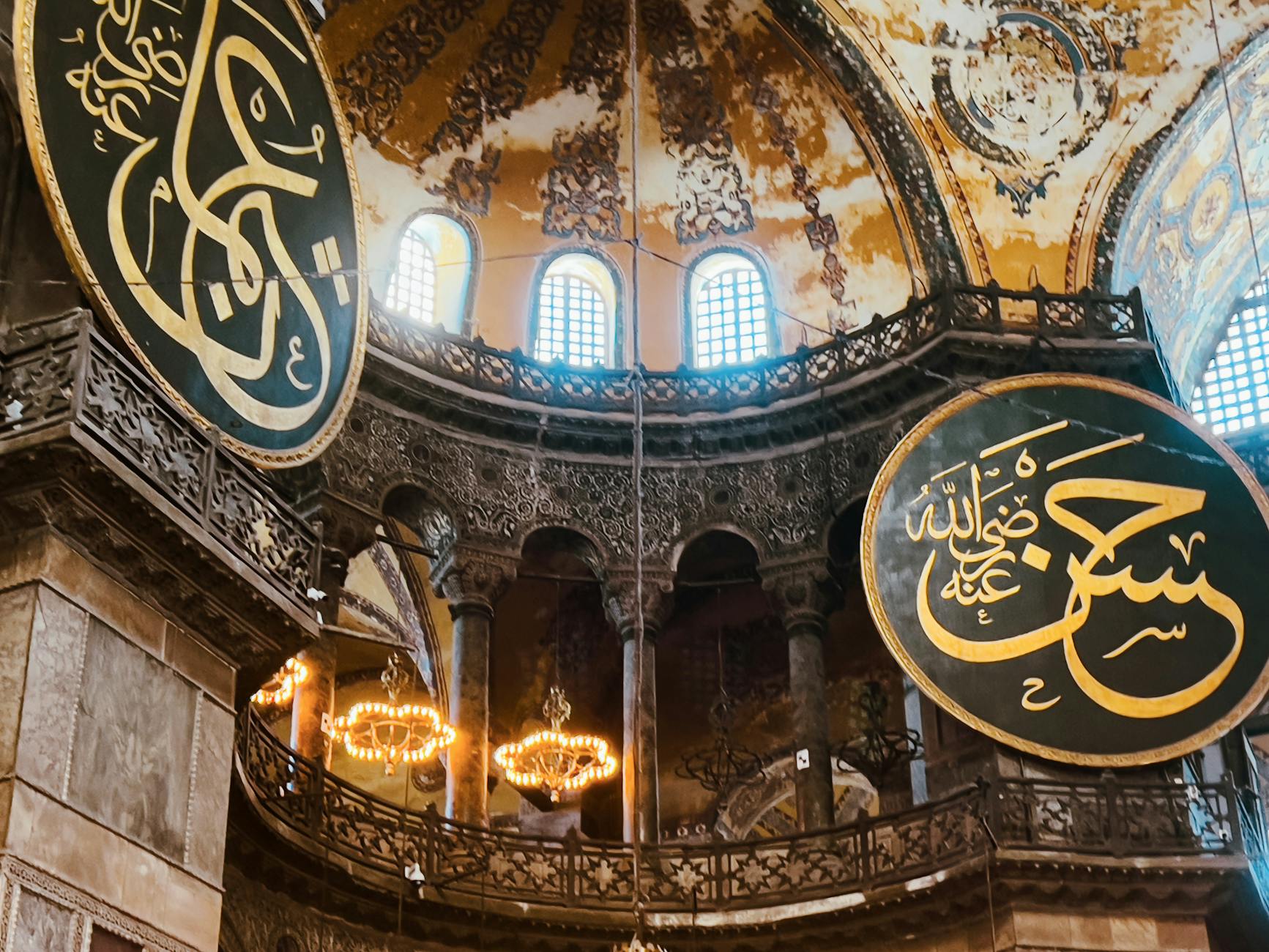
What strikes you first isn't the history — it's the light. The dome, 31 meters across and ringed by 40 arched windows, seems to hover above the nave on a halo of diffused sun. The 6th-century historian Procopius wrote that it appeared "suspended from heaven by a golden chain," and standing beneath it today you understand why he reached for the supernatural. The engineering is real, but the effect is genuinely disorienting.
Since its reconversion to a functioning mosque in 2020, Hagia Sophia operates under a dual logic: worship on the ground floor, tourism largely directed to the upper galleries. The shift has changed the atmosphere. Carpets muffle the marble. Some mosaics are covered during prayer times, then revealed again. You'll need to time your visit around the five daily prayers, but the tradeoff is that you're seeing the building in active use — closer to how it functioned for most of its existence than the hushed museum it was from 1935 to 2020.
Hagia Sophia sits in the Sultanahmet district of Istanbul, a short walk from the Blue Mosque and the Basilica Cistern. The T1 tram drops you at the Sultanahmet stop, practically at the door. Since January 2024, foreign visitors pay a €25 entrance fee, with access generally from 9:00 AM to 7:30 PM. Arrive early. By mid-morning the upper gallery fills, and the quality of that famous light changes with the crowd.
Researched by the Audiala editorial team from historical records, architectural archives, and local expertise.
What to see
The Dome and the Forty Windows
Here's what nobody tells you about the dome: it's not the size that gets you — though at 31 meters across and 55.6 meters up, it could comfortably swallow the Statue of Liberty's head. It's the light. Forty arched windows ring the dome's base, and on a clear morning the sun pours through them so intensely that the dome appears to hover, disconnected from the building below, as if someone cut a hole in the ceiling and pinned a piece of sky there. The 6th-century historian Procopius wrote that it seemed "suspended from heaven by a golden chain," and for once the ancient source wasn't exaggerating.
Anthemios of Tralles and Isidoros of Miletus — a mathematician and a physicist, not traditional builders — engineered this in just five years, from 532 to 537 AD. The original dome actually collapsed in an earthquake in 558, and its replacement sits slightly higher, which arguably improved the effect. Stand directly beneath it and speak. The reverberation time stretches to nearly 10 seconds, turning your voice into something unrecognizable — less a sound than a presence filling the room. That acoustic quality was intentional, designed to make Byzantine chanting feel like it came from everywhere and nowhere at once.
The Byzantine Mosaics and the Imperial Gate
Most visitors walk through the Imperial Gate — the central door, reserved for emperors for nearly a thousand years — and never look back. That's a mistake. Directly above you, visible only when you turn around, is a 9th-century mosaic of Christ Pantocrator enthroned, with Emperor Leo VI prostrating himself at his feet. The gold tesserae catch whatever light filters through the narthex, and Christ's expression shifts depending on where you stand: stern from the left, almost compassionate from the right. Whether that's artistry or accident, nobody can say for certain.
The upper gallery is where the real treasures live. Climb the worn stone ramp — not stairs, a ramp, wide enough that horses once carried empresses up it — and you'll find the 13th-century Deësis mosaic, widely considered one of the finest works of Byzantine art to survive anywhere. Christ's face has a softness that feels centuries ahead of its time, closer to Renaissance portraiture than medieval iconography. Some mosaics are covered with curtains during active prayer times, so visiting in the morning between prayers gives you the best chance of seeing everything uncovered. The Omphalion, a circle of inlaid colored stones on the nave floor below, marks the exact spot where Byzantine emperors were crowned — easy to miss, impossible to forget once you know.
A Slow Walk Through Fifteen Centuries
Skip the crowds and do this instead: arrive when the doors open at 9:00 AM, enter through the tourist entrance (foreign visitors pay €25, introduced in January 2024), and give yourself at least ninety minutes. Start in the outer narthex, where the cool marble and low ceilings compress you before the nave explodes open — that transition is deliberate, and rushing through it robs you of the single greatest architectural reveal in Istanbul. Pause at the Weeping Column on the lower level, where a thumb-sized hole in the copper cladding stays perpetually damp; according to tradition, inserting your finger and rotating it grants a wish. Locals still do it.
Then climb to the upper gallery for the mosaics, and finish by stepping outside into the western courtyard. From there, turn east: you'll see the full profile of the building, its four Ottoman-era minarets framing the Byzantine dome, pink marble and green porphyry sourced from islands and quarries across three continents. The whole structure is a geological map of an empire. For the best exterior photograph, walk five minutes south to Sultanahmet Arkeolojik Park — or better yet, catch it after dark from a rooftop restaurant nearby, when floodlights turn the dome the color of old honey. The T1 tram drops you at Sultanahmet station, a two-minute walk away.
Plan your visit
Getting There
The T1 tram line drops you at the Sultanahmet stop, a 3-minute walk from the entrance — this is the easiest option by far. From Istanbul Airport, the HAVAIST shuttle (HVIST-12 or HVIST-11) runs to the Sultanahmet/Aksaray area. Don't bother driving: there's no dedicated parking, and Sultanahmet's narrow streets will punish you for trying.
Opening Hours
As of 2026, tourist entry runs roughly 09:00 AM to 07:30 PM, but Hagia Sophia is an active mosque — expect closures during the five daily prayer times and especially during Friday midday prayers. Summer hours may stretch slightly longer. Check the Müze İstanbul portal or the boards at the entrance gate on the day of your visit, because schedules shift with the seasons and religious calendar.
Time Needed
If you only walk the main floor and crane your neck at the dome, 45–60 minutes will do. But the upper gallery — where the Byzantine mosaics live and the dome's scale truly registers — demands another 30–45 minutes. Budget 1.5 to 2 hours for a proper visit that doesn't feel rushed.
Tickets & Cost
As of 2026, foreign visitors pay a €25 entrance fee; children under 8 enter free with an adult. Tickets are sold at the entrance, though online booking is increasingly available and saves queue time. There's no formal skip-the-line option — arriving before 09:00 AM is the real hack.
Accessibility
Ramps have been added in recent years, so wheelchair users can access the main floor, but the upper galleries remain difficult or impossible to reach due to the building's 6th-century bones. Interior stone flooring is uneven in places. UNESCO has requested a comprehensive Master Plan that may bring accessibility improvements through 2026, so conditions could change.
Tickets & tours.
These are guided options from our partners — same price as booking direct.
Prices are indicative — final pricing and availability are confirmed at checkout. Audiala may earn a commission from bookings made through these links.
Also on GetYourGuide
More tours for Hagia Sophia
Curated from GetYourGuide. Same price as official, free cancellation on most.
Prices shown are indicative — final pricing and availability are confirmed at checkout. Audiala may receive a commission from bookings made via these links.
Photo Gallery
The historic Hagia Sophia is silhouetted against a vibrant golden sunset in Istanbul, with ferries passing by on the Bosphorus. · Meriç Tuna on PexelsThe interior of the historic Hagia Sophia in Istanbul showcases a stunning blend of Byzantine architectural grandeur and iconic Islamic calligraphy. · Mehmet Turgut Kirkgoz on PexelsThe historic Hagia Sophia glows brilliantly against the night sky in this stunning aerial view of Istanbul, Turkey. · Kelly on PexelsThe interior of the Hagia Sophia in Istanbul, Turkey, showcases a stunning blend of Byzantine architecture and Islamic art illuminated by warm, hanging chandeliers. · Tuğba on PexelsThe majestic Hagia Sophia stands tall in Istanbul, Turkey, framed by a vibrant foreground fountain and lush park greenery under a bright, sunny sky. · Rahmi Aksöz on PexelsA breathtaking interior view of the Hagia Sophia in Istanbul, highlighting the intricate Byzantine dome architecture and historic Islamic calligraphy. · Mehmet Turgut Kirkgoz on PexelsA scenic view of the historic Hagia Sophia in Istanbul, showcasing its magnificent dome and slender minarets against a soft, cloudy sky. · Gizem Ş. on Pexels
History
Three Churches, Two Empires, One Argument That Never Ends
The Hagia Sophia you see today is actually the third building on this site. The first church, dedicated in 360 AD under Emperor Constantius II, burned during riots in 404. Its replacement, inaugurated by Theodosius II in 415, lasted just over a century before it too was destroyed — this time in the catastrophic Nika Riots of 532, which nearly toppled Emperor Justinian I himself. What Justinian built next, in a furious five-year construction sprint from 532 to 537, was designed to be unburnable, unbreakable, and unlike anything the world had seen.
For 916 years it served as the seat of Eastern Orthodox Christianity. Then, on a single morning in 1453, it became a mosque. It stayed one for nearly 500 years, was secularized into a museum in 1935 under Atatürk, and was reconverted to a mosque in 2020. Each transition left physical marks — minarets bolted to Byzantine walls, Arabic calligraphy discs hung beside Christian mosaics, prayer carpets rolled over Roman marble. The building doesn't just contain history; it wears every chapter simultaneously.
The turning point
Anthemios of Tralles and the Dome That Shouldn't Exist
Anthemios of Tralles was not an architect. He was a mathematician and geometrician — the ancient equivalent of hiring a theoretical physicist to build your house. But in 532, Emperor Justinian I had just survived the Nika Riots, which had left half of Constantinople in ashes and his previous cathedral a ruin. He wanted a structure that would assert, beyond argument, that God favored his reign. He gave Anthemios and his colleague Isidoros of Miletus an impossible brief: build the largest enclosed space in the world, crown it with a dome wider than anything attempted before, and do it in five years.
The stakes for Anthemios were existential. Justinian was a ruler who had ordered the massacre of 30,000 rioters in the Hippodrome just weeks earlier. Failure was not an abstract career setback. Anthemios's solution was the pendentive — triangular curved sections that transfer the weight of a circular dome onto a square base. No one had used them at this scale. He specified lightweight bricks from Rhodes, mixed the mortar with crushed brick for flexibility, and angled each course of the dome inward so gravity worked as compression rather than collapse. The dome rose to 55 meters, roughly the height of a 15-story building, without any internal scaffolding strong enough to support it during construction.
It worked. When Justinian entered the completed church on December 27, 537, records indicate he declared: "Solomon, I have surpassed thee." But the dome's triumph was provisional. An earthquake in 557 caused a partial collapse, and Isidoros the Younger rebuilt it with a steeper profile. The dome cracked again in 989 and was repaired once more. Each failure and repair is visible in the slight asymmetries of the current structure — proof that the "miracle" was always a human achievement, maintained by human hands, across fourteen centuries.
The Fall: May 29, 1453
As Ottoman forces breached the Theodosian Walls on the morning of May 29, 1453, hundreds of citizens and clergy crowded into Hagia Sophia. According to tradition, they believed an angel would descend to repel the invaders at the last moment. No angel came. Sultan Mehmed II rode to the building, and legend holds that he dismounted, scooped dust from the ground, and poured it over his turban as a gesture of humility before God. He then ordered the building converted into a mosque. The Byzantine Empire, which had lasted 1,123 years, ended in this nave. Mehmed added a minaret within weeks; three more followed over the next century. The Christian mosaics were plastered over but — critically — not destroyed, which is why many survive today.
The Crusader Sack and the Missing Treasures
The Ottomans weren't the first to desecrate the building. In 1204, soldiers of the Fourth Crusade — fellow Christians — broke into Hagia Sophia and stripped it of everything they could carry. Gold liturgical vessels, silver iconostasis panels, relics of saints: all looted and shipped to Venice, Paris, and points west. The bronze horses now atop St. Mark's Basilica in Venice were taken from Constantinople's Hippodrome during this same rampage. What happened to the rest remains an open question. Some scholars argue that sealed chambers beneath Hagia Sophia's foundations — often dismissed as drainage cisterns — may still contain artifacts hidden by clergy who saw the Crusaders coming. No systematic excavation of the substructure has ever been permitted.
Tips for visitors
Dress Code Is Enforced
Shoulders and knees must be covered for everyone. Women must wear a headscarf — bring your own, because the ones sold by vendors outside are overpriced and flimsy. Security will turn you away if they judge your clothing inappropriate, and tight leggings don't pass muster.
Photography Etiquette
Photos are allowed, but no flash and absolutely no pointing your camera at people praying. Tripods and professional video gear require a government permit, and drones are strictly banned across the entire historic peninsula.
Watch For Scams
The Sultanahmet area is prime territory for the "shoe-shine drop" — a man drops his brush near you, you pick it up, and suddenly you owe him money or get steered into a shop. Also check café menu prices before sitting down; tourist-trap markups around the square can be eye-watering.
Eat Like A Local
Sultanahmet Köftecisi, the original grilled-meatball spot on Divanyolu Caddesi, has been serving the same recipe since 1920 — skip any imitators with similar names. For Ottoman palace cuisine at a higher price point, Matbah Restaurant near the Four Seasons is well-regarded by locals. Grab a simit from a street cart for a 5-lira breakfast on the walk over.
Arrive Early, Go Upstairs
The morning light flooding through the upper windows is at its best between 09:00 and 10:30 AM, and crowds are thinnest then. Head straight for the upper gallery — that's where the 9th-century Deësis mosaic lives, and where the dome's 31-meter span finally makes your stomach drop.
Combine Nearby Sights
The Blue Mosque, Basilica Cistern, and Topkapi Palace are all within a 5–10 minute walk. Do Hagia Sophia first thing in the morning, the Cistern second (it's cool underground on hot days), and save the Blue Mosque for after its midday prayer closure lifts.
Where to Eat
local_dining
Don't Leave Without Trying
Serpme Kahvaltı (sprawling Turkish breakfast with cheeses, olives, menemen, and kaymak with honey)Mezze (small shared plates)Simit (sesame-crusted bread rings)Lahmacun (Turkish pizza with spiced meat)Hamsi (fresh anchovies, grilled or fried)Levrek (sea bass)Dondurma (traditional Turkish ice cream with chewy texture)Rakı (anise-flavored liqueur)Turkish coffeeBörek (savory pastries)
Street food
quick bite
Turkish Street Food€€star5.0(4)
Order: Simit (sesame-crusted bread rings), lahmacun (Turkish pizza with spiced meat), and seasonal roasted chestnuts—this is where locals grab breakfast and lunch between sightseeing.
Located steps from Hagia Sophia in Alemdar, this is authentic street-level Istanbul eating. No tourist markup, no fuss—just the real thing.
checkDistinguish between a lokanta (family-run, daily home-style dishes), a meyhane (tavern for mezze and rakı), and a restoran (formal dining) to match your mood.
checkStreet food is the most authentic and affordable way to eat in Sultanahmet—simit vendors and casual spots are where locals actually eat.
checkMezze are best enjoyed slowly, shared with others, often accompanied by rakı or tea.
checkMany neighborhood bakeries and cafes don't have formal websites or extended opening hours posted—ask locals or check Google Maps for current hours before visiting.
Food districts:Sultanahmet (around Hagia Sophia) — dense with casual eateries, street food, and seafood restaurantsAlemdar — the main pedestrian drag near the monument, packed with quick bites and neighborhood spots
Restaurant data powered by Google
Watch & Explore Hagia Sophia.
🇹🇷 Hagia Sophia | 4K Walking Tour | ISTANBUL | 🇹🇷 Turkey
City Trips10 min246K
Hagia Sophia Entry Fee and Changes Explained for 2024 | Everything You Need to Know!
Waypoint of View6 min33K
Hagia Sophia Guide | Ticket Prices, Opening time, Dress code and more! What to see inside the Mosque
Travel Reviews4 min5K
Frequently asked
Is Hagia Sophia worth visiting?
Absolutely — it's the single building that best explains why Istanbul exists. Built in 537 AD, its dome spans 31 meters across (roughly the length of a blue whale) and floats 55.6 meters above you on a ring of 40 windows that make the ceiling look like it's dissolving into light. Even if you've seen a thousand churches and mosques, nothing prepares you for the scale of a space that has served as both for nearly 1,500 years.
How long do you need at Hagia Sophia?
Plan for 1.5 to 2 hours if you want to actually absorb the place. A quick walk through the main floor takes 45–60 minutes, but the upper gallery — where you'll find the Byzantine mosaics and Viking graffiti scratched into the marble balustrades — deserves its own unhurried hour. Factor in possible closures during the five daily prayer times, which can eat into your schedule if you arrive at the wrong moment.
How do I get to Hagia Sophia from Istanbul?
The easiest route from anywhere in Istanbul is the T1 tram line — exit at the Sultanahmet stop and you're a two-minute walk away. From Istanbul Airport, the HAVAIST shuttle (lines HVIST-11 or HVIST-12) runs directly to the Sultanahmet/Aksaray area. Don't bother driving; there's no dedicated parking and the old city streets will punish you for trying.
What is the best time to visit Hagia Sophia?
Early morning, right when it opens at 09:00 AM, before the tour groups arrive. Midday is the worst — crowds peak and Friday noon prayers close the building to tourists entirely. If you can visit on a weekday morning in late autumn or early spring, you'll have stretches where the only sound is your own footsteps echoing off stone that was quarried before the fall of Rome.
Can you visit Hagia Sophia for free?
Not anymore — since January 2024, foreign tourists pay a €25 entrance fee. Children under 8 enter free with an adult. Turkish citizens and residents who come to pray are not charged, but tourist access is routed through a separate entrance, typically leading to the upper gallery.
What should I not miss at Hagia Sophia?
Three things most visitors walk right past. First, the Omphalion — an intricate circle of colored stones on the nave floor marking the exact spot where Byzantine emperors were crowned. Second, the Imperial Gate mosaic above the main entrance, showing Christ Pantocrator; you have to turn around and look up to see it. Third, in the upper gallery, look for scratched runic graffiti on the marble railings — a Viking mercenary from the 9th or 10th century carved what essentially reads "Halfdan was here."
Do you need to cover your head at Hagia Sophia?
Women must cover their hair with a headscarf, and all visitors need to cover shoulders and knees — it's an active mosque, not a museum. Men should avoid shorts and sleeveless shirts. Bring your own scarf; vendors near the entrance sell them, but at tourist-inflated prices, and security can turn you away if they deem your clothing inappropriate.
Are the mosaics at Hagia Sophia still visible?
Many of the major Byzantine mosaics remain visible, including the 867 AD Virgin and Child in the apse and the Deësis mosaic in the upper gallery. However, some mosaics may be covered or obscured during active prayer times, which is part of the ongoing tension since the 2020 conversion back to a mosque. UNESCO has expressed concern about the long-term preservation of these works, so visiting the upper gallery — where the best-preserved mosaics live — should be your priority.
Sources & attribution19
Researched and written by the Audiala editorial team from historical records, architectural archives, and local expertise. Last updated April 2026.
Strictly necessary cookies keep the site working. Analytics (PostHog, Google Analytics) measures how each visitor uses our pages. Marketing loads YouTube videos and walking-route maps without a tap and lets Google Analytics set advertising cookies. We never sell your data. You can change this any time from the footer.
Privacy
Cookie preferences
Pick what you're okay with. You can change this any time from the footer.
Strictly necessary
Always on
Sign-in, language, navigation. Always on.
Product analytics
PostHog (EU) and Google Analytics record which pages you view and how you use them, under a random identifier stored in your browser. Helps us see which pages work and which need fixing. Google's ad personalisation stays off. No selling.
Marketing
Loads YouTube videos and the walking-route maps (OpenFreeMap) without a tap; without it, they load only when you tap them. If analytics is also on, Google Analytics may set advertising cookies. Ad personalisation stays off.