
Origins and Early Development
The Maelbeek Stream and Urban Transformation
Maelbeek’s name comes from the historic Maelbeek stream, or “mill brook,” which once powered mills and nourished the ponds along its route through Brussels. Originating in the grounds of the Abbey of La Cambre and winding through Etterbeek and the Leopold Quarter, the stream was eventually channeled underground by 1872 to enable city expansion and resolve chronic flooding—particularly as the European Quarter took shape around Rue de la Loi and Rue Belliard (Wikipedia).
Construction and Inauguration
Built in 1965 as part of Brussels’ modernization drive, Maelbeek opened as a premetro station in December 1969, introducing underground tram services and marking a pivotal step in the city’s transition toward a modern rapid transit system (Wikipedia).
Maelbeek’s Evolution as a Metro Hub
Conversion to Heavy Metro
In response to Brussels’ growing metropolitan needs, the premetro lines—including Maelbeek—were upgraded in the mid-1970s to accommodate full metro trains. The station reopened in its current configuration in 1976, now serving as a crucial interchange on Metro Lines 1 and 5 (Wikipedia).
Strategic Location and Connectivity
Situated on Rue de la Loi/Wetstraat, Maelbeek is steps from the European Parliament, European Commission, and key administrative buildings. Metro Lines 1 and 5 link it to major stations like Arts-Loi and Schuman, making Maelbeek a vital gateway for EU officials, international visitors, and local commuters (Moovit).
Architectural and Artistic Features
Renovations and Public Art
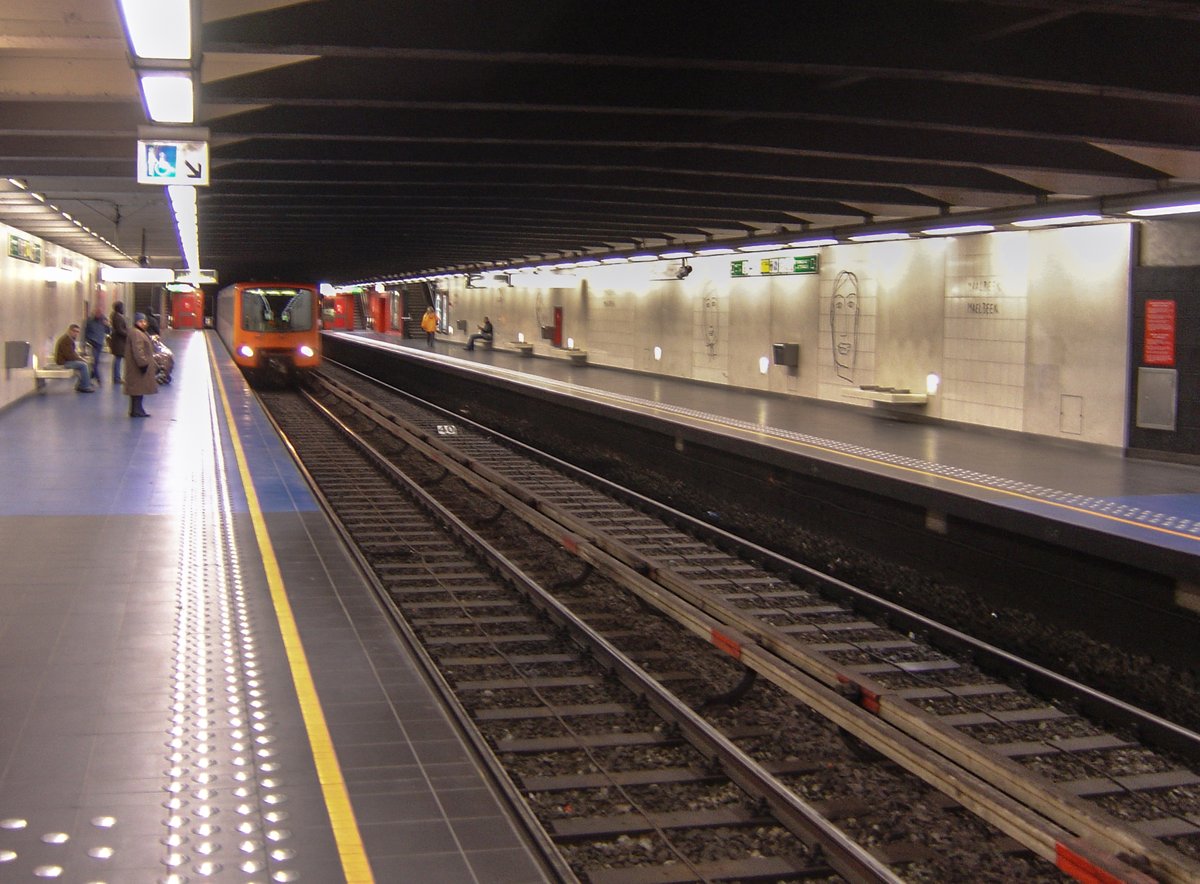
A major renovation in 1999 introduced sleek white azulejos tiles and eight striking portrait murals by Belgian artist Benoît van Innis, reflecting the station’s multicultural identity and Brussels’ tradition of integrating art into public spaces (Wikipedia). The memorial wall, created after the 2016 attacks, preserves handwritten tributes and drawings, serving as a living archive of solidarity.
Accessibility Enhancements
Since 2013, Maelbeek has included elevators, ramps, and tactile paving, ensuring barrier-free access for passengers with reduced mobility (Wikipedia).
Visiting Maelbeek Metro Station: Practical Information
Visiting Hours
- Open Daily from 5:30 a.m. to midnight (some sources indicate 05:00–00:30; always check real-time updates via the STIB-MIVB app)
- Frequency Trains run every 3–10 minutes depending on the time of day (Visit Brussels).
Tickets and Fares
- Where to buy Vending machines, STIB/MIVB BOOTIK/KIOSK outlets, and via contactless payment.
- Types Single ride, day pass, multi-day, and Brupass (unlimited travel in Brussels Region).
- Payment Bank cards, smartphones, MOBIB cards, limited paper tickets. For up-to-date prices, visit the STIB-MIVB website.
How to Get There
- Metro Lines 1 & 5
- Bus Lines 12, 21, 27, 36, 56, 59, 60, 64 (Moovit)
- Train Bruxelles-Schuman (4 min walk)
- Entrances Main access points on Rue de la Loi/Wetstraat and Jozef II-straat.
Accessibility
- Elevators, raised platforms, tactile paving, accessible ticket machines.
- Step-free access to platforms and support for visually impaired passengers.
Facilities & Safety
- Ticket machines, info kiosks, seating, clear signage.
- Security presence (military/police), CCTV, and enhanced protocols since 2016 (BBC News).
- No public toilets or shops inside; nearby cafés and stores available.
The 2016 Terrorist Attack and Its Legacy
On March 22, 2016, Maelbeek was the site of a devastating terrorist attack. At 9:11 a.m., a suicide bomber detonated an explosive in a departing train, killing 16 (some reports indicate 17–20) and injuring over 100. The attack, part of a coordinated assault including Brussels Airport, led to immediate metro network closure, major security upgrades, and a citywide outpouring of grief and resilience (Straits Times; Politico).
Maelbeek’s reopening in April 2016 was marked by new memorial art, a remembrance wall, and ongoing vigilance, transforming the station into a symbol of collective memory and urban solidarity (Wikipedia).
Ongoing Modernization and Accessibility
Recent years have seen continued improvements at Maelbeek, including temporary closures for construction near Schuman and further investments in accessibility and security. The station’s ongoing modernization ensures it remains safe, inclusive, and efficient for all users (Moovit).
Nearby Attractions and Historical Sites
Maelbeek is an ideal starting point for exploring Brussels’ European Quarter and beyond. Notable sites within walking distance include:
- European Parliament and Commission Visit the heart of the EU.
- Parc Leopold Lush green space and museums.
- Parc du Cinquantenaire Grand park with Autoworld and Royal Museum of Armed Forces.
- Museum of Natural Sciences
- Ixelles Art Nouveau architecture and vibrant neighborhoods.
For a cultural deep dive, consider the Brussels Card for combined museum and transit discounts (Visit Brussels).
FAQs
Q: What are Maelbeek Metro Station’s operating hours?
A: Daily from 5:30 a.m. to midnight (or 05:00 to 00:30—check the STIB-MIVB app for real-time updates).
Q: How can I buy tickets at Maelbeek?
A: Use vending machines, kiosks, or contactless payment on vehicles. MOBIB and Brupass cards are recommended for frequent use.
Q: Is the station accessible?
A: Yes, with elevators, tactile paving, and raised platforms for wheelchair users.
Q: What public art can I see at Maelbeek?
A: Memorial wall for 2016 attack victims and ceramic murals by Benoît van Innis.
Q: Are there guided tours?
A: While the station itself does not offer tours, many nearby sites do.
Q: Is there security at the station?
A: Yes, with regular military/police presence and CCTV surveillance.