Destinations Belgium

Belgium.

Brussels 12 cities

Belgium is what happens when a small country packs four centuries of trade, rebellion, painting, brewing, and language politics into a train network you can cross before dinner.

Get the app Cities in Belgium
Belgium
Belgium
Brussels
Capital
12
Cities
Spring to early autumn (April-October)
best season
5-8 days
trip length
Euro (EUR)
currency

EntrySchengen rules; many non-EU travelers get 90 days visa-free

01 An introduction

verified

BThis Belgium travel guide starts with the country’s trick: within two hours, North Sea dunes, guildhalls, abbey beer, and Ardennes forests fit on one rail map.

Belgium makes sense once you stop treating it as a stopover between Paris and Amsterdam. Brussels gives you royal facades, comic-strip walls, and stoemp in old brasseries; Bruges turns canal reflections and bell towers into a study in medieval wealth; Ghent feels sharper, with student energy wrapped around guild houses and the van Eycks’ unfinished mystery, the missing Just Judges panel of the Ghent Altarpiece. None of these cities are far apart. That changes how you travel: breakfast in Brussels, lunch in Mechelen, a late beer beside the quays in Antwerp, and you still sleep without feeling rushed.

The country’s real drama lies in contrast, not scale. Antwerp built fortunes on trade and diamonds, Liège leans industrial and stubborn along the Meuse, Leuven runs on old university habits and late-night bars, while Namur and Dinant open the door to river cliffs, citadels, and the first folds of the Ardennes; farther east, Spa turns mineral water into a whole social ritual that Europe copied by name. Then the table starts talking. Frites come with mayonnaise, not apology, boulets à la liégeoise stick to your fingers, grey shrimp croquettes punish impatience, and Belgian beer is less a drink list than a map of monasteries, yeast strains, and local pride.

Foodie History Buff Photography Hotspot Outdoor Adventure Budget Friendly

A History Told Through Its Eras

When Caesar Learned the North Would Not Kneel

Belgae and Rome, 57 BCE-430 CE

A shield slips from a frightened soldier's hand, and Julius Caesar snatches it up himself. That is the scene he leaves us for 57 BCE, somewhere near the Sabis, when the Nervii came so close to breaking the Roman army that the future master of Rome had to fight in the front line like a common officer. He wrote, with the cold admiration of a conqueror, that the Belgae were the bravest of all Gaul. One hears the compliment. One should also hear the massacre behind it.

Ce que l'on ignore souvent, c'est que Belgium enters written history not as a tidy province but as a wound. Ambiorix, king of the Eburones, tricked a Roman force into leaving camp near Atuatuca, usually linked with Tongeren, then destroyed it in a forested valley in 54 BCE. Caesar never caught him. Instead he tried to erase an entire people. The first great Belgian hero is already a fugitive, already a statue in waiting.

Rome then did what Rome always did when fear gave way to administration. Roads appeared, villas multiplied, grain moved north and south, and towns tied themselves to the imperial map. Tongeren became one of the oldest urban centers in the region. Namur watched the Meuse and Sambre. Trade, taxes, baths, pottery, glass: the empire prefers receipts to legends.

Yet the peace was never quite complete. Frankish raids tested the frontier, peasants rebelled, and the great villa economy began to fray in the 3rd and 4th centuries. A mine still worked at Baelen-Nereth while other places emptied. Then the record goes quiet around 430. No grand last stand, no theatrical curtain. Just officials gone, garrisons thinned, and the old Roman order dissolving into damp northern silence.

Ambiorix survives in memory because he did the unforgivable thing: he beat Rome and then vanished before Rome could turn him into a trophy.

The bronze Ambiorix in Tongeren was unveiled in 1866, when the modern Belgian state was still young enough to need an ancestor with a sword.

Bell Towers, Relics, and the Insolence of Cloth Merchants

Abbeys, Counties, and Bold Towns, 500-1477

Picture a reliquary glinting in candlelight, carried through the Ardennes while nobles, monks, and peasants all stare at the same gold with very different motives. In the centuries after Rome, power in these lands settled not only in castles but in abbeys. Saint Remacle's foundations at Stavelot and Malmedy grew rich on routes, forges, and devotion. Relics moved money. Sanctity had accounts to keep.

Then the towns began to behave like princes. Bruges filled with foreign merchants. Ghent spun wool into political muscle. Ypres, Leuven, Mechelen, and Liège each learned that a charter could matter as much as a bloodline if enough armed burghers stood behind it. The belfry becomes the perfect Belgian symbol here: not a church tower, not quite a palace, but a civic declaration in stone.

One date still crackles: 1302. At Kortrijk, Flemish militias faced French chivalry and won. The field was bad, the ditches worse, and aristocratic confidence proved heavier than armor. More than 500 golden spurs were gathered from the dead and hung in a church. The lesson was brutal and modern: a weaver with discipline can humble a duke with lineage.

And yet medieval Belgium never belonged to one story. It belonged to many. Prince-bishops ruled in Liège. Counts maneuvered in Flanders. The dukes of Burgundy, with their appetite for ceremony and central control, began gathering these prosperous territories into something larger. In 1432, in Ghent, Jan van Eyck's Mystic Lamb opened its painted wings over a world of merchants, pilgrims, financiers, and sinners. The age of city liberties was not ending yet, but courtly magnificence had entered the room and would soon insist on the best chair.

Godfrey of Bouillon remains the strangest kind of local lord: a man who mortgaged home, left for Jerusalem, and never returned to reclaim his own castle.

The missing panel of the Ghent Altarpiece, The Just Judges, stolen in 1934, has never been found; one of Europe's greatest masterpieces still contains an absence.

A Court of Velvet, Then Fire in the Streets

Burgundians, Habsburgs, and Revolt, 1477-1713

Begin with cloth-of-gold, marriage contracts, and a widow's peril. When Mary of Burgundy died in 1482 after a riding accident, the Low Countries passed into Habsburg hands through inheritance rather than conquest. Such turns often look elegant on a family tree. On the ground, in Brussels, Antwerp, and Ghent, they meant taxes, bargaining, resentments, and the uneasy feeling that distant dynasties had discovered just how rich these provinces were.

Antwerp became one of Europe's great stages in the 16th century. Silver, spices, English cloth, German bankers, printers, painters, and rumors all passed through its quays and counting houses. Ce que l'on ignore souvent, c'est que wealth here always had a nervous pulse. The same city that dazzled merchants could panic overnight when faith and power collided. The iconoclasm of 1566 smashed images in churches across the Low Countries. What broke was not only sculpture. Trust went with it.

The Dutch Revolt split north from south. The northern provinces moved toward independence; the southern provinces, much of present-day Belgium, remained under Habsburg rule and under stronger Catholic discipline. Brussels acquired the air of a government capital, while the Counter-Reformation clothed cities in Baroque splendor. Rubens painted like a diplomat with pigments. Jesuits built as if persuasion needed marble.

Then came war after war, and with them the terrible privilege of Belgium's geography. Louis XIV wanted these lands because every monarch wanted them: they were rich, strategic, and inconveniently close. Fortresses mattered. So did bombardments. In 1695, Brussels saw its Grand-Place shattered by French artillery. The rebuilt square is so harmonious today that one almost forgets it rose from calculated destruction. Almost. Out of those ashes came the Belgian habit of rebuilding magnificently while remembering the insult.

Margaret of Austria, governing from Mechelen, showed that regency could be more effective than kingship when exercised by a woman who knew both music and power.

The Grand-Place of Brussels, admired for its unity, is largely the result of a forced reconstruction after the French bombardment of 1695.

A Small Kingdom With Too Many Histories for One Crown

From Revolution to Federal Kingdom, 1713-2026

A ballroom, a riot, and an opera chorus: Belgium likes to enter history through theater. In August 1830, after a performance of Auber's La Muette de Portici in Brussels, patriotic excitement spilled into the streets. The timing mattered, but so did accumulated irritation under Dutch rule after 1815. Within months a new state was being improvised from old provinces, languages, habits, and rival ambitions. Such births are rarely serene.

Leopold I took the constitutional oath on 21 July 1831, and the monarchy began with a German prince learning to look Belgian quickly. The new country industrialized at astonishing speed. Coal, steel, railways, and finance transformed Wallonia into one of continental Europe's earliest industrial regions. Liège forged cannon. Ghent wove. Brussels expanded with bourgeois confidence. Yet prosperity had a shadow, and Belgium projected one abroad in the Congo under Leopold II, whose appetite for grandeur at home was financed by violence overseas. The parks and arcades remain lovely. The ledger beneath them is not.

The 20th century was merciless. In 1914 Germany violated Belgian neutrality and turned small towns, forts, and fields into world news. Dinant suffered massacre. Liège resisted longer than Berlin expected. Ypres, just across today's border of memory, became a synonym for industrial slaughter. Then, after one war ended, another returned in 1940. Occupation, collaboration, resistance, deportation: Belgium, like the rest of Europe, discovered again that civilization is thinner than its facades.

Peace did not simplify the country. It made complexity constitutional. Flemish and Francophone political life drifted apart, Brussels became both capital and argument, and the state slowly federalized itself to avoid tearing. That sounds dry until one sees what it means in daily life: languages on signs, parliaments layered atop parliaments, identities both local and national. And still the country persists, inventive and faintly amused by its own improbability. Brussels now hosts European institutions, Antwerp remains a world diamond and port city, Bruges trades on silence and water, and Ghent keeps its rebellious intelligence. The next chapter is not about unity in the sentimental sense. It is about coexistence, negotiated line by line.

Leopold II is the king Belgium cannot treat as a simple builder, because every monument he left at home casts a longer shadow toward Central Africa.

Belgium's independence was helped along by an opera night in Brussels, one of the few moments in European history when a soprano can plausibly be counted among the causes of a revolution.

The Cultural Soul

A Country That Answers in Three Tongues

Belgium speaks as if speech were a border crossing. In Brussels, a baker says bonjour, the next customer answers in Dutch, a clerk switches to English with the weary grace of someone changing knives between courses. The miracle is not harmony. The miracle is speed. A country can survive many humiliations if it learns to conjugate them.

Words here carry weather. Belgian French gives you septante and nonante with the calm of people who prefer arithmetic without drama; then it slips in drache for the rain that soaks your socks in three seconds flat. In Flanders, goesting means appetite, desire, mood, impulse, and a private permission to want what you want. No exact translation exists. Good. A language should keep a few locked drawers.

Even place names become tests of character. Liège tastes different in the mouth from Luik. Ghent and Gent are not rivals, only two coats on the same hook. Belgians know that language is never just vocabulary; it is schooling, class, region, memory, and sometimes revenge served cold at a municipal counter. They have therefore developed the highest local art: precision without confession.

The Fryer as National Theology

Belgium takes frying seriously because it takes pleasure seriously. A cone of frites from a stand in Brussels or Antwerp arrives too hot to hold, the paper already darkening with fat, the smell of potato and oil rising into the damp evening like a practical prayer. Mayonnaise follows. Of course it does. Puritanism has no standing here.

The national table prefers abundance disguised as modesty. Carbonnade flamande looks brown and humble until the beer, onion, and mustard begin their slow argument on the tongue. In Liège, boulets arrive lacquered with sirop de Liège, sweet and dark enough to make a moralist nervous. In Ghent, waterzooi pretends to be a pale broth and turns out to be comfort with cutlery.

Belgian cuisine mistrusts purity. It likes cream with bitterness, sugar with vinegar, beer in the stew, shrimp inside a croquette that can blister the roof of your mouth if you show impatience. This is not contradiction. This is manners. A country is a table set for strangers, and Belgium sets the table with fries, beer, and a sauce whose name you were not expecting.

The Lamb, the Skull, the Joke

Belgian art has always understood that devotion and mischief can share a frame. In Ghent, the Adoration of the Mystic Lamb glows with such technical serenity that one almost misses the audacity of it: fur, brocade, blood, meadow, pearl, all painted with a patience close to obsession. Then you remember that one panel, the Just Judges, vanished in 1934 and never came back. Belgium can produce a masterpiece and a mystery in the same breath.

The line continues. James Ensor in Ostend painted masks that grin like bad consciences; René Magritte in Brussels looked at a pipe and used it to destroy certainty with schoolmaster courtesy. Belgian art rarely shouts. It smiles, straightens your collar, and removes the floorboards under your feet.

This may be the national genius: to admit the sacred, then place beside it something embarrassing, comic, or slightly wrong. A reliquary in hammered gold. A saint in candle smoke. A surreal sentence in a neat suit. The result is not cynicism. It is intimacy. Belgium does not ask art to be pure. It asks art to tell the truth, which is harder.

Brick, Bell Towers, and Private Grandeur

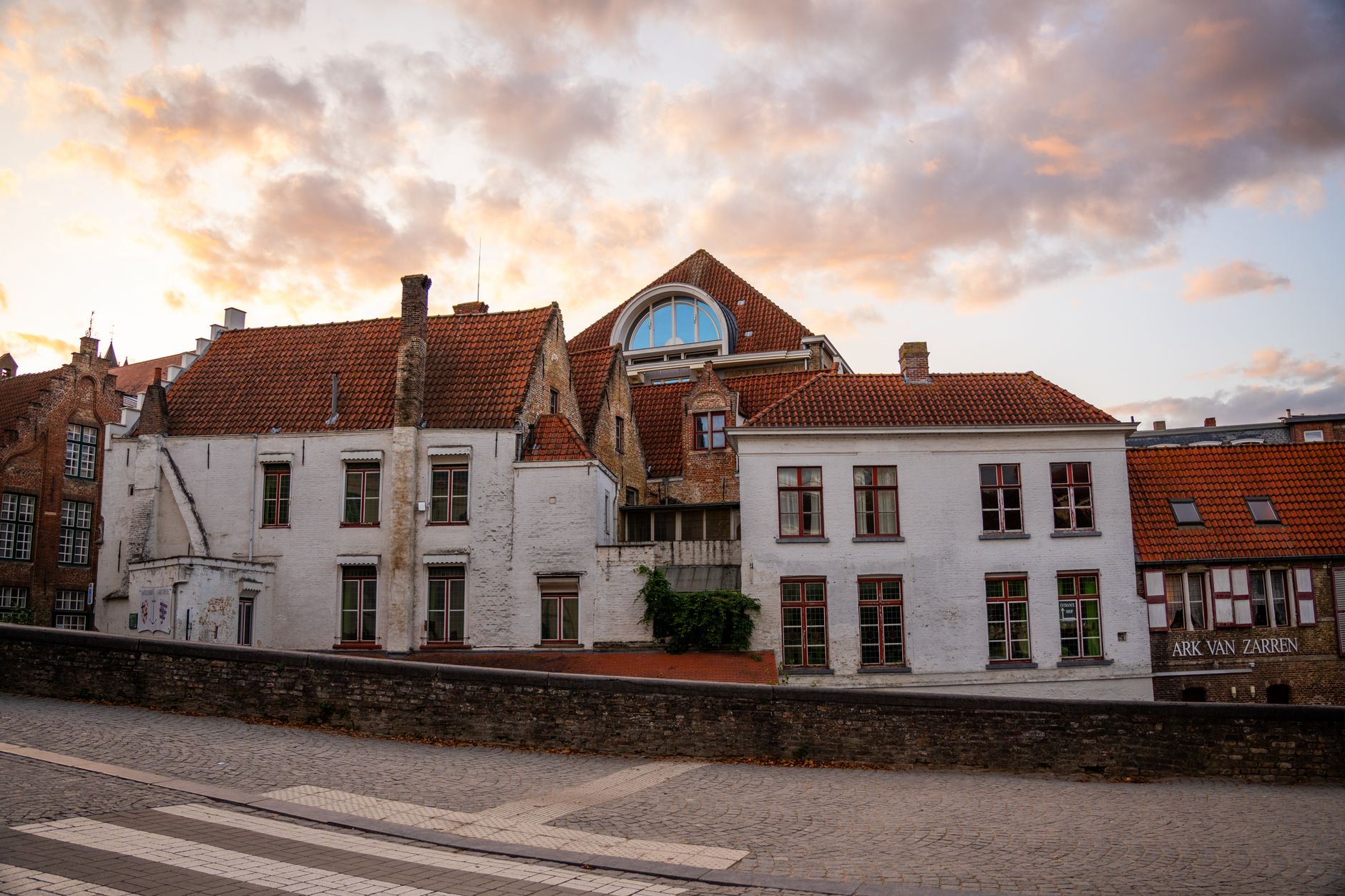
Belgian architecture does not seduce at first glance. It waits. Bruges gives you stepped gables, canals, and a silence so composed it almost feels staged; then a side street breaks the spell with laundry, bicycle bells, and the smell of beer yeast from somewhere unseen. Beauty here likes interruption. It keeps things honest.

In Antwerp, guild houses perform wealth with disciplined faces. In Namur and Dinant, stone rises above the Meuse as if cliffs had learned administration. Brussels is another matter entirely: grand place facades polished like jewelry, then Art Nouveau houses by Victor Horta where iron stems twist across stairwells with the insolence of living plants, followed two streets later by an office block with all the charm of a tax audit. The city does not hide its bad decisions. I respect that.

Belgium builds in layers because it lives in layers. Gothic towers, Spanish traces, Austrian order, French appetite, industrial brick, modernist severity, postwar accidents. The streets read like a family archive with water damage. And yet Mechelen, Leuven, Mons, Tongeren keep proving the same point: brick in this country is not merely material. It is temperament made visible.

Courtesy Without Performance

Belgian politeness begins with restraint. One greets first. One does not fling oneself into conversation as if intimacy were a human right. In Brussels, a clean bonjour or goedendag opens doors more reliably than charm; in Flanders, punctuality is a form of respect so exact it can feel almost architectural. You arrive when you said you would. This is not coldness. It is hygiene.

At table, the codes soften. Beer is discussed with the gravity other nations reserve for treaties. A glass is not a container but an argument about shape, foam, memory, monastery, temperature. Someone will tell you which beer belongs to which glass, and they will be correct. In Liège, the ritual around boulets and fries has the same solemnity, though with more napkins.

Belgian etiquette dislikes noise, boasting, and sentimental display. It does, however, make room for wit, and wit here works best when delivered flat, almost bureaucratically, as if the absurdity in question were entirely standard procedure. This is a country that knows the difference between friendliness and intrusion. The distinction is civilized. Also delicious.

Order with a Secret Compartment

Belgian design often looks sober until you live with it for ten minutes. Then the intelligence emerges: the exact weight of a chair, the disciplined line of a lamp, the way a brutalist facade in Brussels suddenly frames a square of sky like a painting. The country has a weakness for clean surfaces and hidden intentions. So do I.

You see it in fashion, in gallery spaces, in station halls, in the severe pleasures of Flemish interiors where wood, linen, stone, and shadow conduct a long marriage without speaking much. This is not minimalism for exhibitionists. It is minimalism after rain, after invoices, after dinner. Objects must justify their existence. If they can do so elegantly, all the better.

Belgium distrusts showiness but adores refinement. The result is design that whispers rather than poses: the polished counter in a chocolate shop in Brussels, the typography on an old café sign in Ghent, the immaculate box from a biscuit maker who has been ruining diets since the nineteenth century. Taste here is less about display than calibration. Every line knows why it is there.


02 What Makes Belgium Unmissable.

train

Built For Rail

Belgium is compact enough that Brussels, Antwerp, Ghent, Bruges, Leuven, Namur, and Liège work as one connected trip rather than separate expeditions. Fast rail links are part of the appeal, not just the logistics.

castle

Cities With Memory

Guildhalls, belfries, beguinages, citadels, and cloth halls survive here in unusual density. Bruges keeps its canals, Ghent guards the Ghent Altarpiece, and Dinant climbs dramatically beneath its cliffside fortress.

restaurant

Brasserie Logic

Belgian food is rich, exact, and happily unfashionable. Think carbonnade with dark beer, mussels by the pot, Liège meatballs in sweet-sour sauce, and fries treated with the seriousness other countries reserve for wine.

local_bar

Beer Has Geography

Beer in Belgium is tied to abbeys, monasteries, city pride, and specific glasses that locals take very seriously. In Brussels, Antwerp, and Leuven, a menu can read like a condensed history of the country.

hiking

Ardennes Reset

South of the big northern cities, the land lifts into forests, river valleys, and cold-weather walking country. Namur, Dinant, and Spa make strong bases when you want stone villages and less pavement.

palette

Art With A Plot

Belgium’s museums and churches hold work by van Eyck, Rubens, Magritte, and Ensor, but the stories are half the draw. The Ghent Altarpiece alone was stolen, hidden, dismantled, and still has one panel missing.

03 Cities in Belgium.

12 cities — start with the ones we'd send you to first.

Brussels
01

Brussels

A city that runs the European Union by day and argues about surrealism, frites, and comic-strip murals by night, all within walking distance of the same Grand-Place that Victor Hugo called the most beautiful square in th

Bruges
02

Bruges

Medieval wool-trade money froze this city in amber around 1400, leaving a canal network, 83 bridges, and a skyline of guild towers that the 20th century barely touched.

Ghent
03

Ghent

Where Bruges is a museum, Ghent is a living city — university students on bikes, the Van Eyck altarpiece behind bulletproof glass in Sint-Baafskathedraal, and a Saturday market that sells everything from vinyl to live ra

Antwerp
04

Antwerp

The port that once handled half the world's trade still moves 235 million tonnes a year, and the diamond district, the Rubens house on Wapper, and the fashion graduates of the Royal Academy of Fine Arts all operate withi

Liège
05

Liège

The most French-feeling city in Belgium sits where the Meuse and Ourthe rivers meet, its Sunday Batte market sprawling two kilometres along the quay, its Simenon-haunted back streets smelling of boudin and strong coffee.

Namur
06

Namur

A citadel on a rock where the Sambre meets the Meuse has been fought over by Burgundians, Spanish, French, Dutch, and Germans — the fortifications are still there, and the view over the confluence explains exactly why ev

Leuven
07

Leuven

The oldest Catholic university in the Low Countries, founded 1425, gives this compact Flemish city a Grote Markt town hall so extravagantly Gothic that contemporaries compared it to a reliquary in stone, and a student-to

Mons
08

Mons

Van Gogh lived in the nearby Borinage coalfields in 1879, drawing the miners he was trying to save; the city itself holds a dragon procession every Trinity Sunday that has been classified by UNESCO and involves a very la

Dinant
09

Dinant

Adolphe Sax invented the saxophone here in 1814, the Meuse cuts through a gorge beneath a citadel that French troops blew apart in 1914, and the onion-domed collegiate church at the water's edge looks architecturally imp

All 12 cities

04 Regions.

Brussels

Brussels and Brabant

Belgium's political capital is also its most revealing contradiction: royal facades, Art Nouveau houses, immigrant food streets, and bureaucracy with lipstick on. Brussels, Leuven, and Mechelen sit close enough for easy rail hops, but each speaks differently: Brussels in many voices, Leuven with student confidence, Mechelen in a lower, older register.

Brussels Leuven Mechelen
Ghent

Flemish Art Cities

This is the dense northern belt where merchant wealth turned brick, bells, and paint into a civic argument. Bruges keeps the medieval image polished almost to unreality, Ghent feels larger and less obedient, and Antwerp trades lace-curtain prettiness for ambition, diamonds, and baroque scale.

Bruges Ghent Antwerp
Namur

Meuse Valley and Ardennes Edge

South and east of the central plateau, the country folds into river cliffs, citadels, and weather that arrives with intent. Namur, Dinant, Liège, and Spa belong to the same broad map but not the same mood: Namur is measured, Dinant dramatic, Liège restless, Spa softer around the edges.

Namur Dinant Liège Spa
Mons

Hainaut and the Old Industrial West

Western Wallonia carries coal, war, and church towers in the same frame. Mons is the cleanest entry point, a city that hides its old strategic importance behind an elegant square and a stubbornly local calendar; the surrounding region makes more sense if you like Belgium when it stops posing.

Mons
Tongeren

Limburg and Roman Belgium

Belgium's northeast is quieter on the standard route and better for that. Tongeren gives you Ambiorix, Roman layers, and a market-town rhythm that feels older than the modern state, while the wider region trades grandeur for depth and rewards anyone willing to read small details carefully.

Tongeren

05 Top Monuments in Belgium.

Château D'Herbeumont

Herbeumont

Art & History Museum

City Of Brussels

Kings Gallery

City Of Brussels

Old Masters Museum

City Of Brussels

Obelisk Anspach

City Of Brussels

Millennium Iconoclast Museum of Art

City Of Brussels

Arc Du Cinquantenaire

City Of Brussels

Place Du Luxembourg

City Of Brussels

Maison De La Dernière Cartouche

Bouillon

Porte De Hal/Hallepoort Metro Station

City Of Brussels

Grand-Place

City Of Brussels

Ixelles Ponds

City Of Brussels

Place Rogier - Rogierplein

City Of Brussels

Cauchie House

City Of Brussels

Monument to the War Pigeon

City Of Brussels

Horta Museum

City Of Brussels

Het Zinneke

City Of Brussels

Manneken Pis

City Of Brussels

06 From Belgae Warriors to a Federal Kingdom

A country assembled from river crossings, trading cities, dynastic marriages, revolts, and long negotiations over language and power.

  1. swords
    57 BCEBelgae and Roman Conquest

    Caesar Invades the Belgae

    Julius Caesar enters the lands of the Belgae and discovers resistance fiercer than he expected. His famous line praising their bravery survives because the fighting nearly cost him control of the campaign.

  2. person
    54 BCEBelgae and Roman Conquest

    Ambiorix Destroys a Roman Force

    Ambiorix of the Eburones tricks Roman commanders into leaving camp near Atuatuca and leads them into annihilation. Caesar responds with a campaign of vengeance, but the rebel king slips out of the record and into legend.

  3. location_city
    1st century CEGallo-Roman Belgium

    Tongeren Rises as a Roman Town

    Atuatuca Tungrorum, present-day Tongeren, becomes one of the earliest urban centers in what is now Belgium. Roads, trade, baths, and administration tie the region into the imperial machine.

  4. church
    c. 650Early Medieval Principalities

    Saint Remacle Founds Stavelot-Malmedy

    Abbey power takes root in the Ardennes as Saint Remacle establishes one of the region's great monastic houses. Religion, landholding, metalwork, and politics begin to travel together.

  5. castle
    1096Feudal Belgium

    Godfrey of Bouillon Leaves for the First Crusade

    Godfrey mortgages his castle at Bouillon to finance his departure east. He will help take Jerusalem and never return to reclaim the fortress above the Semois.

  6. military_tech
    1302Communes and Counties

    Battle of the Golden Spurs

    Flemish militias defeat French knights near Kortrijk in one of medieval Europe's great social reversals. The collected golden spurs become a trophy and, centuries later, a political memory.

  7. crown
    1384Burgundian Netherlands

    Burgundian Rule Expands in the Low Countries

    With Philip the Bold's inheritance of Flanders, the Burgundian state begins gathering wealthy principalities under one glittering court culture. Ceremony, finance, and centralization now move in the same direction.

  8. palette
    1432Burgundian Netherlands

    The Ghent Altarpiece Is Unveiled

    Jan van Eyck's Adoration of the Mystic Lamb appears in Ghent, changing the possibilities of painting in oil. It will also become one of the most stolen artworks in European history.

  9. person
    1500Habsburg Netherlands

    Birth of Charles V in Ghent

    A child born in Ghent will inherit an empire on which, as the formula says, the sun never set. The Low Countries are no provincial corner now; they are at the center of dynastic Europe.

  10. breaking_news
    1566Wars of Religion

    Iconoclasm Sweeps the Low Countries

    Protestant crowds attack churches, smash images, and turn religious conflict into a public rupture. The violence helps set the stage for revolt against Habsburg rule and the eventual split between north and south.

  11. account_balance
    1585Spanish Netherlands

    Antwerp Falls to Spanish Forces

    The capture of Antwerp and the closing of the Scheldt shift commercial power northward. One of Europe's richest cities loses population, capital, and some of its future in a single geopolitical turn.

  12. local_fire_department
    1695Wars of Louis XIV

    Brussels Is Bombarded

    French artillery devastates the Grand-Place and surrounding quarters of Brussels. The square rebuilt afterward is so beautiful that the destruction that made it possible is easy to underestimate.

  13. gavel
    1713Austrian Netherlands

    Southern Netherlands Pass to Austrian Rule

    The Treaty of Utrecht transfers the southern Low Countries from Spain to the Austrian Habsburgs. Dynasties change; local elites and old habits remain stubbornly present.

  14. theater_comedy
    1830Independence and Nation-Building

    Belgian Revolution Breaks Out in Brussels

    After an opera performance in Brussels, unrest spills into the streets and becomes a revolution. The new state that emerges is liberal for its age, monarchic by calculation, and complicated from birth.

  15. crown
    1831Independence and Nation-Building

    Leopold I Becomes King of the Belgians

    Leopold I takes the constitutional oath and gives the new kingdom a measured, diplomatic face. The formula matters: king of the Belgians, not king of Belgium, because the people are meant to come first in theory if not always in practice.

  16. public
    1885Industrial and Colonial Belgium

    Leopold II Secures the Congo Free State

    At the Berlin Conference, Leopold II gains personal control over the Congo Free State. The wealth extracted there will help finance grandeur in Belgium and horror in Central Africa.

  17. warning
    1914World Wars

    Germany Invades Neutral Belgium

    Belgian neutrality is violated at the opening of the First World War, bringing Liège, Leuven, Dinant, and countless smaller places into catastrophe. International sympathy for 'Poor Little Belgium' cannot soften the reality on the ground.

  18. history_edu
    1940World Wars

    Occupation Begins Again

    German forces invade in May 1940, and Belgium enters a second occupation within a generation. Resistance, collaboration, deportation, and daily compromise mark the years that follow.

  19. science
    1958Postwar Belgium

    Expo 58 Opens in Brussels

    The Atomium rises for the Brussels World's Fair, offering a futuristic image for a country still carrying wartime memory. Belgium presents itself as modern, technical, and confidently European.

  20. account_tree
    1993Federal Belgium

    Belgium Becomes a Federal State

    Constitutional reforms formally turn Belgium into a federal state, acknowledging the depth of its linguistic and regional realities. Unity survives, but only by accepting that it must now be negotiated institution by institution.

  21. person
    2013Contemporary Belgium

    Philippe Ascends the Throne

    King Philippe succeeds Albert II and inherits a monarchy that still matters less as a source of command than as a hinge between parts of the country. In Belgium, continuity is often quieter than charisma.

07 The story of Belgium.

0157 BCE-430 CE

When Caesar Learned the North Would Not Kneel

Belgae and Rome

Ambiorix survives in memory because he did the unforgivable thing: he beat Rome and then vanished before Rome could turn him into a trophy.

A shield slips from a frightened soldier's hand, and Julius Caesar snatches it up himself. That is the scene he leaves us for 57 BCE, somewhere near the Sabis, when the Nervii came so close to breaking the Roman army that the future master of Rome had to fight in the front line like a common officer. He wrote, with the cold admiration of a conqueror, that the Belgae were the bravest of all Gaul. One hears the compliment. One should also hear the massacre behind it.

Ce que l'on ignore souvent, c'est que Belgium enters written history not as a tidy province but as a wound. Ambiorix, king of the Eburones, tricked a Roman force into leaving camp near Atuatuca, usually linked with Tongeren, then destroyed it in a forested valley in 54 BCE. Caesar never caught him. Instead he tried to erase an entire people. The first great Belgian hero is already a fugitive, already a statue in waiting.

Rome then did what Rome always did when fear gave way to administration. Roads appeared, villas multiplied, grain moved north and south, and towns tied themselves to the imperial map. Tongeren became one of the oldest urban centers in the region. Namur watched the Meuse and Sambre. Trade, taxes, baths, pottery, glass: the empire prefers receipts to legends.

Yet the peace was never quite complete. Frankish raids tested the frontier, peasants rebelled, and the great villa economy began to fray in the 3rd and 4th centuries. A mine still worked at Baelen-Nereth while other places emptied. Then the record goes quiet around 430. No grand last stand, no theatrical curtain. Just officials gone, garrisons thinned, and the old Roman order dissolving into damp northern silence.

Did you know

The bronze Ambiorix in Tongeren was unveiled in 1866, when the modern Belgian state was still young enough to need an ancestor with a sword.

02500-1477

Bell Towers, Relics, and the Insolence of Cloth Merchants

Abbeys, Counties, and Bold Towns

Godfrey of Bouillon remains the strangest kind of local lord: a man who mortgaged home, left for Jerusalem, and never returned to reclaim his own castle.

Picture a reliquary glinting in candlelight, carried through the Ardennes while nobles, monks, and peasants all stare at the same gold with very different motives. In the centuries after Rome, power in these lands settled not only in castles but in abbeys. Saint Remacle's foundations at Stavelot and Malmedy grew rich on routes, forges, and devotion. Relics moved money. Sanctity had accounts to keep.

Then the towns began to behave like princes. Bruges filled with foreign merchants. Ghent spun wool into political muscle. Ypres, Leuven, Mechelen, and Liège each learned that a charter could matter as much as a bloodline if enough armed burghers stood behind it. The belfry becomes the perfect Belgian symbol here: not a church tower, not quite a palace, but a civic declaration in stone.

One date still crackles: 1302. At Kortrijk, Flemish militias faced French chivalry and won. The field was bad, the ditches worse, and aristocratic confidence proved heavier than armor. More than 500 golden spurs were gathered from the dead and hung in a church. The lesson was brutal and modern: a weaver with discipline can humble a duke with lineage.

And yet medieval Belgium never belonged to one story. It belonged to many. Prince-bishops ruled in Liège. Counts maneuvered in Flanders. The dukes of Burgundy, with their appetite for ceremony and central control, began gathering these prosperous territories into something larger. In 1432, in Ghent, Jan van Eyck's Mystic Lamb opened its painted wings over a world of merchants, pilgrims, financiers, and sinners. The age of city liberties was not ending yet, but courtly magnificence had entered the room and would soon insist on the best chair.

Did you know

The missing panel of the Ghent Altarpiece, The Just Judges, stolen in 1934, has never been found; one of Europe's greatest masterpieces still contains an absence.

031477-1713

A Court of Velvet, Then Fire in the Streets

Burgundians, Habsburgs, and Revolt

Margaret of Austria, governing from Mechelen, showed that regency could be more effective than kingship when exercised by a woman who knew both music and power.

Begin with cloth-of-gold, marriage contracts, and a widow's peril. When Mary of Burgundy died in 1482 after a riding accident, the Low Countries passed into Habsburg hands through inheritance rather than conquest. Such turns often look elegant on a family tree. On the ground, in Brussels, Antwerp, and Ghent, they meant taxes, bargaining, resentments, and the uneasy feeling that distant dynasties had discovered just how rich these provinces were.

Antwerp became one of Europe's great stages in the 16th century. Silver, spices, English cloth, German bankers, printers, painters, and rumors all passed through its quays and counting houses. Ce que l'on ignore souvent, c'est que wealth here always had a nervous pulse. The same city that dazzled merchants could panic overnight when faith and power collided. The iconoclasm of 1566 smashed images in churches across the Low Countries. What broke was not only sculpture. Trust went with it.

The Dutch Revolt split north from south. The northern provinces moved toward independence; the southern provinces, much of present-day Belgium, remained under Habsburg rule and under stronger Catholic discipline. Brussels acquired the air of a government capital, while the Counter-Reformation clothed cities in Baroque splendor. Rubens painted like a diplomat with pigments. Jesuits built as if persuasion needed marble.

Then came war after war, and with them the terrible privilege of Belgium's geography. Louis XIV wanted these lands because every monarch wanted them: they were rich, strategic, and inconveniently close. Fortresses mattered. So did bombardments. In 1695, Brussels saw its Grand-Place shattered by French artillery. The rebuilt square is so harmonious today that one almost forgets it rose from calculated destruction. Almost. Out of those ashes came the Belgian habit of rebuilding magnificently while remembering the insult.

Did you know

The Grand-Place of Brussels, admired for its unity, is largely the result of a forced reconstruction after the French bombardment of 1695.

041713-2026

A Small Kingdom With Too Many Histories for One Crown

From Revolution to Federal Kingdom

Leopold II is the king Belgium cannot treat as a simple builder, because every monument he left at home casts a longer shadow toward Central Africa.

A ballroom, a riot, and an opera chorus: Belgium likes to enter history through theater. In August 1830, after a performance of Auber's La Muette de Portici in Brussels, patriotic excitement spilled into the streets. The timing mattered, but so did accumulated irritation under Dutch rule after 1815. Within months a new state was being improvised from old provinces, languages, habits, and rival ambitions. Such births are rarely serene.

Leopold I took the constitutional oath on 21 July 1831, and the monarchy began with a German prince learning to look Belgian quickly. The new country industrialized at astonishing speed. Coal, steel, railways, and finance transformed Wallonia into one of continental Europe's earliest industrial regions. Liège forged cannon. Ghent wove. Brussels expanded with bourgeois confidence. Yet prosperity had a shadow, and Belgium projected one abroad in the Congo under Leopold II, whose appetite for grandeur at home was financed by violence overseas. The parks and arcades remain lovely. The ledger beneath them is not.

The 20th century was merciless. In 1914 Germany violated Belgian neutrality and turned small towns, forts, and fields into world news. Dinant suffered massacre. Liège resisted longer than Berlin expected. Ypres, just across today's border of memory, became a synonym for industrial slaughter. Then, after one war ended, another returned in 1940. Occupation, collaboration, resistance, deportation: Belgium, like the rest of Europe, discovered again that civilization is thinner than its facades.

Peace did not simplify the country. It made complexity constitutional. Flemish and Francophone political life drifted apart, Brussels became both capital and argument, and the state slowly federalized itself to avoid tearing. That sounds dry until one sees what it means in daily life: languages on signs, parliaments layered atop parliaments, identities both local and national. And still the country persists, inventive and faintly amused by its own improbability. Brussels now hosts European institutions, Antwerp remains a world diamond and port city, Bruges trades on silence and water, and Ghent keeps its rebellious intelligence. The next chapter is not about unity in the sentimental sense. It is about coexistence, negotiated line by line.

Did you know

Belgium's independence was helped along by an opera night in Brussels, one of the few moments in European history when a soprano can plausibly be counted among the causes of a revolution.

08 The cultural soul.

language

A Country That Answers in Three Tongues

Belgium speaks as if speech were a border crossing. In Brussels, a baker says bonjour, the next customer answers in Dutch, a clerk switches to English with the weary grace of someone changing knives between courses. The miracle is not harmony. The miracle is speed. A country can survive many humiliations if it learns to conjugate them.

Words here carry weather. Belgian French gives you septante and nonante with the calm of people who prefer arithmetic without drama; then it slips in drache for the rain that soaks your socks in three seconds flat. In Flanders, goesting means appetite, desire, mood, impulse, and a private permission to want what you want. No exact translation exists. Good. A language should keep a few locked drawers.

Even place names become tests of character. Liège tastes different in the mouth from Luik. Ghent and Gent are not rivals, only two coats on the same hook. Belgians know that language is never just vocabulary; it is schooling, class, region, memory, and sometimes revenge served cold at a municipal counter. They have therefore developed the highest local art: precision without confession.

cuisine

The Fryer as National Theology

Belgium takes frying seriously because it takes pleasure seriously. A cone of frites from a stand in Brussels or Antwerp arrives too hot to hold, the paper already darkening with fat, the smell of potato and oil rising into the damp evening like a practical prayer. Mayonnaise follows. Of course it does. Puritanism has no standing here.

The national table prefers abundance disguised as modesty. Carbonnade flamande looks brown and humble until the beer, onion, and mustard begin their slow argument on the tongue. In Liège, boulets arrive lacquered with sirop de Liège, sweet and dark enough to make a moralist nervous. In Ghent, waterzooi pretends to be a pale broth and turns out to be comfort with cutlery.

Belgian cuisine mistrusts purity. It likes cream with bitterness, sugar with vinegar, beer in the stew, shrimp inside a croquette that can blister the roof of your mouth if you show impatience. This is not contradiction. This is manners. A country is a table set for strangers, and Belgium sets the table with fries, beer, and a sauce whose name you were not expecting.

art

The Lamb, the Skull, the Joke

Belgian art has always understood that devotion and mischief can share a frame. In Ghent, the Adoration of the Mystic Lamb glows with such technical serenity that one almost misses the audacity of it: fur, brocade, blood, meadow, pearl, all painted with a patience close to obsession. Then you remember that one panel, the Just Judges, vanished in 1934 and never came back. Belgium can produce a masterpiece and a mystery in the same breath.

The line continues. James Ensor in Ostend painted masks that grin like bad consciences; René Magritte in Brussels looked at a pipe and used it to destroy certainty with schoolmaster courtesy. Belgian art rarely shouts. It smiles, straightens your collar, and removes the floorboards under your feet.

This may be the national genius: to admit the sacred, then place beside it something embarrassing, comic, or slightly wrong. A reliquary in hammered gold. A saint in candle smoke. A surreal sentence in a neat suit. The result is not cynicism. It is intimacy. Belgium does not ask art to be pure. It asks art to tell the truth, which is harder.

architecture

Brick, Bell Towers, and Private Grandeur

Belgian architecture does not seduce at first glance. It waits. Bruges gives you stepped gables, canals, and a silence so composed it almost feels staged; then a side street breaks the spell with laundry, bicycle bells, and the smell of beer yeast from somewhere unseen. Beauty here likes interruption. It keeps things honest.

In Antwerp, guild houses perform wealth with disciplined faces. In Namur and Dinant, stone rises above the Meuse as if cliffs had learned administration. Brussels is another matter entirely: grand place facades polished like jewelry, then Art Nouveau houses by Victor Horta where iron stems twist across stairwells with the insolence of living plants, followed two streets later by an office block with all the charm of a tax audit. The city does not hide its bad decisions. I respect that.

Belgium builds in layers because it lives in layers. Gothic towers, Spanish traces, Austrian order, French appetite, industrial brick, modernist severity, postwar accidents. The streets read like a family archive with water damage. And yet Mechelen, Leuven, Mons, Tongeren keep proving the same point: brick in this country is not merely material. It is temperament made visible.

etiquette

Courtesy Without Performance

Belgian politeness begins with restraint. One greets first. One does not fling oneself into conversation as if intimacy were a human right. In Brussels, a clean bonjour or goedendag opens doors more reliably than charm; in Flanders, punctuality is a form of respect so exact it can feel almost architectural. You arrive when you said you would. This is not coldness. It is hygiene.

At table, the codes soften. Beer is discussed with the gravity other nations reserve for treaties. A glass is not a container but an argument about shape, foam, memory, monastery, temperature. Someone will tell you which beer belongs to which glass, and they will be correct. In Liège, the ritual around boulets and fries has the same solemnity, though with more napkins.

Belgian etiquette dislikes noise, boasting, and sentimental display. It does, however, make room for wit, and wit here works best when delivered flat, almost bureaucratically, as if the absurdity in question were entirely standard procedure. This is a country that knows the difference between friendliness and intrusion. The distinction is civilized. Also delicious.

design

Order with a Secret Compartment

Belgian design often looks sober until you live with it for ten minutes. Then the intelligence emerges: the exact weight of a chair, the disciplined line of a lamp, the way a brutalist facade in Brussels suddenly frames a square of sky like a painting. The country has a weakness for clean surfaces and hidden intentions. So do I.

You see it in fashion, in gallery spaces, in station halls, in the severe pleasures of Flemish interiors where wood, linen, stone, and shadow conduct a long marriage without speaking much. This is not minimalism for exhibitionists. It is minimalism after rain, after invoices, after dinner. Objects must justify their existence. If they can do so elegantly, all the better.

Belgium distrusts showiness but adores refinement. The result is design that whispers rather than poses: the polished counter in a chocolate shop in Brussels, the typography on an old café sign in Ghent, the immaculate box from a biscuit maker who has been ruining diets since the nineteenth century. Taste here is less about display than calibration. Every line knows why it is there.

09 Notable Figures.

Ambiorix

fl. 54 BCETribal king and resistance leader
Linked to Tongeren and the Roman frontier in present-day Belgium

Ambiorix enters history by humiliating Rome, which is usually the quickest way to become unforgettable. He lured a Roman force into disaster near Atuatuca, then disappeared so completely that Caesar spent two campaigns chasing a ghost across what is now Belgian ground.

Godfrey of Bouillon

c. 1060-1100Crusader lord
Born in the region of Brabant and tied to Bouillon

He pawned his castle at Bouillon to finance the First Crusade, which already tells you something about the scale of his ambition. After Jerusalem fell in 1099, he refused the title of king and chose a holier one instead, though the road there had run red enough to make piety a complicated ornament.

Margaret of Austria

1480-1530Habsburg regent and patron
Ruled the Low Countries from Mechelen

From her court in Mechelen, Margaret governed with more intelligence than many crowned men and turned the city into one of Europe's polished political salons. She collected art, managed dynastic disasters, and understood that ceremony is never merely decorative when power feels fragile.

Charles V

1500-1558Holy Roman Emperor
Born in Ghent

Charles V was born in Ghent and went on to inherit a quantity of territory so absurd that even his enemies sounded tired listing it. Yet the emperor who ruled Spain, the Low Countries, and half the known dynastic map never quite escaped the stern, urban world of the Low Countries that formed him.

Peter Paul Rubens

1577-1640Painter and diplomat
Worked in Antwerp

Rubens made Antwerp look like the capital of movement itself: flesh, silk, horses, saints, diplomats, all in motion. He was not just a painter of altarpieces and mythological exuberance; he was also a negotiator who understood that in the Spanish Netherlands, images and politics often shared the same commission.

Leopold I

1790-1865First King of the Belgians
Took the constitutional oath in Brussels in 1831

Belgium chose a foreign prince to make a new kingdom look stable, which was sensible and faintly comic. Leopold I proved the choice shrewd: cool-headed, constitutional, and careful enough to build a monarchy that could survive in a country already arguing with itself.

Leopold II

1835-1909King and imperial architect
Transformed Brussels, Ostend, and other Belgian cities through major building projects

He gave Belgium parks, avenues, galleries, and royal ambitions in stone, especially in Brussels, and he liked to be praised for them. The bill, or rather part of it, was paid through the Congo Free State, where forced labor and terror turned one king's vanity into one of Europe's darkest colonial records.

Adolphe Sax

1814-1894Instrument maker
Born in Dinant

Dinant gave the world Adolphe Sax, which means one small Meuse town changed the sound of military bands, jazz, and half the 20th century without ever seeing New Orleans. He survived a childhood so accident-prone that his mother reportedly called him a child condemned to misfortune, then answered fate by inventing brilliance in brass.

Georges Simenon

1903-1989Novelist
Born in Liège

Simenon carried Liège with him even when he wrote Paris, ports, barges, and damp hotel rooms elsewhere. His gift was not elegance but atmosphere: the smell of a hallway, a guilty silence, a face at a window. Very Belgian, in its way, because nothing is explained too loudly.

10 Suggested Itineraries.

3 days

3 Days: Brussels, Mechelen and Leuven

This is the compact first trip for travelers who want city texture without spending half the holiday in transit. Start in Brussels for museums and big-square theatre, slip to Mechelen for a smaller Flemish city with less crowd pressure, then finish in Leuven where student energy sharpens the old stone.

BrusselsMechelenLeuven
Best for: first-timers, weekend travelers, museum fans
7 days

7 Days: Bruges, Ghent and Antwerp

Flanders makes sense in a line: Bruges for medieval stagecraft, Ghent for sharper edges and late-night life, Antwerp for fashion, Rubens, and river-port swagger. The rail hops are short, so you can spend your time looking up at guildhalls and altarpieces instead of staring at departure boards.

BrugesGhentAntwerp
Best for: art lovers, architecture fans, travelers without a car
10 days

10 Days: Namur, Dinant, Liège and Spa

Wallonia rewards travelers who like river valleys, citadels, and food that takes sauce seriously. Begin in Namur where the Sambre meets the Meuse, follow the river drama to Dinant, move east to Liège for grit and appetite, then slow the pace in Spa where the word itself became a global export.

NamurDinantLiègeSpa
Best for: repeat visitors, slow travelers, food and landscape lovers
14 days

14 Days: Mons, Brussels, Tongeren and Spa

This route crosses the country without repeating the obvious postcard circuit. Mons brings industrial memory and a handsome old core, Brussels resets the scale with royal axes and comic absurdity, Tongeren reaches back to Roman Belgium, and Spa closes the trip with forests, springs, and a little strategic idleness.

MonsBrusselsTongerenSpa
Best for: history-focused travelers, second trips, travelers mixing cities with downtime

11 Taste the Country.

frites from a fritkot

Eat standing. Paper cone, mayonnaise, cold air, two fingers of salt, late afternoon or after midnight.

moules-frites

Order the pot for the table. Steam, shells, empty shell as tool, fries between mouthfuls, white wine or beer beside it.

carbonnade flamande

Eat in a brasserie on a wet evening. Bread or fries for the sauce, dark beer in the stew, dark beer in the glass.

waterzooi

Choose it at lunch in Ghent. Spoon and fork together, broth first, then chicken or fish, conversation kept low.

boulets à la liégeoise

Eat with fries in Liège. Sauce on the fingers, napkin on the knee, beer before dessert.

garnaalkroketten

Cut first. Lemon after, parsley beside, first bite delayed until the filling stops punishing impatience.

chicons au gratin

Eat at home or in a plain restaurant. Endive, ham, béchamel, cheese, winter, no need for decoration.

14Before you go

Practical Information

badge

Visa

Belgium is in the Schengen Area. EU travelers can enter with a valid national ID or passport, while US, Canadian, UK, and Australian passport holders can usually stay visa-free for up to 90 days in any 180-day period; non-EU passports should be valid for at least three months beyond departure, and the EU's Entry/Exit System now records eligible arrivals digitally.

payments

Currency

Belgium uses the euro, and displayed prices already include VAT. Cards are standard in Brussels, Bruges, Ghent, Antwerp, and Liège, but small friteries, markets, and some family-run places still prefer Bancontact or cash, so keep a little money on hand.

flight

Getting There

Brussels Airport is the easiest gateway, with trains running from the station under the terminal to Brussels in about 20 minutes and Antwerp in about 35. Charleroi works for low-cost flights, but the airport bus to Brussels Midi adds roughly 55 minutes, which can erase the cheap-fare advantage.

train

Getting Around

Trains are the default because Belgium is small and the network is dense: Brussels, Bruges, Ghent, Antwerp, Leuven, Mechelen, Namur, Mons, Liège, and Dinant are simple to link by rail. The SNCB/NMBS planner now shows national train data alongside STIB/MIVB, De Lijn, and TEC, which makes one app enough for most trips.

cloud

Climate

Expect a maritime pattern: mild temperatures, regular rain, and skies that turn from bright to slate in one afternoon. April to June and September to October are the sweet spots for moving around on foot, while January and February are cheaper but often grey, cold, and wet outside the Ardennes.

wifi

Connectivity

Mobile coverage is strong in cities and on main rail lines, and eSIM use is easy for most visitors. Free Wi-Fi is common in stations, hotels, and cafes, but speeds vary; if you need reliable uploads, Brussels and Antwerp are safer bets than small Walloon towns.

health_and_safety

Safety

Belgium is an easy country to travel, with the usual big-city cautions around pickpocketing in Brussels Midi, central Brussels, and crowded festival zones. Strike action can disrupt trains, trams, and airport links with little patience for visitors' plans, so check transport apps the night before and again in the morning.

15 Tips for visitors.

Budget Your Beds

Bruges and central Brussels spike hardest on Friday and Saturday nights. If you want better value, sleep in Ghent, Leuven, Mechelen, or Namur and use the train.

Book Rail Smart

Belgian domestic trains usually do not need advance booking, which is liberating. Eurostar into Brussels is different: buy early if you are coming from London, Paris, or Amsterdam, because the cheapest seats disappear first.

Eat By Clock

Lunch deals are often the best-value meal of the day, especially in Brussels and Antwerp. For moules-frites, grey shrimp croquettes, or a serious beer list, reserve Friday and Saturday dinner slots a few days ahead.

Carry Small Cash

Cards work almost everywhere, but not everywhere equally. Keep enough cash for a market lunch, a rural fritkot, or the one cafe that accepts Bancontact and shrugs at foreign credit cards.

Greet First

Start with a clear hello in the local language when you can: French in Namur, Dinant, Mons, Liège, and Spa; Dutch in Bruges, Ghent, Antwerp, Mechelen, Leuven, and Tongeren. In Brussels, asking 'English?' before launching into a question lands better than assuming.

Mind The LEZ

If you rent a car, the main headache is not distance but city rules. Brussels, Antwerp, and Ghent have low-emission zones, and foreign-plated vehicles may need registration before you drive in.

Festival Dates Matter

Prices jump fast during Ghent Festivities, Tomorrowland, Christmas markets, and big trade-fair weeks in Brussels. Check the calendar before you congratulate yourself on finding a cheap room.

Explore Belgium with a personal guide in your pocket

Your personal curator

The whole Belgium,
told well.

Audio guides for 1,100+ cities across 96 countries. History, stories, and local insight — offline ready.

M Family · slow walking
Continue listening
Largo do Carmo
4 min remaining
0113:00 — 17:30
Afternoon
sunny · 24°C · outdoor
the prettiest stretch is uphill
Santa Chiara shelters an afternoon well spent.

With a thunderstorm overhead and the temperature sitting at 13°C, the Basilica di Santa Chiara — free to enter…

16 Frequently asked

Do I need a visa for Belgium as a US or UK tourist?

Usually no, if you are staying for up to 90 days in any 180-day Schengen period. You still need a passport that meets Schengen validity rules, and non-EU travelers should expect digital registration at the external border under the Entry/Exit System.

Is Belgium expensive to travel right now?

Moderately, not ruinously. A careful traveler can manage on about €70-110 a day, but Bruges and central Brussels push prices up fast, especially on weekends and during festivals.

What is the best way to get around Belgium without a car?

Take the train. Belgium is compact, the rail network is dense, and city-center stations make Brussels, Bruges, Ghent, Antwerp, Leuven, Namur, Liège, Mons, and Dinant easy to combine without the parking misery.

How many days do you need for Belgium?

Three days is enough for one compact route, but seven to ten days gives the country room to make sense. That is when Brussels stops crowding out Bruges, Ghent, Antwerp, Namur, Dinant, or Liège, and the regional differences start to register.

Is Bruges or Ghent better for a first trip to Belgium?

Bruges is prettier at first glance, but Ghent is often the better base. Bruges wins on concentrated medieval spectacle, while Ghent gives you major art, strong nightlife, and easier breathing room once the day-trippers thin out.

Can you do Belgium as a day trip from Paris, London, or Amsterdam?

Yes, but it works best if you keep your ambitions narrow. Brussels is the easiest target by Eurostar, while Bruges or Antwerp can work if you start early and accept that most of the day will be shaped by train times.

Is Belgium safe for solo travelers?

Yes, generally. The main problems are petty theft in transport hubs and occasional disruption from strikes, not personal security in the violent-crime sense.

Do I need cash in Belgium or can I pay by card everywhere?

Bring both. Cards dominate in cities, but cash still smooths over small purchases at markets, friteries, older cafes, and a handful of places that prefer Bancontact over foreign bank cards.

17 Sources & attribution

Last reviewed