

Medieval and Renaissance Origins
The Clam-Gallas Palace site traces its roots back to the medieval era, with evidence of continuous habitation since the Romanesque and Early Gothic periods (Muzeum Prahy). Through the centuries, ownership changed among prominent families, including the Otlín and Samuelovský lineages. In 1604, the Kinsky family acquired the estate and transformed it into a Renaissance residence, laying the groundwork for its later expansion.
Baroque Transformation
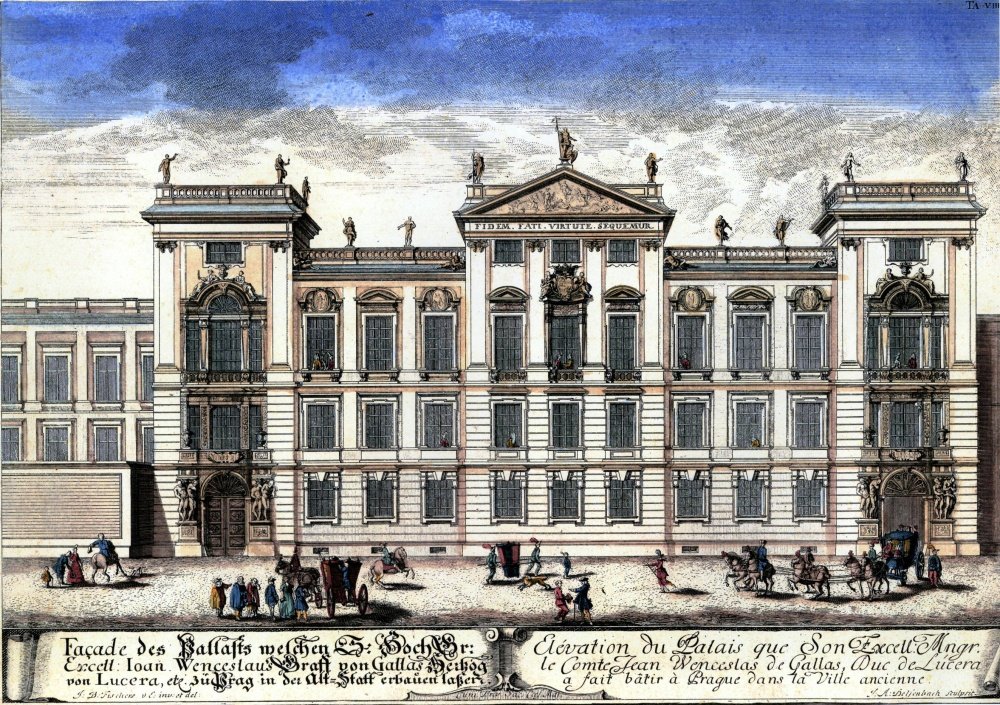
The most significant transformation occurred in the early 18th century when Johann Wenzel Gallas, seeking a residence befitting his rank, commissioned Johann Bernhard Fischer von Erlach—one of Central Europe’s preeminent architects—to design a grand Baroque palace (Prague Now). The palace’s construction, completed in the 1720s and 1730s, resulted in a four-winged complex centered on a monumental courtyard.
Enlightenment Cultural Hub
Under the Clam-Gallas family, the palace became a center for aristocratic gatherings, musical performances, and intellectual salons. Notably, Ludwig van Beethoven performed here, and tradition suggests that Wolfgang Amadeus Mozart and Josepha Duschek were also guests (Prague Guide). The palace’s private theatre and ballrooms were renowned throughout Prague’s high society.
19th–21st Centuries: Adaptation and Restoration
Throughout the 19th century, the palace underwent stylistic updates—introducing Classicist, Biedermeier, and Second Rococo elements—and expanded with a corner garden after the demolition of nearby medieval buildings (Muzeum Prahy). Later, the palace was repurposed for various governmental and archival functions. Extensive restorations between 1978–1994 and 2017–2022 revitalized the palace, culminating in its reopening to the public and recognition as the Building of the Year 2022 (Prague Visitor Pass).
Architectural Highlights
Clam-Gallas Palace epitomizes the high Baroque style:
- Grand Staircase Designed by Carlo Innocenzo Carloni and adorned with stucco and mythological frescoes, it creates a dramatic entrance.
- Sculptural Program Matthias Bernhard Braun’s statues—most notably Hercules at the entrance—symbolize strength and heroism.
- Ceremonial Halls The Marble Hall, China Room, Golden and Turquoise Rooms, and Winter Garden reflect opulent tastes and shifting styles.
- Private Theatre One of the few surviving examples of aristocratic entertainment spaces in the region.
- Neptune Fountain and Terezka Statue Enrich the palace’s courtyards and gardens with allegorical and historic themes.
The palace’s symmetrical four-wing layout around a central courtyard was innovative for its time, balancing grandeur, privacy, and the flow of ceremonial processions (View from Prague).
Visiting Information
- Address Husova 158/20, Prague 1, Old Town
- Opening Hours Tuesday–Sunday, 10:00 AM–6:00 PM; closed Mondays and public holidays
- Tickets
- Adults: 250–350 CZK (depending on exhibition/event)
- Students/Seniors: Discounted rates
- Children under 6: Free
- Family and group tickets available
- Purchase Options On-site and online via the official website
Note: Ticket prices may vary during special exhibitions or events. Always check the official website for current information.
Tours and Cultural Events
- Guided Tours Available in English and Czech, lasting 60–90 minutes. Advance booking is recommended, especially during peak seasons.
- Self-Guided Tours Supported by multilingual audio guides and informative panels.
- Special Events The palace regularly hosts concerts, art exhibitions, and major public festivals such as the Bohemian Carnival (Masopust) and international days like Japanese Day (Eventland, Prague.org).
Nearby Attractions and Travel Tips
- Location Benefits The palace is within walking distance of major landmarks like Old Town Square, Charles Bridge, and the Jewish Quarter.
- Dining The area is filled with traditional Czech and international restaurants.
- Transport Reachable by metro (Staroměstská, Můstek stations) and tram.
- Practical Tips
- Wear comfortable shoes for cobblestone streets.
- Book tickets in advance for popular tours and events.
- Visit early or late in the day for a quieter experience.
Accessibility and Facilities
- Wheelchair Access Main exhibition areas are wheelchair accessible; some historic sections may be challenging.
- Facilities Modern restrooms, cloakroom, and gift shop available.
- Photography Non-flash photography is permitted in most areas (some exhibitions may have restrictions).
- Family Friendly Children are welcome with adult supervision.
FAQs
Q: What are the Clam-Gallas Palace opening hours?
A: Tuesday–Sunday, 10:00 AM–6:00 PM; closed Mondays and public holidays.
Q: How much are tickets?
A: Standard tickets range from 250–350 CZK, with discounts for students, seniors, and children.
Q: Are guided tours available?
A: Yes, in English and Czech. Book in advance for guaranteed spots.
Q: Is the palace wheelchair accessible?
A: Major areas are accessible; contact the palace for specific needs.
Q: Can I take photos inside?
A: Yes, non-flash photography is allowed.
Q: Are there special events?
A: Yes, including concerts, exhibitions, and festivals like Masopust and Japanese Day.