Type 2+ letters to search all countries, cities, and places
/Ctrl KEsc
travel_explore
Type 2+ letters to search all countries, cities, and places
Press Enter to open the top result
Luar Batang Mosque
Jakarta·Indonesia·6° S · 106° E·Updated Apr 2026
A saint’s tomb draws steady pilgrims to this 18th-century mosque in Jakarta’s old port quarter, where prayer, sea air, and kampung life still meet every day.
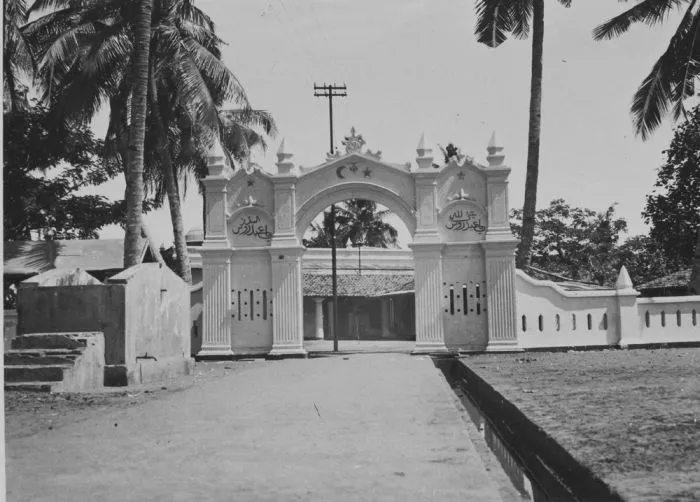
Photo: G.F.J. (Georg Friedrich Johannes) Bley (Fotograaf/photographer). · CC BY-SA 3.0
A harbor tax barrier and a saint's tomb should not produce the same place name, yet that is exactly the riddle of Moschea Di Luar Batang in Giacarta, Indonesia. Come here for more than prayer: this mosque holds a revered grave, a living pilgrimage tradition, and one of Jakarta's sharpest collisions between port history, colonial control, and miracle lore. The air smells of sea salt and incense, and the story under your feet is older than modern Indonesia by roughly two centuries.
Most scholars date the mosque's origins to around 1739, when Habib Husein bin Abubakar Alaydrus, a Hadhrami preacher with a fast-growing following, became inseparable from this waterfront quarter. Records and community tradition agree on the broad outline even when the finer points blur: a small prayer space grew beside his tomb into one of North Jakarta's most visited religious sites.
What makes this place worth your time is the tension it never hides. The neighborhood name "Luar Batang" seems to come from a VOC-era customs barrier at Sunda Kelapa harbor, yet legend holds that it refers to a coffin that would not keep Habib Husein's body inside. Commerce named the ground first. Faith claimed it later.
Stand still for a minute and the mosque starts confessing. Pilgrims move toward the tomb, the 24 pillars mark the hours of a full day, and the rebuilt minarets rise 57 meters, about as tall as a 19-story apartment block. This is not polished heritage behind glass. It is a place still argued over, still prayed in, still alive.
Researched by the Audiala editorial team from historical records, architectural archives, and local expertise.
What to see
The prayer hall and its 12 wooden pillars
The surprise inside Masjid Luar Batang is how intimate it feels. Founded around 1739, the hall is held up by 12 original wooden pillars, spaced like a small forest of trunks, and the light slips between them in narrow bands while low voices recite Quran over the hum of fans and distant motorcycles from Kampung Luar Batang.
Look for the old door inscription that records 20 Muharram 1152 AH, commonly read as 29 April 1739. Most people walk past it. And that is the point: this mosque does not show off its age, it lets you notice it for yourself.
The tomb of Habib Husein
The emotional center of the complex is the tomb of Habib Husein bin Abubakar Alaydrus, who died on 24 June 1756 and is still addressed here as if he has merely stepped into the next room. Pilgrims arrive from across Indonesia to pray, make vows, and press close to the shrine; the air carries rose water, incense, and that faint salt-and-diesel smell drifting in from Sunda Kelapa harbor a few minutes away.
According to tradition, prayers made here are answered. Believe that or don't. What matters is the atmosphere it creates: gratitude, pleading, tears, hands resting on the cloth cover, and a sense that this is less a monument than a live wire in Jakarta's religious life.
Walk in from Sunda Kelapa through Kampung Luar Batang
Come on foot from the old harbor instead of arriving by car and missing the whole story. The route from Sunda Kelapa into Jl. Luar Batang V is short, but it carries you through one of Jakarta's oldest coastal neighborhoods, with fishing boats, warung smoke, cracked walls, children cutting through the lanes, and then suddenly the white mosque rising from the middle of it all like a remembered promise.
This is the right order. You smell the sea first, then hear the call to prayer, then understand why the mosque matters: it was never separate from the port, the kampung, or the people who built a sacred place beside trade, mud, weather, and empire.
Plan your visit
Getting There
Transjakarta is the cleanest move: take route 12B and get off at Halte Masjid Luar Batang, a stop named for the mosque itself. From Kota Tua, the mosque sits about 1.5 km north, roughly a 20-minute walk or 5-10 minutes by Gojek or Grab; by car, use Jl. Luar Batang V, but the lanes are tight as a market aisle and parking is patchy.
Opening Hours
As of 2026, independent visitors usually come between 08:00 and 17:00, though the mosque functions around daily prayer times from Fajr to Isya. Avoid Friday around 11:30-13:00 and expect heavier traffic during Ramadan evenings, when the compound fills with worshippers and pilgrims.
Time Needed
Give it 20-30 minutes if you're coming for a quick look and a respectful pause in the courtyard. Stay 45-90 minutes if you want the full rhythm of the place: prayer hall, shrine atmosphere, and the old port kampung around it; pair it with Kota Tua or Sunda Kelapa and you have a half-day.
Accessibility
Access is limited. The approach runs through narrow kampung lanes with uneven surfaces, and the mosque entrance has steps with no confirmed ramp, so wheelchair users will likely need assistance for the last stretch.
Cost & Tickets
As of 2026, entry is free; this is an active mosque, not a ticketed monument. No booking is needed, and the only money question on site is whether you want to leave a donation in the kotak amal.
Photo Gallery
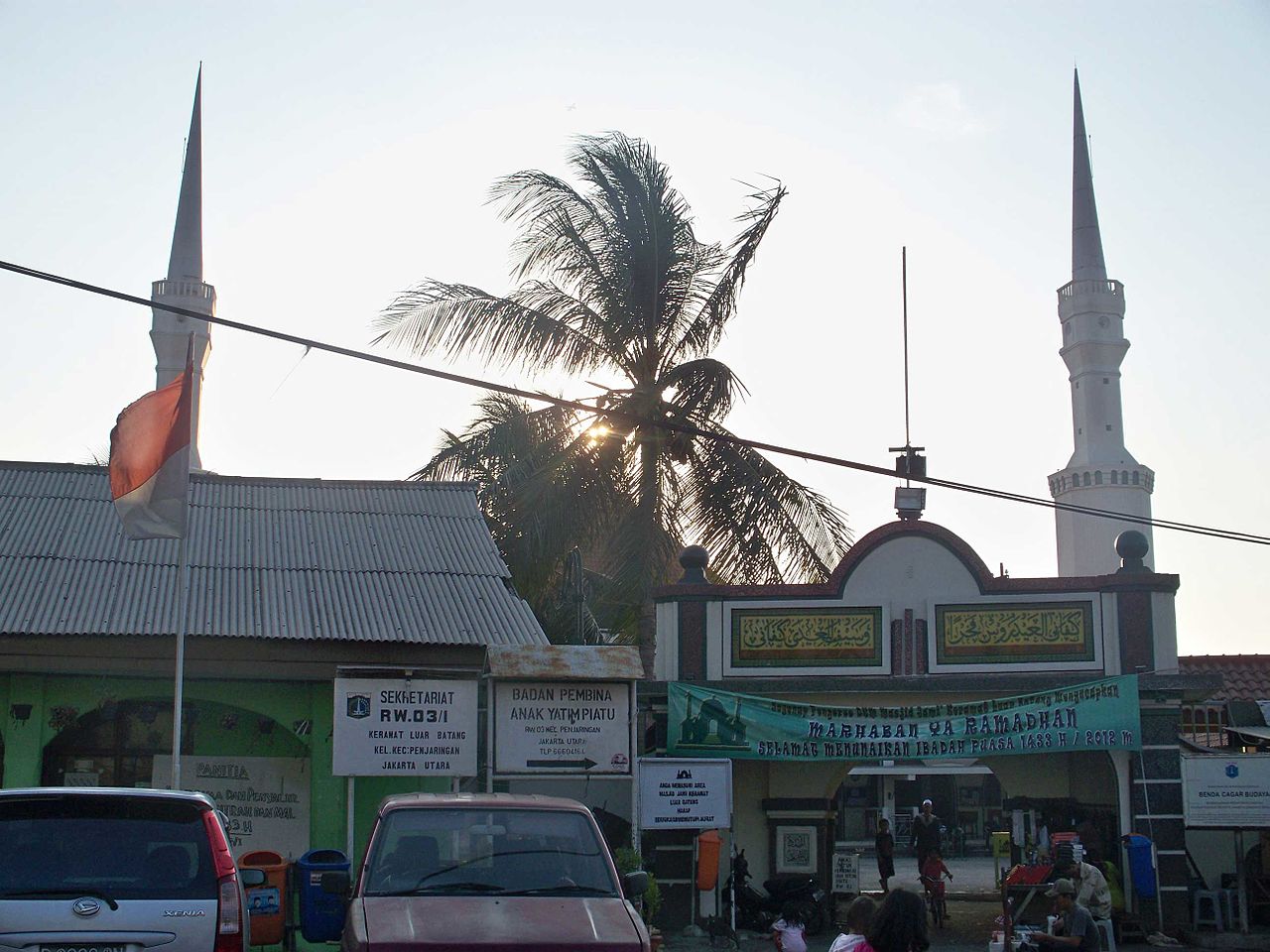
A view of Moschea Di Luar Batang, Giacarta, Indonesia. · Akhmad FauziA vintage view of the historic Moschea Di Luar Batang in Jakarta, Indonesia, showcasing its traditional arched entrance and surrounding palm trees. · G.F.J. (Georg Friedrich Johannes) Bley (Fotograaf/photographer).The Moschea Di Luar Batang in Jakarta, Indonesia, stands under a golden sunset with its iconic twin minarets and traditional entrance gate. · Akhmad FauziA young boy walks through the iconic arched entrance of the historic Moschea Di Luar Batang in Jakarta, Indonesia, framed by the bustling street life beyond. · Muhammad Ishomil
History
The Preacher The Port Could Not Contain
Masjid Luar Batang is really the story of one man and the city that could not quite absorb him. Habib Husein bin Abubakar Alaydrus arrived in Batavia, now Giacarta, in the 1730s, a young Hadhrami sayyid preaching in a port run by the VOC, a trading company with soldiers, prisons, and a deep suspicion of anyone who could gather a crowd.
Documented sources agree that he died on 24 June 1756, and local devotion turned his burial place into the heart of the mosque complex. The harder question is why his memory endured so fiercely. Part of the answer lies in piety. Part lies in politics.
The turning point
Habib Husein and the Cell That Failed
For Habib Husein, the stakes were personal and immediate. He preached to ordinary residents of colonial Batavia, including people with little protection under VOC rule, and a religious teacher who drew loyalty outside official power could look dangerous very quickly.
According to tradition, VOC authorities arrested him and his family and held them in Glodok. Then came the turning point that made his reputation impossible to contain: local accounts describe prison officers finding him asleep in his locked cell while worshippers elsewhere saw him leading prayers at the same hour. Miracle story, political allegory, or both, the message was the same. The state could jail the man, but not the authority people believed he carried.
After his release, his standing only deepened. When he died in 1756, devotion did not end with burial; it fixed itself to this site, until mosque, shrine, and neighborhood became one shared memory.
Early Life and Vision
Sources place Habib Husein's arrival in Batavia around 1736, likely when he was still a young man. He came from the Ba'Alawi scholarly world of Hadhramaut, where lineage carried spiritual force, but lineage alone did not build Luar Batang. What mattered here was reach: he preached in a waterfront district of sailors, laborers, and traders, where the smell of fish, mud, and ship tar would have mixed with recited prayer.
Legacy and Influence
Most scholars date the mosque's foundation to the mid-18th century, often around 1739, though the exact day rests on a later inscription placed on a door in 1916. His legacy spread far beyond one building. Pilgrims still come to the tomb, the mosque remains protected as national cultural heritage, and even the shape of the site keeps changing, from qibla corrections in 1827 to the replacement of older minarets in 2008.
Tips for visitors
Dress Properly
Shoulders and knees need to be covered, women should bring a headscarf, and men should skip shorts. Shoes come off before entering the prayer area, so wear something easy to slip on and off.
Shoot Carefully
Exterior and courtyard photos are usually fine if you're discreet, but skip flash and don't point your camera at people in prayer without asking. Treat the tomb area like a sacred room, not a backdrop.
Watch Your Bag
Crowds are the real hassle here, especially on Thursday nights, Fridays, and religious holidays. Keep your phone and bag on you rather than handing them to someone in the group; mosque staff have warned about mix-ups in the crush.
Pick Your Hour
Morning is calmer, cooler, and easier for seeing the mosque as a lived place rather than a bottleneck. Ramadan evenings and Friday midday have their own charge, but you'll be sharing the lanes with a flood of pilgrims.
Eat Nearby
Skip the idea of a polished cafe stop right outside. For the neighborhood's real flavor, head to Muara Baru Modern Fish Market for budget-to-mid seafood, try Sunda Kelapa Seafood Restaurant for a sit-down meal, or save Cafe Batavia in Kota Tua for after, when you want air-conditioning and colonial theatrics.
Pair The Visit
Luar Batang makes more sense when you see its neighbors: Kota Tua, Museum Bahari, Sunda Kelapa, and Pasar Ikan sit close by like chapters of the same port-city story. The museum holds the old warehouses; this mosque holds the community that never left.
Where to Eat
local_dining
Don't Leave Without Trying
Soto Madura — beef broth soup with rice and fresh herbs, the soul of Madurese cookingAyam Penyet — smashed fried chicken with fiery sambal, a Madura classicBebek Pedes — spicy fried duck, Madurese style with layers of chili heatLele Goreng — fried catfish with sambal, crispy outside and tender withinGado-Gado — peanut sauce vegetable salad, found at street stalls throughout the areaSate Ayam — chicken satay with peanut sauce, a street vendor stapleRendang — slow-braised spiced beef, rich and deeply flavoredMie Godog — boiled noodle soup, comforting and simple
KLCR Coffee
cafe
Cafe€€star5.0(67)
Order: The coffee here is the real deal — locals keep coming back for the quality brews and the late-night vibe that keeps this place buzzing until midnight.
KLCR is where the neighborhood actually hangs out, not a tourist spot. With 67 reviews and a perfect 5-star rating, this is the kind of authentic Jakarta cafe where you'll see regulars nursing espressos at 11 PM.
Order: Ask locals what they're drinking — this is a neighborhood gem where the menu is secondary to the atmosphere and the people-watching from the street-side seating.
A genuine local cafe with a perfect 5-star rating, Hotang Gedong is the kind of place that serves the kampung community from morning until evening, no frills, just honest coffee and conversation.
Order: Ibu Atun's snacks and light bites — this is a warung where homemade matters more than menu variety. Come for the jajanan (Indonesian snacks) that locals know by heart.
Run by Ibu Atun herself, this warung is the real pulse of Luar Batang — a 5-star rated neighborhood spot where you're eating what the locals eat for their afternoon break.
Order: Whatever you need at 3 AM — this is the only 24-hour option on the strip, so grab coffee, snacks, or a quick meal whenever hunger strikes.
Open around the clock with a perfect 5-star rating, KBGG is the safety net for night owls and early risers in Luar Batang, proving that good food doesn't sleep.
checkThe entire Luar Batang kampung area is predominantly Muslim; virtually all food is halal by default.
checkBudget dining here is exceptional — a full meal at a local warung costs under IDR 50,000 (roughly $3 USD).
checkCafes in this neighborhood are social hubs for locals, not tourist destinations; expect authentic Jakarta life, not Instagram backdrops.
checkAll five verified restaurants listed are within walking distance of Moschea Di Luar Batang, concentrated on Jalan Luar Batang and its side streets.
Food districts:Jalan Luar Batang — the main artery where all five cafes cluster, heart of the local eating sceneKampung Luar Batang — the urban village immediately surrounding the mosque, where neighborhood warungs and street vendors operatePenjaringan district — North Jakarta's working-class neighborhood with authentic local food culture, no tourist polish
Restaurant data powered by Google
Frequently asked
Is Moschea Di Luar Batang worth visiting?
Yes, if you want a place with real devotional weight rather than a polished heritage stop. This mosque in Penjaringan is tied to the tomb of Habib Husein bin Abubakar Alaydrus, so the draw is living pilgrimage culture, old-port history, and the smell of sea air and incense in the same breath. Go expecting prayer, vows, and neighborhood life, not a museum display.
How long do you need at Moschea Di Luar Batang?
Most visitors need 45 to 90 minutes. Give it 20 to 30 minutes if you're only seeing the prayer hall and tomb area, but stay longer if you want to absorb the kampung approach, the 12 wooden pillars, and the harbor edge around Sunda Kelapa. Paired with Kota Tua and Museum Bahari, it easily becomes a half-day.
How do I get to Moschea Di Luar Batang from Jakarta?
The easiest route is usually Transjakarta Route 12B to Halte Masjid Luar Batang, whose name tells you you're close. From Kota Tua, the mosque sits about 1.5 kilometers north, roughly the length of 15 football fields, so an ojek takes about 5 to 10 minutes and walking takes around 20 minutes through tight Penjaringan lanes. From Jakarta Kota Station, combine a short ride with bus or ojek because no MRT or KRL stop sits nearby.
What is the best time to visit Moschea Di Luar Batang?
Weekday mornings are the best time if you want space to think and look closely. Thursday nights, Fridays, Ramadan evenings, and major pilgrimage dates bring bigger crowds, more chanting, and a different mood entirely. Avoid arriving right at prayer times if you're not there to worship, especially Friday midday.
Can you visit Moschea Di Luar Batang for free?
Yes, entry is free. It's an active mosque, not a ticketed monument, though a donation box is usually available and worth using if you've come to look, listen, and borrow the quiet. Dress modestly, remove your shoes, and treat the tomb area like a sacred room, because that's what it is.
What should I not miss at Moschea Di Luar Batang?
Don't miss the tomb of Habib Husein, the 12 wooden pillars in the prayer hall, and the old door inscription that records the mosque's remembered 1739 completion date. Ask caretakers about the preserved original sections, because renovation has changed much of the complex and those older fragments matter. The approach through Kampung Luar Batang matters too; the mosque makes more sense once you've walked in with the harbor smell still on your clothes.
Sources & attribution51
Researched and written by the Audiala editorial team from historical records, architectural archives, and local expertise. Last updated April 2026.
COLLECTIE TROPENMUSEUM Moskee Luar Batang (Batavia) TMnr 60046455 — G.F.J. (Georg Friedrich Johannes) Bley (Fotograaf/photographer). — CC BY-SA 3.0 (https://creativecommons.org/licenses/by-sa/3.0/) — Source: https://commons.wikimedia.org/wiki/File:COLLECTIE_TROPENMUSEUM_Moskee_Luar_Batang_(Batavia)_TMnr_60046455.jpg
Masjid Luar Batang - panoramio — Akhmad Fauzi — CC BY 3.0 (https://creativecommons.org/licenses/by/3.0/) — Source: https://commons.wikimedia.org/wiki/File:Masjid_Luar_Batang_-_panoramio.jpg
Mesjid luar batang — Muhammad Ishomil — CC BY-SA 4.0 (https://creativecommons.org/licenses/by-sa/4.0/) — Source: https://commons.wikimedia.org/wiki/File:Mesjid_luar_batang.jpg
Strictly necessary cookies keep the site working. Analytics (PostHog, Google Analytics) measures how each visitor uses our pages. Marketing loads YouTube videos and walking-route maps without a tap and lets Google Analytics set advertising cookies. We never sell your data. You can change this any time from the footer.
Privacy
Cookie preferences
Pick what you're okay with. You can change this any time from the footer.
Strictly necessary
Always on
Sign-in, language, navigation. Always on.
Product analytics
PostHog (EU) and Google Analytics record which pages you view and how you use them, under a random identifier stored in your browser. Helps us see which pages work and which need fixing. Google's ad personalisation stays off. No selling.
Marketing
Loads YouTube videos and the walking-route maps (OpenFreeMap) without a tap; without it, they load only when you tap them. If analytics is also on, Google Analytics may set advertising cookies. Ad personalisation stays off.