Introduction
A 19th-century painter's mansion now receives ambulance sirens, IV drips, and the hard fluorescent light of modern medicine. Cikini Hospital in Jakarta, Indonesia, is worth visiting because few buildings show the city's layers so plainly: aristocratic estate, colonial charity hospital, wartime seizure, and still, after all that, a place where people come hoping to leave healed. Stand on Jl. Raden Saleh Raya and the old facade still gives itself away. This is no ordinary hospital block.
Documented records tie the site to Raden Saleh Sjarif Boestaman, the celebrated painter whose Cikini residence rose in 1852, when much of this district still felt semi-rural. The house later entered a medical story that began elsewhere, in a modest clinic at Gang Pool, before moving here in June 1897 and becoming a hospital on 12 January 1898.
That continuity is what makes the place matter. Patients, nurses, families waiting under fans, the sharp smell of disinfectant cutting through Jakarta heat: the function has stayed almost stubbornly the same even as the name changed from Queen Emma's hospital to RS Tjikini, then PGI Cikini, and now Primaya Hospital PGI Cikini.
The surrounding neighborhood gives the visit extra depth. A walk here links the hospital to Cikini's wider memory, from Raden Saleh's vanished estate to the cultural district around Taman Ismail Marzuki, while the grander state story of Jakarta waits farther west at Merdeka Palace.
What to See
Raden Saleh’s Former Mansion Facade
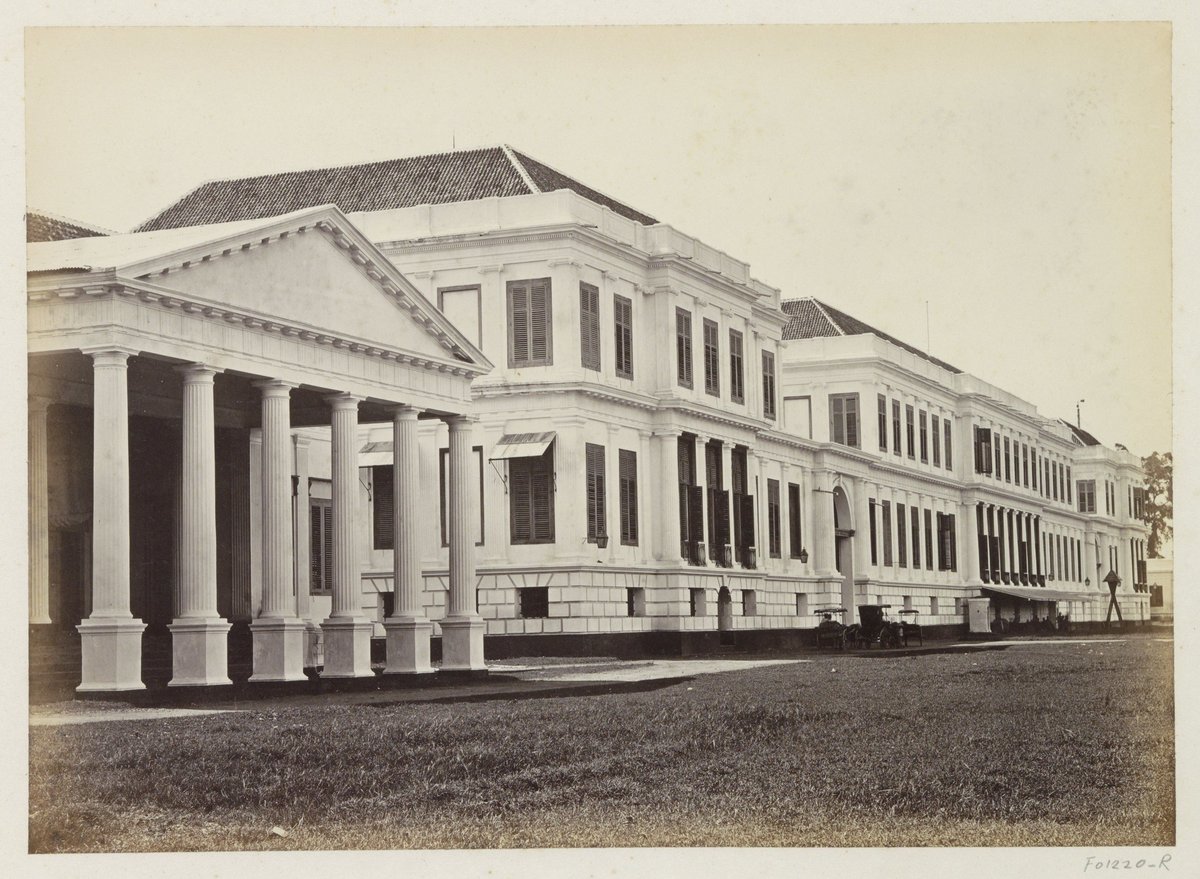
The surprise at Cikini Hospital is that one of Jakarta’s oldest working hospitals began as a private house in 1852, built for the painter Raden Saleh on Jl. Raden Saleh Raya. Stand outside and you can still read the old ambition in the neo-Gothic proportions: tall arched windows, a formal symmetry, and a scale that feels less like a clinic than a colonial-era statement piece, the kind of residence meant to impress before a word was spoken.
Look slowly. The old shell and the later hospital additions don’t quite hide their seams, and that mismatch is half the pleasure here; cornice lines shift, window rhythms change, and the building quietly confesses how Jakarta keeps reusing itself instead of starting over.
The Chapel and the Quiet Interior Light
If the chapel is open, go in without expectations and let the light do the work. Visitor accounts describe a soft, filtered glow inside, and that makes sense in a complex like this: outside you get traffic, motorbikes, heat off the road; inside, the air seems to drop a degree and every footstep sounds more deliberate.
This is the part many people miss because they treat the site as a historical footnote. They shouldn’t. A hospital chapel tells you more about the place than any plaque could, because it holds the building’s oldest habit: caring for bodies, yes, but also making room for fear, waiting, relief, and the long silence between them.
Walk the Estate Edges Toward Cikini’s Historic Core
The smartest way to see Cikini Hospital is on foot, using it as one chapter in a wider Central Jakarta walk rather than a standalone stop. Start at the hospital grounds, pay attention to the mature trees that still hint at the old estate, then continue into Jakarta with Cikini’s historical layers in mind, or fold the visit into a longer city day that begins or ends at Gambir Railway Station, about 3 kilometers away, roughly the length of 35 football pitches laid end to end.
Why this route works is simple: the hospital makes the neighborhood legible. After you’ve seen a 19th-century mansion turned medical institution still operating in the middle of modern Jakarta, nearby government buildings, stations, and old streets stop feeling separate; they start reading like one long argument about power, care, memory, and who gets to leave a mark on the city.
Photo Gallery
Explore Cikini Hospital in Pictures

A historical view of the colonial-era Cikini Hospital building in Jakarta, Indonesia, surrounded by lush palm trees.
Unknown authorUnknown author · cc by-sa 3.0

The historic Cikini Hospital building in Jakarta, Indonesia, captured in a vintage photograph showcasing its distinctive colonial-era architectural style.
Charls & Van Es & Co. NV (Fotostudio). niet bekend / unknown (Fotograaf/photographer). · cc by-sa 3.0

The serene, tree-lined grounds of Cikini Hospital in Jakarta, Indonesia, showcase historic colonial architecture amidst a peaceful garden setting.
Cun Cun · cc by-sa 4.0

The historic chapel building at Cikini Hospital in Jakarta, Indonesia, showcases classic Gothic architectural elements.
Cun Cun · cc by-sa 4.0

The historic Cikini Hospital in Jakarta, Indonesia, is known for its distinctive Gothic-revival architectural style and grand entrance.
Cun Cun · cc by-sa 4.0

A view of the historic Cikini Hospital in Jakarta, Indonesia, showcasing its traditional colonial architecture set against a backdrop of modern urban development.
Cun Cun · cc by-sa 4.0

The serene, tree-lined grounds of Cikini Hospital in Jakarta offer a peaceful green space contrasted against the city's modern architecture.
Cun Cun · cc by-sa 4.0
From the gate on Jalan Raden Saleh Raya, look beyond the newer medical blocks for the older mansion massing and the unusually large shade trees. Those trees are remnants of the estate landscape, and they make the site feel older than the traffic around it.
Visitor Logistics
Getting There
RS PGI Cikini stands at Jl. Raden Saleh Raya No.40 in Central Jakarta, a 4-minute walk from Taman Ismail Marzuki and about 90 to 272 meters from nearby bus stops, which is shorter than a football pitch. As of 2026, Moovit lists buses 5M, JAK.10A, JAK.10B, 6H and trains on the Bogor and Lingkar Cikarang lines nearby; from Blok M, one sample route takes about 62 minutes by bus and transfer. By car or taxi, use the name "RS Cikini" or "Primaya PGI Cikini" rather than the full historic title.
Opening Hours
As of 2026, this is a working hospital open 24 hours a day for medical services, with posted patient visiting hours of 11:00-13:00 WIB and 17:00-19:00 WIB. No seasonal closure calendar appears on the official hospital pages, but visitor access can tighten around clinical needs, holidays, or ward rules.
Time Needed
Give it 30 to 60 minutes if you're visiting a patient or stopping for a respectful exterior look. Set aside 2 to 3 hours if you want to pair the hospital's facade and grounds with a walk through Cikini's heritage streets and nearby arts venues.
Accessibility
Official hospital pages do not publish a detailed accessibility map, so confirm step-free routes and elevator access at reception before you arrive. The approach is easier than it used to be: Cikini Station added platform lifts in early 2026, and the walk from the closest stops is only 2 to 7 minutes, roughly the length of one city block to three.
Cost & Entry
As of 2026, no public admission fee or heritage ticket is listed because this is not a museum but an operating private hospital. If you're coming for care rather than a quick exterior look, appointments and registration run through the hospital's channels, including WhatsApp at 0822 8888 9702 and the contact center at 1500 007.
Tips for Visitors
Hospital Etiquette
Treat the site as a hospital first and a historic building second. Dress modestly, keep your voice low, and don't wander into wards or side corridors just because an old staircase looks tempting.
Photos Carefully
Exterior shots are usually fine if you're quick and discreet, but interior clinical areas are off-limits unless staff say otherwise. Skip flash, tripods, and any photo that includes patients or medical staff who have not agreed.
Eat Nearby
For coffee within a few minutes, Arah Kopi at Jl. Raden Saleh No.39 is the easy pick, while Kopikina at No.66 works if you want a longer sit-down break; both fall in the mid-range cafe bracket. If you want something more local and less polished, walk toward Jalan Cikini Raya for nasi goreng, mie ayam, and soto betawi rather than settling for whatever is closest to the gate.
Use App Taxis
Cikini and Menteng are low-risk by Jakarta standards, but transport is where small annoyances begin. Use Gojek or Grab instead of negotiating with informal drivers, and expect minor parking-attendant requests in the Rp 2,000-5,000 range if you arrive by car.
Best Time
Come early in the day for the calmest exterior visit and softer light on the old mansion walls, before Jakarta's heat turns the pavement into a griddle. Midday works for official visiting hours, but the air is heavier and the traffic noise rises with it.
Pair It Well
This stop makes the most sense as part of a Cikini walk, especially with Taman Ismail Marzuki a few minutes away and Menteng's older streets close by. The hospital's story lands harder when you see it in context: Raden Saleh's former estate did not vanish, it changed jobs.
Where to Eat
Don't Leave Without Trying
NASI GORENG GILA CIMANDIRI MAS IGOY
local favoriteOrder: The signature nasi goreng gila (crazy fried rice) — loaded with protein and a perfect late-night fuel stop with a cult following among locals.
This is where Cikini's night owls go. Open until 2 AM and perfecting one dish obsessively, it's the kind of no-frills spot that gets 5 stars because it does one thing brilliantly.
Ayam Bakar Bbq & Ayam Geprek Memble
local favoriteOrder: The ayam bakar (chargrilled chicken) and ayam geprek memble — smoky, tender grilled bird paired with the crispy, flattened fried version for two textures in one meal.
A straightforward neighborhood spot that nails the fundamentals: quality chicken, proper technique, and honest pricing. The kind of place locals eat at regularly without fanfare.
Kopi Ketemu Raden Saleh
cafeOrder: Indonesian coffee — this is a coffee-focused spot where the brew is the star. Pair it with a light snack for an afternoon break.
A dedicated coffee cafe in a neighborhood not oversaturated with them. Afternoon-to-evening hours make it perfect for a post-work coffee ritual or a quiet study spot.
Nasi Mie Goreng & Capcay "Pondok Reagan"
quick biteOrder: Nasi goreng and mie goreng with capcay (stir-fried mixed vegetables) — simple, reliable Indonesian comfort food done well.
A humble warung-style spot on Raden Saleh that represents authentic Jakarta eating: no pretense, good flavors, prices that won't hurt your wallet.
Dining Tips
- check Cash is still king in neighborhood warungs and cafes — many don't accept cards.
- check Late-night eating is part of Jakarta culture; several spots stay open past midnight.
- check Sambal (chili paste) is served on the side — adjust heat to your taste.
- check Portion sizes are generous; don't order too much if eating alone.
Restaurant data powered by Google
Historical Context
A House That Never Stopped Receiving the Sick
Cikini Hospital's real subject is continuity. Documented records show that before this address became a hospital, a Christian care association founded on 15 March 1895 was already treating patients without regard to social status, first in a smaller clinic at Gang Pool and then, from 1898, in Raden Saleh's former house on Jl. Raden Saleh Raya.
Everything around that mission changed. Owners changed, regimes changed, the city thickened into traffic and concrete, and nearby Jakarta kept rewriting itself all the way to the station halls of Gambir Railway Station. But the basic ritual endured: people arrived hurt, frightened, feverish, or in labor, and this site answered with care.
Raden Saleh's House Becomes Queen Emma's Hospital
Raden Saleh had built this place as a statement of rank and taste, not mercy. For him, the house was personal theater: a European-inflected villa in Cikini, set within an estate large enough to shape the district's future, proof that an Indigenous Javanese aristocrat and painter could claim social ground usually reserved for colonial power.
Then came the turn. Documented records show that in June 1897 the residence was purchased for a hospital project backed by Dominee Cornelis de Graaf, Adriana J. de Graaf-Kooman, and a donation from Queen Emma of the Netherlands; on 12 January 1898, the building was upgraded into a hospital. What changed in that moment was the building's purpose and, in a way, Saleh's afterlife: his private house stopped being a symbol of one man's prestige and became a place where strangers arrived in pain, a harder and more durable kind of monument.
What Changed
Names and authorities kept shifting. Documented records show wartime occupation by the Japanese Navy between 1942 and 1945, postwar management through RAPWI and then private hands, transfer to Indonesian church leadership in 1957, renaming to Yayasan Kesehatan PGI Cikini in 1989, and partnership with Primaya from 2021. The old estate outside the hospital walls changed just as sharply, with Raden Saleh's grounds broken apart into later urban institutions and Cikini becoming part of modern central Jakarta.
What Endured
Care outlasted every rebranding. Contemporary accounts and institutional records agree on the through-line: treatment first for ordinary patients in the 1895 clinic, then in this building from 1898 onward, through occupation, independence, church stewardship, and corporate-era modernization. Even the sounds tell the same story across time, just with different machinery behind them: footsteps in corridors, anxious voices, metal trolleys, doors opening for people who need help right now.
Listen to the full story in the app
Your Personal Curator, in Your Pocket.
Audio guides for 1,100+ cities across 96 countries. History, stories, and local insight — offline ready.
Audiala App
Available on iOS & Android
Join 50k+ Curators
Frequently Asked
Is Cikini Hospital worth visiting? add
Yes, but as a heritage stop rather than a destination you spend half a day inside. The real draw is that this working hospital on Jalan Raden Saleh began as Raden Saleh's 1852 mansion, then became a hospital on 12 January 1898. Go for the facade, the old trees, and the strange pleasure of finding a piece of 19th-century Batavia still doing useful work.
How long do you need at Cikini Hospital? add
Most visitors need 30 to 60 minutes if they're only seeing the exterior and getting a feel for the grounds. Give it 2 to 3 hours if you fold it into a Cikini walk with nearby Taman Ismail Marzuki and the wider Menteng area. Longer than that only makes sense if you're visiting a patient or have arranged access for a specific reason.
How do I get to Cikini Hospital from Jakarta? add
The easiest route is by commuter rail or bus into Central Jakarta, then a short walk. Officially the address is Jl. Raden Saleh Raya No.40, Cikini, Central Jakarta, and Moovit lists stops like Jalan Cikini VIII about 90 meters away, roughly the length of a football field. If you're starting elsewhere in Jakarta, a Gojek or Grab drop-off is usually less hassle than driving yourself.
What is the best time to visit Cikini Hospital? add
Morning or late afternoon works best for the exterior. The light is softer, the trees throw better shade, and the old masonry reads more clearly than it does under Jakarta's flat midday glare. If you're visiting someone, stick to the published visiting windows of 11:00 to 13:00 WIB and 17:00 to 19:00 WIB.
Can you visit Cikini Hospital for free? add
Yes for the exterior, but this is an active hospital, not a ticketed heritage site. No public entrance fee is listed on the official Primaya PGI Cikini pages, though that is absence of a fee notice rather than a formal visitor policy. Expect security to care more about privacy and patient flow than about sightseeing.
What should I not miss at Cikini Hospital? add
Don't miss the old mansion facade and the points where the historic shell meets later clinical blocks. That seam tells the whole story: an artist's estate from 1852, a Christian hospital from 1898, and a modern medical complex pressed into the same footprint. If the chapel is accessible, the filtered light inside is the detail people remember.
Sources
-
verified
Primaya Hospital PGI Cikini (English)
Official hospital page used for current identity, address, visiting hours, contact numbers, and operational status.
-
verified
Primaya Hospital PGI Cikini (Indonesian)
Official Indonesian-language hospital page confirming visiting hours, address, and current services.
-
verified
Wikidata Q23926489
Reference record used for site identity, coordinates, and official website linkage.
-
verified
Wikipedia - Cikini Hospital
Secondary overview used for the long historical timeline, ownership changes, and Raden Saleh mansion background.
-
verified
ANTARA News - Taking a walk down history lane in Cikini
Used for neighborhood heritage context and the hospital's place within walking tours of Cikini.
-
verified
CNN Indonesia - Sejarah RS PGI Cikini
Used for hospital history, older local naming, and the 12 January 1898 hospital date.
-
verified
Kompas Travel - Sejarah Singkat Rumah Raden Saleh di Cikini
Used for Raden Saleh estate history, mansion chronology, and the broader Cikini site story.
-
verified
The Jakarta Post - National history comes alive: A walking tour through Cikini
Used for cultural-walk context and how the hospital fits into local heritage itineraries.
-
verified
Goalkes - RS PGI Cikini listing
Directory-style source used for hospital identity and reference confirmation.
-
verified
UNESCO World Heritage Centre - Jakarta Old Town tentative list
Context source for broader Jakarta heritage framing.
-
verified
NOW Jakarta - The Charm of Cikini
Used for neighborhood character, architectural clues, and the coexistence of old and new in Cikini.
-
verified
Wikipedia - Cikini, Menteng
Used for neighborhood history and the wider Cikini estate and zoo context.
-
verified
Liputan6 - 5 Rumah Sakit Tertua di Indonesia
Used to cross-check late-19th and mid-20th century hospital chronology.
-
verified
Jatim Network - Rumah Sakit di Cikini ini bekas rumah Raden Saleh
Secondary summary used for renaming chronology references.
-
verified
Okezone Travel - Rumah Sakit PGI Cikini ternyata dulunya istana pelukis Raden Saleh
Used to support wartime use and mansion-to-hospital transition details.
-
verified
Universitas Terbuka nomor.net reference page
Used as a secondary chain for management transitions and later institutional naming.
-
verified
Kompas Megapolitan - Ruangan Patologi RS PGI Cikini Terbakar
Used for the 4 September 2018 fire and evacuation details.
-
verified
ANTARA - Fire at RS PGI Cikini
Used to cross-check the 2018 fire, timing, and lack of casualties.
-
verified
Detik Properti - Rumah Raden Saleh di Cikini bakal dipugar ke desain asli
Used for planned restoration status, contractor delays, and missing original design evidence.
-
verified
Kompas Nasional - Rumah Raden Saleh Dikonservasi
Used for earlier conservation efforts and restoration timeline context.
-
verified
Wikipedia - Raden Saleh
Used for background on the artist whose mansion became the hospital.
-
verified
Primaya web mirror - PGI Cikini
Used to confirm current visiting hours and service information.
-
verified
Primaya Press Release - Pembangunan Gedung Baru
Used for current development, parking claims, and family-facing amenities.
-
verified
Moovit - Rumah Sakit PGI Cikini page
Used for nearby bus stops, walking times, and rail connections.
-
verified
Moovit - Blok M to Rumah Sakit PGI Cikini
Used for example public transit routing from another part of Jakarta.
-
verified
ANTARA Foto - Platform lift at Cikini Station
Used for 2026 accessibility improvements at nearby Cikini Station.
-
verified
Detik News - Lift tangga di Stasiun Cikini
Used to confirm accessibility upgrades for disabled and elderly rail users.
-
verified
Qraved - Arah Kopi Cikini
Used for nearby cafe reference on Jalan Raden Saleh.
-
verified
Wahana Honda - Kopikina Cikini
Used for nearby food and drink context in the hospital area.
-
verified
MLDSPOT - Kopikina Cikini
Used to support nearby cafe options around Cikini.
-
verified
Cybo - Upnormal Coffee Roasters Raden Saleh
Directory source used for nearby amenity references.
-
verified
Audiala - Cikini Hospital
Secondary travel-style reference used for experiential and visitor-facing framing.
-
verified
Universitas Brawijaya Student Journal PDF
Used for heritage and architectural analysis of the former Raden Saleh residence.
-
verified
Instagram - Cikini Hospital Chapel post
Used for the few direct sensory clues about chapel light and interior atmosphere.
-
verified
Wikipedia Indonesia - Rumah Sakit Primaya PGI Cikini
Used for local naming, cultural identity, and Indonesian-language historical framing.
-
verified
Warta Kota / Tribunnews - Sejarah Jakarta Rumah Sakit Cikini
Used for local cultural memory, architecture, and neighborhood sentiment.
-
verified
IKJ Repository - Peran Taman Ismail Marzuki
Used for the cultural role of nearby Taman Ismail Marzuki in the Cikini area.
Last reviewed: