
Early Development and Railway Heritage
Hayes & Harlington Railway Station was established in 1868, marking a significant phase in the expansion of the Great Western Main Line. The line itself, engineered by Isambard Kingdom Brunel and opened in 1838, was instrumental in linking London with the Thames Valley, Bristol, South Wales, and the West Country. The station became a key local gateway, welcoming suburban commuters and supporting the rapid growth of West London (Wiki-Gateway).
Notably, Hayes station played a brief role in London's suburban rail boom, being served by District Railway trains between Mansion House and Windsor from 1883 to 1885. Though this service ceased quickly, Hayes’ importance as a commuter hub only increased with London's westward expansion. The subsequent electrification of the lines with 25kV a.c. overhead power further modernized the station and the surrounding network.
Integration with London’s Transport Network
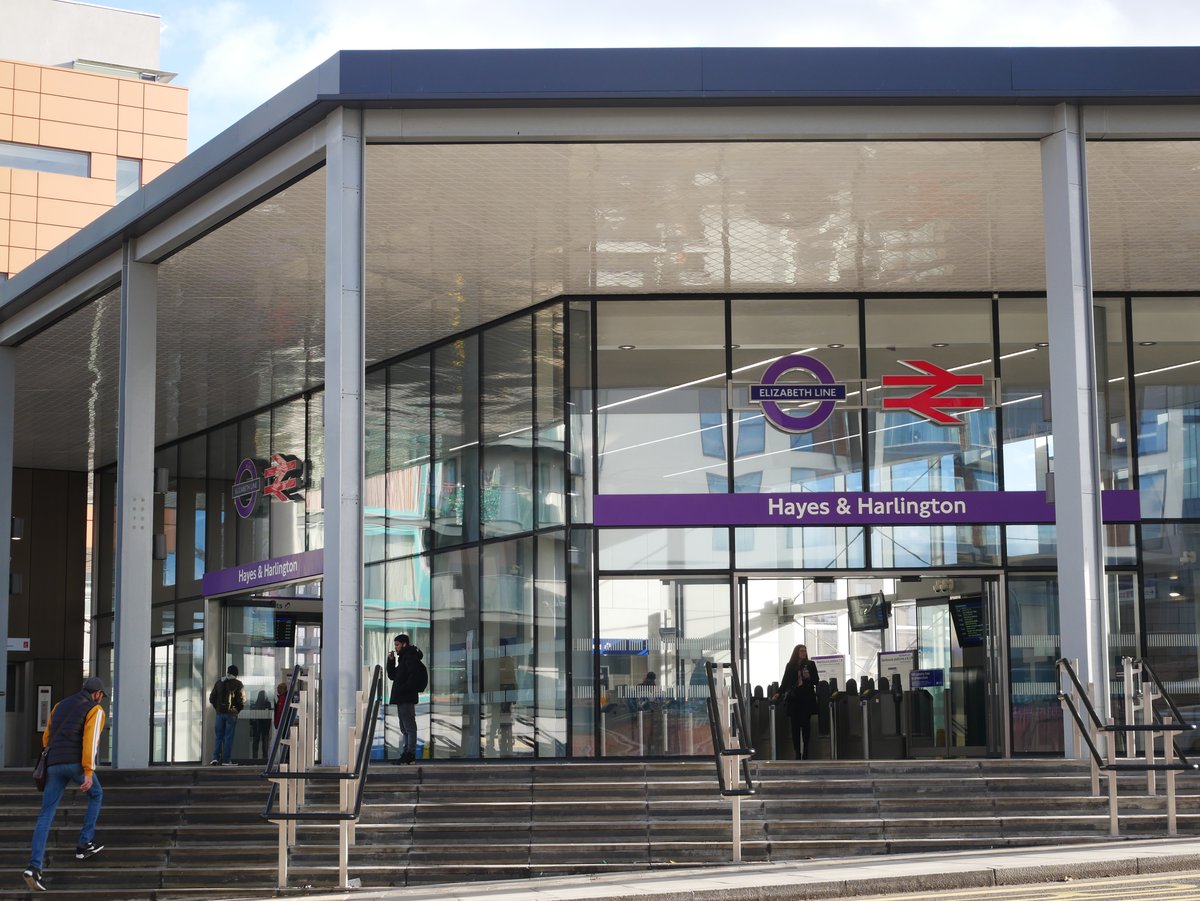
The rise of Heathrow Airport and the Elizabeth line (Crossrail) cemented Hayes & Harlington as a key interchange, facilitating direct connections to the airport, central London, Docklands, and beyond. The Elizabeth line’s opening brought significant upgrades: a new glass-and-steel entrance, expanded ticket hall, wide gatelines supporting contactless payments, and improved passenger information systems (TfL; Railway-News).
Visiting Hours & Ticket Information
Visiting Hours
- Open daily, typically from early morning until late evening, matching train service schedules.
- For precise times, consult the TfL or National Rail websites.
Ticketing Options
- Ticket Office Located at the main entrance, open during staffed hours.
- Ticket Machines Available at all times; accept Oyster cards, contactless payments, and smartcards.
- Contactless and Oyster Fully supported for both local and Elizabeth line services.
- Penalty Fares Ensure you purchase your ticket or tap in before boarding.
Ticket prices depend on destination and time of travel; real-time fares are available on official websites or at the station.
Station Layout & Facilities
General Arrangement
- Five platforms (including four through and one bay platform), all accessible via a modern footbridge.
- Ticket hall Spacious, with real-time information screens, wide gatelines, and help points.
- Waiting areas Platform 3 features a waiting room; other platforms offer seating and shelters.
- Toilets Standard and accessible toilets (RADAR key operated) on platforms 4 & 5.
- Customer Help Points Located throughout for real-time assistance.
- Cycle storage Available (not covered by CCTV).
- WiFi Not available; mobile data recommended.
- Shops & refreshment facilities Limited; plan ahead if you need refreshments.
For a detailed map and station arrangement, refer to Railway-News or National Rail.
Accessibility Features
Hayes & Harlington station is fully step-free, with lifts and ramps connecting the street to all platforms. Other accessibility features include:
- Accessible toilets (RADAR key required)
- Lowered ticket counters
- Induction loops at counters and help points
- Portable boarding ramps
- Passenger Assist (pre-booked or turn-up-and-go)
- Blue Badge parking bays
Find comprehensive accessibility details at National Rail Access Aid.
Limitations:
- No on-site accessible taxi rank or public telephone
- No designated drop-off point for mobility-impaired users
Parking & Connections
- Car Park On-site, including Blue Badge spaces (AccessAble).
- Bus Services Multiple TfL routes (90, 140, 195, 350, E6, H98, U4, U5, 696, 698), with direct buses to Heathrow Airport.
- Taxi Rank Not available.
- Cycle Storage Provided but not monitored by CCTV.
Nearby Attractions
Hayes & Harlington station provides a convenient base for exploring:
- St Mary’s Parish Church Grade II* listed site
- Barra Hall Historic manor house and community venue
- Minet Country Park Green space for nature walks
- Local shopping and dining Diverse options within walking distance
The Elizabeth line and local buses offer swift connections to central London museums, parks, and entertainment districts.
Travel Tips
- Travel off-peak Mid-morning or early afternoon for a quieter experience
- Use contactless payment/Oyster For seamless travel
- Bring a RADAR key if you require accessible toilets
- Check train times and connections for onward journeys, especially to Heathrow
Frequently Asked Questions (FAQs)
Q: What are the opening hours of Hayes & Harlington Station?
A: Open daily from early morning to late evening. Check TfL or National Rail for precise times.
Q: Can I buy tickets at the station?
A: Yes, at the ticket office (during staffed hours) or at ticket machines.
Q: Is the station wheelchair accessible?
A: Yes; step-free throughout, with lifts and accessible toilets.
Q: Is parking available?
A: Yes, including Blue Badge spaces.
Q: How do I get to Heathrow Airport?
A: Take TfL bus 350 from Bus Stop L outside the station for a direct route.
Summary and Final Recommendations
Hayes & Harlington Railway Station exemplifies the fusion of historic legacy and modern convenience. As both a commuter hub and a gateway to cultural, historical, and travel experiences, the station offers:
- Fully accessible, step-free facilities
- Contactless ticketing and Oyster compatibility
- Convenient links to Heathrow Airport and central London
- Proximity to local attractions and green spaces
Stay informed by consulting official transport websites (National Rail; South Western Railway; TfL), and use travel apps like Audiala for real-time updates. Whether you’re a regular commuter or a first-time visitor, Hayes & Harlington offers a reliable, accessible, and culturally rich travel experience.