Bull Ring
BirminghamUnited Kingdom 52° N · 1° W Updated Aug 2026
A medieval market charter from 1166 still echoes through Birmingham’s Bull Ring, where St Martin’s church meets a disc-clad icon of modern retail today.
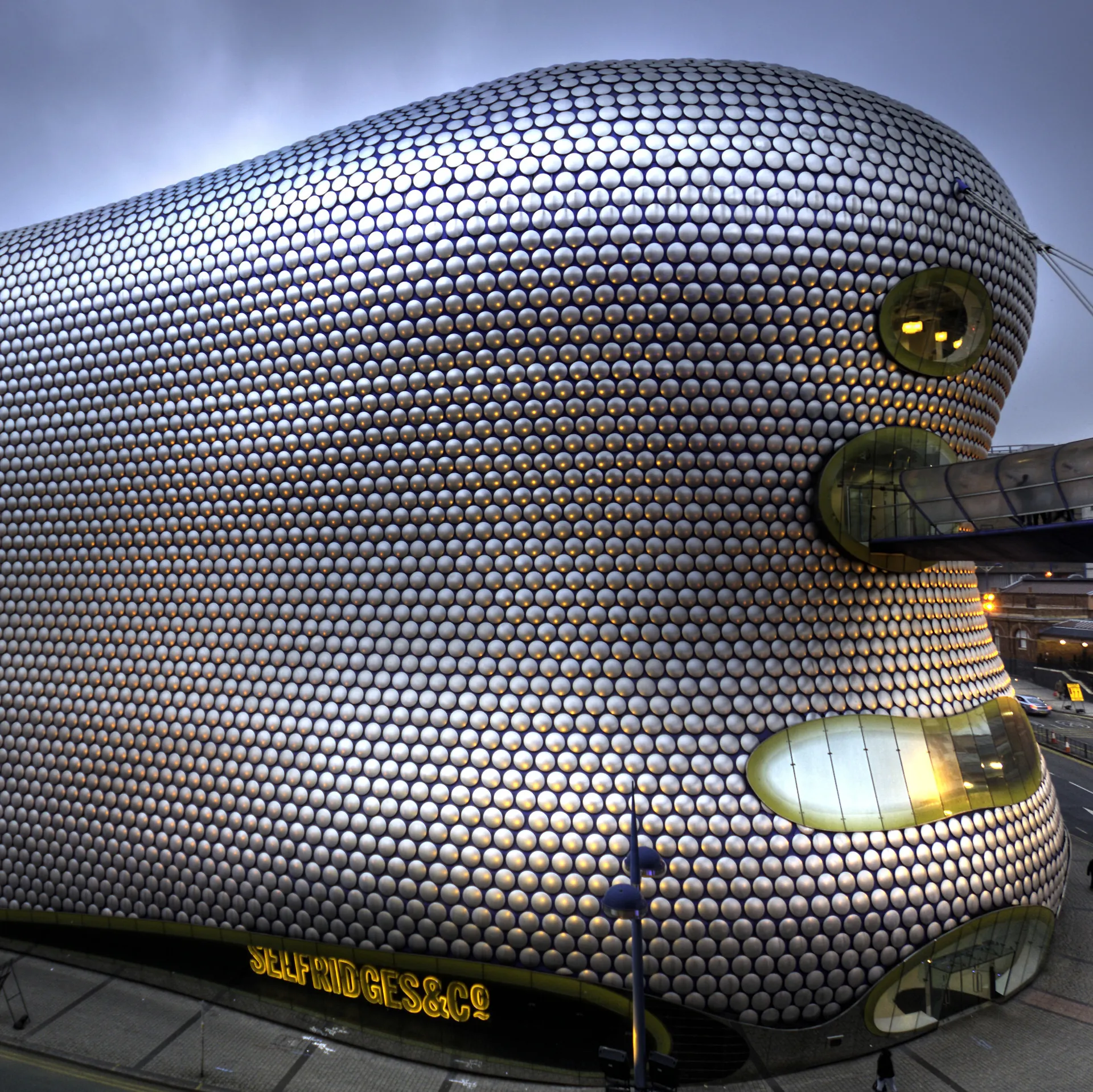 Photo: Bs0u10e0 · CC BY-SA 4.0
- Entry
- Free entry
Fifteen thousand spun-aluminium discs give Selfridges at Birmingham's Bull Ring a silver skin, while a documented market charter, a recorded riot, and a church with medieval roots occupy the same few acres. Visit Bull Ring in Birmingham, United Kingdom, to see the city's commercial memory pressed against its loudest modern experiment: St Martin's spire, Nelson's bronze, and a retail centre that looks faintly extraterrestrial. Come for the shopping; stay for the deliciously awkward question of what a marketplace remembers.
Records show that in 1166 Henry II granted Peter FitzWilliam de Bermingham a weekly Thursday market at his manor. That charter turned a local meeting point into a commercial habit, and the Bull Ring still performs the same basic trick: bringing strangers together to exchange money, goods, news, and opinions.
What visitors see now is a layered argument rather than a preserved medieval square. Architectural histories confirm that J. A. Chatwin rebuilt most of St Martin-in-the-Bull Ring between 1873 and 1875, while the 1809 Nelson statue quietly claims to be Britain's first public monument to the admiral.
Look closely at the names underfoot. Local histories connect The Shambles and Spiceal Street with the old butcher stalls and traders in cloth, spices, and apothecary goods. The merchandise has changed; the instinct to gather here has not.
What to see
-
Selfridges Birmingham
The surprise is that a department store can look like it has landed from orbit: completed in 2003 by Future Systems, Jan Kaplický and Amanda Levete’s four-storey Selfridges wears roughly 15,000 spun aluminium discs over a cobalt-blue, curving shell. Walk close and the discs break your reflection into hundreds of tiny, fish-eye silhouettes; from St Martin’s steps, the building shifts from silver to gunmetal as the sky changes, turning shopping into an accidental lesson in light, steel and Paco Rabanne-inspired fashion. Look up once more—the building’s soft, cornerless bulk makes Birmingham’s old Gothic spire seem suddenly more precise. -
St Martin-in-the-Bullring
Behind the traffic, buskers and escalator hum, St Martin-in-the-Bullring offers an abrupt change of temperature and sound: heavy doors close, footsteps soften, and amber and blue light settles beneath the timber roof. J. A. Chatwin rebuilt the church in 1873–1875 on 12th-century foundations, preserving its medieval spire, while the interior holds de Bermingham alabaster effigies and a jewel-coloured Burne-Jones window made by Morris & Co. Give the worn red sandstone and the enormous Gothic door hinges a close look; they make the surrounding retail complex feel less like a break with history than its latest, rather noisy layer. -
From medieval market to modern Bull Ring
Start halfway down St Martin’s terraced steps, where the church spire and Selfridges’ shimmering discs share one improbable frame, then find Laurence Broderick’s 2.2-metre bronze bull, The Guardian, near the mall entrance. The sculpture weighs 6.5 tonnes—about as much as a large African elephant—and its horns, snout and shoulder shine gold where generations of visitors have rubbed the bronze smooth. Continue through the glass-roofed gallerias toward Grand Central, listening as plaza bells, bus brakes and polished-stone echoes replace one another; the route traces Birmingham’s commercial story from Henry II’s 1166 market charter through the 1964 shopping centre to the bold reinvention of 2003.
Plan your visit
- Getting There
- Birmingham New Street station sits directly beneath Grand Central: take the lifts or escalators to the concourse, then follow the enclosed LinkStreet into Bullring without going outdoors. Birmingham Moor Street is opposite the Selfridges side, under a 2-minute walk; from Victoria Square, follow pedestrianised New Street east for 5–7 minutes, or walk from Digbeth and the Custard Factory along High Street Deritend in 5–8 minutes. Drivers can use Bullring, Moor Street or Edgbaston Street car parks, open daily 08:00–00:00, but the site lies inside Birmingham’s Clean Air Zone.
- Opening Hours
- As of 2026, Bullring opens Monday–Friday 10:00–20:00, Saturday 09:00–20:00 and Sunday 11:00–17:00; Grand Central opens Monday–Saturday 09:00–20:00 and Sunday 11:00–17:00. Individual shops, restaurants and Selfridges may keep different hours, while many retailers close on Easter Sunday and Christmas Day; bank-holiday times vary, so check the official centre listing before setting out.
- Time Needed
- Allow 45–60 minutes for the architectural highlights: Future Systems’ silver-disc Selfridges façade, Laurence Broderick’s 2.2-metre bronze Bull and St Martin’s churchyard. Shopping with a light meal takes 2–3 hours; adding the Bull Ring markets, St Martin’s Square and Digbeth makes a satisfying 4–6-hour half-day, with market smells and buskers replacing the mall’s polished hush.
- Step-Free Access
- All seven main Bullring entrances have automatic doors and step-free access, with public lifts near M&S, Costa Coffee on Level 0, Selfridges East Mall and the Whittard/Grand Central corner. Free ShopMobility wheelchairs and powered scooters are available from Bullring Centre Car Park Level -1, but bring two forms of ID; the centre also has two Changing Places rooms and indoor audio routing through the Waymap app.
- Cost And Tickets
- Entry to Bullring, Grand Central, St Martin’s Square and the public concourses is free, with no general ticket or advance booking. As of 2026, car parking starts at £4 for 0–1 hour, £6.50 for 1–2 hours and £11.50 for 3–4 hours, with full-day tariffs reaching £20 or more; shops, restaurants and temporary attractions charge separately.
Photo Gallery


History
The Market That Refused to Disappear
The Bull Ring's oldest story is not architectural. Records show a commercial ritual beginning with Peter de Bermingham's 1166 charter: a regular market in the centre of Birmingham, where trade made the town visible to the wider region. The stalls have vanished, but the function remains legible in the crowds, the shopfronts, and the steady percussion of footsteps.
Continuity here does not mean that the same building survived untouched. St Martin's was largely rebuilt, the livestock market moved to Smithfield in 1817 according to local historical accounts, and the 1964 shopping centre eventually gave way to Bullring in 2003. What endured was the public habit of using this ground for commerce, ceremony, argument, and spectacle.
The turning point
When the Market Became a Parliament
According to the UK Parliament's account, thousands gathered around Nelson's statue in July 1839 as the National Chartist Convention brought working-class demands into the open air. William Lovett and John Collins helped turn the monument's base into a reading room without walls, where political news and speeches travelled through the crowd. For Lovett and Collins, the stakes were personal: public leadership brought the real risk of arrest and the loss of their liberty.
The turning point came on 4 July, when sixty Metropolitan Police officers brought from London charged into a gathering that local authorities had declared unlawful. Accounts describe the crowd retaliating, iron churchyard railings becoming makeshift weapons, and troops restoring order near Moor Street. Ten days later, after Parliament rejected the Chartist petition, further violence sent fire and cavalry through the Bull Ring and High Street.
The episode makes the site's continuity unusually vivid. People were still gathering to exchange something in public; only the commodity had changed from meat and cloth to political possibility. A marketplace can sell goods, but it can also decide who gets heard.
What Changed
What Endured
Tips for visitors
Dress For St Martin’s
The mall has no formal dress code beyond shirts and footwear, but St Martin in the Bull Ring asks for modest, respectful clothing. Keep voices low during prayer or worship, and visit the church Tuesday–Friday 12:00–17:00 or Saturday–Sunday 12:00–16:00.Shoot The Bull
Handheld photos of the Bull statue, Selfridges and public architecture are allowed, and the church welcomes casual photography when services are not disrupted. Drones are banned across the estate, while tripods, flash equipment and commercial filming need written permission from Hammerson.Guard Your Phone
Take extra care along the Bullring–St Martin’s Square–New Street Station corridor, especially when escalators and train crowds compress everyone together. Keep bags closed, decline persistent petition collectors or pseudo-monks, and avoid buying unverified electronics or designer perfumes from street hawkers.Eat Beyond The Chains
For a budget meal, try Mount Fuji by the Moor Street entrance or Franco Manca on Stephenson Street; Bill’s Bullring is a mid-range choice overlooking St Martin’s church. Dishoom at Chamberlain Square is about a 10-minute walk for a pricier Bombay-Irani meal, while Sabai Sabai Central suits a mid-range Thai dinner near Southside.Go Early, Then Wander
Arrive around Grand Central’s 09:00 opening on Saturday for quieter escalators and cleaner reflections on Selfridges’ mirrored discs; Sunday mornings are gentler still, though Bullring itself opens at 11:00. Pair the visit with the Bull Ring Indoor and Open Markets, then continue downhill into Digbeth and the Custard Factory before evening crowds gather.Skip The Car
New Street station delivers you underneath the centre, and Moor Street is less than two minutes from Selfridges, making rail cheaper and less troublesome than parking for a short visit. If driving, compare the three centre car parks with the Clean Air Zone charge before departure; free entry is the easy saving.
Frequently asked
Is Bull Ring worth visiting?
Yes—especially if you like architecture, urban history, or shopping with a spectacular building attached. Future Systems’ Selfridges is wrapped in 15,000 aluminium discs, while St Martin-in-the-Bull Ring offers a hushed Gothic counterpoint just across the terraces. Look for the 1809 Nelson statue too: it predates Nelson’s Column in Trafalgar Square by more than 30 years.
How long do you need at Bull Ring?
Allow 45–60 minutes for the main architectural highlights, 2–3 hours for shopping and a meal, or 4–6 hours for the markets and Digbeth as well. A quick circuit takes in Selfridges, Laurence Broderick’s 2.2-metre bronze Bull, St Martin’s Church, and the central gallerias. The half-day version feels less like a mall visit and more like a walk through Birmingham’s trading history.
How do I get to Bull Ring from London?
Take a train from London to Birmingham New Street, whose concourse connects directly to Grand Central and the Bullring through the indoor LinkStreet walkway. From the station, follow signs for Grand Central; Birmingham Moor Street is another nearby arrival point, directly opposite the Selfridges side. You can reach the centre without stepping outside, which is a small mercy in West Midlands rain.
What is the best time to visit Bull Ring?
Visit on a weekday morning for the calmest walkways and clearest views of the architecture, ideally in daylight when the Selfridges discs shift from silver to gunmetal. Bullring generally opens at 10:00 on weekdays, while Grand Central opens from 9:00; Saturdays are busier and Sundays have shorter hours. Winter brings festive installations, while August Bank Holiday weekend brings free outdoor performances during Birmingham Weekender.
Can you visit Bull Ring for free?
Yes, entry to Bullring, Grand Central, St Martin’s Square, and the public concourses is free. You only pay for shopping, food, special events, or parking, with the centre’s car parks charging by duration. St Martin-in-the-Bull Ring also welcomes visitors during its published visiting hours, provided church activities are treated respectfully.
What should I not miss at Bull Ring?
Don’t miss Selfridges’ 15,000-disc façade, the polished horns and snout of the 6.5-tonne bronze Bull, and the red-sandstone interior of St Martin-in-the-Bull Ring. Inside the church, look for medieval de Bermingham effigies and stained glass associated with Edward Burne-Jones and William Morris & Co.; outside, find Sir Richard Westmacott’s 1809 Nelson monument. Stand halfway down St Martin’s steps for the best collision of Gothic spire and cobalt-silver blob architecture.
Sources & attribution 82
- Historic England — Birmingham Smithfield Market objection — Information on the 1166 market charter, the historic market site, and the relationship between Smithfield and the Bull Ring.
- The Guardian — Recent reporting on Birmingham’s indoor market, its traders, and the continuing importance of the historic market district.
- The Iron Room — Birmingham Archives — Historical notes on Birmingham’s market charters, fairs, market buildings, and the evolution of the Bull Ring.
- Bill Dargue’s History of Birmingham — Medieval Birmingham — Background on medieval Birmingham, the de Bermingham family, and the early market charter.
- Tour of Lost Birmingham — Why is the Bull Ring called the Bull Ring? — Account of the Bull Ring name, bull-baiting customs, the former iron ring, and later market clearance.
- Historic England — The Bull Ring listing — Listed-building information on St Martin-in-the-Bull Ring, historic remains, and the medieval setting.
- Bill Dargue’s History of Birmingham — The Bull Ring — Detailed local history covering the Bull Ring’s name, charters, market zones, figures, and changing buildings.
- The Battlefields Trust — Battle of Birmingham — Historical account of Prince Rupert’s 1643 assault on Birmingham and the town’s role in the Civil War.
- Wikipedia — Battle of Camp Hill — Overview of the 1643 Battle of Camp Hill and the Royalist attack through Birmingham.
- Wikipedia — Statue of Lord Nelson, Birmingham — Details on Birmingham’s 1809 Nelson statue, its sculptor, unveiling, and historical importance.
- Victorian Web — Richard Westmacott’s Nelson statue — Art-historical information on Sir Richard Westmacott’s bronze monument and its allegorical details.
- UK Parliament — The Bull Ring Riots — Parliamentary history of the 1839 Chartist gatherings, police intervention, and riots around the Bull Ring.
- University of Birmingham Thesis — Academic research on Birmingham’s Chartist movement and the 1839 Bull Ring disturbances.
- Victorian Web — St Martin-in-the-Bull Ring — Architectural history of J. A. Chatwin’s 1873–1875 rebuilding of St Martin’s Church.
- Looking at Buildings — St Martin in the Bull Ring — Building-focused guide to St Martin’s architecture, history, and Gothic Revival reconstruction.
- The Second World War Experience Centre — Birmingham under fire — Historical account of the Birmingham Blitz and wartime damage to the city centre.
- Historic England — Birmingham industrial city Blitz stories — Information on Birmingham’s wartime bombing, industrial importance, and surviving historic fabric.
- BBC News — Birmingham’s Bull Ring history — History of the 1960s Brutalist Bull Ring Centre and architect James A. Roberts.
- Wikipedia — Bull Ring, Birmingham — General chronology and architectural overview of the Bull Ring’s 1960s and 2003 developments.
- Walk Midlands — Birmingham Camp Hill — Local historical walking account covering Robert Porter, Camp Hill, and Birmingham’s Civil War history.
- Chartist Collins Archives — Detailed narrative of the 1839 Bull Ring Riots, Chartist leaders, crowds, police, and military response.
- Visit Birmingham — Bullring & Grand Central — Visitor information on the connected retail centres, free public access, and operating details.
- Bullring & Grand Central — Opening hours — Official opening hours for Bullring and Grand Central, including regular weekly schedules.
- Bullring & Grand Central — Getting here — Official transport, parking, access, and car-park tariff information.
- Birmingham Mail — Spring bank holiday opening hours — Reporting on adjusted Bullring opening hours during the 2026 spring bank holiday.
- West Midlands Railway — Trains to Bullring — Directions from Birmingham New Street and rail travel information for reaching the Bullring.
- CrossCountry — Birmingham New Street to Bullring — Information on the distance and indoor connection between Birmingham New Street and the Bullring.
- Bullring & Grand Central — Accessibility — Official details on step-free entrances, lifts, ShopMobility, Changing Places facilities, Waymap, and the wellbeing hub.
- AccessAble — Bullring and Grand Central toilet facilities — Accessible guide to toilets, baby-changing facilities, and Changing Places provision.
- Stasher — Birmingham city-centre luggage storage — Information on left-luggage storage near Birmingham New Street and the Bullring.
- Bounce — Birmingham New Street luggage storage — App-based luggage-storage locations near Birmingham New Street Station.
- Radical Storage — Bullring luggage storage — Nearby luggage-storage options around the Bullring.
- Bullring & Grand Central — Terms and conditions — Official estate rules covering photography, commercial filming, drones, conduct, and visitor behaviour.
- Bullring & Grand Central — Privacy policy — Official privacy and photography-related policy information for the shopping centre estate.
- Trip.com — Bull Ring comprehensive guides — Visitor descriptions of St Martin’s Square, public performances, plaza activity, and the surrounding atmosphere.
- Wikipedia — Selfridges Birmingham — Overview of the Selfridges building, Future Systems, its completion in 2003, and architectural awards.
- Amalgam Architects — Hammerson — Architectural information on Bullring and Grand Central’s gallerias, atriums, lighting, and circulation.
- ADI.tv — Bullring and Grand Central — Project information on the centre’s digital media, public-facing design, and architectural installation.
- Facebook — St Martin in the Bullring — Visitor and community material about St Martin’s interior, atmosphere, stained glass, and church history.
- RIBA Journal — Selfridges Birmingham — Architectural analysis of Future Systems’ Selfridges building, its aluminium discs, structure, materials, and awards.
- Birmingham Mail — Bullring Bull — Information on Laurence Broderick’s bronze Bull, its scale, public affection, and polished touchpoints.
- Instagram — Selfridges architectural view — Visual reference for the viewpoint framing St Martin’s spire against the Selfridges façade.
- Instagram — Bull statue — Visual reference for the Bull sculpture and its tactile, polished bronze surfaces.
- Facebook — St Martin’s structural details — Community visual material on St Martin’s timber doors and wrought-iron Gothic hinges.
- Facebook — What’s On Birmingham Christmas Bar — Information on seasonal Christmas installations and pop-up activity around the Bullring.
- TikTok — Birmingham Christmas Market — Reference for seasonal visitor activity linked to Birmingham’s Christmas market period.
- Instagram — Birmingham Weekender — Visual reference for Birmingham Weekender performances and public events.
- University of Birmingham — Exchange event post — Reference for public arts and heritage events connected with Birmingham’s city-centre programme.
- Tripadvisor — Positively Birmingham walking tour — Information on walking tours linking the Bullring with Digbeth, public art, and industrial history.
- Wild in Art — Snoopy sculpture trail — Reference for temporary public-art trails and QR-linked activities in Birmingham.
- Facebook — St Martin’s tour — Visitor-tour reference for St Martin’s architectural and historical interpretation.
- Historic England Archive — Birmingham Blitz image AA42/00723 — Historic photograph documenting Blitz damage to Birmingham and the Bull Ring market area.
- Historic England Archive — Bull Ring clearance image JLP01/08/063325 — Historic photograph showing clearance of the Market Hall remains for later redevelopment.
- Historic England Archive — Shopping centres built by Laing — Archive material on John Laing’s shopping-centre construction, including Birmingham’s 1960s Bull Ring.
- Atlas of Birmingham — Brummie people and slang — Information on Birmingham nicknames, Brummie expressions, and local cultural identity.
- TikTok — Birmingham slang reference — Supplementary reference for local Birmingham terminology and pronunciation.
- Reddit r/brum — Things to do in Birmingham — Local discussion reflecting how residents describe the Bullring and central Birmingham.
- Reddit r/brum — Merry Hill versus Bullring — Local opinions on shopping at the Bullring, Merry Hill, parking, crowds, and access.
- Reddit r/brum — Bullring and city-centre discussion — Local discussion of changing perceptions and conditions around the Bullring and Birmingham city centre.
- Birmingham Light Festival — FORGED — Official information on the FORGED public artwork and Birmingham Light Festival programming.
- Bullring & Grand Central — Birmingham Light Festival post — Reference for light-festival installations and seasonal activity at the Bullring.
- Bullring & Grand Central — Birmingham Weekender 2026 — Official event information for Birmingham Weekender performances and free outdoor arts programming.
- Birmingham City Council — St Martin-in-the-Bullring — Council listing for St Martin’s Church, including community activities and visitor information.
- Historic England — Uncovering Digbeth’s heritage — Historical and architectural background on Digbeth, its industrial buildings, and cultural setting near the Bullring.
- Reddit r/BirminghamUK — Birmingham evening safety — Local discussion of evening movement and perceived safety around Birmingham city centre.
- Get Licensed — Birmingham family-friendly safety guide — General safety advice for moving through Birmingham’s central areas.
- Yugo — Birmingham safety guide — Practical safety guidance for Birmingham residents and visitors.
- Birmingham City Council — Bull Ring Indoor Market — Official information on the Bull Ring Indoor Market and its market-trading role.
- Accor — Birmingham food markets — Guide to Birmingham’s food markets, market culture, and local culinary traditions.
- BBC News — Smithfield redevelopment — Reporting on proposed market demolition, housing plans, and the planning dispute around Smithfield.
- Architects’ Journal — Smithfield housing appeal — Planning and architectural reporting on the appeal approving redevelopment around Birmingham’s markets.
- Smithfield Birmingham — Updated designs — Developer information on the proposed Smithfield redevelopment and updated designs.
- Yahoo News UK — Birmingham pickpocketing report — Reporting on reported pickpocketing and theft risks around Birmingham New Street and nearby routes.
- Reddit r/BirminghamUK — Bullring market discussion — Local discussion of crowding, street activity, and visitor concerns around the Bullring markets.
- Photography Stack Exchange — Birmingham New Street photography — Discussion of photography restrictions at Birmingham New Street and related private-estate rules.
- St Martin in the Bull Ring — Visit us — Official church visitor hours, worship etiquette, photography guidance, and visiting information.
- Birmingham Heritage — St Martin’s — Heritage information on St Martin-in-the-Bull Ring, its history, architecture, and visitor access.
- TheFork — Restaurants near Bullring & Grand Central — Restaurant listings and price guidance for dining near the Bullring and Grand Central.
- Tripadvisor — Birmingham restaurants — Visitor-reviewed restaurant listings used for nearby dining recommendations.
- Bill’s Restaurants — Bullring — Official information on Bill’s Bullring restaurant and its location overlooking St Martin’s area.
- Condé Nast Traveller — Best restaurants in Birmingham — Editorial guide to Birmingham restaurants, including nearby dining recommendations.
- The Travelista — Birmingham foodie guide — Food-focused guide to Birmingham restaurants and the city’s dining culture.
Built from cited sources · see the method · How we make our guides →
More in Birmingham.
364 places to discover — a few worth pairing.
Pick up where you left off
Saved and recently read places — kept on this device only.
Photo credits (12)
- Verity Sanders — Unsplash License (https://unsplash.com/license) — Source: https://images.unsplash.com/photo-1599834562135-b6fc90e642ca
- Selfridges Building, Birmingham (2012) cropped — Bs0u10e0 — CC BY-SA 4.0 (https://creativecommons.org/licenses/by-sa/4.0/) — Source: https://commons.wikimedia.org/wiki/File:Selfridges_Building,_Birmingham_(2012)_cropped.jpg
- Birmingham City Centre 1968 03 England — Sempoerna — CC BY-SA 3.0 (https://creativecommons.org/licenses/by-sa/3.0/) — Source: https://commons.wikimedia.org/wiki/File:Birmingham_City_Centre_1968_03_England.jpg
- Anti Gaddafi demonstration in Birmingham (5477201445) — Lukas Large from Stourbridge, United Kingdom — CC BY-SA 2.0 (https://creativecommons.org/licenses/by-sa/2.0/) — Source: https://commons.wikimedia.org/wiki/File:Anti_Gaddafi_demonstration_in_Birmingham_(5477201445).jpg
- Bull Ring Birmingham (7690461598) — Tony Hisgett from Birmingham, UK — CC BY 2.0 (https://creativecommons.org/licenses/by/2.0/) — Source: https://commons.wikimedia.org/wiki/File:Bull_Ring_Birmingham_(7690461598).jpg
- Bull Ring Birmingham 14-08-83 (209002025) — Andrew Miller from Thornton-Cleveleys, United Kingdom — CC BY-SA 2.0 (https://creativecommons.org/licenses/by-sa/2.0/) — Source: https://commons.wikimedia.org/wiki/File:Bull_Ring_Birmingham_14-08-83_(209002025).jpg
- Bullring - Edgbaston Street, Birmingham - floral displays (9432819479) — Elliott Brown from Birmingham, United Kingdom — CC BY 2.0 (https://creativecommons.org/licenses/by/2.0/) — Source: https://commons.wikimedia.org/wiki/File:Bullring_-_Edgbaston_Street,_Birmingham_-_floral_displays_(9432819479).jpg
- Bull Ring Shopping Centre, Birmingham (2) (8568042717) — Daniel from Glasgow, United Kingdom — CC BY 2.0 (https://creativecommons.org/licenses/by/2.0/) — Source: https://commons.wikimedia.org/wiki/File:Bull_Ring_Shopping_Centre,_Birmingham_(2)_(8568042717).jpg
- Bull Ring Shopping Centre, Birmingham (1) (8568038617) — Daniel from Glasgow, United Kingdom — CC BY 2.0 (https://creativecommons.org/licenses/by/2.0/) — Source: https://commons.wikimedia.org/wiki/File:Bull_Ring_Shopping_Centre,_Birmingham_(1)_(8568038617).jpg
- Bullring - geograph.org.uk - 4697050 — N Chadwick — CC BY-SA 2.0 (https://creativecommons.org/licenses/by-sa/2.0/) — Source: https://commons.wikimedia.org/wiki/File:Bullring_-_geograph.org.uk_-_4697050.jpg
- Bullring - geograph.org.uk - 4697014 — N Chadwick — CC BY-SA 2.0 (https://creativecommons.org/licenses/by-sa/2.0/) — Source: https://commons.wikimedia.org/wiki/File:Bullring_-_geograph.org.uk_-_4697014.jpg
- Bullring - geograph.org.uk - 2723686 — N Chadwick — CC BY-SA 2.0 (https://creativecommons.org/licenses/by-sa/2.0/) — Source: https://commons.wikimedia.org/wiki/File:Bullring_-_geograph.org.uk_-_2723686.jpg
Photos may have been resized or cropped.