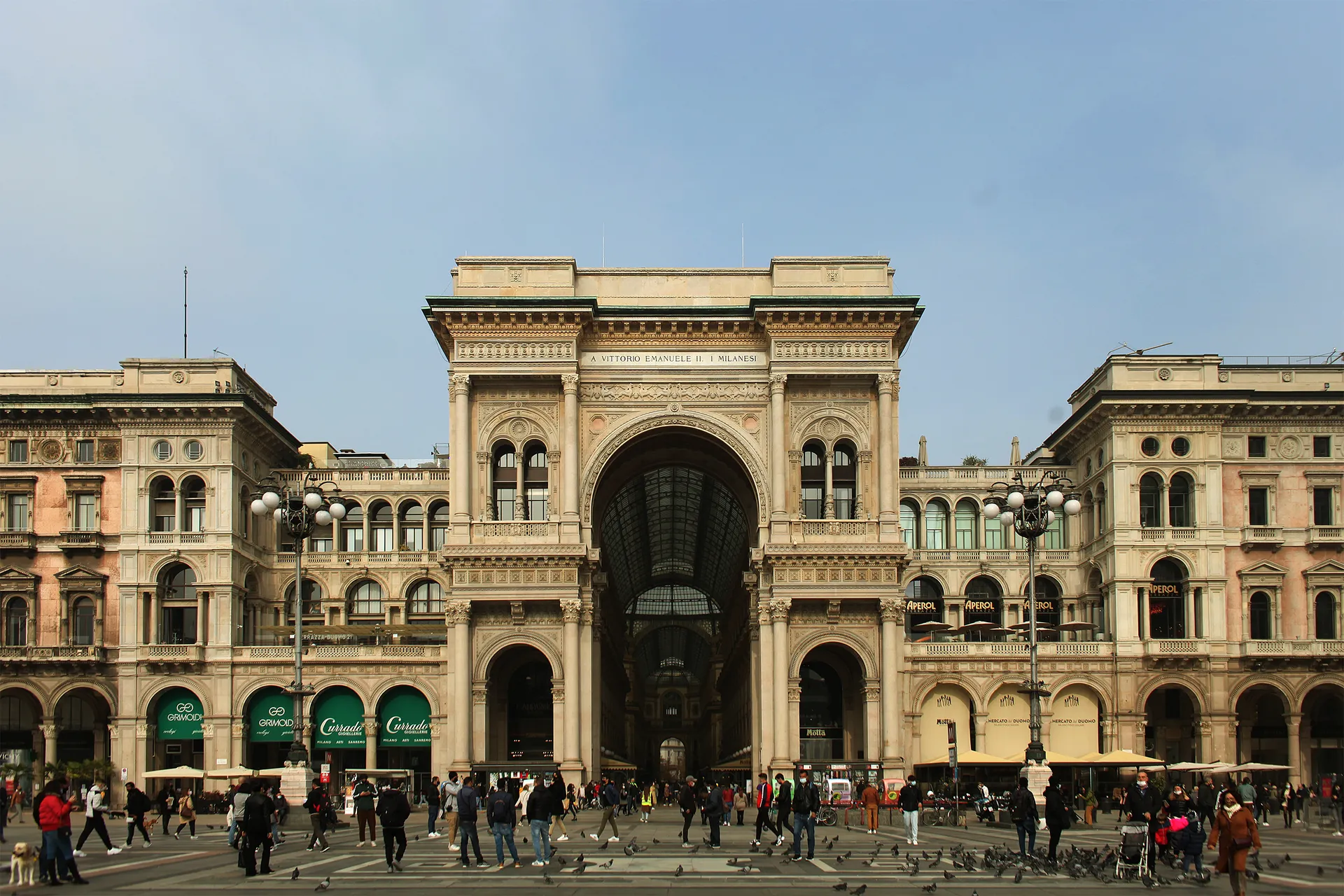
The king it's named for never saw it finished. Vittorio Emanuele II died on 9 January 1878, weeks before the triumphal arch was unveiled — and the architect who built it for him, Giuseppe Mengoni, was already in the ground, having fallen from his own scaffolding on 30 December 1877. Today the Galleria Vittorio Emanuele II hums under glass and iron in the heart of Milan, Italy, linking the Duomo di Milano to La Scala with 196 metres of marble, mosaic, and luxury commerce. Come for Italy's oldest active shopping arcade; stay because every tile underfoot is arguing about who Italy belongs to.
Step inside on a winter morning and the light does something unfair. It pours through the central dome — 37.5 metres across, wider than the nave of most cathedrals — and lands on cream marble already buffed by 158 years of leather soles. Espresso machines hiss from Caffè Biffi, the first place in Milan to install electric lighting in 1882. Heels click. Somebody is always grinding a right foot into a bull mosaic on the floor.
Milanese call it il salotto — the drawing room — and they mean it as ownership, not as marketing. The Galleria was conceived as a monument to Italian unification, a civic cathedral linking faith (the Duomo di Milano) to culture (La Scala) under one industrial-age roof. That it became Italy's oldest active shopping mall is not a fall from grace. It was the point. Mengoni designed a temple to bourgeois public life and got one.
The bull on the floor is not a charm. It marks Milan's old grievance with Turin, first capital of unified Italy under the Savoys, and the heel-spinning ritual tourists now line up for began as public mockery of the crown. Most visitors leave never knowing they performed a 150-year-old insult.
Researched by the Audiala editorial team from historical records, architectural archives, and local expertise.
What to see
The Octagon and its glass dome
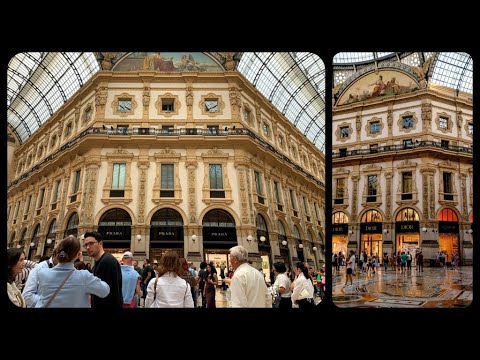
Stand dead center under the crossing and tilt your head back. The dome reads 37.5 metres across — wider than two London buses parked nose-to-nose — ribbed iron radiating from a single oculus, glass panels by Saint-Gobain that turn winter fog into lantern light. Giuseppe Mengoni built it without a single visible tie-rod, a structural party trick that left Victorian engineers slightly furious.
Look down before you leave. Four city emblems ring the Savoy crest in mosaic — Rome's she-wolf, Florence's lily, Turin's bull, Milan's red cross — laid in 1867 and entirely re-tessellated in 1967 after Allied bombs left the original a wreck. The acoustic is hard, marble-bouncy, espresso-clatter loud. Mark Twain wanted to live here. You'll see why in about ninety seconds.
The bull's testicles ritual
On the Turin coat-of-arms, between the bull's hind legs, you'll find a worn divot in the stone. Not metaphorical wear — a real depression, deep enough to feel through a thin sole. Place your right heel there, spin three times clockwise, and Milanese tradition promises good luck for the year. Counter-clockwise reportedly invites the opposite.
The ritual is so relentless the mosaic was restored in 2007, then quietly re-restored as the queue keeps grinding. Go early — before nine, before the Duomo di Milano crowds spill in — and you'll get the bull to yourself. Locals do it sheepishly, then check no one's watching. Everyone's watching. Everyone's also next in line.
Highline rooftop walk
Most visitors never look up past the cornice. The few who book a Highline ticket (€15 timed, €25 guided) climb to the sixth floor and walk a grilled skywalk fifty metres above the marble — past the dome at its own height, ducking through a transept passage with a ceiling under 1.80 m. The Sala degli Orologi houses the 1932 master clock that once drove every public clock hand in Milan. The terrace puts the Madonnina of the Duomo at eye level. No stilettos, no vertigo, no regrets.
Plan your visit
Getting There
Metro M1 (red) or M3 (yellow) to Duomo drops you at the south arch on Piazza Duomo; M3 to Montenapoleone puts you at the Scala end. From Milano Centrale, M3 direct to Duomo runs about 13 minutes for €1–2. Trams 1, 2, 12, 14, 16, 27 and buses 50, 57, 60, 65, 96 all stop within 100m. Skip driving — the Cerchia dei Bastioni ZTL cameras will fine you; use Autosilo Diaz on Piazza Diaz, three minutes on foot.
Opening Hours
As of 2026, the Galleria itself is a public passage and never closes — walk through at 4am if you want. Shops run roughly 10:00–19:00 daily, most shut 25–26 December. The Highline Galleria rooftop walk runs Tue–Sun 10:00–18:00 (last entry 17:30), closed Mondays.
Time Needed
A straight Duomo-to-Scala walk through the 196m arcade takes 15–20 minutes. Add the bull-spin ritual, photos under the dome, and window-staring at Prada and you're at 30–45 minutes. Tack on the Highline rooftop for another 60–90 minutes, or a Camparino aperitivo for 30–60.
Accessibility
Ground level is flat marble and mosaic, fully wheelchair accessible end to end with no thresholds between the Duomo and Scala arches. The Highline rooftop is a different story — a public lift reaches the 6th floor, but mandatory stairs along the grated outdoor walkway block step-free completion. No public toilets inside; nearest accessible facilities are inside Rinascente next door.
Cost & Tickets
Walking the Galleria costs nothing — it's a civic passage, not a paid attraction. The Highline rooftop is the only ticketed bit; book online for busy days since on-site availability isn't guaranteed. Top-floor viewpoint runs around €12 from a separate operator.
Photo Gallery
Christmas lights and a towering tree fill the glass-roofed Galleria Vittorio Emanuele II in Milan. Crowds move beneath the ornate 19th-century arcades and luxury storefronts. · János Korom Dr. >17 Million views from Wien, AustriaSunlight cuts across the entrance to Galleria Vittorio Emanuele II, where shoppers pass beneath carved arches and a richly decorated ceiling. · Ray Swi-hymn from Sijhih-Taipei, TaiwanWarm light pours through the grand arches of Galleria Vittorio Emanuele II in Milan as shoppers move beneath its richly decorated arcade. · XshooternorwayThe entrance arch of Galleria Vittorio Emanuele II rises above Milan with carved marble, tall columns, and a vaulted glass roof catching the daylight. · Lunna CamposThe glass-vaulted roof of Galleria Vittorio Emanuele II rises above ornate 19th-century arcades in central Milan. Daylight filters through the iron-and-glass dome, showing the scale of Italy's historic shopping gallery. · Lunna CamposThe monumental entrance to Galleria Vittorio Emanuele II glows under streetlights in central Milan. Wet cobblestones and ornate 19th-century facades give the scene its late-night polish. · Lucalari84The Galleria Vittorio Emanuele II glows after dark, its glass vaults, mosaic floor, and ornate arcades reflecting the polish of central Milan. · Lucalari84
History
Mengoni's Last Climb
In 1860 Milan held a competition. Eighteen architects submitted plans to remake the muddle of streets between the cathedral and the opera house into something worthy of the new Italian kingdom. Giuseppe Mengoni — Bologna-trained engineer, Risorgimento veteran from a small Romagna town — won on his third try in September 1863, beating Florentine rival Niccolò Matas amid what records call fierce controversy. Milanese architects attacked his design as pompous. He spent the next fourteen years proving them wrong, then died proving them right.
Construction ran from 1865 to 1877, financed by the English-registered City of Milan Improvement Co. Ltd until it went bankrupt and the comune was forced to take over. Mengoni built bigger than the Parisian Galerie d'Orléans, used wrought-iron arches with no visible tie-rods, and stitched together two glass-vaulted arms in a Latin cross. The partial inauguration came on 15 September 1867. The grand triumphal arch facing Piazza del Duomo took another decade — and it killed him.
The turning point
The Fall from the Arch
The popular story is tidy. King Vittorio Emanuele II inaugurated the Galleria in glory, a triumphal arch crowning his architect's achievement. Look closer and the dates collapse. Partial opening came in September 1867, ten years before Mengoni finished anything. The king it's named for died on 9 January 1878. He never set foot inside the completed arcade. Neither did its architect.
On the late afternoon of 30 December 1877, Mengoni climbed the scaffolding wrapping the unfinished triumphal arch facing the Duomo — the very piece critics had savaged as a 'pronounced mixture of styles and excessive monumentality.' He was 48. The English contractor's bankruptcy had left him personally fighting to salvage the arch's reception ahead of the royal opening planned for the new year. He fell from the cornice. His body landed on the pavement below. Italian local-history sources still call it la misteriosa tragedia — accident or suicide, scholars cannot agree.
Walk under the Duomo arch today and you are crossing the spot where Mengoni's body landed two days before his life's work was meant to be crowned. Above you is the section of arcade he died unable to defend from its critics. Eleven days later the king it honours died too, having never seen any of it lit.
The Bull and the Four Capitals
The mosaic floor of the central octagon is heraldry, not decoration. Four coats of arms mark the four capitals of unified Italy: Turin's bull, Florence's lily, Rome's she-wolf with Romulus and Remus, and Milan's red cross on white. Tourists almost always notice only the bull. The full set is a compressed timeline of the Risorgimento capital-shuffle — Turin in 1861, Florence in 1865, Rome in 1871 — written in tile under your feet. According to tradition, the heel-grinding ritual on the Turin bull began as Milanese sbeffeggio against Savoy primacy; today the comune periodically re-tiles the worn-out groin, meaning the 'tradition' physically destroys the artifact it venerates.
Bombed and Reborn
On 13 August 1943, Allied bombs shattered the Galleria's glass-and-iron roof in the firestorm raid that gutted central Milan. Photographs in the Publifoto archive show the central dome blown open, the marble floor strewn with broken panes. Postwar reconstruction restored the arcade, though preservation scholars at the Politecnico still debate how much of the wrought-iron framework is original Atelier Henry Joret work and how much is mid-century replica. The most recent intervention came in 2015, when Prada funded a pre-Expo cleaning that scoured a century of soot off the façades and revealed Mengoni's original two-tone scheme. Most photographs taken before 2015 show a uniform grey building that was never the architect's intent.
Tips for visitors
Pickpocket Hotspot
The Galleria and adjacent Duomo sit at the top of every Milan theft map — phones lifted from back pockets, bags slit under the central octagon. Front pockets only, bag zipped and in front, and don't unfold a paper map in the middle of the crowd.
Refuse The Bracelet
Men near the Duomo arch will try to tie a string on your wrist or press a rose into your hand, then demand €10–20. Same crew runs the deaf-mute clipboard petition while an accomplice works your bag. Don't make contact, don't slow down.
Spin The Bull
The Turin bull mosaic in the central octagon has a hole worn into its groin — heel down, three full turns, supposedly buys you a return to Milan. Use your heel only, not your full weight, since the tiles get re-laid every few years from the damage. Locals quietly grumble it's vandalism dressed as folklore.
Come At Eight
Between 11:00 and 19:00 the arcade clogs with Duomo overflow plus shoppers; weekends, December, and Fashion Weeks (February and September) are worse. Arrive 07:00–09:00 before shops open and you'll get the dome, the mosaics, and the empty cross-axis to yourself. Morning light through the eastern barrel vault is the photo.
Eat Like A Local
Skip the Galleria interiors for meals — Savini and Cracco are splurge-only (Savini tastings run €120–170), and most other in-arcade spots are tourist-priced. Walk 50m to Luini on Via Santa Radegonda for a €4 panzerotto (queue moves fast), or cross to Brera for proper aperitivo. Inside, Camparino's 1915 bar is the one worth the €18 cocktail.
Photo Rules
Handheld photos and video are unrestricted under the dome — no flash police, no permit needed. Tripods require a Comune di Milano permit and security will shut you down without one. Drones are banned outright (centro storico no-fly + glass roof).
Dress For The Shops
No formal code for the passage itself, but Prada, Louis Vuitton and Versace flagships will snub anything beachy — smart-casual minimum to get past the door staff. The Highline rooftop bans high heels (it's a grated walkway) and asks for "appropriate clothing."
Stack Your Stops
The north arch opens directly onto Piazza della Scala — the Scala museum sits 30 seconds away and most visitors skip it. South takes you to the Duomo; ten minutes northwest reaches Clerici Palace and Brera. Build the day around the Galleria as your hinge.
Where to Eat
local_dining
Don't Leave Without Trying
Risotto alla MilaneseCotoletta alla MilaneseOssobucoCassoeulaPanettone
I 12 Gatti Pizzeria
local favorite
Artisanal Pizza€€star4.5(1867)
Order: The Gatti special pizza, known for its crispy crust and top-tier ingredients.
It is a true hidden gem tucked away on the top floor of the Galleria; you have to navigate to the Leonardo3 museum entrance and take the lift, but the privacy and quality make it a local secret worth finding.
Order: Their high-quality club sandwich or the omelette with cheese and ham for a refined, calm breakfast.
Tucked away on a side street, it offers a necessary refuge from the Duomo crowds with genuinely warm service and a relaxed atmosphere perfect for a quiet morning.
Order: The signature Camparino Spritz; it is the quintessential Milanese aperitivo experience.
It’s not just a bar, but a piece of history; the ornate interior and the tradition of the aperitivo make it a mandatory stop for anyone wanting to soak in the true spirit of Milan.
checkTipping is not obligatory; if you receive excellent service, a cash tip left directly to the server is best.
checkExpect a midday closure gap; many restaurants shut between 15:00 and 19:00.
checkLunch is best enjoyed between 12:30 and 14:30; dinner usually starts around 20:00.
checkAlways carry some cash, as it remains the most reliable way to ensure tips reach the staff.
checkArrive at least an hour before kitchen closing times to ensure you are served.
Food districts:BreraGalleria Vittorio Emanuele II area
Restaurant data powered by Google
Watch & Explore Galleria Vittorio Emanuele II.
ROCKY'S ITALY: Milan - The Galleria Vittorio Emanuele II
Rocky Ruggiero2 min16K
Explore Milan
Is Milan in Italy Really Worth the Hype?
DW Travel8 min310K
Galleria Vittorio Emanuele II - Milan's Extravagant Shopping Mall
The Adventurous Vlogger3 min5K
Frequently asked
Is the Galleria Vittorio Emanuele II worth visiting?
Yes — it's free, open 24/7, and sits between the Duomo di Milano and Teatro alla Scala, so you'll cross it anyway. Built 1865–1877 by Giuseppe Mengoni, it's Italy's oldest active shopping arcade and the template every later European galleria copied. Come for the iron-glass dome, stay for the mosaic floor and the bull-spin ritual.
How long do you need at the Galleria Vittorio Emanuele II?
Fifteen to twenty minutes to walk through, 30–45 if you stop for photos and the bull-mosaic spin. Add 60–90 minutes for the Highline rooftop walk on top of the glass roof. A coffee at Camparino or Marchesi adds another half-hour.
How do I get to the Galleria Vittorio Emanuele II from Milano Centrale?
Take metro M3 (yellow) direct to Duomo — about 13 minutes, €1–2. The south entrance opens straight onto Piazza del Duomo; the north end leads to Piazza della Scala via Montenapoleone (M3). Trams 1, 2, 12, 14, 16, 27 and buses 50, 57, 60, 65, 96 also stop nearby. Don't drive: the Cerchia dei Bastioni ZTL is camera-enforced.
What is the best time to visit the Galleria Vittorio Emanuele II?
Early morning, 7–9am, before the shops open and the Duomo crowds spill in — the octagon is near-empty and the light through the dome is at its best. Avoid weekend lunchtimes, Fashion Weeks (February and September), and the December Christmas-tree crowd. Winter fog turns the interior lantern-like at night.
Can you visit the Galleria Vittorio Emanuele II for free?
Yes. The arcade itself is a public covered street, free and open 24/7. Only the Highline rooftop walk costs money — from €15 for a timed self-guided visit, €20 flexible, €25 for a two-hour guided tour including the Sala degli Orologi and the rooftop terrace above the triumphal arch.
What should I not miss at the Galleria Vittorio Emanuele II?
The bull mosaic in the central octagon — heel on the Turin bull's testicles, three clockwise spins for luck. Also look up at the four-continents lunettes most tourists miss, and find the four city emblems on the floor (Turin bull, Florence lily, Rome she-wolf, Milan red cross) — a compressed Risorgimento timeline. For the splurge, the Highline rooftop puts you at the Madonnina's eye level.
Why do people spin on the bull in the Galleria Vittorio Emanuele II?
Tradition says three clockwise heel-spins on the Turin bull's groin bring luck, fertility, or a guaranteed return to Milan. The real origin is mockery: after unification, Milanesi resented Turin's primacy as Savoy capital and ground their heels on its heraldic bull as civic spite. The mosaic erodes constantly and the Comune re-tiles the bull's genitals on a near-permanent rotation.
Is the Galleria Vittorio Emanuele II safe?
Yes by day and night — heavily policed with constant Carabinieri and CCTV — but it's Milan's number-one pickpocket hotspot alongside the Duomo. Watch for the friendship-bracelet scam at the Piazza Duomo entrance, fake-petition clipboards, and the rose-in-hand trick. Keep bags zipped and front-facing in the octagon crowd.
Sources & attribution20
Researched and written by the Audiala editorial team from historical records, architectural archives, and local expertise. Last updated April 2026.
Visit Milano (official tourism) — Latin-cross plan dimensions (196 × 105 m), Duomo–Scala connection, neo-Renaissance attribution.
Highline Galleria official site — Rooftop walk hours, ticket tiers (€15/€20/€25), Sala degli Orologi access, accessibility rules.
In Galleria — Mengoni the Architect — Mengoni biography, competition timeline (1860–1863), foundation stone 7 March 1865, partial inauguration 15 September 1867.
Saved and recently read places — kept on this device only.
Photo credits (10)
Veduta della Galleria Vittorio Emanuele II da piazza del Duomo, Milano — Paolobon140 — CC BY-SA 4.0 (https://creativecommons.org/licenses/by-sa/4.0/) — Source: https://commons.wikimedia.org/wiki/File:Veduta_della_Galleria_Vittorio_Emanuele_II_da_piazza_del_Duomo,_Milano.jpg
2006 01 29 Photo-0027 (48682579137) — János Korom Dr. >17 Million views from Wien, Austria — CC BY-SA 2.0 (https://creativecommons.org/licenses/by-sa/2.0/) — Source: https://commons.wikimedia.org/wiki/File:2006_01_29_Photo-0027_(48682579137).jpg
20170706 MilanoGalleria 9298 (36747350085) — Ray Swi-hymn from Sijhih-Taipei, Taiwan — CC BY-SA 2.0 (https://creativecommons.org/licenses/by-sa/2.0/) — Source: https://commons.wikimedia.org/wiki/File:20170706_MilanoGalleria_9298_(36747350085).jpg
Backwards Milano — Xshooternorway — CC BY-SA 4.0 (https://creativecommons.org/licenses/by-sa/4.0/) — Source: https://commons.wikimedia.org/wiki/File:Backwards_Milano.jpg
-i---i- (22210596593) — Lunna Campos — CC BY 2.0 (https://creativecommons.org/licenses/by/2.0/) — Source: https://commons.wikimedia.org/wiki/File:-i---i-_(22210596593).jpg
-i---i- (22413319987) — Lunna Campos — CC BY 2.0 (https://creativecommons.org/licenses/by/2.0/) — Source: https://commons.wikimedia.org/wiki/File:-i---i-_(22413319987).jpg
DSC 3914 web — Lucalari84 — CC BY-SA 4.0 (https://creativecommons.org/licenses/by-sa/4.0/) — Source: https://commons.wikimedia.org/wiki/File:DSC_3914_web.jpg
DSC 0665 web — Lucalari84 — CC BY-SA 4.0 (https://creativecommons.org/licenses/by-sa/4.0/) — Source: https://commons.wikimedia.org/wiki/File:DSC_0665_web.jpg
Galleria Vittorio Emanuele II. Fortepan 50066 — FOTO:Fortepan — ID 50066: Adományozó/Donor: Nagy Gyula. — CC BY-SA 3.0 (https://creativecommons.org/licenses/by-sa/3.0/) — Source: https://commons.wikimedia.org/wiki/File:Galleria_Vittorio_Emanuele_II._Fortepan_50066.jpg
DSC 2605 web — Lucalari84 — CC BY-SA 4.0 (https://creativecommons.org/licenses/by-sa/4.0/) — Source: https://commons.wikimedia.org/wiki/File:DSC_2605_web.jpg
Strictly necessary cookies keep the site working. Analytics (PostHog, Google Analytics) measures how each visitor uses our pages. Marketing loads YouTube videos and walking-route maps without a tap and lets Google Analytics set advertising cookies. We never sell your data. You can change this any time from the footer.
Analytics and marketing cookies are optional and only load if you agree. Details under Customize.
Privacy
Cookie preferences
Pick what you're okay with. You can change this any time from the footer.
Strictly necessary
Always on
Sign-in, language, navigation. Always on.
Product analytics
PostHog (EU) and Google Analytics record which pages you view and how you use them, under a random identifier stored in your browser. Helps us see which pages work and which need fixing. Google's ad personalisation stays off. No selling.
Marketing
Loads YouTube videos and the walking-route maps (OpenFreeMap) without a tap; without it, they load only when you tap them. If analytics is also on, Google Analytics may set advertising cookies. Ad personalisation stays off.