Akershus Fortress
OsloNorway 59° N · 10° E Updated Aug 2026
Akershus Fortress is still an active military HQ, royal crypt, and free public park — all on the same 700-year-old ramparts above the Oslofjord in Oslo.
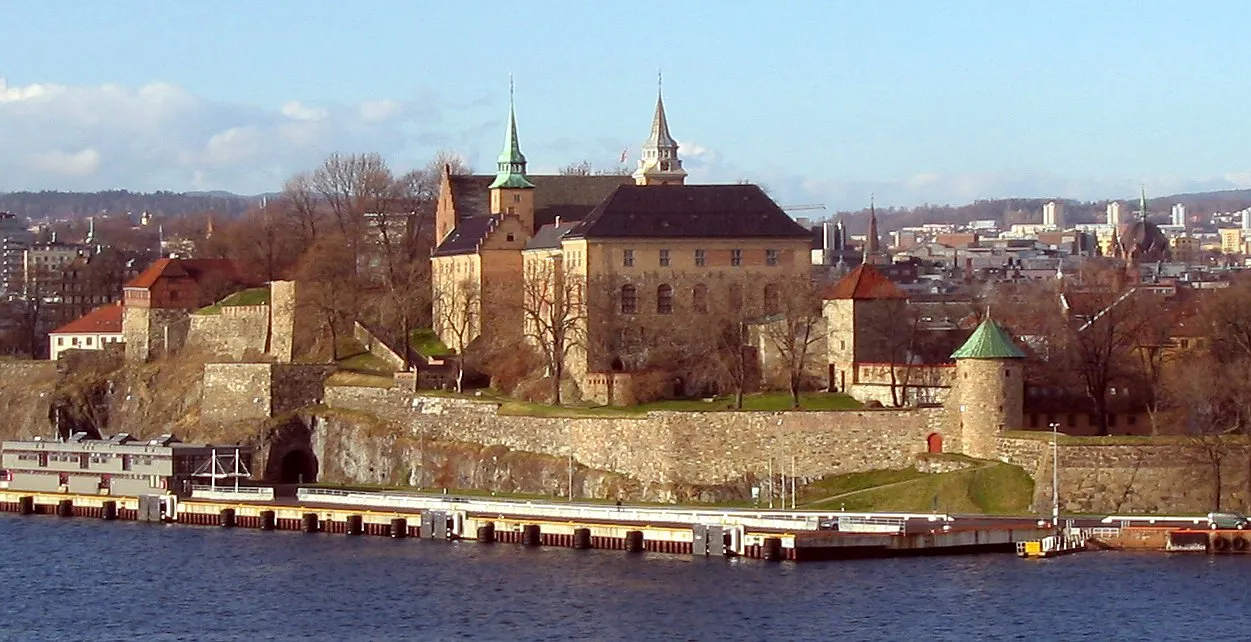 Photo: Photo © 2005 by Tomasz Sienicki [user: tsca, mail: tomasz.sienicki at gmail.com] · CC BY 2.5
- Time needed
- 1-2 hours
- Entry
- Free grounds; castle interior ticketed
- Access
- Limited; uneven cobblestones and steep ramparts
- Best season
- Summer (May-August)
Why did a fortress that turned back every Swedish siege for six centuries open its gates to the Wehrmacht on 9 April 1940 without firing a shot? That paradox shadows Akershus Fortress in Oslo, Norway — a place where medieval vaults, royal tombs, and a Nazi-era execution ground share the same cobbled courtyards. You come here not for one clean story, but to stand inside Norway's most layered piece of ground.
The fortress grips a granite headland above the Oslofjord, its ramparts a jumble of 13th-century gatehouses and 17th-century bastions. Walk up from the harbour and you pass through the 1653 Festningsporten gate, where Christian IV's cipher still glares down from the keystone. The complex still houses Norway's Defence Staff, yet the public can wander the walls free from early morning until late evening.
The living and the dead sit close here. In the castle church, regular Sunday services and military confirmations continue beneath Emanuel Vigeland's stained glass, while the Royal Mausoleum below holds white marble sarcophagi of King Haakon VII, Queen Maud, and King Olav V. Oslo's working monarchy lives up the hill at the Royal Palace, Oslo; Akershus keeps the watch and the dead.
Then the path turns toward Retterstedet, the execution ground where German occupation forces shot Norwegian resistance fighters between 1940 and 1945. Fresh flowers still appear there, placed by descendants and strangers. No fence separates the memorial from the picnic grass.
What to see
-
Inside Akershus Castle
The first thing that hits you inside Akershus's royal chambers isn't the furniture, it's the floor—the Witch's Pit dungeon slopes so dramatically you have to brace against the stone to keep from sliding into the medieval tunnel below. In the Bailiff's Chamber, an iron-banded tax chest from Drøbak has two coin slots: one funneled tolls straight to the Crown, the other legally claimed the bailiff's own share, corruption with a receipt. Climb to the Daredevil Tower room and look high on the eastern wall for the spontaneous brick crown masons laid on February 21, 1937, the day Prince Harald became the first Norwegian prince born on domestic soil in five centuries; no architect drew it, but it stayed. -
The Ramparts and Bastions
Start at Festningsporten, the 1653 gate with Christian IV's monogram carved above you like a bureaucratic warning, then climb to Skarpenort Bastion where the harbor spreads out in a sheet of hammered silver. The crunch of gravel underfoot mixes with ferry horns from the Nesodden route, and the wind off the fjord finds every gap in the stone. Down near the powder magazine, a small plaque marks where Vidkun Quisling faced a firing squad on October 24, 1945, but also pause at the Resistance Museum for the quieter stories of 42 others whom the Nazis executed against these very walls. -
A Self-Guided Loop Through Seven Centuries
Stitch the site together on a 90-minute loop that begins at the Visitor Centre in the 1774 artillery building, threads through the Maiden's Tower gate alley where medieval walls mute the city noise, and dips into the Carp Pond fed by the old moat system. Don't rush past the yellow-painted Slavery barracks—by 1842 they held 530 prisoners at peak, men rented out to Oslo as hard labor until the term 'slaveriet' was retired in 1850. End on the southern King's Bastion at golden hour, when the low sun turns the castle's brick facades the color of embers against Oslo below; from here you can see the Royal Palace, Oslo rising on its hill, a reminder that power shifted just a few hundred meters inland.
Plan your visit
- Getting There
- Walk 15–20 minutes from Oslo S down Karl Johans gate or Tollbugata through Kvadraturen. From City Hall or Aker Brygge, it's a 5–10 minute walk east up the hill. Tram 12, 17, or 18 stops at Christiania torv; bus 30, 31, or 54 at Wessels plass; all metro lines to Stortinget or Nationaltheatret; no parking inside, use nearby garages.
- Opening Hours
- As of 2026, the fortress grounds and ramparts open daily 06:00–21:00 year-round. Akershus Castle interior opens daily 10:00–16:00 in summer (May–August) and weekends only (roughly 12:00–17:00) in winter. Because this is an active military and state venue, entire sections can close without notice for royal burials, state dinners, or military ceremonies.
- Time Needed
- For a quick walk over the ramparts and courtyard, allow 30–45 minutes. A standard visit with the castle interior—banquet halls, Royal Mausoleum, dungeon—takes 1.5–2 hours. Add the Resistance Museum and Armed Forces Museum and you'll need 2.5–3.5 hours.
- Accessibility
- The grounds and Castle Church have step-free routes, but historic cobblestones, flagstones, and steep ramps make manual wheelchairs hard work. Akershus Castle interior lacks elevators; you'll face medieval spiral staircases and narrow corridors, so most upper rooms and dungeons are not wheelchair accessible.
- Cost/Tickets
- Walking the fortress grounds and ramparts is free, as is the Armed Forces Museum. Akershus Castle interior costs 160 NOK for adults, 110 NOK for seniors/students, and 40–80 NOK for children (family ticket 250–400 NOK). The Oslo Pass covers both the castle interior and on-site museums, with no advance time-slot booking required.
Photo Gallery


History
The Watch That Never Ended
For more than seven centuries, someone has stood guard on this harbor promontory. Akershus began around 1299 when King Haakon V fortified Oslo after making it Norway's permanent capital; records show the castle first appears in a royal letter in 1300. It has never become a ruin.
The continuity is not architectural purity. Much of what you see was rebuilt between 1905 and the 1960s. What survived is function: the same corridors that echoed with medieval sentries now carry the boots of His Majesty The King's Guard.
The turning point
The Mismatched Soldier Who Ended the Occupation
The guidebook version of Akershus is simple: the fortress that never fell. Swedish forces besieged it in 1308, 1449, 1502, 1523, 1567, and 1716. Each time, they went home without taking the citadel.
But the story stumbles on 9 April 1940. German forces occupied Oslo and the garrison did not fight. Commanders evacuated the Norwegian capital and left the stronghold to the Wehrmacht. For five years, the Gestapo used these stone walls as prisons and execution grounds.
The real test came on 11 May 1945, when 30-year-old Milorg officer Terje Rollem marched through the gate with a tiny, under-equipped detachment. Major Josef Nichterlein and his adjutant still commanded hundreds of fully armed German soldiers inside. A single nervous sentry could have turned the courtyard into a bloodbath. Rollem had no polished uniform and no overwhelming force — only the authority of Germany's surrender three days earlier. Nichterlein, in polished boots and medals, formally handed over the fortress without a shot.
Stand in the courtyard today and you see the spot where Norway's occupation ended. The same sentry posts that went unguarded in 1940 now hold the daily watch of the King's Guard. The military duty never snapped; it changed hands.
What Changed
What Endured
Tips for visitors
Leave the drone at home
Drones are a strict no-fly zone here because Akershus is an active military installation and central government airspace. Norwegian aviation law treats unauthorized drone flights as a national security offense—confiscation, heavy fines, or deportation have happened to tourists.Respect the sentries
This is not a museum piece; armed guards patrol the grounds and government offices operate inside. Do not cross cordoned-off administrative zones or obstruct sentry paths when taking photos—they will stop you.Sunset from the ramparts
Locals flood the grassy bastions on clear summer evenings for the best free fjord view in Oslo; the light over Aker Brygge turns soft around 21:00–22:00 in June and July. Winter visits offer empty ramparts but icy stones—wear studded soles.Grounds are free
You don't need a ticket to walk the ramparts or see the fjord view—the grounds, courtyards, and Armed Forces Museum cost nothing. If you plan to enter the castle and Resistance Museum, buy an Oslo Pass to bundle them with transit.Quiet at the execution site
The WWII Resistance Memorial and the Royal Mausoleum inside the castle chapel require hushed voices, no hats, and modest dress. Treat these as you would a cemetery—Norwegian visitors will notice disrespect immediately.Sturdy shoes, no wall-walking
Historic cobblestones and rampart stairs get slippery in rain or freezing weather; flat shoes with grip save you from a twisted ankle. Climbing on the medieval walls is prohibited—the drops have no barriers.
Frequently asked
Is Akershus Fortress worth visiting?
Yes, if you like places where 700 years of Norwegian power, imprisonment, and ritual overlap on one walled peninsula. You can walk the ramparts free, catch sunset light hitting Aker Brygge from the bastions, and decide whether the castle interior's 160 NOK ticket earns its keep.
How long do you need at Akershus Fortress?
Budget 90 minutes to 2 hours for the ramparts and castle interior; add another hour if you want the Resistance Museum too. A quick free circuit of the outer bastions and courtyard takes 30–45 minutes.
How do I get to Akershus Fortress from Oslo Central Station?
Walk 15–20 minutes (about 1.2 km) southwest from Oslo S down Karl Johans gate or Tollbugata into Kvadraturen, then enter through the main fortress gates. Trams 12, 17, and 18 to Christiania torv or Rådhusplassen also leave you a short climb from the entrance.
What is the best time to visit Akershus Fortress?
Come May through August if you want the castle interior; it opens daily 10:00–16:00, while the grounds stay open year-round from roughly 06:00 to 21:00. Late afternoon and golden hour work best for photos from the King's and Skarpenort bastions, with smaller crowds than mid-morning.
Can you visit Akershus Fortress for free?
Yes, the fortress grounds, courtyards, bastions, and rampart paths are free and open daily. You pay only if you enter Akershus Castle's interior (160 NOK for adults) or the on-site museums, though the Armed Forces Museum is also free.
What should I not miss at Akershus Fortress?
Look up inside the Jomfrutårnet gate passage for the medieval portcullis grooves and murder hole—the rawest surviving mechanics of Haakon V's 1299 fortress. Inside the castle, the Vågehalsen room hides a spontaneous brick crown laid by masons in 1937 for Prince Harald's birth, and the Royal Mausoleum holds Haakon VII and Olav V in marble and bronze.
Is Akershus Castle open in winter?
The castle interior generally opens only on weekends (around 12:00–17:00) from September to April, so check signage before you climb the hill. Outdoor grounds remain open daily year-round, usually 06:00–21:00, with icy cobblestones and far fewer visitors.
Where is Akershus Fortress located?
It occupies the Akersneset peninsula at the edge of Oslo's harbor, a 5–10 minute walk east from Oslo City Hall and Aker Brygge. You'll see its granite bluff and ramparts rise directly above the fjord, just south of the Kvadraturen street grid.
Sources & attribution 9
- Wikipedia — Timeline and historical events from the 1287 raid through the 1940 German surrender, including sieges, fires, and the 1945 handover.
- DigitaltMuseum — Visitor guide with castle interior room details, the 1937 brick crown, royal mausoleum, and castle church furnishings.
- Forsvarshistorisk museum — Official Akershus Castle opening information, ticket prices, and its role as a state representation venue.
- StoryHunt — Visitor logistics for free grounds access, walking routes from Oslo S, opening hours, and recommended time budgets.
- Sea Experience — Practical history timeline including museum hours, WWII execution dates, and the 1945 handover.
- Visit Norway — Ticket pricing for adults, children, families, and Oslo Pass inclusion details.
- Castlopedia — Architecture and fortification zones, siege history, and the 1945 surrender to Terje Rollem.
- Oslo Spirit — Seasonal access, castle tour information, and descriptions of on-site museums.
- The Hidden North — Self-guided walking route with physical details of gates, bastions, and medieval defensive features.
Built from cited sources · see the method · How we make our guides →
More in Oslo.
123 places to discover — a few worth pairing.
Pick up where you left off
Saved and recently read places — kept on this device only.
Photo credits (17)
- Fortaleza de Akershus — Bene Riobó — CC BY-SA 4.0 (https://creativecommons.org/licenses/by-sa/4.0/) — Source: https://commons.wikimedia.org/wiki/File:Fortaleza_de_Akershus.jpg
- Det Kongelige Mausoleum Akershus — Orf3us — CC BY-SA 4.0 (https://creativecommons.org/licenses/by-sa/4.0/) — Source: https://commons.wikimedia.org/wiki/File:Det_Kongelige_Mausoleum_Akershus.jpg
- Oslo Akershus Fortress — Макс Вальтер — CC BY-SA 3.0 (https://creativecommons.org/licenses/by-sa/3.0/) — Source: https://commons.wikimedia.org/wiki/File:Oslo_Akershus_Fortress.JPG
- Akershus Fortress panorama — User:jimg944 — CC BY 2.0 (https://creativecommons.org/licenses/by/2.0/) — Source: https://commons.wikimedia.org/wiki/File:Akershus_Fortress_panorama.jpg
- OSLO-NO-02 05 ubt — Photo © 2005 by Tomasz Sienicki [user: tsca, mail: tomasz.sienicki at gmail.com] — CC BY 2.5 (https://creativecommons.org/licenses/by/2.5/) — Source: https://commons.wikimedia.org/wiki/File:OSLO-NO-02_05_ubt.jpeg
- "Am Ufer des Oslofjords liegt die Festung Akershus" 06 — Holger Uwe Schmitt — CC BY-SA 4.0 (https://creativecommons.org/licenses/by-sa/4.0/) — Source: https://commons.wikimedia.org/wiki/File:"Am_Ufer_des_Oslofjords_liegt_die_Festung_Akershus"_06.jpg
- "Am Ufer des Oslofjords liegt die Festung Akershus" 01 — Holger Uwe Schmitt — CC BY-SA 4.0 (https://creativecommons.org/licenses/by-sa/4.0/) — Source: https://commons.wikimedia.org/wiki/File:"Am_Ufer_des_Oslofjords_liegt_die_Festung_Akershus"_01.jpg
- "Am Ufer des Oslofjords liegt die Festung Akershus" 02 — Holger Uwe Schmitt — CC BY-SA 4.0 (https://creativecommons.org/licenses/by-sa/4.0/) — Source: https://commons.wikimedia.org/wiki/File:"Am_Ufer_des_Oslofjords_liegt_die_Festung_Akershus"_02.jpg
- "Am Ufer des Oslofjords liegt die Festung Akershus" 05 — Holger Uwe Schmitt — CC BY-SA 4.0 (https://creativecommons.org/licenses/by-sa/4.0/) — Source: https://commons.wikimedia.org/wiki/File:"Am_Ufer_des_Oslofjords_liegt_die_Festung_Akershus"_05.jpg
- "Am Ufer des Oslofjords liegt die Festung Akershus" 04 — Holger Uwe Schmitt — CC BY-SA 4.0 (https://creativecommons.org/licenses/by-sa/4.0/) — Source: https://commons.wikimedia.org/wiki/File:"Am_Ufer_des_Oslofjords_liegt_die_Festung_Akershus"_04.jpg
- "Am Ufer des Oslofjords liegt die Festung Akershus" 10 — Holger Uwe Schmitt — CC BY-SA 4.0 (https://creativecommons.org/licenses/by-sa/4.0/) — Source: https://commons.wikimedia.org/wiki/File:"Am_Ufer_des_Oslofjords_liegt_die_Festung_Akershus"_10.jpg
- "Am Ufer des Oslofjords liegt die Festung Akershus" 09 — Holger Uwe Schmitt — CC BY-SA 4.0 (https://creativecommons.org/licenses/by-sa/4.0/) — Source: https://commons.wikimedia.org/wiki/File:"Am_Ufer_des_Oslofjords_liegt_die_Festung_Akershus"_09.jpg
- "Am Ufer des Oslofjords liegt die Festung Akershus" 08 — Holger Uwe Schmitt — CC BY-SA 4.0 (https://creativecommons.org/licenses/by-sa/4.0/) — Source: https://commons.wikimedia.org/wiki/File:"Am_Ufer_des_Oslofjords_liegt_die_Festung_Akershus"_08.jpg
- "Am Ufer des Oslofjords liegt die Festung Akershus" 03 — Holger Uwe Schmitt — CC BY-SA 4.0 (https://creativecommons.org/licenses/by-sa/4.0/) — Source: https://commons.wikimedia.org/wiki/File:"Am_Ufer_des_Oslofjords_liegt_die_Festung_Akershus"_03.jpg
- "Am Ufer des Oslofjords liegt die Festung Akershus" 07 — Holger Uwe Schmitt — CC BY-SA 4.0 (https://creativecommons.org/licenses/by-sa/4.0/) — Source: https://commons.wikimedia.org/wiki/File:"Am_Ufer_des_Oslofjords_liegt_die_Festung_Akershus"_07.jpg
- "Am Ufer des Oslofjords liegt die Festung Akershus" 12 — Holger Uwe Schmitt — CC BY-SA 4.0 (https://creativecommons.org/licenses/by-sa/4.0/) — Source: https://commons.wikimedia.org/wiki/File:"Am_Ufer_des_Oslofjords_liegt_die_Festung_Akershus"_12.jpg
- "Am Ufer des Oslofjords liegt die Festung Akershus" 11 — Holger Uwe Schmitt — CC BY-SA 4.0 (https://creativecommons.org/licenses/by-sa/4.0/) — Source: https://commons.wikimedia.org/wiki/File:"Am_Ufer_des_Oslofjords_liegt_die_Festung_Akershus"_11.jpg
Photos may have been resized or cropped.