Nakanoshima Museum of Art, Osaka
OsakaJapan 34° N · 135° E Updated Aug 2026
A 40-year civic saga produced Osaka’s giant black-box museum, where Modigliani, Gutai, Yūzō Saeki, and a futuristic space-suited cat share Nakanoshima.
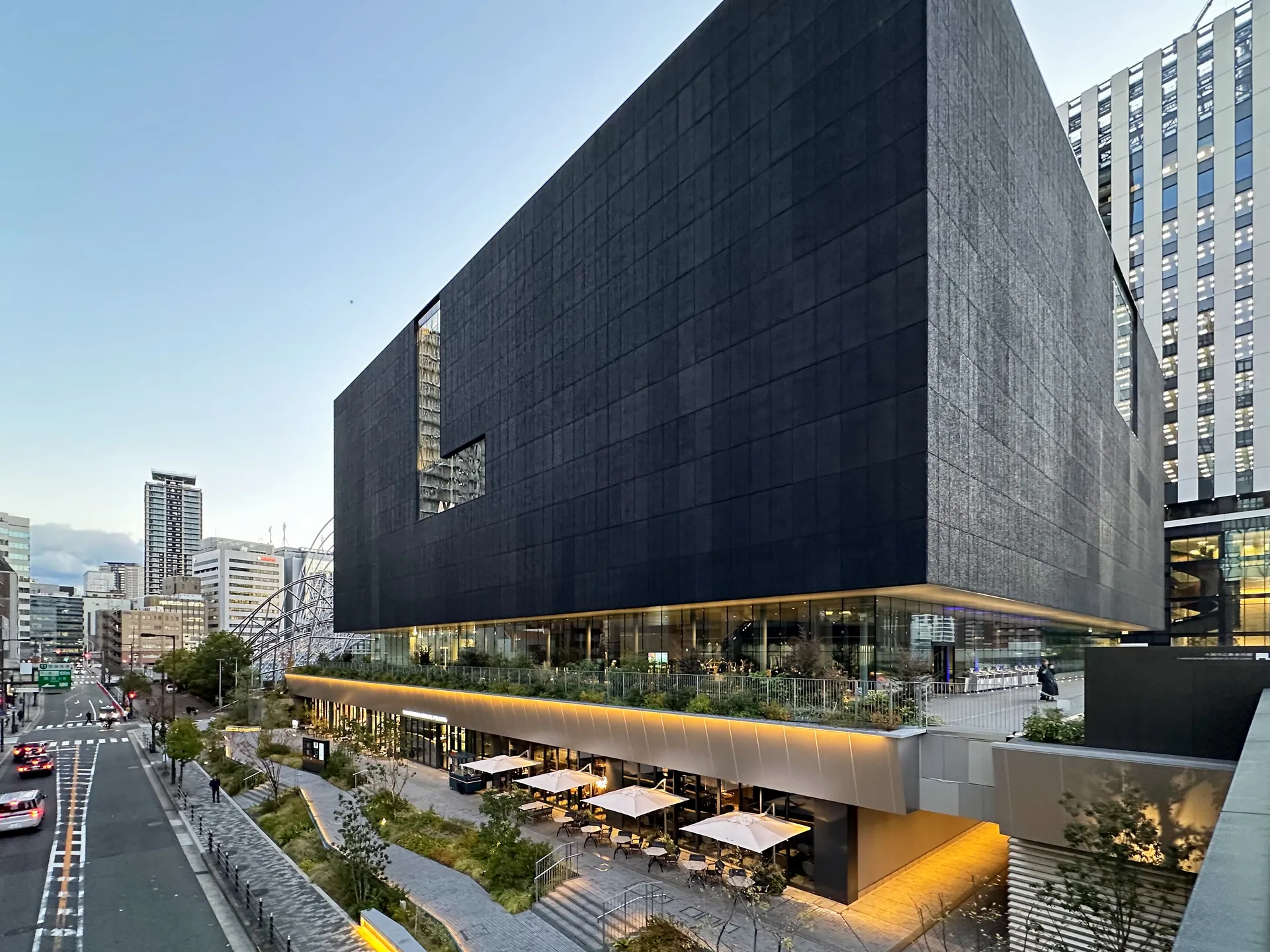 Photo: Прикли · CC BY 4.0
- Entry
- Free public areas; exhibition fees vary
A black box full of river light is where Osaka kept its modern art waiting for nearly 40 years. Nakanoshima Museum of Art, Osaka, in Osaka, Japan, is the reward for that delay: come for Yūzō Saeki, Modigliani, Gutai, and a five-storey atrium where escalators seem to float. The mood shifts from quiet galleries to the public Passage, with the Dojima and Tosabori rivers close enough to make the city feel like part of the collection.
Records show that Osaka City first announced the museum in August 1983, as part of projects marking the centenary of its 1889 municipal incorporation. Soon after, the family of businessman Hatsujirō Yamamoto gave the city 574 works, including 33 paintings by Osaka-born Yūzō Saeki; the gift turned an aspiration into a responsibility with canvases attached. That is a very Osaka kind of origin story: civic ambition, private conviction, and a collection too important to leave indefinitely in storage.
Records cited by Japan Cultural Expo and the Osaka Cultural Memory Database show that the city acquired Amedeo Modigliani’s 1917 Reclining Nude with Loose Hair in 1989, reportedly for about 1.93 billion yen. When the asset bubble collapsed, municipal finances stalled the building for decades, while parts of the collection appeared in a temporary Shinsaibashi exhibition space between 2004 and 2012. The official chronology places the decisive restart in 2013 and the public opening on February 2, 2022.
According to the museum’s architectural account, Katsuhiko Endo won the 2017 competition from 60 submissions with a building wrapped in roughly 600 black precast-concrete panels. Inside, the severe exterior gives way to the Passage: a free, open civic arcade entered from four directions, washed by skylight and crossed by long diagonal escalators. Osaka finally got its museum, and Endo made sure it didn’t behave like a vault.
What to see
-
The black box and the Passage
Surprise arrives before the art: Katsuhiko Endo’s museum rises like a suspended black cube, its facade assembled from 609 matte ultra-high-performance concrete panels that swallow Osaka’s glare rather than reflect it. Step inside and the weight lifts away—the central Passage opens from the 2nd floor to the roofline, with black escalators slicing through cool daylight, soft footsteps gathering in the air, and Kenji Yanobe’s 7.2-meter Giant Torayan looming above like a yellow-suited robot almost twice the height of an adult. Look back from the upper balcony; its mechanical joints and tiny pilot reward the visitor who resists walking straight into the galleries. -
Saeki, Gutai, and a collection with a long memory
The 4th-floor collection galleries tell Osaka’s modern story through paintings that feel made rather than merely displayed: Yūzō Saeki’s streets carry the damp, close atmosphere of the city, while Gutai works crack, puncture, and drag paint across the surface with the physical force of a workshop. The holdings began with 574 works donated by the Yamamoto family, including 33 paintings by Osaka-born Saeki, and later acquired Amedeo Modigliani’s 1917 Reclining Nude with Loose Hair during the bubble years. Exhibition rotations change, so ask what is currently on view; the pleasure lies in seeing how local grit sits beside European elegance without behaving politely. -
A small circuit around the museum
Begin on the open lawn with SHIP’S CAT (Muse), Kenji Yanobe’s 3.5-meter white cat sealed inside a red-and-orange protective suit, then circle the black concrete volume until its pitted aggregate catches the light differently after rain. Cross the walkway toward the National Museum of Art, Osaka for the best architectural contrast—one building a dark monolith, the other a silver, curving frame—before returning for a quiet pause on NAKKA’s western terrace above the river greenery. Finish downstairs at Musée KARATO or browse HAY OSAKA, where custom wire mesh from Higashi-Osaka quietly connects Danish design to the city’s industrial hands.
Plan your visit
- Getting There
- From Keihan Watanabebashi Station, take Exit 2 and walk southwest for about 5 minutes; Higobashi Station Exit 4 takes roughly 10 minutes west. JR Osaka Station is a scenic 15–20-minute walk through the Dojima passages, while Osaka City Bus 53 or 75 from the Osaka Station terminal reaches Taminobashi, a 2-minute walk away. Drivers can use the paid north-entrance car park, with 72 spaces—about the size of a modest office lot.
- Opening Hours
- As of 2026, the exhibition galleries open 10:00–17:00, with final entry at 16:30. Mondays are normally closed; when a national holiday falls on Monday, the museum opens that day and closes the following weekday instead. Year-end hours typically include closure on December 31 and January 1, while exhibitions may bring extra maintenance closures.
- Time Needed
- Allow 45–60 minutes for the free public Passage, the black-box atrium, SHIP'S CAT (Muse), shops, and café—a coffee-length introduction. A focused gallery visit takes 1.5–2 hours; seeing exhibitions on both floors, listening to an audio guide, eating, and adding a neighboring museum can easily fill 2.5–4 hours.
- Accessibility
- The 2022 building is fully barrier-free, with level entry through the 1F East Entrance, ramps 155–210 cm wide—broad enough for a wheelchair and companion—and elevators linking the public floors to the 4F and 5F galleries. Elevator doors measure 110 cm, while free wheelchairs and strollers are loaned from the 2F ticket counter; accessible restrooms are on 1F, 2F, 4F, and 5F. Guide dogs, mobility service dogs, and hearing assistance dogs are welcome.
- Cost & Tickets
- As of 2026, adult admission usually runs ¥1,200–¥2,200, depending on whether you choose a collection exhibition or a major special show. The 1F and 2F Passage, Lawn Plaza, outdoor sculptures, shops, and café are free; tickets are needed only for the 4F and 5F galleries. Timed-entry tickets are available through the official online portal, while same-day tickets are sold at the 2F counter.
Photo Gallery


History
The Forty-Year Collection
The museum’s official history records a 1983 beginning, but the story reaches further back, into the private rooms where Osaka collectors preserved modern art before the city had a public home for it. Hatsujirō Yamamoto’s family donation supplied the core collection, while Saeki’s restless paintings gave the future institution a distinctly local pulse.
The wait was shaped by money as much as by taste. According to the official chronology, Osaka bought important works during the late-1980s boom, then froze the museum project after the crash; planning, land acquisition, archaeology, temporary exhibitions, and political reconsideration stretched across nearly four decades before Endo’s design finally made the collection visible.
The turning point
Yūzō Saeki and the Painting Made Against Time
According to biographical accounts, Osaka-born painter Yūzō Saeki left for Paris determined to prove that Japanese oil painting could speak in a new, abrasive accent. He met rejection, poverty, tuberculosis, and severe psychological distress; after Maurice de Vlaminck dismissed his work in 1924, Saeki turned toward the peeling walls, shopfronts, and poster-crusted streets of Montparnasse. What was at stake was painfully personal: with his health collapsing and money scarce, painting was his last convincing argument that he still belonged to the world.
The turning point came in March 1928. Museum and biographical accounts say that Saeki encountered a local mail carrier and, over an intense two-day burst, painted The Postman, driving frantic black marks through the figure and the surrounding air. He was coughing blood by the end of the month, suffered a severe breakdown, and died in Paris in August at 30. The canvas did not save him, but it carried his final urgency forward.
Decades later, Yamamoto’s family donated 574 works to Osaka City, including 33 by Saeki. Records identify that donation as the foundation of the museum’s collection and the pressure behind its long-delayed construction. A painter who died without a proper public home helped force one into existence.
The Wharf Beneath the Museum
Gutai’s Impossible Room
Tips for visitors
Rules And Layers
The galleries are held at 20–23°C, so a light cardigan can rescue a summer visit from refrigerator conditions. No food or drink enters the galleries; public corridors allow only water or unsweetened tea in a sealed spill-proof bottle, and gallery notes must be written with graphite pencil rather than ink.Photo Boundaries
Personal, non-commercial photography is allowed in the 1F/2F Passage, Lawn Plaza, and outdoor grounds. Inside galleries, photograph only works marked with the permitted-camera icon; flash, video, tripods, monopods, gimbals, selfie sticks, drones, and photos on the escalators are prohibited.Eat By The Rivers
For a meal without leaving the building, try Café Restaurant Musée KARATO for vegetable-forward French-Japanese cooking at mid-range to splurge prices. Mid-range alternatives include Nakanoshima Social Eat Awake in Central Public Hall for yoshoku dishes, or GARB weeks by Nakanoshima Park for pizza and riverside drinks.Visit Early
Arrive at 10:00 on a Tuesday–Friday for the calmest start, especially during popular loan exhibitions that can create queues later in the day. The museum’s climate stays cool year-round, while the river promenades are most pleasant in the softer light of late afternoon.Pair Nakanoshima
The National Museum of Art, Osaka stands directly beside NAKKA, with the Osaka Science Museum just across the plaza. Plan 2.5–4 hours for two institutions and a meal; the contrast between NAKKA’s black architectural volume and the neighboring museum’s mostly subterranean design makes the pairing especially satisfying.Free, Then Stow
If you want the building, SHIP'S CAT (Muse), shops, and café rather than an exhibition, skip the gallery ticket and use the free public floors. Coin lockers on 1F and 2F take a refundable ¥100 deposit; oversized luggage can be checked at the 2F counter from 09:30–17:30 on exhibition days, but never overnight. Watch for fast commuter bicycles on river paths and bridge crossings during 08:00–09:30 and evening rush.
Frequently asked
Is Nakanoshima Museum of Art, Osaka worth visiting?
Yes—especially if you like modern art, bold architecture, or Osaka stories that refuse to behave politely. Katsuhiko Endo’s 2022 black concrete museum rises around a five-storey Passage with diagonal escalators, while the collection brings together Yūzō Saeki, Modigliani, Gutai, Japanese design, and graphic art. Give yourself 1.5 to 2 hours for one exhibition, and arrive early for quieter galleries.
How long do you need at Nakanoshima Museum of Art, Osaka?
Allow 1.5 to 2 hours for one exhibition plus the building’s public areas. A 45- to 60-minute visit covers the Passage, Kenji Yanobe’s 3.5-metre SHIP’S CAT (Muse), shops, and café, while two exhibitions, the audio guide, lunch, and the neighboring museums can fill 2.5 to 4 hours.
How do I get to Nakanoshima Museum of Art, Osaka from Osaka?
From JR Osaka Station, walk southwest for roughly 15 to 20 minutes, or take the Keihan Nakanoshima Line to Watanabebashi Station and walk about 5 minutes. Higobashi Station on the Yotsubashi Line is around a 10-minute walk, and Osaka City Bus routes 53 and 75 stop at Taminobashi, just 2 minutes away.
What is the best time to visit Nakanoshima Museum of Art, Osaka?
Weekday mornings are the best choice for calmer galleries, with spring and autumn offering the most agreeable riverside weather. The museum is generally open from 10:00 to 17:00, with last entry at 16:30, and closes on Mondays unless a national holiday shifts the closure to the following weekday. The galleries stay at 20°C to 23°C, so bring a light layer even in Osaka’s summer.
Can you visit Nakanoshima Museum of Art, Osaka for free?
Yes—the 1st- and 2nd-floor Passage, Lawn Plaza, outdoor sculptures, shops, and café areas are free to enter, while tickets are needed for the 4th- and 5th-floor galleries. Exhibition admission usually costs about ¥1,200 to ¥2,200 for adults, and advance timed tickets are sensible for popular shows.
What should I not miss at Nakanoshima Museum of Art, Osaka?
Don’t miss the floating-looking escalators in the central Passage, SHIP’S CAT (Muse) outside, and the collection’s Yūzō Saeki and Gutai works. Look over the upper balcony for Kenji Yanobe’s 7.2-metre Giant Torayan, then seek out Amedeo Modigliani’s Reclining Nude with Loose Hair when it appears in the display. The contrast between the matte-black box and the neighboring silver National Museum of Art, Osaka is the building’s best visual joke.
Sources & attribution 36
- Nakanoshima Museum of Art, Osaka — Official museum homepage, collection context, visitor information, and exhibition resources.
- Art Tourism — Museum history, collection highlights, architecture, public areas, amenities, and opening details.
- Navitime Japan — Background on the museum’s long planning period, donation history, and major acquisitions.
- Nakanoshima Museum of Art, Osaka: Architecture — Official information on architect Katsuhiko Endo, the Passage, and the building’s design.
- NAKKA Art Commons — Record of the museum’s opening exhibition and venue information.
- Nakanoshima Museum of Art, Osaka: History — Official institutional timeline covering the museum’s conception, site, construction, and operation.
- Japan Cultural Expo — Information on the Yamamoto collection, Yūzō Saeki, and Modigliani’s Reclining Nude with Loose Hair.
- Osaka Cultural Memory Database — Collection record for Amedeo Modigliani’s Reclining Nude with Loose Hair.
- designboom — Architectural report on the black concrete volume, internal void, and diagonal escalators.
- Tokyo Art Beat — Report on the Gutai exhibition, Gutai history, and the group’s performance-based practice.
- Nakanoshima Museum of Art, Osaka: GUTAI — Official information on the 2022 Gutai retrospective and the museum’s Gutai holdings.
- Comforts Japan — Historical account of the former Osaka University medical site and Nakanoshima’s layered past.
- Art Tourism: SHIP’S CAT — Background on Kenji Yanobe’s SHIP’S CAT (Muse) and its placement outside the museum.
- Yanobe.com — Artist information and work details for SHIP’S CAT (Muse).
- NAKKA Ticket Portal — Official multilingual platform for advance exhibition ticket booking.
- Nakanoshima Museum of Art, Osaka: Visitor Information — Official opening hours, closures, admission information, and visitor guidance.
- Osaka Info — Osaka tourism authority information on hours, admission, location, and access.
- Tokyo Art Beat: Nakanoshima Museum of Art, Osaka — Venue listing with opening and closure information.
- Nakanoshima Museum of Art, Osaka: Year-End Information — Official seasonal closure and New Year opening information.
- Nakanoshima Museum of Art, Osaka: Visitor Requirements — Official rules covering tickets, lockers, photography, luggage, food, drink, and accessibility services.
- Art Tourism — Additional museum overview covering its history, building, collection, and public amenities.
- Nakanoshima Museum of Art, Osaka: Access — Official directions from rail stations, Osaka Station, buses, and parking facilities.
- Universal Tourism Osaka — Detailed access, parking, barrier-free routes, lifts, restrooms, and family facilities.
- Trip Moments — Visitor-based timing suggestions for combining exhibitions, dining, and nearby museums.
- Nakanoshima Museum of Art, Osaka: Shops and Restaurants — Official information on Musée KARATO, HAY OSAKA, and museum retail facilities.
- Roppongi Mirai Kaigi — Artist profile for Kenji Yanobe and information on SHIP’S CAT and Giant Torayan.
- Note.com — Visual and visitor observations concerning Yanobe’s sculptures and museum viewpoints.
- Joly Pao Watercolorist — Visitor account describing the museum shop and 2nd-floor concourse.
- Trip.com Moments — Seasonal observations on the museum surroundings, riverside foliage, and spring visits.
- Wanderlog — Context on the museum’s relationship to nearby Osaka art institutions and architectural contrast.
- PR Times — Local cultural-media information on the NAKKA name and the reported Korenaka partnership.
- The Asahi Shimbun — Local reporting on the museum’s 40-year development, Gutai connections, and public access.
- Nakanoshima Museum of Art, Osaka: History — Official Japanese-language history page referenced for the museum’s institutional timeline.
- Honno Hitokoto — Cultural commentary on Yūzō Saeki, the Yamamoto donation, and the museum’s long gestation.
- Bijutsu Techo — Art publication coverage of the Modigliani acquisition, Osaka’s collecting culture, and the PFI model.
- Bespoke Discovery — Neighborhood context on Nakanoshima’s rivers, architecture, cultural buildings, and nearby dining.
Built from cited sources · see the method · How we make our guides →
More in Osaka.
183 places to discover — a few worth pairing.
Pick up where you left off
Saved and recently read places — kept on this device only.
Photo credits (12)
- Nakanoshima Museum of Art Osaka — Прикли — CC BY 4.0 (https://creativecommons.org/licenses/by/4.0/) — Source: https://commons.wikimedia.org/wiki/File:Nakanoshima_Museum_of_Art_Osaka.jpg
- Nakanoshima Museum of Art (Osaka Kita-ku) hdsr S5 01 — Hyppolyte de Saint-Rambert — CC BY 4.0 (https://creativecommons.org/licenses/by/4.0/) — Source: https://commons.wikimedia.org/wiki/File:Nakanoshima_Museum_of_Art_(Osaka_Kita-ku)_hdsr_S5_01.jpg
- Nakanoshima Museum of Art (Osaka Kita-ku) hdsr S5 02 — Hyppolyte de Saint-Rambert — CC BY 4.0 (https://creativecommons.org/licenses/by/4.0/) — Source: https://commons.wikimedia.org/wiki/File:Nakanoshima_Museum_of_Art_(Osaka_Kita-ku)_hdsr_S5_02.jpg
- Nakanoshima — K0ME — CC BY-SA 4.0 (https://creativecommons.org/licenses/by-sa/4.0/) — Source: https://commons.wikimedia.org/wiki/File:Nakanoshima.jpg
- Nakanoshima Museum of Art (Osaka Kita-ku) hdsr S5 03 — Hyppolyte de Saint-Rambert — CC BY 4.0 (https://creativecommons.org/licenses/by/4.0/) — Source: https://commons.wikimedia.org/wiki/File:Nakanoshima_Museum_of_Art_(Osaka_Kita-ku)_hdsr_S5_03.jpg
- NAKKA Museum — Mr.SN — CC BY-SA 4.0 (https://creativecommons.org/licenses/by-sa/4.0/) — Source: https://commons.wikimedia.org/wiki/File:NAKKA_Museum.jpg
- Nakanoshima Museum of Art Atrium 2025 — Fotoinjp — CC BY 4.0 (https://creativecommons.org/licenses/by/4.0/) — Source: https://commons.wikimedia.org/wiki/File:Nakanoshima_Museum_of_Art_Atrium_2025.jpg
- Nakanoshima Museum of Art Level 2 podium access 2025 — Fotoinjp — CC BY 4.0 (https://creativecommons.org/licenses/by/4.0/) — Source: https://commons.wikimedia.org/wiki/File:Nakanoshima_Museum_of_Art_Level_2_podium_access_2025.jpg
- Nakanoshima Museum of Art Level 1 Access 2025 — Fotoinjp — CC BY 4.0 (https://creativecommons.org/licenses/by/4.0/) — Source: https://commons.wikimedia.org/wiki/File:Nakanoshima_Museum_of_Art_Level_1_Access_2025.jpg
- Nakanoshima Museum of Art Level 2 2025 — Fotoinjp — CC BY 4.0 (https://creativecommons.org/licenses/by/4.0/) — Source: https://commons.wikimedia.org/wiki/File:Nakanoshima_Museum_of_Art_Level_2_2025.JPG
- Nakanoshima Museum of Art Atrium shadow 2025 — Fotoinjp — CC BY 4.0 (https://creativecommons.org/licenses/by/4.0/) — Source: https://commons.wikimedia.org/wiki/File:Nakanoshima_Museum_of_Art_Atrium_shadow_2025.jpg
- Nakanoshima Museum of Art Level 4 2025 — Fotoinjp — CC BY 4.0 (https://creativecommons.org/licenses/by/4.0/) — Source: https://commons.wikimedia.org/wiki/File:Nakanoshima_Museum_of_Art_Level_4_2025.JPG
Photos may have been resized or cropped.