Jatiyo Smriti Soudho
DhakaBangladesh 23° N · 90° E Updated Apr 2026
Seven concrete spires turn Bangladesh's war memory into a skyline. In Savar, this memorial feels spacious on quiet days and fiercely ceremonial on national ones.
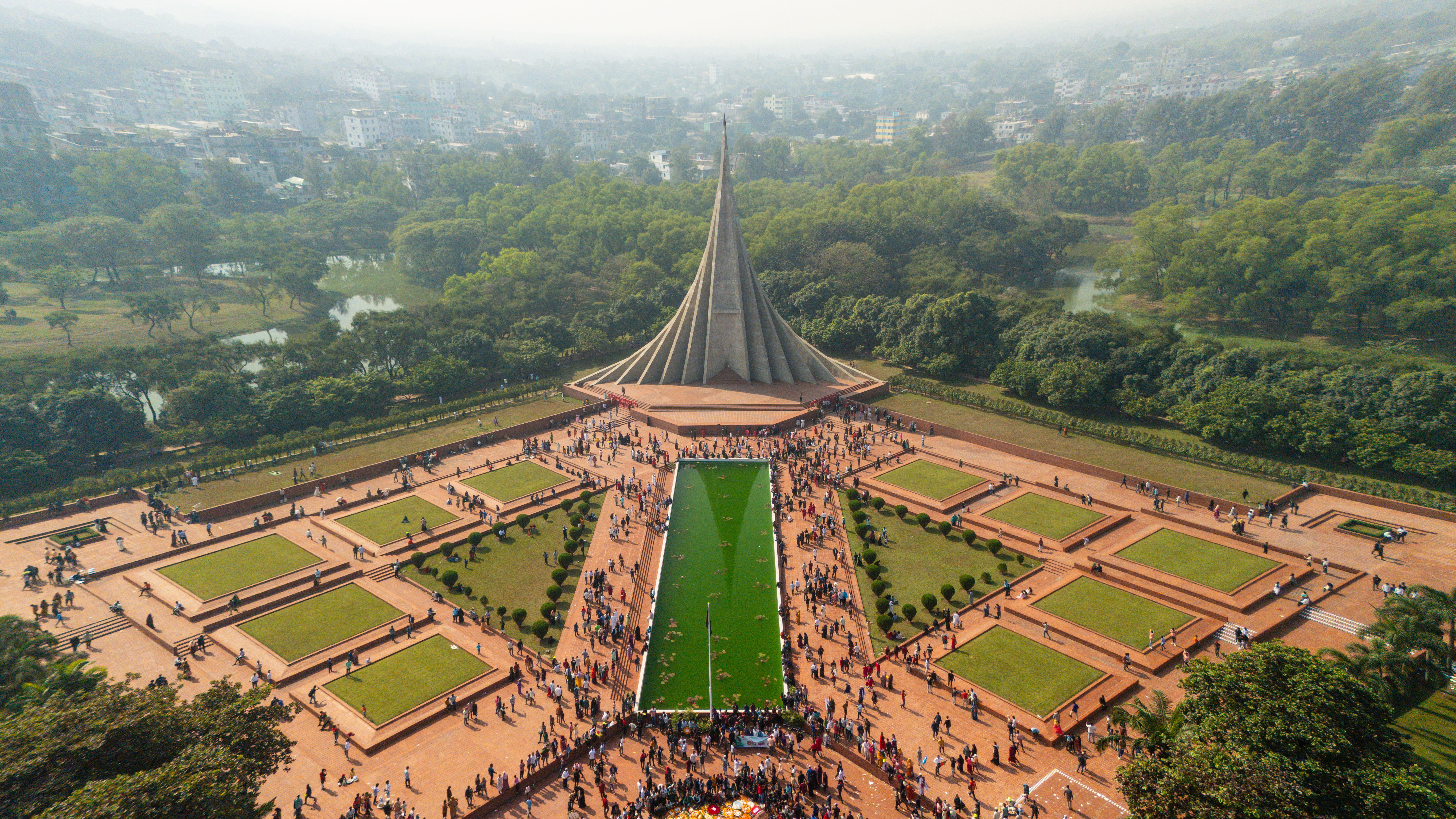 Photo: Somogro Bangladesh / Pexels
Seven concrete blades rise from the plain at জাতীয় স্মৃতিসৌধ as if grief itself had been taught geometry. In Savar, filed under Dhaka, Bangladesh, this is the place to come when you want the story of 1971 stripped of slogans and turned into space, water, and silence. You visit for the monument, then stay for the walk toward it: the long approach, the still lake, the way the memorial keeps changing shape until the last few steps.
Records show that the National Martyrs' Memorial commemorates those killed in the 1971 Liberation War and genocide, but the site does more than mourn a single year. Official readings of its seven planes tie them to a chain of Bengali political struggles from 1952 to 1971, so the memorial reads like compressed national memory rather than a single monument.
The setting does part of the argument. You enter through ordered greenery, hear footsteps sharpen on the paving, and watch the concrete forms pull their reflections across the water like folded paper scaled up to the height of a 15-story building.
Most visitors photograph the spires and miss what matters underfoot. Inside the complex lie graveyards of unknown martyrs, easy to mistake for decorative markers until you realize the country built its national cenotaph around people whose names still haven't come home.
What to see
-
The Main Memorial Across the Water
The surprise is how long the monument refuses to let you arrive. Syed Mainul Hossain's memorial, inaugurated on 16 December 1982, stands 150 feet high, about the height of a 15-storey building, yet the brick approach, the bridge, and the still water keep pushing it just out of reach until the concrete planes suddenly feel less like sculpture and more like a wound held upright. Walk past the first frontal photo spot and keep moving. Banglapedia notes that the seven triangular forms change shape as you circle them, so what looks like a single blade from the gate opens into layered geometry tied to 1952, 1954, 1956, 1962, 1966, 1969, and 1971; the memorial stops being an object then, and starts reading like compressed history. -
Mass Graves and the Shaheed Bedi
The emotional center of the site is lower and quieter than the spire. Several mass graves sit along the approach, and the Shaheed Bedi, the altar where wreaths pile up on 26 March and 16 December, strips away any temptation to treat this as abstract patriotism; people were killed in 1971, and the flowers only make that fact sharper. Come early if you can. In the softer morning light, with dew on the grass and footsteps clicking on red brick, the site feels less ceremonial and more intimate, which is exactly when the scale of national mourning becomes hardest to dodge. -
Walk the Processional Route, Not Just the Postcard View
Treat the whole 34-hectare complex, about the size of 47 football pitches, as the attraction. Start at the entrance, pause for the inscription and foundation stone if they are accessible, then follow the brick walk as it rises, dips, and slows your body down before you cross the water toward the monument; that choreography is the point, because struggle is built into the route rather than explained on a plaque. Skip midday if you want silence. An ordinary winter morning, when fog softens the concrete and the lawns hold a little dampness in the air, lets you peel off toward the water edges and the greener corners where the memorial's severity eases for a moment before the central axis pulls you back.
Plan your visit
- Getting There
- The memorial stands in Nabinagar, Savar, about 35 km northwest of central Dhaka, roughly the length of driving from downtown to the airport and back halfway again. By car or taxi, expect about 50 to 60 minutes in normal traffic via the Dhaka-Aricha Highway; by transit, the clearest route is metro to Uttara Centre or Uttara North, then a taxi for about 25 minutes, or a bus marked Savar or Nobinagar and a short walk from Nabinagar bus stand to the main gate.
- Opening Hours
- As of 2026, no reliable official daily timetable is published. The safest reading is daylight access, with third-party sources suggesting anything from 8:00 AM to 6:00 PM or 9:00 AM to 5:00 PM, while ceremonial closures still happen around 16 December, 26 March, and high-profile state visits.
- Time Needed
- Give it 45 to 60 minutes for the central axis, reflection water, and a quiet walk to the monument. Most visitors need 1.5 to 2 hours, and 2 to 3 hours feels right if you want to linger on the grounds, cross the bridge, and let the place do its work.
- Accessibility
- Banglapedia describes paved approaches with changes in level and a bridge over the artificial lake, so the route is not flat from end to end. As of 2026, I found no official statement on wheelchair ramps, accessible toilets, reserved parking, or other barrier-free features, so travelers with limited mobility should not assume full step-free access.
- Cost and Tickets
- As of 2026, entry appears to be free, and I found no official booking system, timed-entry pass, or skip-the-line option. Paid tours sold online cover transport and a guide, not faster admission.
Photo Gallery


History
The Architect Who Gave Grief a Shape
জাতীয় স্মৃতিসৌধ belongs to Syed Mainul Hossain as much as it belongs to the state. He was 26 when he won the 1978 national design competition, and Bangladesh had handed him an impossible brief: turn fresh grief, political memory, and national legitimacy into a form that could survive speeches, crowds, and time.
Records show that work around the memorial complex had already begun in 1972 with land acquisition and access roads, but Hossain's design gave the place its permanent voice. His concrete planes do not imitate a tomb, a mosque, or a victory arch. They rise, hesitate, narrow, and then meet in a gesture that feels both wounded and defiant.
The turning point
Syed Mainul Hossain's Turning Point
June 1978 changed Hossain's life. Banglapedia and later newspaper accounts record that 57 designs entered the national competition, and his was the one chosen to stand for the dead of 1971 in perpetuity. For a young architect, the stakes were personal as well as professional: if he failed, he would not merely lose a commission, he would fail a country trying to decide how it wished to remember its martyrs.
The turning point came on 16 December 1982, when the memorial was inaugurated on Victory Day and the abstract drawing became national ritual. Crowds, officials, wreaths, water, concrete, all of it finally aligned. And yet later accounts describe a bitter irony: Hossain reportedly was not invited into the main ceremony and saw his own creation only after the dignitaries had gone.
That detail matters because it changes how the monument reads. The memorial is not just a state symbol. It is a work by a man who gave Bangladesh one of its clearest images of itself, then lived long enough to feel how easily nations celebrate the object and forget the hand that made it.
Early Life & Vision
Legacy & Influence
Tips for visitors
Go By Day
Plan for late morning or mid-afternoon, not evening. The memorial reads best in daylight anyway, when the concrete planes throw long shadows and the water catches the sky instead of traffic haze.Avoid State Days
Skip early morning on 16 December and 26 March unless you specifically want the ceremony and the crush. Those hours bring wreath-laying, police cordons, traffic jams from Gabtoli through Nabinagar, and occasional full closure.Match The Tone
Locals treat Smritishoudho as a national mourning ground, not a casual park. Dress modestly, keep voices low near the altar approach, and step back if wreath-laying or official tributes are underway.Photos, Yes
Phone and regular camera shots are common on ordinary days, but drones are the category most likely to cause trouble under Bangladesh's tighter aviation rules. Tripods and pro-level setups can draw attention when security is already tense.Eat Afterward
Food is better treated as a post-visit ritual than part of the memorial itself: Dakpion Cafe and Restaurant in Nabinagar is a useful budget-to-mid-range stop, New Savar Nanna Biriyani near Savar Bus Stand is cheap and practical, and Blue Mountain Restaurant works if you want a longer family-style meal.Decline Firmly
Freelance photographers can be persistent around the grounds. A clear no and steady walking usually works better than polite hesitation, which tends to invite a second sales pitch.
Frequently asked
Is National Martyrs' Memorial worth visiting?
Yes, if you want to understand how Bangladesh turns grief into public memory. This is not a museum stop with labels and air-conditioning; it is a 46-meter monument, about as tall as a 15-storey building, set inside a processional ground of red brick, water, graves, and long sightlines. Go for the walk as much as the monument, because the route tells the story.
How long do you need at National Martyrs' Memorial?
Most visitors need 1.5 to 2 hours. An hour covers the main axis, the reflecting water, and a slow approach to the monument, while 2 to 3 hours gives you time to circle for side views and notice the graves of unknown martyrs that many people pass without understanding. Heat and traffic can stretch the day.
How do I get to National Martyrs' Memorial from Dhaka?
The easiest route is by car or taxi to Savar, about 35 kilometers northwest of Dhaka, roughly the length of crossing a large city end to end. Public transport works too: take a bus toward Savar or Nabinagar, get off near Nabinagar bus stand, then walk to the main gate on the Dhaka-Aricha Highway. Metro does not reach the memorial directly, though current route planners suggest using the metro to Uttara and taking a taxi from there.
What is the best time to visit National Martyrs' Memorial?
Go on a quiet morning on an ordinary day. Early light sharpens the concrete planes, the brick paths stay cooler underfoot, and the place feels closer to a vigil than a picnic ground; national days such as 26 March and 16 December bring flowers, bugles, crowds, and heavy security instead. If you want ceremony, choose those dates, but don't expect calm.
Can you visit National Martyrs' Memorial for free?
Yes, current visitor sources indicate that entry is free. I found no reliable sign of an online booking system or paid general admission, though access can close without much romance before state visits, security operations, or the wreath-laying ceremonies on 16 December and 26 March. Free does not mean frictionless.
What should I not miss at National Martyrs' Memorial?
Don't stop at the postcard view from the front. Walk the full approach, cross the bridge over the water, then look back from the side angles where the seven concrete planes shift shape; Banglapedia notes that the monument changes as you move around it, and that is one of the design's quiet tricks. And pause at the grave markers for unknown martyrs, because that is where the memorial stops being abstract.
Sources & attribution 80
- Banglapedia — Core source for the memorial's history, phased construction from 1972, site layout, monument form, dimensions, and approach sequence.
- Bangladesh Tourism Board — Official tourism summary for location, symbolism of the seven forms, competition timeline, and general access context.
- Wikipedia — Background summary used to cross-check the memorial's identity, symbolism, and common framing.
- Bangladesh Tourism Board — Used to verify the 21 February 1952 Language Movement connection in official commemorative framing.
- Bangladesh Tourism Board — Used for Independence Day and Victory Day context, including 26 March 1971 and 16 December 1971.
- A Walk in the World — Secondary travel-history article used for contextual war chronology and popular interpretation.
- The Daily Star — Feature on the memorial's symbolism, Mainul Hossain, public ritual role, and the politics of memorialization.
- Prothom Alo English — Used to confirm Syed Mainul Hossain's posthumous Independence Award in 2022.
- UNB — Used to confirm the 2022 posthumous Independence Award for Syed Mainul Hossain.
- The Daily Star — Used for the anecdote about Mainul Hossain's neglect and reported absence from the inauguration ceremony.
- The Daily Star — Used for public readings of the seven forms, including links to the seven Birshreshtho.
- Bangla Tribune — Used for reporting on the unknown martyrs' graveyards inside the complex and the archival gap around them.
- The Business Standard — Used for recent maintenance, repainting, lake restoration, and Victory Day preparations in December 2025.
- Banglapedia — Used to verify the historical background of 21 February 1952.
- Banglapedia — Used to verify the 1954 United Front election context referenced in the memorial's symbolism.
- Wikipedia — Used cautiously for the 1962 education movement date in the symbolic sequence.
- Banglapedia — Used to verify key 1966 Six-Point movement dates in the memorial's historical frame.
- Banglapedia — Used to verify the 25 March 1971 crackdown in Dhaka.
- Britannica — Used for broad confirmation of Bangladesh Liberation War chronology.
- The Business Standard — Used for temporary public-entry restrictions around Victory Day in December 2025.
- The Daily Star — Used for security measures and access restrictions during a major political visit.
- Dhaka Tribune — Used for February 2026 public-entry suspension ahead of an official tribute.
- The Business Standard — Used for route-management and security rules before Independence Day observances.
- Bangladesh Tourism Board — Official visitor-facing listing used for location and public-facing practical context.
- Rome2Rio — Used for current route-planning estimates from Dhaka, including metro-plus-taxi options.
- Trip.com — Used for visitor timing estimates, free-entry claims, and address formatting.
- Tripadvisor — Used for visitor impressions, commonly shown opening-hour claims, and practical traveler observations.
- Tripadvisor — Used for traveler-reported confirmation that general entry is free.
- Tripadvisor — Used for user-reported daylight-based visiting hours.
- GoWithGuide — Used for route description, on-site timing, parking, refreshments, and visitor flow.
- Radisson Hotels — Used for third-party visitor guidance on hours and on-site restaurant claims.
- Dhaka Bus Service — Used to identify bus routes connecting central Dhaka with Savar and Nabinagar.
- Dhaka Bus Service — Used to identify bus routes serving Nabinagar and Savar.
- Dhaka Bus Service — Used to identify Savar-linked bus service from Dhaka.
- Dhaka Bus Service — Used to identify Savar and Nabinagar bus options.
- Dhaka Bus Service — Used to identify AC bus service passing through Baipayl, Nabinagar, and Savar.
- Dhaka Bus Service — Used to identify another bus route passing through Nabinagar and Savar.
- CBCL Bangladesh — Used for third-party visitor hour estimates and typical visit duration.
- Offroad Bangladesh — Used for corroborating free-entry claims.
- Bproperty — Used for descriptive reporting on the approach route, bridge, paving, and secondary site details.
- Rochona — Used as a secondary source for entrance inscription and foundation-stone details.
- Wikimedia Commons — Used to verify the presence of a lake or lily-pond area within the memorial grounds.
- Archnet — Used for architectural classification and framing of the memorial as a modernist monument.
- The Indian Express — Used to corroborate key dates, symbolism, and public explanation of the memorial form.
- Tripadvisor — Used for references to mass graves, side details, and visitor observations inside the grounds.
- Dhaka Tribune — Used for current ceremony coverage and floral tributes on national observance days.
- BSS News — Used for Victory Day ceremony details, wreath-laying, public participation, and behavioral expectations.
- The Economic Times — Used for ceremony atmosphere, including bugles and state homage.
- Wikimedia Commons — Used to assess common frontal viewpoints and visual reading of the monument.
- Voice7 News — Used for reporting on fog and winter atmosphere around Victory Day at the memorial.
- Prothom Alo English — Used for ordinary-day visitor atmosphere and flower-selling context near the memorial.
- Dhaka Tribune — Used to corroborate the 1978 competition and Syed Mainul Hossain's authorship.
- Texas Tech University Libraries — Used to corroborate the 16 December 1982 inauguration date.
- Armed Forces Division, Bangladesh — Used to confirm official Victory Day commemorative practice at the memorial.
- The Daily Star — Used to confirm Independence Day observances and the memorial's role in them.
- The Daily Star — Used for ceremony details, crowd composition, and public homage on Independence Day.
- Prothom Alo English — Used to confirm Independence Day tribute activity at the memorial.
- Prothom Alo — Used to show common local shorthand such as 'Savar Smritishoudho' in Bengali coverage.
- Prothom Alo — Used to show everyday Bengali shorthand for the memorial in local media.
- Tripadvisor — Used for nearby dining context in the Savar area.
- Nandan Park — Used for nearby food and leisure context around Nabinagar and Savar.
- The Daily Star — Used for the memorial's place in broader Bengali architectural history.
- Dhaka Tribune — Used for crowd control and traffic management around major commemorations.
- The Daily Star — Used for the memorial's political charge and conflict around a 2025 procession.
- Prothom Alo — Used to mirror Bengali reporting on the 2025 procession clash.
- The Daily Star — Used for protocol details, wreath-laying practice, and public access during a high-profile political visit.
- Foodpanda — Used for nearby budget food context around Savar Bus Stand.
- Restaurants10 — Used for nearby restaurant options and price clues in Nabinagar, Savar.
- Foodpanda — Used for nearby cafe and snack pricing around Savar Bus Stand.
- Foodpanda — Used for nearby chain-style bakery and snack options.
- Amar Vacation — Used for another nearby dining reference in the Nabinagar area.
- Wikimedia Commons — Used to verify the visual character of Independence Day floral tributes.
- Wikimedia Commons — Used to verify lateral viewpoints and how the monument reads from the side.
- Prothom Alo English — Used for 2026 pre-Independence Day closure and preservation warnings.
- BSS News — Used to confirm 2026 cleaning, security, and closure measures before Independence Day.
- The Daily Star — Used to confirm the February 2026 tribute visit after the temporary public-entry suspension.
- Dhaka Tribune — Used for public-access control and standard approach references via Nabinagar and the main gate.
- Banglapedia — Used to distinguish the National Martyrs' Memorial from the Central Shaheed Minar and their different commemorative roles.
- YouTube — Used as light local-culture evidence for roadside jhal muri around Nabinagar and Savar.
- The Daily Star — Used for national drone-rule context relevant to photography planning.
Built from cited sources · see the method · How we make our guides →
More in Dhaka.
107 places to discover — a few worth pairing.

Pick up where you left off
Saved and recently read places — kept on this device only.
Photo credits (14)
- Somogro Bangladesh — Pexels License (https://www.pexels.com/license/) — Source: https://www.pexels.com/photo/35258589/
- Sayeed Chowdhury — Pexels License (https://www.pexels.com/license/) — Source: https://www.pexels.com/photo/35252674/
- 20180901125023 IMG 3860 — Itissakib — CC BY-SA 4.0 (https://creativecommons.org/licenses/by-sa/4.0/) — Source: https://commons.wikimedia.org/wiki/File:20180901125023_IMG_3860.jpg
- 4.জাতীয় স্মৃতিসৌধ — Pinu Rahman — CC BY-SA 4.0 (https://creativecommons.org/licenses/by-sa/4.0/) — Source: https://commons.wikimedia.org/wiki/File:4.জাতীয়_স্মৃতিসৌধ.jpg
- Bmcopy — Mamun Ismail — CC BY-SA 4.0 (https://creativecommons.org/licenses/by-sa/4.0/) — Source: https://commons.wikimedia.org/wiki/File:Bmcopy.jpg
- A normal photo of nationalmonument — Shuvo Ck — CC BY-SA 4.0 (https://creativecommons.org/licenses/by-sa/4.0/) — Source: https://commons.wikimedia.org/wiki/File:A_normal_photo_of_nationalmonument.jpg
- Final edited DVD 7 JATIO SMRITI SAOD 043 — Babul abdul malek — CC BY-SA 4.0 (https://creativecommons.org/licenses/by-sa/4.0/) — Source: https://commons.wikimedia.org/wiki/File:Final_edited_DVD_7_JATIO_SMRITI_SAOD_043.jpg
- Bangladesh National Martyrs' Memorial Monument 2 — Mohammadalimranhasan — CC BY-SA 4.0 (https://creativecommons.org/licenses/by-sa/4.0/) — Source: https://commons.wikimedia.org/wiki/File:Bangladesh_National_Martyrs'_Memorial_Monument_2.jpg
- JATIO SMRITI SAOD - — Babul abdul malek — CC BY-SA 4.0 (https://creativecommons.org/licenses/by-sa/4.0/) — Source: https://commons.wikimedia.org/wiki/File:JATIO_SMRITI_SAOD_-.jpg
- JATIO SMRITI SAOD -S — Babul abdul malek — CC BY-SA 4.0 (https://creativecommons.org/licenses/by-sa/4.0/) — Source: https://commons.wikimedia.org/wiki/File:JATIO_SMRITI_SAOD_-S.jpg
- JATIO SMRITI SAOD -K — Babul abdul malek — CC BY-SA 4.0 (https://creativecommons.org/licenses/by-sa/4.0/) — Source: https://commons.wikimedia.org/wiki/File:JATIO_SMRITI_SAOD_-K.jpg
- Sriti shoud — Luthador — CC BY-SA 3.0 (https://creativecommons.org/licenses/by-sa/3.0/) — Source: https://commons.wikimedia.org/wiki/File:Sriti_shoud.jpeg
- JATIO SMRITI SAOD -A — Babul abdul malek — CC BY-SA 4.0 (https://creativecommons.org/licenses/by-sa/4.0/) — Source: https://commons.wikimedia.org/wiki/File:JATIO_SMRITI_SAOD_-A.jpg
- JATIO SMRITI SAOD -D — Babul abdul malek — CC BY-SA 4.0 (https://creativecommons.org/licenses/by-sa/4.0/) — Source: https://commons.wikimedia.org/wiki/File:JATIO_SMRITI_SAOD_-D.jpg
Photos may have been resized or cropped.