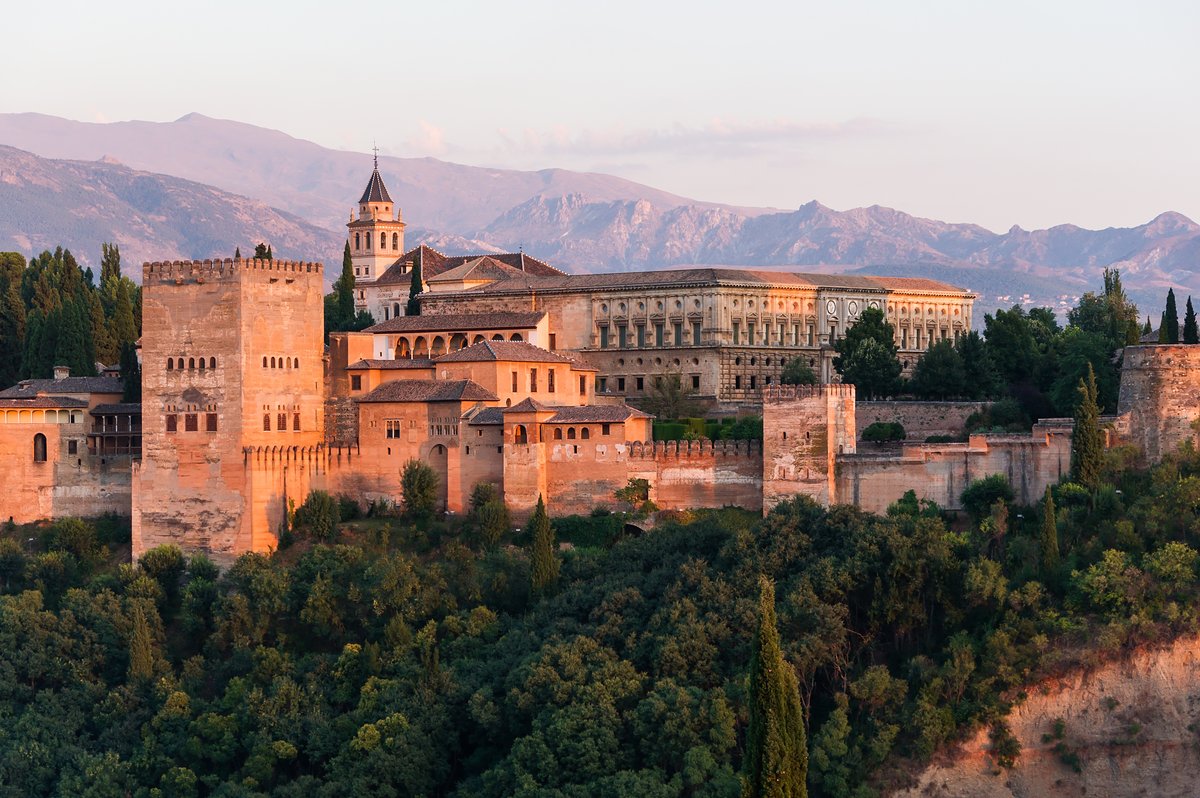
The garden tourists photograph as a preserved fourteenth-century Islamic paradise was mostly designed in 1931. The Generalife, perched on the Cerro del Sol above Granada's Alhambra in southern Spain, is a Nasrid summer palace layered with Italian formal beds, nineteenth-century water jets, and a rose labyrinth added by a Republican-era architect. Come for the Moorish bones; stay for the strange, beautiful palimpsest Spain built on top of them.
The complex sits about ten minutes' walk from the main Alhambra gates, linked by cypress avenues and a working 800-year-old irrigation channel called the Acequia Real. Built as an almunia — a country villa crossed with a market garden — it served Granada's last Muslim dynasty as the place to escape court intrigue without leaving the hilltop.
Most visitors arrive already saturated from the Nasrid palaces below and mistake the Generalife for an afterthought. It isn't. The Patio de la Acequia, with its twin rows of water jets and long pool, is arguably the most photographed Islamic garden on earth. It is also almost entirely the product of twentieth-century restorers reading their own idea of paradise back into the stones.
What survives intact is more interesting than the postcard suggests: a 1319 mirador that invented a whole architectural form, a stairway where water runs down the handrails, and ten verses of propaganda-poetry carved above a doorway by a vizier who knew his dynasty was running out of time. Bring headphones and read the inscriptions. Almost nobody does.
Researched by the Audiala editorial team from historical records, architectural archives, and local expertise.
What to see
Patio de la Acequia
Forty-nine meters long, twelve wide — a slot of water and stone oriented like a drawn sword toward the Albaicín. The Acequia Real runs down the center in an open channel, fed by snowmelt diverted from the Rio Darro eight kilometers up in the Sierra Nevada. The canal was dug first; the palace was built around it. You're not standing in a garden with a fountain. You're standing inside working irrigation infrastructure that a sultan decided to wrap in marble.
The crossing water jets everyone photographs? Not Nasrid. They're 19th- and 20th-century additions — the medieval patio had a single quiet central channel, nothing more. Knowing this reframes the sound: that higher-pitched splash layered over the deeper murmur is a Victorian embellishment on a 700-year-old spine.
Look up at the north pavilion and you'll see the collision of two civilizations grafted together. Five slender Islamic arches carved with sebka diamond-lattice stucco — then the Catholic Monarchs' heavier upper story, bolted on in 1494 after the Reconquista. Step under the portico and three marble arches with muqarnas stalactite capitals reveal themselves behind the five. The Arabic inscription bands running along the walls were composed by Ibn al-Jayyab, vizier-poet to Isma'il I, around 1319. Most visitors register calligraphy and walk on. The text is actual verse, praising the ruler and the garden as paradise.
Escalera del Agua
Fourteenth-century, three flights, laurel trees arched overhead like a green tunnel — and water running on every surface you can reach. The handrails aren't handrails. They're carved stone channels, fed by the Acequia Real, and cold Sierra Nevada water flows down them fast enough that you hear it before you see it. Run your hand along the top of the parapet as you climb. Every local guide tells you to, and they're right: in July heat the shock of that cold is the single most physical sensation in the whole Alhambra complex.
At each landing, a small round patio with a pool and a fountain; water also runs down the center of the steps between your feet. At the midpoint where all four sources overlap — handrail channels left and right, stair channel below, landing fountain ahead — the acoustics stack into something enveloping. Laurel scent intensifies in the warmth overhead. This is the coolest microclimate on the site, measurably.
Most day-trippers turn around here. Keep climbing. The upper terrace hands you the whole Generalife, the Alhambra towers, and the Cerro del Sol in one sweep.
Patio de la Sultana & the broken cypress
Tucked behind the north pavilion through a passage most hurried visitors miss — a U-shaped pool, Baroque jets, myrtle hedges clipped flat enough to sit on, and one enormous dead tree held upright by a metal brace. That's the Ciprés de la Sultana. Legend holds that Morayma, wife of Boabdil — the last Nasrid sultan — met a knight of the Abencerrajes clan here in secret; when the sultan found out, he massacred the entire family in the Alhambra's Court of Lions. The original cypress is the desiccated trunk. A younger replacement grows beside it. A bronze plaque explains, quietly.
Come at opening or just before closing. The arcaded loggia on the north side is a Renaissance addition from 1584–1586, grafted on like the north pavilion's upper floor — Christian Spain writing over Nasrid Granada, again. On still mornings the cypress and myrtle reflect in the pool and the only sound is water. It's the quietest patio on the whole ridge.
Plan your visit
Getting There
Bus C30 from Plaza Isabel la Católica (Columbus monument) runs every 8–12 minutes and drops you at the Alhambra–Generalife 2 stop, the closest to the garden entrance. Walking up Cuesta de Gomérez from Plaza Nueva takes 15–20 minutes on cobbles with grades up to 23% — beautiful, brutal in August. Drivers use the Ronda Sur (A-395) to the 500-space lot: €3.17/hr, capped at €21.70/day.
Opening Hours
As of 2026, the complex opens daily 08:30–20:00 from 15 March to 14 October, then 08:30–18:00 in winter. Night Generalife runs Tue–Sat 22:00–23:30 in summer, Fri–Sat 20:00–21:30 in winter. Note: night Generalife and night Nasrid Palaces tickets are mutually exclusive — pick one.
Time Needed
Generalife gardens alone deserve 60–90 minutes; pair with the Alcazaba and you're at two hours. The full complex with Nasrid Palaces realistically wants 3–4 hours, and photographers or garden lovers should plan 4–5. Do not underestimate the walking between zones — about an hour just on transit paths.
Tickets
As of 2026, the full Alhambra General ticket runs roughly €22; the Jardines, Generalife y Alcazaba ticket (no Nasrid Palaces) is €12.73. Children under 12 enter free but still need a ticket. Buy only from tickets.alhambra-patronato.es — third-party resellers have charged up to €99 for a €13 ticket.
Accessibility
Generalife garden paths are largely flat and wheelchair-friendly, and roughly 60% of the wider complex is accessible independently. The Nasrid Palaces interior and Alcazaba tower are not. Wheelchairs are loaned free at the Entrance Pavilion on a first-come basis — no advance reservation possible.
Tickets & tours.
These are guided options from our partners — same price as booking direct.
Prices are indicative — final pricing and availability are confirmed at checkout. Audiala may earn a commission from bookings made through these links.
Also on GetYourGuide
More tours for Generalife
Curated from GetYourGuide. Same price as official, free cancellation on most.
Prices shown are indicative — final pricing and availability are confirmed at checkout. Audiala may receive a commission from bookings made via these links.
Photo Gallery
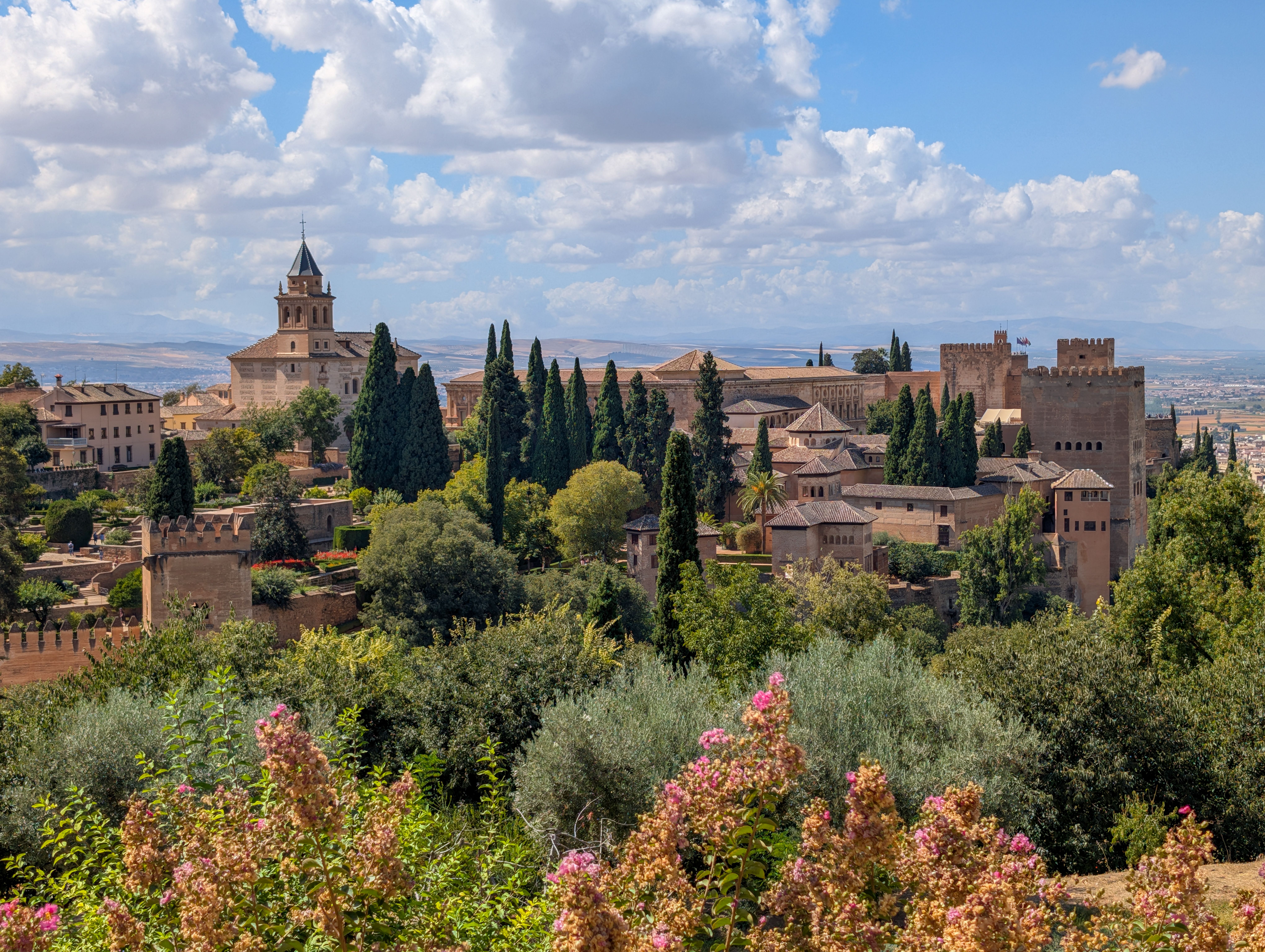
A quiet courtyard at the Generalife shows rough stone walls, brick arches, and clipped greenery in strong Granada sun. The scene captures the palace gardens' calm, fortified character. · JuandevMorning light falls across the whitewashed arcades, tiled roofs, and formal gardens of the Generalife in Granada. The elevated view captures the palace's calm geometry against the Andalusian sky. · Robot8AA view of Generalife, Granada, Spain. · Tibor KovacsA warm midday view of the Generalife shows its brick walls, tiled roofs, and shaded garden paths against a deep blue Andalusian sky. Cypress trees and stonework give the scene its quiet, fortified character. · Jebulon
History
House of the Felicitous Kingdom
Construction likely began in the late thirteenth century under Muhammad II or his son Muhammad III — scholars still argue which — as a working estate of orchards, vegetable plots and pleasure pavilions above the Alhambra. The Arabic name jannat al-'arīf gets translated as Garden of the Architect, the Artist, or the Gnostic, depending on who is selling you the guidebook. Arabist Robert Irwin has warned that the true etymology is genuinely unresolved.
An ornamental inscription inside the palace calls it Dar al-Mamlakat as-Sa'ida — House of the Felicitous Kingdom. That phrase was not decoration. It was a political claim, carved in stucco at a moment when the Nasrid court was fracturing from the inside.
The turning point
Ibn al-Jayyab and the Poet Who Carved a Dynasty Into the Walls
Around 1319, the sultan Isma'il I remodeled the Generalife and handed the decorative programme to his vizier and chief chancery secretary, Abu al-Qasim Muhammad ibn al-Jayyab. Ibn al-Jayyab held the royal seal. He also wrote verse. At Isma'il's court those two jobs were the same job — poetry on a palace wall was legal instrument, liturgy and propaganda compressed into one.
What was at stake for him personally was not small. Isma'il had taken the throne in a coup against his uncle, and factional knives were still out. Ibn al-Jayyab's ten-verse poem in the alfiz above the tripartite arch of the north portico, and the two five-verse poems flanking the reception-hall niches, were the official record naming the palace the House of the Felicitous Kingdom. Call a contested reign felicitous in stone, and you help make it so.
He belongs to a triumvirate with Ibn al-Khatib and Ibn Zamrak whose inscriptions saturate the Alhambra complex — what scholars call talking architecture. Ibn al-Jayyab died in 1349. His verses outlasted three more sultans, the Reconquista of 1492, the Catholic Monarchs' renovations, a 1958 fire, and are still legible above your head. Almost every visitor photographs them without reading a word.
The 1958 Fire That Revealed the Real Garden
In 1958 a fire of unknown cause tore through the northern pavilions. The disaster turned into the most productive archaeological event in the palace's modern history. Excavators clearing debris found seventy centimetres of accumulated fill sitting on top of intact fourteenth-century Nasrid layers: original paving stones, twelve water spouts, and the remains of a hammam and an oratory that had vanished from the historical record entirely. The romantic garden nineteenth-century travellers had swooned over was, it turned out, a lid laid over the real thing. Much of what was uncovered was then covered again with modern materials, and full English-language publication of the findings still does not exist.
The Sultana, the Cypress and a 1595 Novel
The legend goes that Boabdil's wife Morayma met a knight of the Abencerraje family under the great cypress in the Patio del Ciprés de la Sultana, was denounced, and watched her lover's kin beheaded in the Alhambra below. The story was invented, scene by scene, by Ginés Pérez de Hita in his historical novel Guerras civiles de Granada, published in stages from 1595. He fabricated an Arabic source to lend it authority; Washington Irving dismissed the massacre as fiction in 1832. The real Morayma — Maryam bint Ibrahim al-'Attar, married at about fifteen, imprisoned by her father-in-law, her children taken as Castilian hostages — died in 1493 without ever reaching the Fez exile planned for her. The cypress itself lived about six hundred years and died in the late 1980s. Its dried trunk still stands, labelled.
Tips for visitors
Book six weeks out
Nasrid Palaces slots sell out months ahead from April through October. Book 6–8 weeks minimum, and have every visitor's passport or ID number ready — the booking form requires them.
First slot or night
The 08:30 entry and the night Generalife are the only two windows where the gardens feel like yours. Midday in summer means 40°C heat, full coaches, and queues at every photo spot — skip it.
No tripods, no drones
Personal photos are fine in the gardens, but tripods, monopods, and selfie sticks are banned across the complex and staff enforce it. Drones sit in a restricted Spanish flight zone — fines apply, do not attempt.
Eat down in Albaicín
Walk 10 minutes downhill instead of eating at the gates — prices halve, free tapas reappear with every drink. Try Casa Torcuato for hyper-local bar food, Las Tomasas for terrace dining with remojón granadino, or Jardines de Zoraya for tortilla del Sacromonte with flamenco.
Ignore the gate touts
Unofficial guides cluster at Cuesta de Gomérez offering skip-the-line deals — there is no line to skip, entry is timed and ticketed. Pickpockets work the Mirador de San Nicolás at sunset and the lower Albaicín lanes; front pockets only.
Walk the upper huerta
Past the formal gardens, uphill, lie the working agricultural terraces of the original almunia estate. Almost no tour group climbs that far — the quiet and the view back over the Alhambra are the reward.
Festival in the gardens
The Festival Internacional de Música y Danza runs 13 June – 18 July 2026 (75th edition), with ballet performances staged in the open-air Teatro del Generalife itself. Book in January — these tickets vanish faster than the daytime Nasrid slots.
Free lockers inside
Large bags can't enter the monuments, but free lockers sit just below the main ticket office with any valid ticket. No storage at the Generalife gate itself, so leave heavy luggage in city-centre lockers near Bib-Rambla before you start the climb.
Where to Eat
local_dining
Don't Leave Without Trying
Plato Alpujarreño — fried eggs, blood sausage, ham, chorizo, potatoes, green peppersRemojón Granadino — cold salad of shredded salt cod, orange segments, onion, and black olivesTortilla del Sacromonte — omelette with offal (brains, lamb's testicles); specialty of the Sacromonte cave districtPatatas a lo Pobre — slow-fried potatoes, onions, and green peppers in olive oilJamón de Trevélez — DOP-protected cured ham from Sierra Nevada, aged up to 36 monthsPiononos — rolled sponge cake soaked in syrup with toasted cream topping; traditional pastry from Santa Fe near Granada
La Telefónica
fine dining
Spanish Contemporary€€star4.9(9915)
Order: The octopus and crispy fried eggplants are legendary. The Iberico pork shoulder is juicy and well-marbled — as impressive as their steak. Ask staff for wine pairing recommendations.
Nearly 10,000 reviews at 4.9 stars. Granada's most trusted table where locals and serious eaters converge. Every dish carries unmistakable care, and staff like Rocio treat you like a regular.
Order: Order whatever the wife has cooked that day — the menu changes, but each dish is executed with extraordinary care. Come adventurous.
Family-run kitchen in the Albaicín where the wife cooks and the husband serves with genuine warmth. Small and intentional: every dish lands; the whole experience feels like cooking at a friend's.
Order: Fried eggs with homemade chilli oil and toasted almonds on sourdough. The croissants are flaky and fresh; the nut cheesecake will surprise you.
Quality-first brunch where fresh ingredients and creativity actually matter. Rustic-industrial space; coffee treated like an art form; seasonal combinations keep locals coming back.
Order: Fried eggs with olive oil on sourdough — they arrive fast and taste impeccable. The turkey & cheese croissants are flaky; the banana chocolate crêpe rewards early rising.
6,600+ reviews: this is where Granada eats breakfast. Self-service via QR (no wait), excellent value (€16 for eggs, coffee, juice), and a modern vibe that pulls both locals and visitors.
checkFree tapas come with every drink order in Granada — order a beer or wine and a tapa arrives automatically. This is how locals eat: the tapeo crawl, moving bar to bar through the evening.
checkLunch (comida) peaks 2–4 PM; dinner (cena) runs 8:30–11 PM. Kitchens typically open at 8 PM, and locals eat 9–10:30 PM.
checkMonday closures are the norm — most restaurants shut Mondays. Always verify hours.
checkTipping is discretionary, not expected. Locals round up or leave loose coins — €3–8 on a €40–80 bill is genuinely generous.
checkCarry cash for small bars, markets, and tips (card terminals rarely support tipping).
checkMercado San Agustín (opposite the Cathedral): Sunday–Friday 8 AM–midnight, Saturday 8 AM–1 AM. Plaza Larga (Albaicín): Saturdays 10 AM–3 PM only.
Food districts:Albaicín — oldest Arab quarter with narrow cobbled streets, Moroccan teahouses (teterías), and tapas bars with Alhambra viewsRealejo — former Jewish quarter; mix of traditional and contemporary, craft beer bars, vegan tapas, lively local scenePlaza Nueva / Calle Navas / Calle Elvira — dense concentration of tapas bars at city centre; high tourist volume but genuinely popular with localsSacromonte — cave district above Albaicín, famous for flamenco dinner shows
Restaurant data powered by Google
Watch & Explore Generalife.
Explore Granada
The Alhambra Explained
Manuel Bravo19 min1M
Explore Granada
▶️ must-see attractions in GRANADA 🇪🇸 # 124
ROAD TRIP Spain and Portugal27 min84K
Frequently asked
Is the Generalife worth visiting?
Yes — if you care about gardens, water, or Islamic architecture, skip it at your peril. It's the finest surviving Nasrid almunia (royal country estate), and the Escalera del Agua — a 14th-century stairway with water running down the stone handrails — has no equivalent anywhere else in Europe. Book it as part of the full Alhambra ticket, not as a standalone.
How long do you need at the Generalife?
Plan 1 to 1.5 hours for the gardens and palace alone. If you're doing the full Alhambra complex (Nasrid Palaces + Alcazaba + Generalife), budget 3–4 hours minimum. Photographers and garden lovers should add another hour for the upper terraces, which most day-trippers skip.
How do I get to the Generalife from Granada city centre?
Take bus C30 from Plaza Isabel la Católica (next to the Columbus monument) — runs every 8–12 minutes, drops you at the "Alhambra – Generalife 2" stop, closest to the Generalife gate. Walking up the Cuesta de Gomérez takes 15–20 minutes on steep cobbles. By car: Ronda Sur (A-395) to the guarded 500-space car park, €3.17/hr, max €21.70/day.
What is the best time to visit the Generalife?
First slot of the day (08:30) or a night visit — these are the only windows when the gardens feel quiet. May brings peak bloom: roses, wisteria, orange blossom, the air thick with it. Avoid midday in July–August, when the hill hits 40°C and tour groups pack the Patio de la Acequia.
Can you visit the Generalife for free?
Not for general visitors — no free days exist. Children under 12 enter free (ticket still required), Granada province residents get free Sunday access via "La Alhambra más cerca," and EU seniors 65+/students/disabled visitors qualify for reduced rates. The Palacio de Carlos V and Alhambra Museum inside the complex are always free.
What should I not miss at the Generalife?
The Escalera del Agua — the three-flight water stairway with cold Sierra Nevada water running along the carved stone handrails under a laurel canopy. Also: the Ibn al-Jayyab poems carved around the north pavilion arches (composed 1319, most visitors walk past them), the layered 5-arch-then-3-marble-arch portico, and the dead 600-year-old cypress in the Patio de la Sultana, now held upright by a metal brace.
Is the Generalife the same as the Alhambra?
No — the Generalife was the Nasrid sultans' private country retreat (almunia), a separate palace and working farm on the Cerro del Sol hill, connected to the Alhambra by a covered walkway. A single standard ticket covers both, but they're architecturally and functionally distinct: the Alhambra is a fortified royal city, the Generalife is where the sultan went to get away from it.
Are the Generalife gardens original?
Mostly no, and this surprises people. Leopoldo Torres Balbás (1931) and Francisco Prieto Moreno (1931–1951) redesigned most of what you see, adding Italian-influenced formal elements and the rose labyrinth. The famous crossing water jets in the Patio de la Acequia are 19th-century additions — the original 14th-century court had a single central channel. The Acequia Real canal (1238) and the Escalera del Agua are genuinely Nasrid.
Sources & attribution73
Researched and written by the Audiala editorial team from historical records, architectural archives, and local expertise. Last updated April 2026.
Granada trip203 — Tibor Kovacs — CC BY 2.0 (https://creativecommons.org/licenses/by/2.0/) — Source: https://commons.wikimedia.org/wiki/File:Granada_trip203.jpg
Strictly necessary cookies keep the site working. Analytics (PostHog, Google Analytics) measures how each visitor uses our pages. Marketing loads YouTube videos and walking-route maps without a tap and lets Google Analytics set advertising cookies. We never sell your data. You can change this any time from the footer.
Analytics and marketing cookies are optional and only load if you agree. Details under Customize.
Privacy
Cookie preferences
Pick what you're okay with. You can change this any time from the footer.
Strictly necessary
Always on
Sign-in, language, navigation. Always on.
Product analytics
PostHog (EU) and Google Analytics record which pages you view and how you use them, under a random identifier stored in your browser. Helps us see which pages work and which need fixing. Google's ad personalisation stays off. No selling.
Marketing
Loads YouTube videos and the walking-route maps (OpenFreeMap) without a tap; without it, they load only when you tap them. If analytics is also on, Google Analytics may set advertising cookies. Ad personalisation stays off.