Type 2+ letters to search all countries, cities, and places
/Ctrl KEsc
travel_explore
Type 2+ letters to search all countries, cities, and places
Press Enter to open the top result
Great Mosque of Tirana
Tirana·Albania·41° N · 19° E·Updated Apr 2026
Opened in October 2024 after a 32-year delay, Tirana’s Namazgjaja is less a quiet landmark than a fault line of faith, politics, and memory in the city center.
A mosque built for Friday prayer now stands in the thick of Albanian state power, almost shoulder to shoulder with Parliament. The Great Mosque of Tirana, known locally as Namazgja, gives you a sharp way into Tirana, Albania: come for the vast dome, the pale stone, and the blue-washed interior light, but stay for what the building says about faith, politics, and who gets to shape a capital city.
This is not Tirana's old Ottoman mosque scaled up. It is a 21st-century answer to a very public absence. For years, documented accounts describe worshippers spilling into streets and squares on major holidays because Et'hem Bey Mosque could not hold them.
That tension still clings to the place. You hear traffic from the boulevard, see government buildings close by, then step into a prayer hall where sound softens and the ceiling seems to lift away like a second sky.
Visit after you've walked through Tirana a bit. The contrast lands harder then. This mosque makes sense only when you see how the city carries Ottoman memory, communist rupture, and a modern skyline that keeps arguing with both.
Researched by the Audiala editorial team from historical records, architectural archives, and local expertise.
What to see
The Main Prayer Hall
The surprise comes after the threshold: one moment you are in traffic-heavy central Tirana, the next your shoes are off and the sound drops into carpet, echo, and low voices under a dome roughly 30 to 35 meters high, about the height of a 10-storey apartment block. Look up first; the ring of light, Arabic inscriptions, painted motifs, and chandelier lines do more than decorate the room, they tell you this mosque was built to give Albania's capital the scale its Muslim community had been asking for since the 1990s.
The Courtyard, Minarets, and Ablution Area
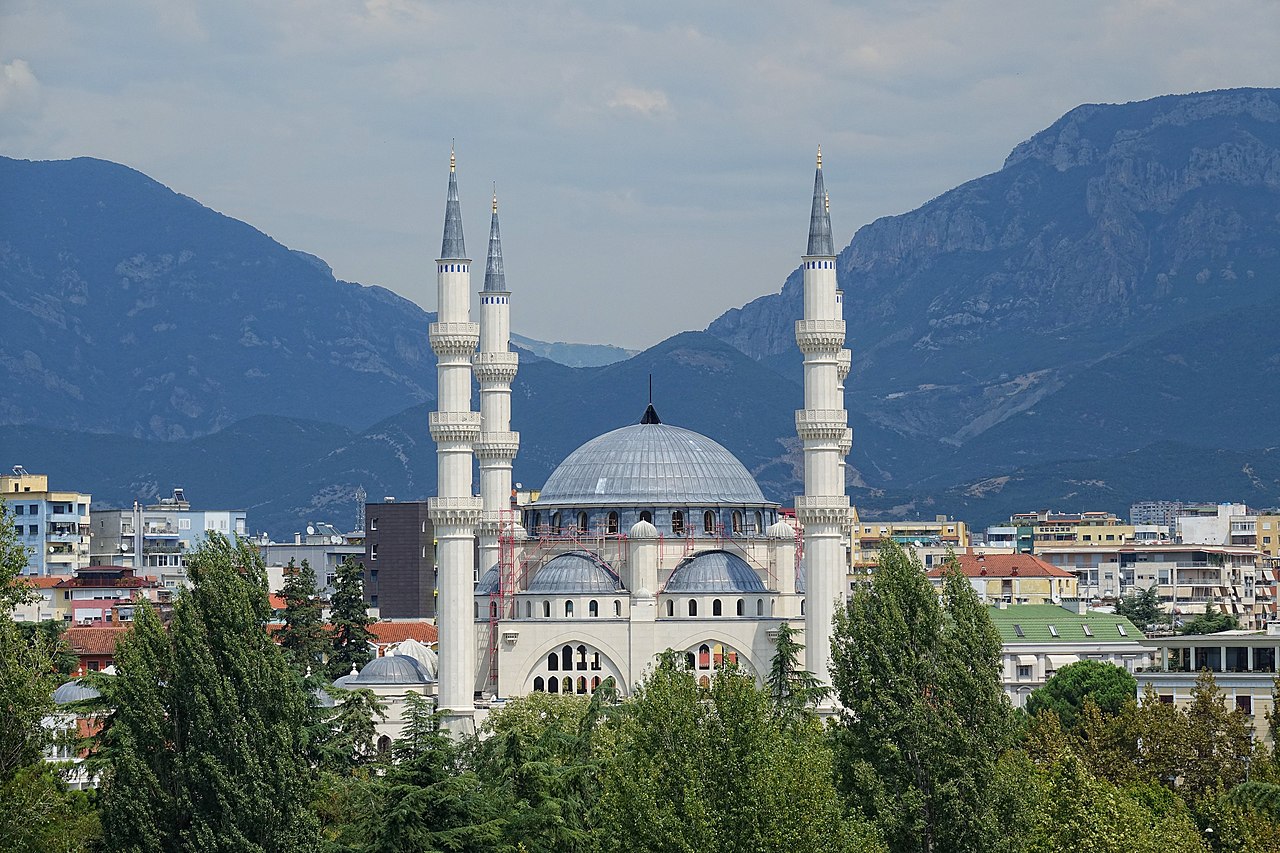
Outside, the building makes its case in stone and proportion: four 50-meter minarets rise like sharpened pencils over Namazgah Square, tall enough to hold their own against the surrounding government blocks and the restless skyline of Tirana. Don't rush past the ablution area; the water, marble, and measured movements before prayer give the whole complex its real rhythm, and in late afternoon the white-and-gold surfaces catch the sun in a way that feels less like spectacle than calm confidence.
Walk It at Sunset
Go late in the day and make this a short urban walk rather than a box to tick: start at the mosque, stay long enough to hear the adhan if timing allows, then head toward the Pyramid for the clearest wider view of dome, minarets, and mountains in one frame. That route explains the building better than any plaque could, because you feel the jump from intimate interior hush to civic scale, and you understand why this mosque became a political argument long before it became a place of prayer.
Plan your visit
Getting There
Namazgjaja stands on Rruga George W. Bush beside Parliament, about a 5-minute walk southeast of Skanderbeg Square and roughly 330 meters from the Pyramid. City buses are the practical public option in 2026: lines L2, L5, L6, and L16 stop within a short walk via Piramida, Kolonat, or Rruga e Elbasanit, and central bus fares are about 40 lek. If you drive, local reporting says the complex has underground parking, though current public-access terms are not clearly posted.
Opening Hours
As of 2026, published hours still conflict. Visit Tirana lists the mosque as open 24 hours, while multiple recent visitor sources cluster around 05:00-21:00 and some show shorter sightseeing windows such as 09:00-18:00, so the safest assumption is early opening for worship and tighter access for tourists. Friday midday prayers, Ramadan evenings, and Eid mornings are the moments most likely to shut out casual visits.
Time Needed
Give it 15-25 minutes if you only want the exterior, courtyard, and that first look up at the four minarets. A normal interior visit takes 30-45 minutes once you factor in shoes off, dress adjustments, and a slow look at the prayer hall; 45-75 minutes makes sense if you linger outside or get paused by prayer times.
Accessibility
The approach is easy by Tirana standards: flat central streets, paved surfaces, no hill, no heroic climb. A 2024 opening report says the complex has an elevator for visitors with disabilities, which matters because the women’s prayer area is reported to be upstairs, but I did not find a full 2026 accessibility statement confirming every route, restroom, and parking connection.
Cost & Tickets
As of 2026, entry is free and I found no official ticketing page, timed-entry system, or skip-the-line option. This is an active mosque, not a turnstile monument, so your real strategy is timing rather than booking: aim for late morning or mid-afternoon on a non-Friday.
Photo Gallery
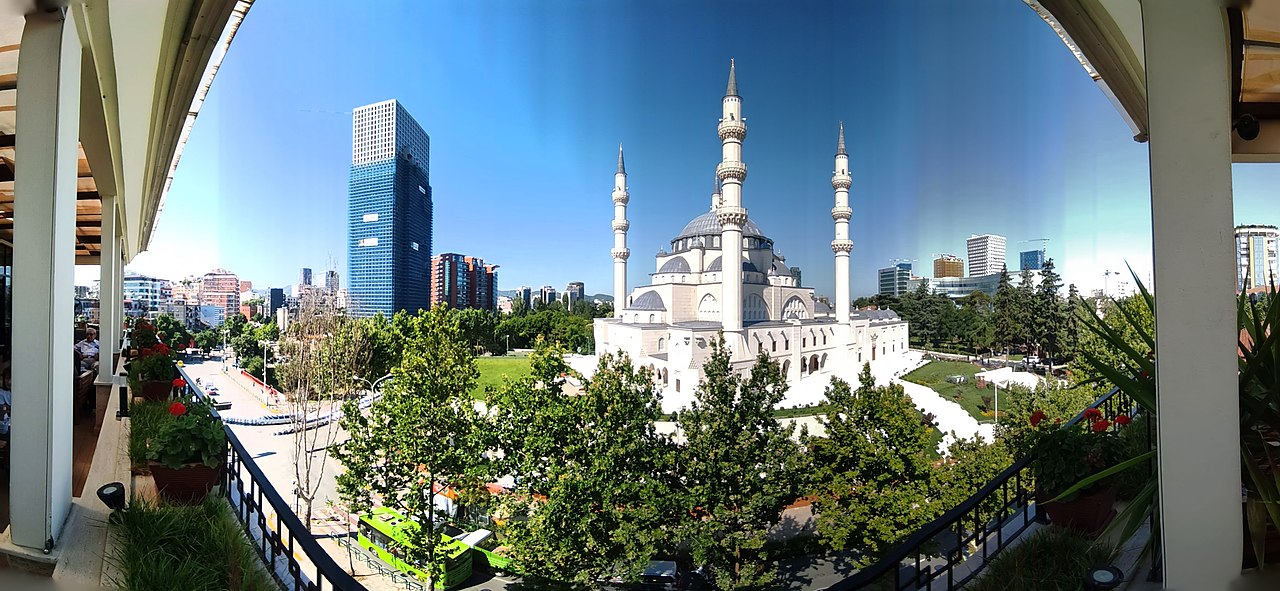
The stunning architecture of the Great Mosque of Tirana is beautifully framed by the warm, golden colors of autumn leaves. · Fjoralba IsmailiThe Great Mosque of Tirana stands as a prominent architectural landmark against the scenic backdrop of the Albanian mountains. · Bjørn Christian TørrissenA stunning panoramic view of the Great Mosque of Tirana, showcasing its impressive architectural design set against the vibrant cityscape of Albania. · LeeturtleA view of the Great Mosque of Tirana in Albania, showcasing its prominent minarets and dome architecture framed by a large winter tree. · Adam Jones from Kelowna, BC, CanadaA scenic view of the Great Mosque of Tirana, Albania, showcasing its traditional architecture contrasted against a modern glass skyscraper and mountain backdrop. · CivArmyThe stunning architecture of the Great Mosque of Tirana stands out against a bright, cloudy sky in the heart of Albania. · FatushCerraga1The Great Mosque of Tirana stands as a prominent architectural landmark in Albania, showcasing elegant white stone construction and towering minarets. · Steffen Schmitz (more photos)
History
The Mosque That Took Three Decades to Arrive
Namazgja matters because its story begins with a void. After the fall of state atheism in 1991, documented reporting shows Albania's religious communities re-emerged into public life at different speeds: Tirana gained new Catholic and Orthodox cathedrals, while Muslims in the capital kept waiting for a central mosque large enough for the city's biggest holy days.
That wait turned one plot near Parliament into a political thermometer. Records and contemporary reporting trace the project from a foundation stone in 1992 to a formal start ceremony in 2013, a Turkish-backed construction push in 2015, and an official opening on 10 October 2024. Thirty-two years from first promise to ribbon-cutting. Longer than many visitors expect.
The turning point
Sali Berisha's Stone, and the Years It Refused to Become a Mosque
Documented accounts say President Sali Berisha laid a foundation stone near Namazgah Square in 1992, trying to mark the return of religious freedom after decades when public worship had been suppressed by the communist state. For Berisha, this was not ceremonial filler. A capital-city mosque would signal that post-communist Albania could not treat its Muslim majority as an afterthought while other confessions built on a grand scale.
Then came the stall. Balkan Insight reports that Parliament speaker Pjetër Arbnori objected to a mosque so close to the legislature, reportedly fearing the image it would project abroad. That turned the foundation stone into something almost theatrical: a promise sitting in public view while governments changed, plans drifted, and believers kept praying in overflow crowds outdoors on feast days.
The turning point came on 20 April 2013, when a formal start-of-works ceremony finally took place with Berisha, Tirana mayor Lulzim Basha, and Muslim Community head Selim Muça present. Even that did not settle the matter. Turkish financing and political backing pushed the project forward from 2015, and the opening in 2024 arrived with its own argument over influence and control. The building rose, but the question underneath it never quite disappeared.
A Capital Looking for Balance
The mosque's long gestation tracks a larger Albanian argument about identity. Documented reporting from the 2000s and 2010s shows the issue was never only about prayer space; it was also about whether Tirana would present itself through Ottoman inheritance, European ambition, or some uneasy mix of both. You can feel that tension in the setting. Parliament is steps away, and the old religious fault lines of the city never feel entirely old.
Opening Day, Finally
On 10 October 2024, documented reports confirm that President Recep Tayyip Erdogan and Prime Minister Edi Rama attended the official inauguration. By then, some local reporting said the building itself had been finished earlier, though the exact completion date remains uncertain in primary-source terms. What mattered to ordinary worshippers was simpler: the capital finally had a mosque scaled for the crowds that had outgrown the old one years before.
Tips for visitors
Dress Properly
Shoes come off at the entrance. Women should cover hair, shoulders, and legs; men should wear long trousers and covered shoulders, and visitor sources say scarves or cover-ups are usually available if you arrive underdressed.
Skip Prayer Rush
Go on a non-Friday in late morning or mid-afternoon if you want the least friction. During the five daily prayer times, and especially Friday midday, the building shifts from visitor stop to working mosque fast.
Shoot Respectfully
Casual photography is generally tolerated, but keep the camera quiet around worshippers and avoid flash during prayer. Tripods, drones, or anything that looks commercial should be cleared with staff first; Parliament is next door, which makes flying anything here a bad place to improvise.
Watch Protest Days
The mosque sits beside Parliament, so politics can spill into your visit. On 20 February 2026, tear gas from a nearby protest affected Ramadan worshippers, which tells you all you need to know: if demonstrations are scheduled, come another day.
Eat Nearby
After your visit, walk a few minutes toward Pazari i Ri for food that tastes like Tirana rather than hotel-menu Albania. Budget: Oda e Prizrenit for qofte or tavë dheu around ALL 250-600; mid-range: Tradita te Meri Garden for fërgesë and other local plates around ALL 200-950; splurge: Mullixhiu, where many dishes run from about ALL 600 to 1,400 or more.
Pair The Walk
The smart route is mosque, Pyramid, then the bazaar quarter, all within an easy central loop through Tirana. If you want one more indoor stop after all that marble and echo, the National Library Of Albania sits back toward the square.
checkThe New Bazaar (Pazari i Ri) is the best place to browse for fresh produce, cheese, and local delicacies—combining market visits with meals or snacks.
checkFor a truly local experience, try `Tavë kosi` (baked lamb with yogurt and egg) or `Fërgesë Tirane` (peppers, tomatoes, and cheese dish).
checkMost traditional Albanian dishes are best shared with friends or family, so don’t be shy about ordering multiple plates.
Food districts:Pazari i Ri (New Bazaar)Avni Rustemi Square
Restaurant data powered by Google
Watch & Explore Great Mosque of Tirana.
Explore Tirana
Moschea Namazgâh - TIrana
SalMac Production3 min452
Explore Tirana
la Grande Moschea di Tirana 1
A P I A Ass. pensionati Italiani Albania2 min242
Frequently asked
Is Great Mosque of Tirana worth visiting?
Yes, especially if you want to understand modern Tirana rather than just photograph it. The mosque opened on 10 October 2024 after a delay that stretched back to a 1992 foundation stone, so the building carries three decades of argument about religion, politics, and Albanian identity. Inside, the shift is immediate: traffic outside, then carpet, soft light, and the pull of a dome ringed with Arabic inscriptions.
How long do you need at Great Mosque of Tirana?
Plan on 30 to 45 minutes for a normal visit. That gives you time for the courtyard, shoe removal, a quiet look inside the main hall, and a few photos without rushing. If you want to sit through the change in light or wait around prayer times, give it closer to an hour.
How do I get to Great Mosque of Tirana from Tirana city center?
Walk if you are already in central Tirana; from Skanderbeg Square it is about 5 minutes southeast toward Rruga George W. Bush, beside Parliament. The mosque’s four 50-meter minarets make it easy to spot once you are near the political quarter, like four white needles above the roofs. If you are farther out, city buses serving the Parliament and Pyramid area are the simplest public-transport option.
What is the best time to visit Great Mosque of Tirana?
Late morning or mid-afternoon on a non-Friday is your safest bet. Public hours still appear inconsistent across current listings, and access can tighten around the five daily prayers, Friday midday prayers, Ramadan evenings, and Eid. For atmosphere, arrive when the light is slanting in; for calm, avoid the prayer rush.
Can you visit Great Mosque of Tirana for free?
Yes, entry is generally free. I found no official ticketing page, no booking system, and no real skip-the-line setup, which makes sense for an active mosque rather than a timed monument. The real condition is etiquette, not payment: dress modestly, remove your shoes, and stay clear of worshippers during prayer.
What should I not miss at Great Mosque of Tirana?
Do not miss the first upward look once you enter the main prayer hall. The dome, chandeliers, calligraphy, and colored motifs do most of the emotional work here, and they read best before your eyes settle on the carpet and crowd. Also pause at the ablution area outside; it slows the visit in the right way.
What should I wear to Great Mosque of Tirana?
Wear modest clothing that covers shoulders and legs, and expect to remove your shoes before entering. Women should cover their hair, and several visitor sources say scarves or robes are often available at the entrance if needed. Men should skip shorts and sleeveless tops; this is an active place of worship, not a set for holiday photos.
Sources & attribution69
Researched and written by the Audiala editorial team from historical records, architectural archives, and local expertise. Last updated April 2026.
Visit Tirana — Official tourism listing used for location, opening context, architecture, and practical visitor basics.
Tirana Municipality — Municipal point-of-interest page used to confirm the mosque’s placement on Rruga George W. Bush.
Tripadvisor — Traveler listing used for reported public hours and current visitor patterns.
Albanify — Visitor guide used for dress code, free entry, and practical visit expectations.
Wanderlog — Travel listing used to compare reported hours and note timing variability.
Booked.ai — Travel page used for atmosphere notes, timing, and visitor impressions.
Albania Turism — Travel source used for free entry, dress guidance, and practical visitor details.
Couples Travel Stories — Recent travel blog used for walking time from Skanderbeg Square, prayer-time advice, and visitor etiquette.
Mapcarta — Map source used for proximity to the Pyramid and stop-area orientation.
Visit Tirana Transport — Official city transport page used for bus system basics in Tirana.
Moovit Parliament — Transit page used for nearby bus approaches around Parliament.
Moovit Pyramid — Transit page used for bus approaches near the Pyramid and mosque area.
Saved and recently read places — kept on this device only.
Photo credits (13)
Albert Hyseni — Unsplash License (https://unsplash.com/license) — Source: https://images.unsplash.com/photo-1731636710439-d80d424cb78c
Daniel Silva — Unsplash License (https://unsplash.com/license) — Source: https://images.unsplash.com/photo-1705174372395-23081b834313
Great Mosque of Tirana (2020) — P4Jags — CC BY-SA 2.0 (https://creativecommons.org/licenses/by-sa/2.0/) — Source: https://commons.wikimedia.org/wiki/File:Great_Mosque_of_Tirana_(2020).jpg
Great Mosque of Tirana, 2019 — Fjoralba Ismaili — CC BY-SA 4.0 (https://creativecommons.org/licenses/by-sa/4.0/) — Source: https://commons.wikimedia.org/wiki/File:Great_Mosque_of_Tirana,_2019.jpg
Great-Mosque-of-Tirana-2018 — Bjørn Christian Tørrissen — CC BY-SA 4.0 (https://creativecommons.org/licenses/by-sa/4.0/) — Source: https://commons.wikimedia.org/wiki/File:Great-Mosque-of-Tirana-2018.jpg
Great Mosque of Tirana (Xhamia e Namazgjasë) — Leeturtle — CC BY-SA 4.0 (https://creativecommons.org/licenses/by-sa/4.0/) — Source: https://commons.wikimedia.org/wiki/File:Great_Mosque_of_Tirana_(Xhamia_e_Namazgjasë).jpg
Mosque with Tree - Tirana - Albania (41877419505) — Adam Jones from Kelowna, BC, Canada — CC BY-SA 2.0 (https://creativecommons.org/licenses/by-sa/2.0/) — Source: https://commons.wikimedia.org/wiki/File:Mosque_with_Tree_-_Tirana_-_Albania_(41877419505).jpg
Great Mosque of Tirana, Albania — CivArmy — CC BY 4.0 (https://creativecommons.org/licenses/by/4.0/) — Source: https://commons.wikimedia.org/wiki/File:Great_Mosque_of_Tirana,_Albania.jpg
Strictly necessary cookies keep the site working. Analytics (PostHog, Google Analytics) measures how each visitor uses our pages. Marketing loads YouTube videos and walking-route maps without a tap and lets Google Analytics set advertising cookies. We never sell your data. You can change this any time from the footer.
Analytics and marketing cookies are optional and only load if you agree. Details under Customize.
Privacy
Cookie preferences
Pick what you're okay with. You can change this any time from the footer.
Strictly necessary
Always on
Sign-in, language, navigation. Always on.
Product analytics
PostHog (EU) and Google Analytics record which pages you view and how you use them, under a random identifier stored in your browser. Helps us see which pages work and which need fixing. Google's ad personalisation stays off. No selling.
Marketing
Loads YouTube videos and the walking-route maps (OpenFreeMap) without a tap; without it, they load only when you tap them. If analytics is also on, Google Analytics may set advertising cookies. Ad personalisation stays off.