Early Brazil–Israel Diplomatic Relations
Brazil was among the first nations to officially recognize the State of Israel, establishing diplomatic relations on February 7, 1949 (gov.br). This step was facilitated by Brazilian diplomat Oswaldo Aranha, President of the UN General Assembly session that authorized the partition plan for Palestine (UN Resolution 181), a pivotal moment in Israel’s founding (gov.br).
History and Development of the Embassy
The Israeli embassy was first inaugurated in Rio de Janeiro, Brazil’s former capital, in 1955, with David Shaltiel as the first ambassador (wikipedia). Following the transfer of Brazil’s capital, the embassy relocated to Brasília in 1971, settling in the Setor de Embaixadas Sul—a key zone for diplomatic missions (wikiwand).
Embassy Services and Visitor Information
Visiting Hours & Location
- Address SES - Av. das Nações - Quadra 809, Lote 38, 70424-900, Brasília, DF, Brazil
- Opening Hours Monday to Friday, 9:00 AM to 5:00 PM (subject to holiday changes; verify in advance)
- Map Israeli Embassy in Brasília Location
Appointments & Security
- Appointments Required for all consular services (visas, passports, legalizations); schedule online or by contacting the consular section (official website)
- Identification Valid government-issued photo ID is mandatory
- Security Expect airport-style screening; large bags and certain electronics are restricted
- Accessibility The embassy is fully accessible to individuals with disabilities; notify staff in advance if special accommodations are needed
Services Offered
- Visa and immigration processing (tourist, business, student, work)
- Passport issuance and renewal for Israeli citizens
- Legalization and notarial services
- Emergency assistance and registration for Israeli nationals
- Promotion of trade, investment, and cultural programs
- Information on academic, cultural, and community events (embaixadas.net)
Role in Bilateral Relations
The embassy has been instrumental in advancing cooperation in defense, technology, agriculture, education, and trade (gov.br). Notably, the Mercosur-Israel Free Trade Agreement (effective since 2010) positioned Israel as the first non-Latin American country with such status. The embassy also supports Brazil’s Jewish community, the largest in Latin America, and nurtures cultural exchange initiatives (gov.br).
Major Historical Milestones
- 1949 Formal diplomatic relations established
- 1955 Embassy inaugurated in Rio de Janeiro
- 1964–1971 Relocation to Brasília
- 1966 State visit by Israeli President Zalman Shazar (wikipedia)
- 2010 Visit by Brazilian President Luiz Inácio Lula da Silva to Israel
- 2018–2019 Reciprocal visits by Israeli PM Benjamin Netanyahu and Brazilian President Jair Bolsonaro, and opening of a Brazilian trade office in Jerusalem (wikipedia)
- 2023–2025 Diplomatic tensions over the Israel–Hamas conflict, leading to recall of ambassadors and reduced diplomatic presence (Times of Israel, Folha de S.Paulo)
Architectural Highlights
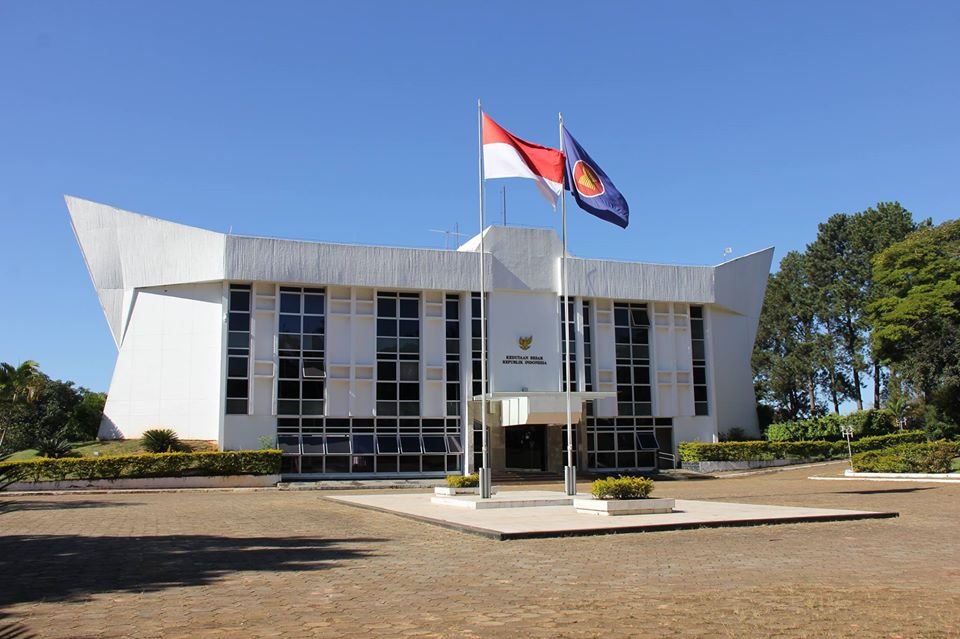
Designed by David Reznik, a contemporary of Oscar Niemeyer, the embassy is an outstanding example of modernist architecture. Its unique Greek cross floor plan—two intersecting arms at a slight angle—symbolizes balance and unity, reflecting its diplomatic mission (new.embassies.gov.il). The structure’s minimalist façade, low horizontal profile, and use of local Brazilian materials integrate seamlessly with Brasília’s cityscape (worldhistoryjournal.com).
Integration with Brasília’s Landscape
Brasília’s urban design, conceived by Lúcio Costa and Oscar Niemeyer, embodies modernist ideals. The embassy’s placement on Avenida das Nações aligns with the city’s diplomatic axis, and its landscaped grounds use native Brazilian flora for security and aesthetic harmony (embassies.net).
Cultural and Diplomatic Significance
The embassy is a focal point for cultural diplomacy, hosting exhibitions, lectures, and educational events that promote Israeli innovation, art, and heritage. It also provides essential consular services and supports interfaith dialogue within Brazil’s diverse community (new.embassies.gov.il).
Visitor Information: Accessibility & Nearby Attractions
Accessibility
- Single-story design for easy movement
- Facilities for individuals with mobility challenges
- Advance notice appreciated for special assistance
Nearby Attractions
- National Congress
- Cathedral of Brasília
- JK Memorial
- Itamaraty Palace
- Other embassies and cultural centers
Brasília’s diplomatic sector is rich in modernist architecture and offers plentiful opportunities for cultural exploration.
Security, Safety & Practical Tips
- Protests Demonstrations near the embassy are generally peaceful but can affect access; monitor local news and advisories (U.S. Embassy Brazil)
- Health Quality healthcare available in Brasília; embassy staff can assist in emergencies
- Transportation Taxis and ride-sharing apps are recommended for direct access
- Language Portuguese, English, and Hebrew are spoken; translation support offered
Frequently Asked Questions (FAQ)
Q: What are the embassy’s visiting hours?
A: Monday to Friday, 9:00 AM to 5:00 PM. Check for holiday changes.
Q: Do I need an appointment?
A: Yes, for all consular services.
Q: What documents are required for visa applications?
A: Valid passport, completed forms, proof of funds, return ticket, accommodation details; specifics vary.
Q: Is the embassy accessible for visitors with disabilities?
A: Yes, with advance notice for special needs.
Q: Are there public tours or open events?
A: No public tours, but some cultural events are open to the public. Check the embassy’s website for announcements.