Type 2+ letters to search all countries, cities, and places
/Ctrl KEsc
travel_explore
Type 2+ letters to search all countries, cities, and places
Press Enter to open the top result
Plaza Del Cabildo
Seville·Spain·37° N · 5° W·Updated Apr 2026
Hidden behind three passageways by Seville Cathedral, this semicircular plaza pairs an Almohad wall with Sunday stalls selling coins, stamps, and curios.
A semicircle of white arcades and a chunk of Almohad wall shouldn't be hiding a few steps from Seville's cathedral, yet Plaza del Cabildo in Seville, Spain, does exactly that. You come for the shock of quiet: three modest passageways open onto a plaza that feels edited out of the city. Visit for the contrast, especially if the crowds around the Giralda have worn you down. On Sunday mornings, the hush gives way to coin dealers and collectors, which suits the place better than silence alone.
Plaza del Cabildo isn't old in the way many visitors assume. The plaza itself is a 20th-century composition, carefully curved and almost theatrical, but it stands on a site with older bones: a surviving stretch of Almohad wall and the lost Colegio de San Miguel, long tied to Seville Cathedral's working life.
That mix is the whole point. Sun hits the upper arches hard, the paving throws back heat, and then your eye lands on rough medieval masonry that looks older than the scene around it by something like eight centuries.
Come here after the cathedral, not before. Seville makes more sense once you've seen one of its grand public faces and then stumbled into this inward-looking pocket, built from demolition, memory, and a very selective respect for the past.
Researched by the Audiala editorial team from historical records, architectural archives, and local expertise.
What to see
The Semicircle and Fountain
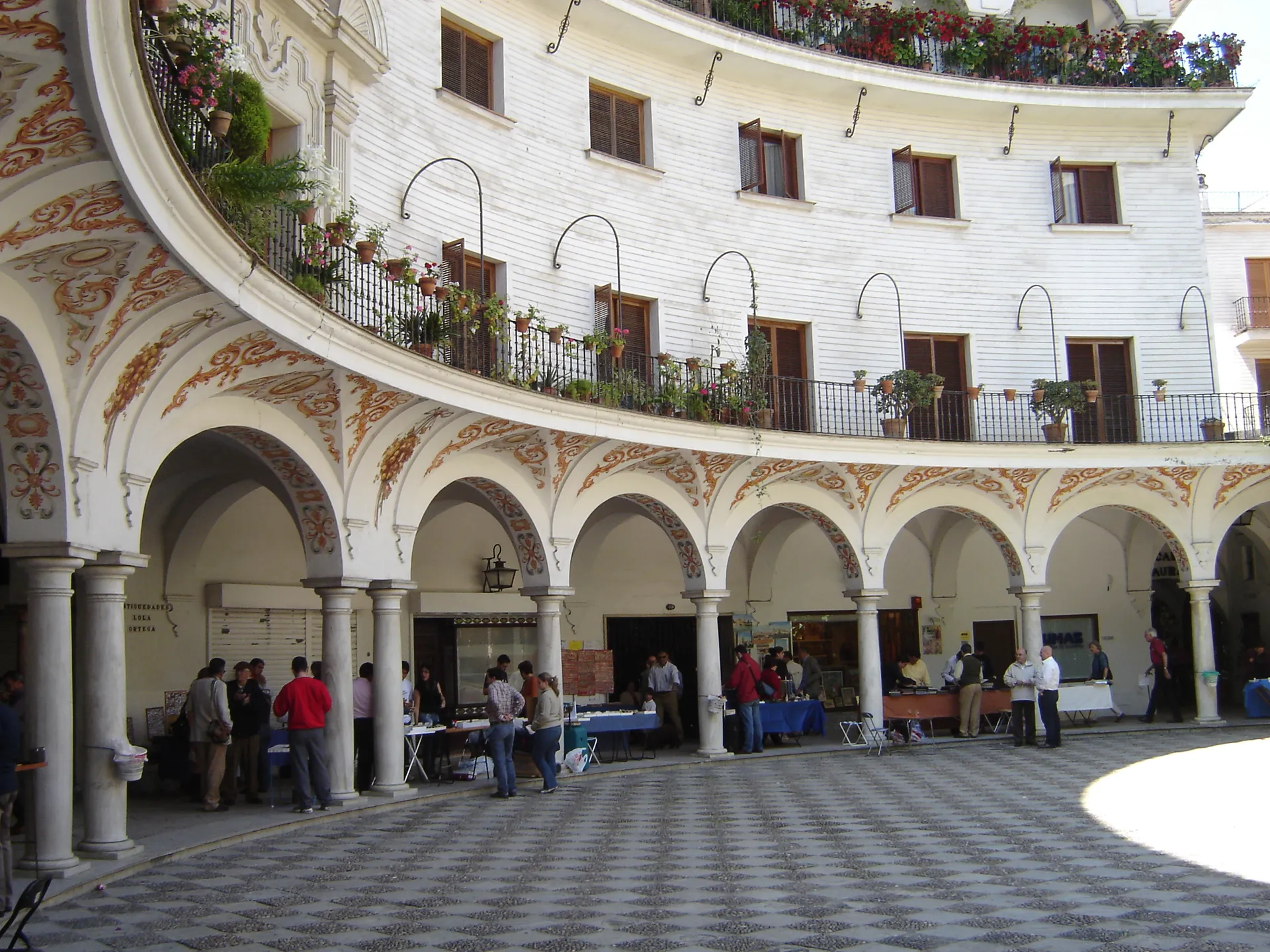
Plaza del Cabildo works because it hides its punchline. You slip in from Avenida de la Constitución through a porticoed passage about 40 meters long, cool as a cloister corridor, then the square opens all at once: frescoed arches by José Palomar, marble columns, balconies stacked in three tidy floors, and a round fountain murmuring in the middle while the cathedral crowds keep roaring somewhere out of sight. Stand near the center and look back toward the entrance. The whole place reads like a stage set built to flatter old Seville, yet the hush, the water, and the shade make it feel less theatrical than intimate.
The Almohad Wall and the Plaques People Miss
The square’s straight edge tells the better story. About 50 meters of Almohad wall, dated by local heritage sources to 1184, runs along one side like a rough brown scar beside the polished semicircle, a collision between Muslim Seville and a mid-20th-century redesign on the site of the vanished Colegio de San Miguel. Slow down here and read the stone instead of photographing the curve again: one plaque recalls the 1755 Lisbon earthquake, when liturgy shifted here after damage nearby, and another points back to the Latin and Arabic schools linked by local tradition to 1254. Suddenly this pretty little plaza stops being decorative.
Sunday Market Route
Come on a weekday if you want the plaza at its most inward-looking; come on Sunday morning if you want to see what Seville does with a quiet corner once collectors arrive. Between roughly 9:00 and 14:00, tables fill with coins, stamps, medals, postcards, and the soft clink of handled metal, and the place shifts from sheltered pause to local ritual just steps from the Giralda. My preferred route is simple: enter through Pasaje de los Seises, pause by the earthquake plaque, cross to the wall for the wide view back, then leave toward the cathedral and keep walking into Seville with the odd feeling that one of its smartest squares was hiding in plain sight.
Plan your visit
Getting There
Plaza del Cabildo hides behind three passageways: Avenida de la Constitución 24, Calle Almirantazgo, and Calle Arfe beside Mercado El Postigo. From the Cathedral facade it is a 1-2 minute walk; from Archivo de Indias, 2-3 minutes; from Puerta Jerez, 6-8 minutes on foot or one short tram hop to Archivo de Indias on MetroCentro T1. If you drive, Interparking Cano y Cueto and Parking Avenida Roma are the least awkward options near the old center.
Opening Hours
As of 2026, Plaza del Cabildo works like a public square rather than a ticketed monument, and no official municipal timetable appears to be published. Local sources agree the entrances are gated at night, so daytime is the safe bet; for a guaranteed visit, aim for roughly 10:00-19:00, and for the Sunday collectors' market use 09:00-14:00.
Time Needed
Give it 10-15 minutes if you just want the semicircle, the fountain, and the shock of sudden quiet a few steps off cathedral traffic. Twenty to 30 minutes suits most visitors; Sunday market browsers can easily spend 45-90 minutes poking through coins, stamps, posters, and the occasional piece of junk dressed up as treasure.
Accessibility
The plaza sits at ground level and does not require monument-style stair climbing, with the Avenida de la Constitución entrance likely the easiest approach for wheelchair users. Historic paving can slow you down, and Sunday mornings get tighter when the market fills the arcades; metro access via Puerta Jerez is better documented, with elevators, wide gates, and low-floor trains.
Cost & Tickets
As of 2026, entry is free and no booking or skip-the-line option exists because this is not a managed attraction. The Sunday market is also free to enter, which makes this one of the rare spots beside central Seville where curiosity costs nothing unless you start buying dubious collectibles.
Photo Gallery
A close-up view of the beautifully painted, ornate arches at the historic Plaza Del Cabildo in Seville, Spain. · CarlosVdeHabsburgoThe beautiful curved arcade of Plaza Del Cabildo in Seville, Spain, showcases intricate frescoed ceilings and a charming balcony filled with greenery. · Granadino anti-andaluzThe elegant curved balcony of Plaza Del Cabildo in Seville, Spain, is adorned with lush potted plants and intricate architectural frescoes. · Granadino anti-andaluzThe elegant, semi-circular facade of the historic Plaza Del Cabildo in Seville, Spain, showcases intricate architectural details and lush balcony greenery. · CarlosVdeHabsburgoA close-up view of the beautifully painted arches and decorative frescoes found within the historic Plaza Del Cabildo in Seville, Spain. · CarlosVdeHabsburgoThe stunning semicircular Plaza Del Cabildo in Seville, Spain, is famous for its elegant arched colonnades and beautifully decorated balconies. · WFanA close-up view of the intricate, hand-painted frescoes adorning the arched walkways of the historic Plaza Del Cabildo in Seville, Spain. · CarlosVdeHabsburgo
History
A School, a Wall, and a City Rehearsing Itself
Plaza del Cabildo began as something less picturesque and more useful. Documented sources tie this plot to the Colegio de San Miguel, a cathedral institution that trained boys, housed clergy and musicians, and helped keep the machinery of one of Spain's richest churches running.
The plaza visitors see now came later. Most scholars treat it as a modern intervention layered over older remains, with the surviving Almohad wall marking a fortified past that belonged to the mosque and alcazaba zone before Christian Seville turned the area into cathedral infrastructure.
The turning point
Hilarión Eslava and the College That Made His Name
Hilarión Eslava y Elizondo arrived in Seville with more than a respectable job at stake. As maestro de capilla of Seville Cathedral, he needed to prove himself in one of the country's most exposed musical posts, and local accounts place him living in the Colegio de San Miguel, on the very site later reshaped as Plaza del Cabildo.
This was no quiet retreat. Choir training, clerical routine, and cathedral ceremony filled the place with disciplined sound, and sources attribute much of the work that built Eslava's Sevillian reputation, especially the famous Miserere, to his years here.
The turning point came when Seville stopped being a provincial chapter in his career and became the platform that sent him toward national stature. After San Miguel, Madrid followed. The polished plaza outside tells you none of that; the site was once a workshop for ambition, not a pretty pause between monuments.
The Earthquake Church
On November 1, 1755, when the Lisbon earthquake damaged Seville Cathedral, records preserved in local inscriptions and later reporting show the Divine Offices moved into the Colegio de San Miguel. For nearly four months, until February 28, 1756, this site worked as emergency sacred infrastructure. Imagine the scene: frightened clergy crossing over from the wounded cathedral, stone dust in the air, liturgy continuing anyway.
The Alfonso X Problem
A plaque nearby ties the area to Alfonso X's General Study of Latin and Arabic, granted on December 28, 1254. That part is documented. The harder question is whether the later Colegio de San Miguel can truly be treated as the same institution or its direct continuation; scholars disagree, and the cleaner claim is that San Miguel is documented later, from the late 14th or early 15th century onward, even if local memory prefers the royal origin story.
Tips for visitors
Pick Your Sunday
Go early on a weekday if you want the plaza at its best: footsteps under the arcade, fountain water, and a pause from cathedral noise. Go Sunday 09:00-14:00 if you want character instead, because the collectors' market turns the hush into a low murmur of bargaining and paper shuffling.
Photo Rules
Casual photography in the plaza appears fine, and the curved facade catches soft light better in the morning than at midday. Leave the drone packed away: central Seville's historic core is a bad place to improvise, and police have acted against unauthorized flights in this area.
Watch Your Pockets
The plaza feels sheltered, but the risk sits 20 meters away in the Cathedral corridor where pickpockets work the crowd. Sunday market stalls also deserve a cool head; if a seller is pushing an 'ancient' coin at a suspiciously friendly price, assume romance is part of the sales pitch.
Eat Nearby
Skip generic cathedral-edge menus if you can. Buy convent sweets at Dulces El Torno inside the plaza for a budget stop, walk to Abacería del Postigo for mid-range tapas, or head to Bodeguita Romero if you want classic Sevillian dishes like pringá and solomillo al whisky without much ceremony.
Cathedral Combo
Pair Plaza del Cabildo with the Cathedral and Giralda because the contrast is the whole point: monumental stone outside, then this tucked semicircle with an Almohad wall fragment and a fountain. Enter from Avenida de la Constitución 24 after your cathedral visit and the place lands like a backstage passage the guidebooks keep flattening into one big tourist zone.
Mind The Tone
No formal dress code applies in the square, but the setting still belongs to the cathedral orbit, so this is not the place for speakerphone chatter or picnic sprawl. If you continue into the Cathedral from here, switch gears: hats off, voices down, and no flash.
Where to Eat
local_dining
Don't Leave Without Trying
SalmorejoCarrillada ibéricaBerenjenas con mielPringáPescaíto fritoJamón ibérico de bellotaEspinacas con garbanzosYemasPestiños
De Nata (Maestranza) - Fábrica de Pastéis de Nata
quick bite
Portuguese Bakery€€star4.8(435)
Order: The pastéis de nata (Portuguese custard tarts) are a must-try – crispy, flaky, and perfectly balanced with creamy custard.
This bakery specializes in authentic Portuguese pastéis de nata, made with a secret recipe. The quick, sweet stop is a favorite among locals and visitors alike.
Order: The bolos de arroz (rice cakes) and travesseiros (almond crescents) are standout treats – light, buttery, and full of flavor.
A hidden gem for Portuguese pastries, Portunata offers a smaller, cozier vibe than De Nata, with equally delicious results. Perfect for a mid-morning coffee and pastry break.
checkSalmorejo is a thick chilled tomato soup, often topped with ham and egg.
checkCarrillada ibérica, or slow-cooked pork cheeks, is a must-try dish in Seville.
checkBerenjenas con miel, fried eggplant with cane honey, is a classic sweet-and-savory tapa.
checkPringá, a rich shredded stewed meat mixture, is often served in a sandwich at local bars.
checkJamón ibérico de bellota, acorn-fed Iberian ham, is a delicacy worth trying at any tapas bar.
Food districts:Plaza del CabildoArenal district
Restaurant data powered by Google
Frequently asked
Is Plaza del Cabildo worth visiting?
Yes, especially if you want a quieter side of central Seville a minute from the cathedral crowds. The square itself is mid-20th century, but it sits against a surviving Almohad wall and on the site of the old Colegio de San Miguel, which gives it more weight than the pretty arcades first suggest. Go for the sudden hush, not for blockbuster scale.
How long do you need at Plaza del Cabildo?
Most people need 20 to 30 minutes. Ten minutes is enough for the passage, the semicircle, the fountain, and the wall; 45 to 90 minutes makes more sense on Sunday morning when the collectors' market fills the square with coins, paper, talk, and a little chaos.
How do I get to Plaza del Cabildo from Seville?
If you're already in central Seville, walk. The easiest entrance is at Avenida de la Constitución 24, opposite the cathedral, and the square also has access from Calle Almirantazgo and Calle Arfe; from Puerta Jerez, it's about a 6 to 8 minute walk, and the nearest metro stop is Puerta Jerez on Line 1.
What is the best time to visit Plaza del Cabildo?
Weekday mornings or late afternoon are best if you want the place at its quietest. Sunday from about 09:00 to 14:00 is the right window if you want the collectors' market instead, when the square trades calm for dealers, browsers, and tables full of stamps, medals, and old paper.
Can you visit Plaza del Cabildo for free?
Yes, Plaza del Cabildo is free to enter. It works as a public square rather than a ticketed monument, and the Sunday market is also free, though the entrances are generally reported to be gated at night.
What should I not miss at Plaza del Cabildo?
Don't miss the contrast between the painted semicircle and the rough Almohad wall, because that clash tells the real story of the site. Also look for the earthquake plaque near the Pasaje de los Seises, which records how this plot became emergency cathedral space after the Lisbon earthquake of November 1, 1755, and stop at Dulces El Torno if you want the square's most local edible detail.
Sources & attribution78
Researched and written by the Audiala editorial team from historical records, architectural archives, and local expertise. Last updated April 2026.
UNESCO World Heritage Centre — Confirmed the 1987 UNESCO inscription for Seville's Cathedral, Alcázar, and Archivo de Indias, giving context for the plaza's monumental setting.
Decoración Plaza del Cabildo — CarlosVdeHabsburgo — CC BY-SA 4.0 (https://creativecommons.org/licenses/by-sa/4.0/) — Source: https://commons.wikimedia.org/wiki/File:Decoración_Plaza_del_Cabildo.jpg
Balcón en el centro de Sevilla — Granadino anti-andaluz — CC BY-SA 4.0 (https://creativecommons.org/licenses/by-sa/4.0/) — Source: https://commons.wikimedia.org/wiki/File:Balcón_en_el_centro_de_Sevilla.jpg
Balcón en Sevilla — Granadino anti-andaluz — CC BY-SA 4.0 (https://creativecommons.org/licenses/by-sa/4.0/) — Source: https://commons.wikimedia.org/wiki/File:Balcón_en_Sevilla.jpg
Balcón (plaza del Cabildo) — CarlosVdeHabsburgo — CC BY-SA 4.0 (https://creativecommons.org/licenses/by-sa/4.0/) — Source: https://commons.wikimedia.org/wiki/File:Balcón_(plaza_del_Cabildo).jpg
Decoración Plaza del Cabildo 01 — CarlosVdeHabsburgo — CC BY-SA 4.0 (https://creativecommons.org/licenses/by-sa/4.0/) — Source: https://commons.wikimedia.org/wiki/File:Decoración_Plaza_del_Cabildo_01.jpg
20191105 Seville Plaza el Cabildo — WFan — CC BY-SA 4.0 (https://creativecommons.org/licenses/by-sa/4.0/) — Source: https://commons.wikimedia.org/wiki/File:20191105_Seville_Plaza_el_Cabildo.jpg
Decoración Plaza del Cabildo 02 — CarlosVdeHabsburgo — CC BY-SA 4.0 (https://creativecommons.org/licenses/by-sa/4.0/) — Source: https://commons.wikimedia.org/wiki/File:Decoración_Plaza_del_Cabildo_02.jpg
Locales plaza del Cabildo — CarlosVdeHabsburgo — CC BY-SA 4.0 (https://creativecommons.org/licenses/by-sa/4.0/) — Source: https://commons.wikimedia.org/wiki/File:Locales_plaza_del_Cabildo.JPG
Strictly necessary cookies keep the site working. Analytics (PostHog, Google Analytics) measures how each visitor uses our pages. Marketing loads YouTube videos and walking-route maps without a tap and lets Google Analytics set advertising cookies. We never sell your data. You can change this any time from the footer.
Analytics and marketing cookies are optional and only load if you agree. Details under Customize.
Privacy
Cookie preferences
Pick what you're okay with. You can change this any time from the footer.
Strictly necessary
Always on
Sign-in, language, navigation. Always on.
Product analytics
PostHog (EU) and Google Analytics record which pages you view and how you use them, under a random identifier stored in your browser. Helps us see which pages work and which need fixing. Google's ad personalisation stays off. No selling.
Marketing
Loads YouTube videos and the walking-route maps (OpenFreeMap) without a tap; without it, they load only when you tap them. If analytics is also on, Google Analytics may set advertising cookies. Ad personalisation stays off.