Place
Italy Updated Oct 2026
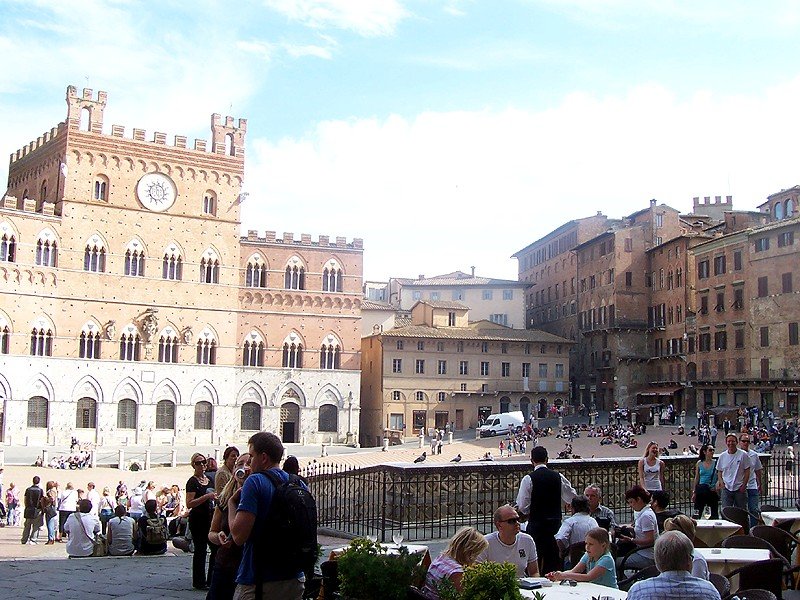
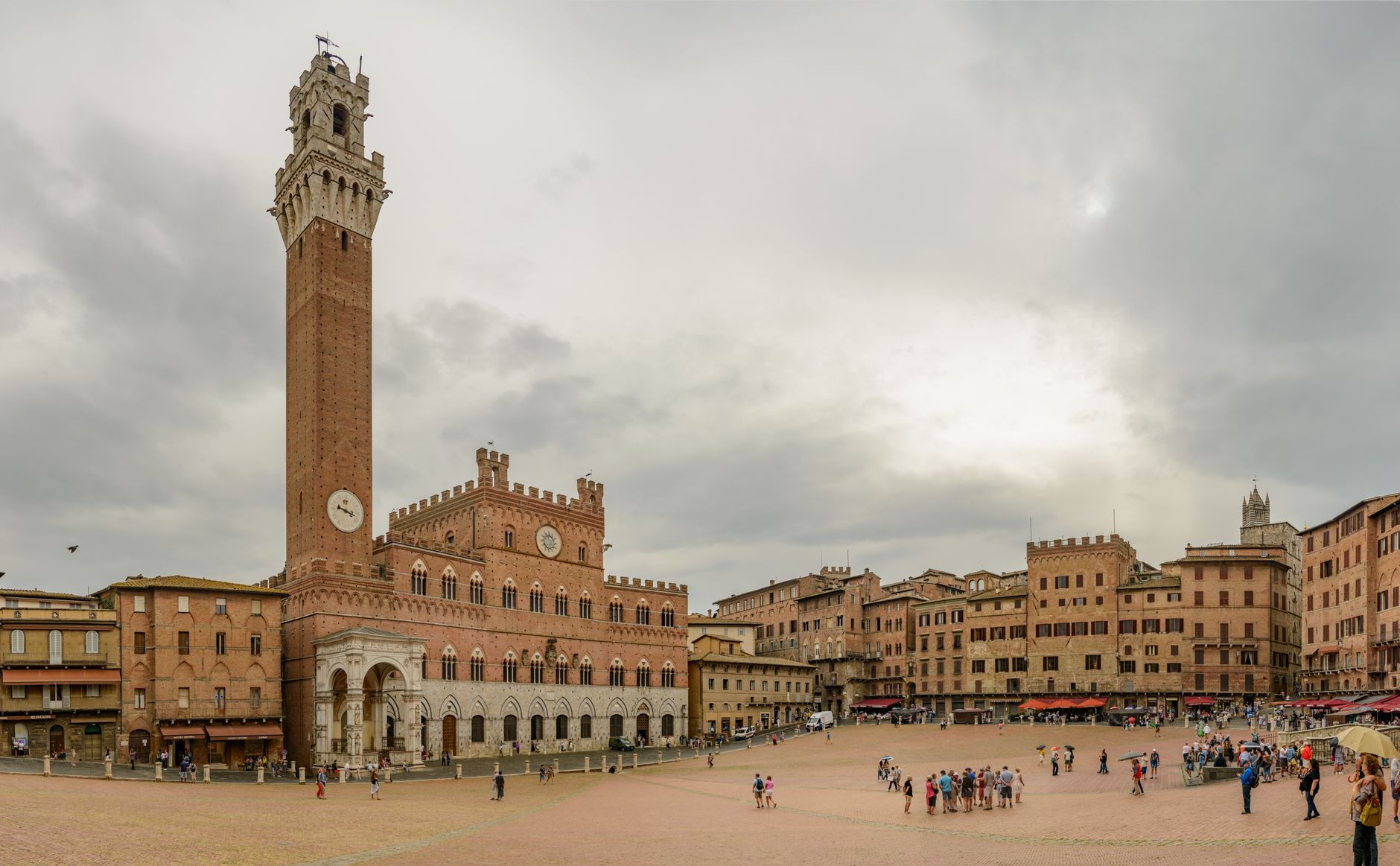
At dusk, Piazza del Campo’s red bricks hold the day’s warmth while bells echo across Siena, Italy. Ten pale stone lines divide the square’s shell-shaped slope into nine sections, recalling the Council of Nine that governed the city from 1287 to 1355.
 Photo: Wolfgang Weiser / Pexels
Built from cited sources · see the method · How we make our guides →
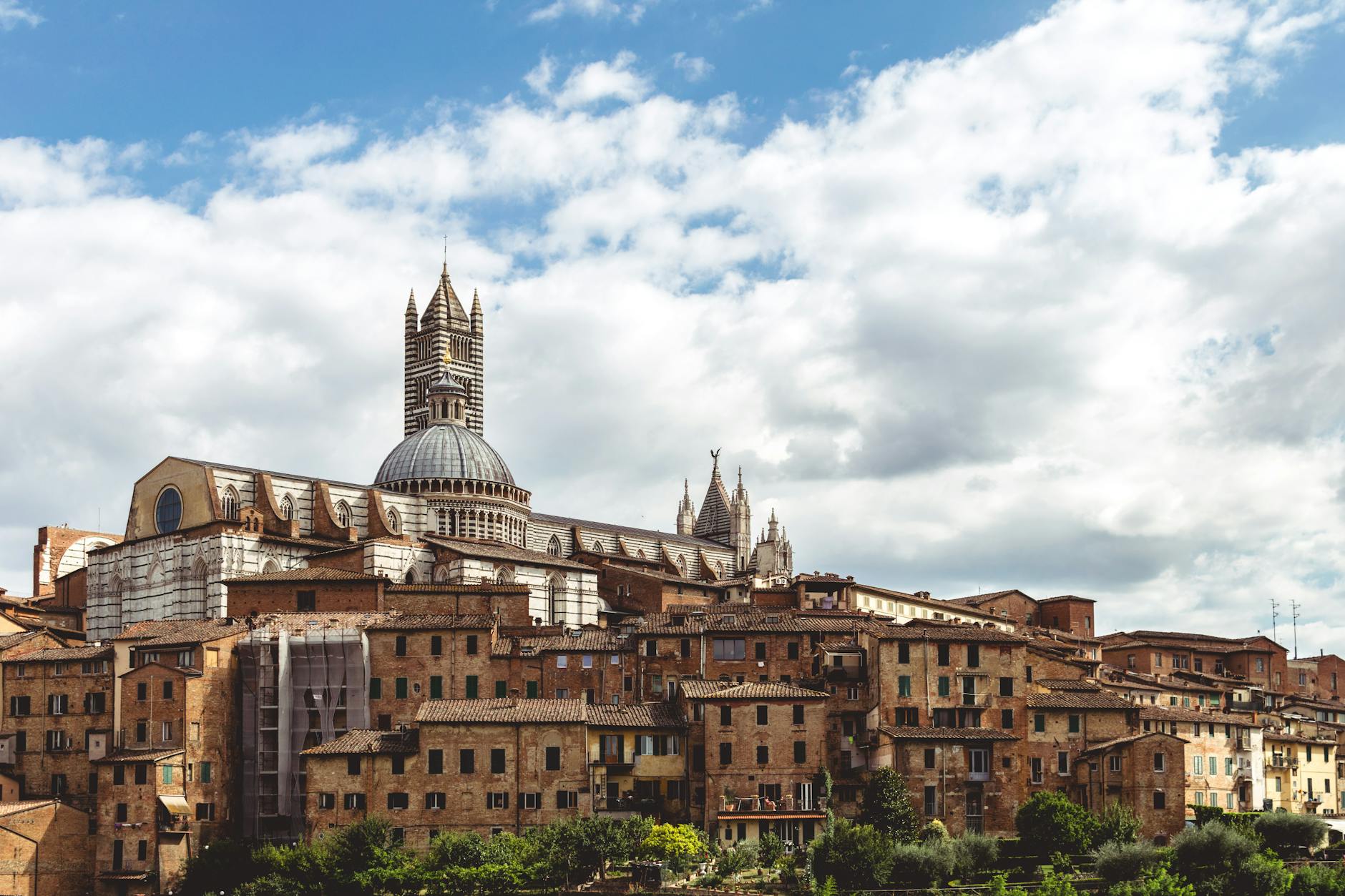
Siena’s streets follow three ridges that converge on the Campo, so a walk through the center brings sudden changes in light, steep lanes and framed views of brick towers. The black-and-white marble Duomo is the other great anchor; inside, 56 inlaid floor panels tell stories in stone, while Pinturicchio’s frescoes brighten the Piccolomini Library.
The Palio, run on July 2 and August 16, turns the Campo into a racetrack and gives the city’s 17 contrade a public expression of loyalties usually lived out in neighborhood oratories, museums and social clubs. The race lasts only about 90 seconds. Its preparations and aftermath occupy far more of the year.
At table, Siena is earthy and exacting: hand-rolled pici arrive with wild-boar ragù or garlic-rich tomato sauce, followed by almond-scented ricciarelli or dense, spiced panforte. Beneath the streets, medieval aqueducts called bottini once carried water to the city’s fountains; their tunnels hint at a Siena built as much on ingenuity as on ceremony.
Not every monument, just the ones we'd walk you past ourselves.


Where to wander, by quarter — each with its own rhythm.
Before you go
Curated from places in this city. Same price as official sites.


Prices shown are indicative — final pricing and availability are confirmed at checkout. Audiala may receive a commission from bookings made via these links.
From Etruscan hilltop settlement to medieval city and modern Italian landmark
Archaeology points to an early settlement on the defensible ridges of Castelvecchio, San Martino, and Camollia. A proposed link between its name and an Etruscan group called the Saina remains uncertain; Siena’s oldest story is written in the shape of its hills.
Under Augustus, Rome established a colony known as Saena Julia among the Tuscan hills. Siena was smaller than the great Roman centers, but its position on inland routes gave it a foothold that outlasted the empire.
Christian tradition places the martyrdom of Ansanus, later Siena’s patron saint, during the persecutions under Emperor Diocletian. The accounts are hagiographic rather than contemporary records, but his story became part of the city’s religious identity.
By around 1000, traffic on the Via Francigena was bringing pilgrims, merchants, and money through Siena on the road to Rome. Inns and markets grew alongside the route, helping turn a hill town into a commercial center.
During the 12th century, Siena’s government shifted from episcopal authority toward a commune led by consuls and local elites. The change gave merchants and nobles a larger hand in the city’s affairs, though struggles over power continued.
A consecration of Siena’s cathedral is traditionally dated to 1179, though work on the building continued in later generations. Its black-and-white marble bands gave the church the city’s heraldic colors and a bold presence above the tiled roofs.
Records place Siena’s Studium, the institution that became its university, in 1240. Teaching in law and medicine drew scholars to a city whose wealth depended on trade as much as learning.
On September 4, Siena’s Ghibelline forces defeated Florence’s larger Guelph army at Montaperti, south of the city. The battle became a defining memory of the rivalry; Dante later recalled the Arbia running red with the dead.
Florentine and Angevin forces defeated Siena’s Ghibelline army at Colle Val d’Elsa, killing its leader Provenzano Salvani. Siena’s military reach shrank, and its leaders had to reckon with a new balance of power in Tuscany.
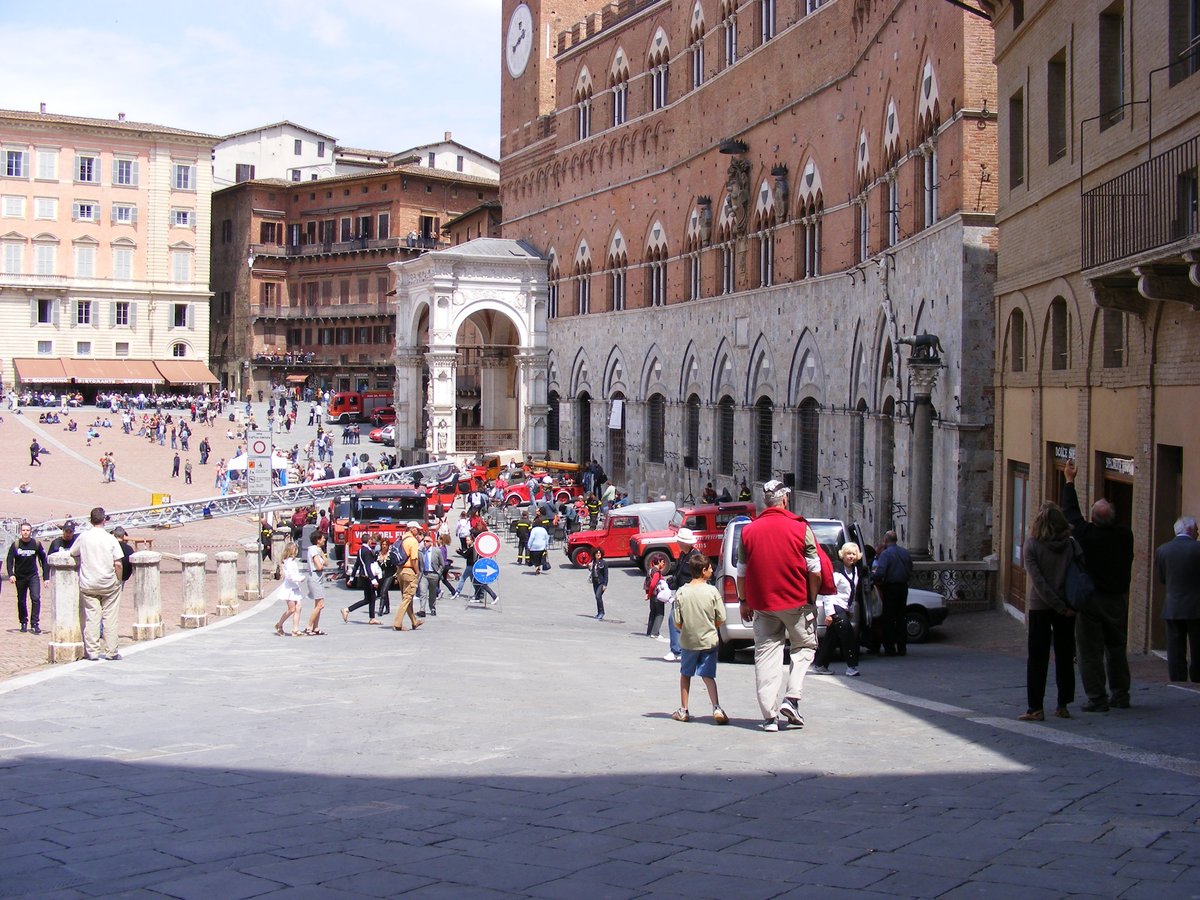
A merchant government known as the Governo dei Nove took power and held it until 1355. The Nine reshaped the civic center: the Palazzo Pubblico rose from 1297, and Piazza del Campo’s nine brick sections came to echo their rule; the Torre del Mangia followed between 1338 and 1348.
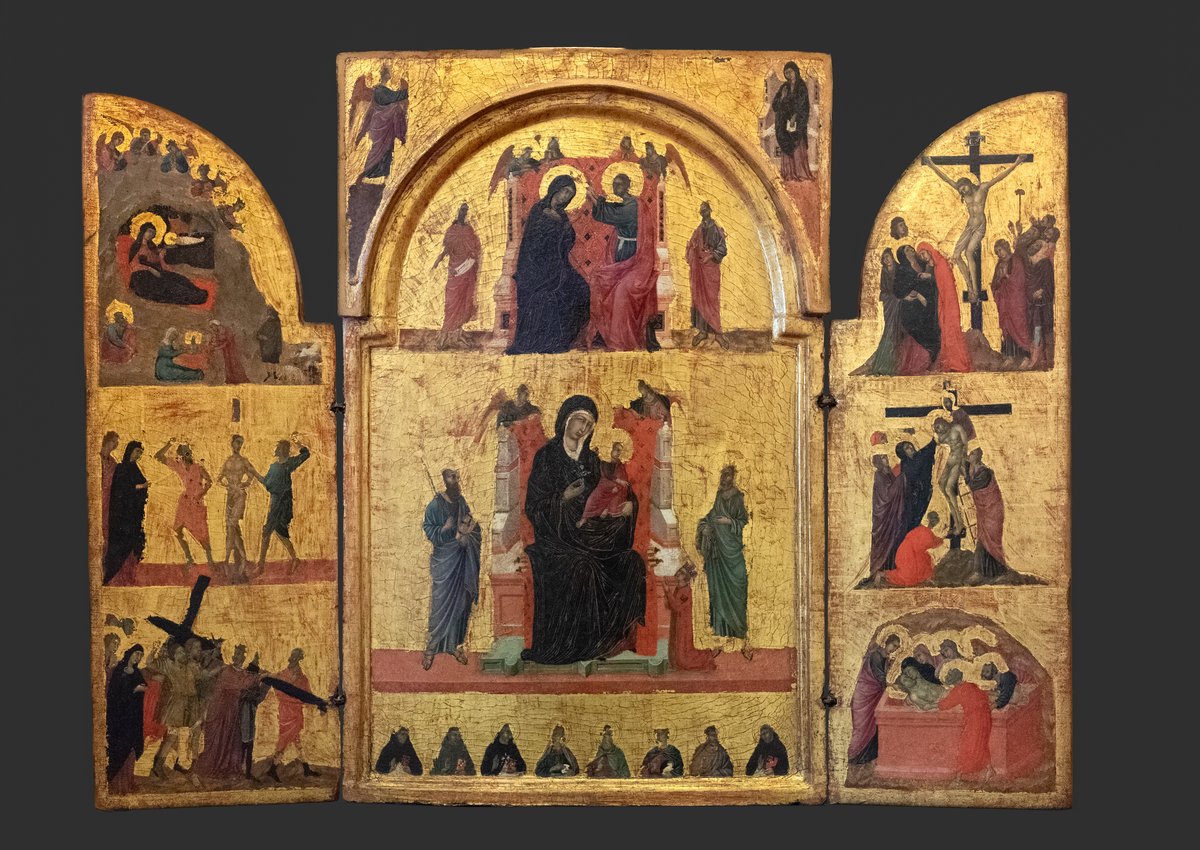
Duccio di Buoninsegna created the cathedral’s monumental Maestà, an altarpiece whose painted panels once faced worshippers in a procession through the city. Gold leaf catches the light across its crowded scenes, while the figures’ gestures lend the sacred story a distinctly human warmth.
Simone Martini painted a Maestà for the Palazzo Pubblico, placing the Virgin and Child above the government chamber. Her protective canopy turns a political room into a sacred one, a reminder that civic authority in medieval Siena was never merely administrative.
Ambrogio Lorenzetti painted the Allegory and Effects of Good and Bad Government in the Palazzo Pubblico’s Sala dei Nove. In the good-government scenes, shops open and workers move through a city whose streets and fields seem alive; this was political instruction rendered in fresco.
Siena’s council approved an immense expansion of the cathedral, intending to make the existing church part of a far larger structure. The Black Death, financial strain, and structural problems soon stopped the project; the unfinished Facciatone still exposes the scale of the ambition.
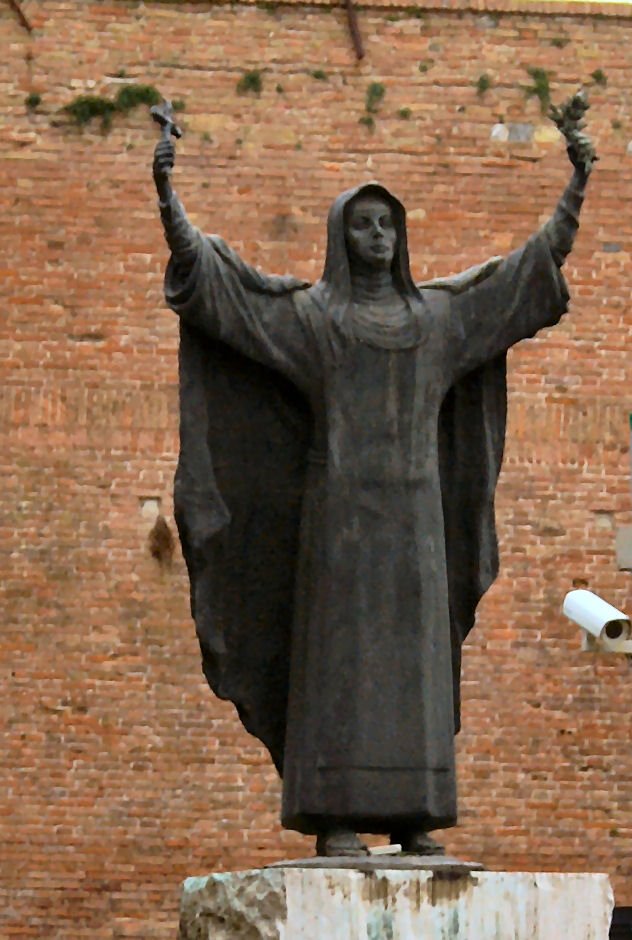
Caterina Benincasa was born into a large family of dyers in Siena. She began her religious life in the city, and the family home now forms part of the Santuario di Santa Caterina; later, her letters and diplomacy would reach the papal court.
The plague struck Siena in 1348, killing a large share of the population within months. Chronicler Agnolo di Tura described the dead filling the city, while the loss of workers, artists, and patrons left major projects unfinished.
The government of the Nine collapsed amid unrest and economic hardship during Emperor Charles IV’s visit to Siena. After 68 years, the merchant regime gave way to a more unstable sequence of councils and rival factions.
Siena commissioned sculptor Jacopo della Quercia to create a monumental fountain for Piazza del Campo; he completed Fonte Gaia in 1419. Its carved figures and reliefs transformed a practical water source into a public artwork, fed by the city’s underground aqueducts.
Humanist Enea Silvio Piccolomini, educated at the University of Siena, became the city’s bishop. Elected Pope Pius II in 1458, he later gave the cathedral’s Piccolomini Library a place in the city’s story through the frescoes commissioned by his nephew.
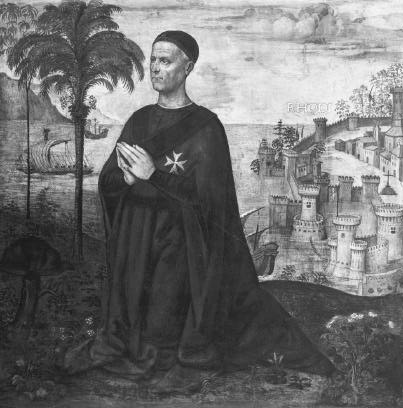
Siena founded the Monte di Pietà to offer loans at modest rates to people who lacked access to ordinary credit. The institution developed into Monte dei Paschi di Siena, whose long history tied the city’s fortunes to banking.
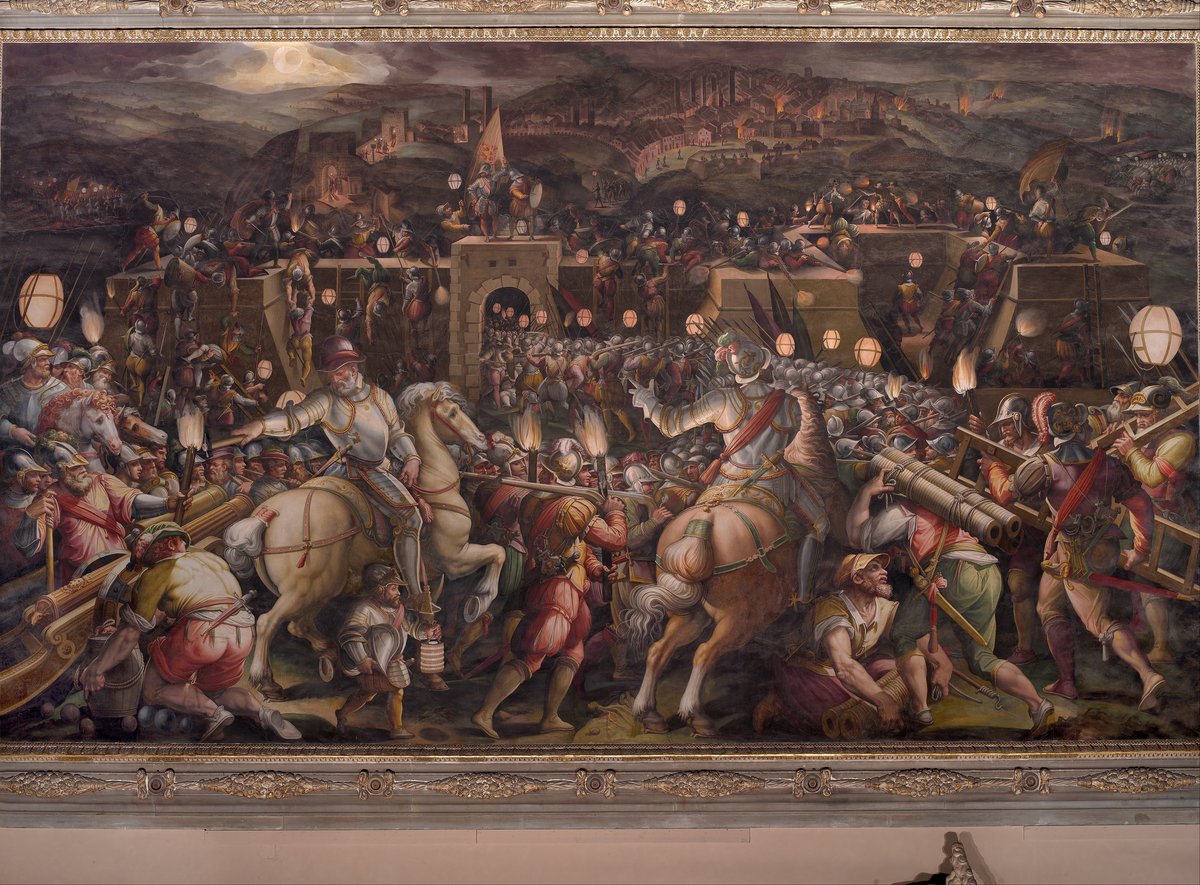
After Siena’s revolt against the Spanish garrison in 1552, imperial Spanish and Florentine troops besieged the city from 1554. Famine forced surrender in 1555; the republican government survived in exile at Montalcino until 1559, while Spain ceded Siena to Cosimo I de’ Medici in 1557.
Cosimo I ordered the construction of the brick Fortezza Medicea to hold a permanent garrison above Siena. Its heavy walls made the change in power plain: the former republic was now watched by the state that had conquered it.
The first documented horse race of the Palio in Piazza del Campo took place in 1656. Contrade rivalry had older roots, but the square’s sloping brick surface now became the stage for a race run at full speed around its shell-shaped edge.
After Tuscany’s 1859 plebiscite, Siena became part of the Kingdom of Italy in 1861. The old republic’s borders and rulers were gone, but its medieval civic center remained the city’s daily frame.
Count Guido Chigi Saracini founded the Accademia Musicale Chigiana in his family’s palazzo. Its courses brought performers and teachers to Siena, adding a modern musical institution to a city better known for its medieval painters.
French forces of the Allied campaign entered Siena on July 3, 1944, as German troops withdrew. Railway facilities outside the historic center had suffered air attacks, but the medieval core escaped major destruction.
Siena began excluding private motor traffic from its historic center, an early move of its kind in Europe. The decision protected narrow streets and old paving from the pressures of a rapidly growing car culture.
UNESCO inscribed Siena’s historic center as a World Heritage site, citing its Gothic urban form and artistic record. The designation recognized a city whose medieval streets still serve as streets, not just as scenery.
Monte dei Paschi faced public scrutiny over losses and risky financial transactions, drawing Siena’s oldest institution into a modern banking crisis. For a city long shaped by the movement of money, the episode exposed how closely local identity remained bound to one bank.
Mystic and saint · 1347–1380
Born in Siena
Catherine was born in Siena in 1347, in a city whose parish streets and political factions shaped her early life. She later wrote letters that reached popes and rulers; she might recognize today’s Siena in its stubborn neighborhood loyalties.
Painter · c. 1290–1348
Created frescoes in Siena’s Palazzo Pubblico
In the Palazzo Pubblico, Lorenzetti turned government into a public argument with his 1338–1339 frescoes on good and bad rule. His scenes of city life still invite visitors to judge Siena by what happens beyond the palace walls.
Painter · c. 1284–1344
Created the Maestà in Siena’s Palazzo Pubblico
Martini painted the Maestà for the Sala del Mappamondo, placing a Madonna and child at the center of Siena’s civic palace. He might be surprised that visitors now gather beneath the same painted authority with cameras rather than petitions.
Painter · c. 1255–1319
Created major works for Siena’s cathedral
Duccio helped define Sienese painting, and his work remains part of the city’s artistic memory and collections. The gold and intricate detail associated with his panels would find an echo in the Duomo’s careful marble work.
Painter · c. 1454–1513
Painted the Piccolomini Library in Siena’s Duomo
Between 1502 and 1508, Pinturicchio covered the Piccolomini Library with bright scenes honoring Pope Pius II. He might appreciate that visitors still step into the room and look up before they look at their phones.
Where locals actually book dinner — not the tourist menus.
Small things that change how the city treats you.
The city, as it actually looks.




Yes, especially if you want a Tuscan city where medieval civic life is still visible in the streets. Piazza del Campo, the Duomo and the frescoes in Palazzo Pubblico make a strong visit; the Palio’s neighborhood rivalries give the city a character beyond its monuments.
Plan on two to three days to see the main landmarks without rushing. One full day can cover the Campo and Duomo area, while extra time leaves room for the civic museum, Santa Maria della Scala and the steep lanes between them.
The direct 131R Rapida bus from Florence’s central bus station takes about 1 hour 15 minutes to 1 hour 30 minutes to reach Siena. Trains from Firenze Santa Maria Novella take about 1 hour 30 minutes, with some requiring a change.
Walk through the historic center, use Autolinee Toscane buses for longer hops, and take the free public escalators to manage the hills. The center is a camera-enforced restricted-traffic zone, so a car is more useful in a garage outside it than on the medieval streets.
Siena is generally considered safe, and local safety guidance describes violent street crime as rare. Use normal awareness with your belongings, particularly in crowds around the Palio.
Costs depend on when you travel, and Palio dates can make accommodation harder to find. For local transport, the urban bus fare is listed at €1.50 for 70 minutes, while the public escalators and exploring the streets on foot are free; check current fares before your trip.
80 places to discover










Showing 1–48 of 80 places
Saved and recently read places — kept on this device only.
Photos may have been resized or cropped.