Type 2+ letters to search all countries, cities, and places
/Ctrl KEsc
travel_explore
Type 2+ letters to search all countries, cities, and places
Press Enter to open the top result
Bibliotheca Alexandrina
Alexandria·Egypt·31° N · 29° E·Updated Apr 2026
Revived in 2002 after 2,000 years, the Bibliotheca Alexandrina holds 8 million books, four museums, and a planetarium — all on the exact site of the ancient wonder.
Nobody knows where the most famous library in history actually stood. Not one wall, column, or foundation stone from the ancient Library of Alexandria has ever been found — no archaeologist can confirm its exact location. The Bibliotheca Alexandrina rises from the waterfront in Alexandria, Egypt, on a site that may or may not be correct, and that uncertainty is part of what makes it worth visiting: a $220 million act of faith in a 2,300-year-old idea.
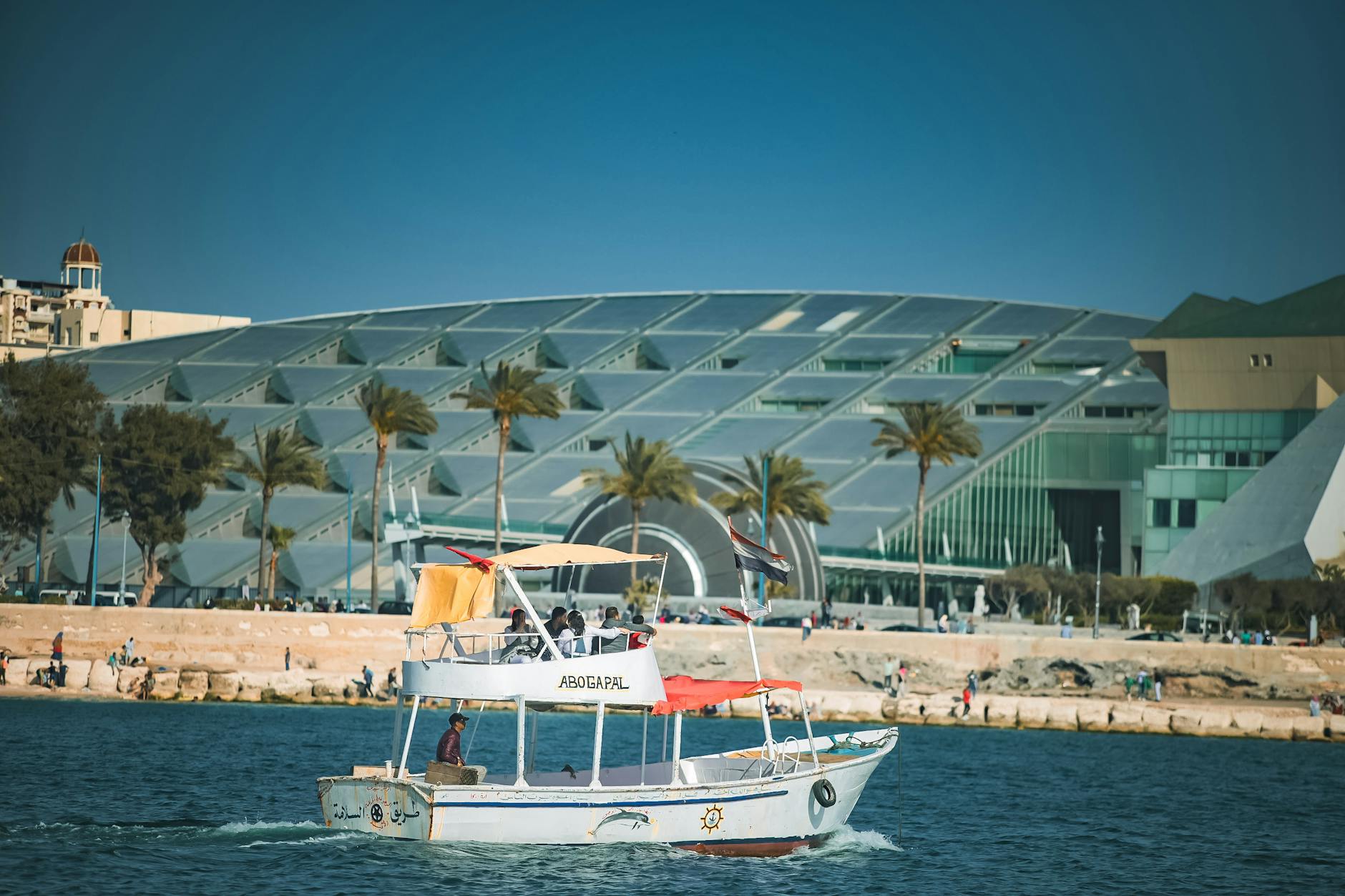
What you see from the Corniche is a 160-meter granite disc tilted 16 degrees toward the Mediterranean — roughly the angle of a clock hand at two o'clock. Norwegian firm Snøhetta designed it as a sun rising from the sea, an echo of Ra, though most visitors assume the tilt is a structural quirk. The exterior wall, clad in Aswan granite, carries roughly 4,000 characters carved from scripts spanning 10,000 years of human writing. Hieroglyphics sit beside Braille. Cuneiform neighbors barcodes. There is no message. That is the message.
Inside, the main reading hall drops seven stories below ground and seats 2,000 — one of the largest reading rooms on Earth. Light enters through the tilted glass roof and spills across cascading terraces of desks. The complex also holds three museums, a planetarium, seven research institutes, and six specialized libraries, including one for the visually impaired and one for children. Around a million people pass through each year, roughly 80 percent of them students from neighboring Alexandria University.
The building opened on 16 October 2002, thirty years after an Alexandrian history professor first proposed the idea during a public lecture. What happened in those three decades — the politics, the money, the irony — is a story the architecture alone cannot tell you.
Researched by the Audiala editorial team from historical records, architectural archives, and local expertise.
What to see
The Main Reading Hall
The reading hall drops. That's what catches you off guard — the floor descends in eleven cascading terraces from the entrance down toward the sea, like an amphitheater built for books instead of gladiators. Snøhetta, the Norwegian firm that won an anonymous international competition in 1989, designed the entire building as a tilted disc 160 meters across — wider than a football pitch — slicing into the ground at an angle that lets diffused Mediterranean light pour through a glass-paneled roof without ever hitting the pages directly. Two thousand readers can sit here at once, surrounded by shelf space for eight million volumes, and the acoustic engineering absorbs their collective silence into something almost physical.
The columns deserve a second look. Each one is different, tapering at odd angles like a concrete forest refusing symmetry. Stand at the lowest terrace and look up toward the entrance: the effect is deliberately vertiginous, a reminder that this space was conceived as a direct answer to the ancient library Ptolemy I founded around 295 BCE. That original collection reportedly held 400,000 scrolls. The modern one already holds over two million books, and it's barely two decades old.
The Granite Wall of Scripts
Before you even step inside, the building's exterior wall stops you cold. A massive cylinder of Aswan granite — 32 meters tall at its highest point, roughly the height of a ten-story building — wraps the library in characters carved from 120 different writing systems. Hieroglyphics sit next to Braille, next to Cherokee syllabary, next to Japanese katakana. The Norwegian sculptor Jorunn Sannes designed it as a record of human attempts to pin meaning to symbols, and the effect at sunset is almost absurd: the low Mediterranean light rakes across the carvings at an angle that turns flat stone into deep relief, and you find yourself tracing alphabets you'll never read.
Walk the full perimeter. It takes about ten minutes at a slow pace, and it's the only way to grasp the scale. Most visitors photograph the front entrance and move on. They miss the sections where ancient Mesopotamian cuneiform neighbours modern Korean hangul — scripts separated by four thousand years of history carved into the same slab of pink granite.
The Antiquities Museum and Planetarium
When construction crews broke ground in the early 1990s, they didn't just find sand. Roman-era villas, mosaic floors, and thousands of artifacts turned up beneath the building site — relics of the ancient Bruchion district where the original library once stood. The Bibliotheca Alexandrina's Antiquities Museum now displays these finds in its basement galleries: a pharaonic collection spanning from the Old Kingdom through the Ptolemaic period, plus underwater archaeology pulled from Alexandria's eastern harbour. The juxtaposition is strange and honest — a 21st-century building literally built on top of what it claims to continue.
Upstairs, the Planetarium juts out from the main structure as an aluminium-clad sphere 19 meters in diameter, tilted toward the sky like a half-buried planet. The 99-seat theatre inside runs digital shows on the cosmos, but the real draw is the object itself — from the Corniche, it catches the afternoon sun and glows against the granite wall like something that landed there by accident. Buy a combined ticket. The library entrance costs 70 Egyptian pounds for foreigners, and the Planetarium adds only a fraction more.
The Full Corniche Walk: Library to Citadel
Here's what most guides skip: the Bibliotheca Alexandrina sits roughly midway along Alexandria's seafront Corniche, and walking east from the library entrance to the Citadel of Qaitbay — the 15th-century fortress built on the exact site of the ancient Pharos Lighthouse — takes about 45 minutes along the Mediterranean. The route passes through the old Chatby district, past crumbling Italian-era mansions with wrought-iron balconies that nobody has restored, past fishermen selling the morning catch straight off wooden boats. The salt air is constant. So is the noise.
This walk connects the two poles of Alexandrian ambition: a modern library that cost $220 million and took over a decade to build, and a medieval fort thrown up in 1477 from the rubble of one of the Seven Wonders. Neither building is subtle. Both are attempts to mark a city that has always defined itself by what it builds at the water's edge. Do the walk in the late afternoon when the light turns gold and the Corniche fills with families, tea sellers, and stray cats who have clearly read the guidebooks about Egyptian hospitality.
Plan your visit
Getting There
The Bibliotheca Alexandrina sits on the Corniche in El Shatby, right where the Eastern Harbour curves toward the Mediterranean. From central Alexandria (Raml Station area), it's a 10-minute taxi or a short walk east along the waterfront promenade. Trams on the Raml line stop at El Shatby station, about 300 meters from the entrance — look for the massive tilted disc of the roof catching sunlight off the sea.
Opening Hours
As of 2026, the library opens Sunday through Thursday from 10:00 AM to 7:00 PM, and Friday through Saturday from noon to 4:00 PM. The complex closes on Egyptian public holidays. Last admission is typically 30 minutes before closing — don't cut it close if you want to see the museums too.
Time Needed
A quick pass through the main reading room and the architecture takes about 45 minutes. Two hours lets you absorb the reading hall, the Antiquities Museum, and the Manuscript Museum properly. If you want the planetarium, the Impressions of Alexandria exhibit, and the rotating galleries, budget a full half-day — three to four hours minimum.
Cost & Tickets
As of 2026, general admission for foreign visitors is around 70 EGP — roughly the price of a decent coffee in Cairo. Separate tickets are required for the planetarium and some temporary exhibitions. Buy tickets at the main entrance; there's no advance online booking system that works reliably, so just show up.
History
Two Libraries, Two Exiles, Twenty-Three Centuries Apart
Every great library is also a political instrument, and this spot on the Alexandrian waterfront has proved the point twice. Around 295 BCE, a disgraced Athenian exile convinced an Egyptian king to collect every book in the known world. In 1972, a local professor convinced UNESCO to try again. Both men built something extraordinary. Both were consumed by the institutions they created.
The ancient Library of Alexandria, founded under Ptolemy I Soter and expanded by Ptolemy II, was the first attempt at a universal collection of human knowledge. It held an estimated 400,000 to 700,000 scrolls — equivalent, very roughly, to 100,000 modern books. Its catalog alone, the Pinakes compiled by Callimachus around 250 BCE, ran to 120 volumes and five times the length of the Iliad. Neither the Library nor the Pinakes survive. The modern Bibliotheca Alexandrina is built on the premise that the idea is more durable than the building.
The turning point
The Professor Who Dreamed the Library Back — and Was Locked Out of It
The surface story is triumphant. In 1972, Mostafa El-Abbadi, a history professor at Alexandria University, proposed reviving the ancient library during a public lecture. Over the next fourteen years he lobbied the Egyptian government and UNESCO, and in May 1986 Egypt formally requested international support. The foundation stone was laid on 26 June 1988 by President Hosni Mubarak and the UNESCO Director-General. An anonymous design competition drew entries from 524 firms across 77 countries. Snøhetta, a then-unknown Norwegian practice, won. Construction began in 1994. Cost: $220 million.
But something doesn't add up. When the Bibliotheca Alexandrina was inaugurated on 16 October 2002 — the culmination of El-Abbadi's thirty-year vision — he was not invited. After the 1988 design competition, politicians and bureaucrats had seized control of the project. The academics who conceived it were pushed out entirely. El-Abbadi told the New York Times the completed library risked becoming merely 'a cultural center' rather than a world-class research institution. After the 2011 revolution, Egypt's Illicit Gains Authority found $145 million earmarked for the library sitting in a bank account belonging to Suzanne Mubarak, the president's wife and the library's honorary patron. The total budget overrun reached $70 million. No public accounting of those funds has ever been confirmed.
El-Abbadi died in 2017. He received a Google Doodle. He never received an apology. When you walk through the reading hall — seven stories of light cascading over open shelves — you are inside a building that exists because one professor refused to stop talking about a 2,300-year-old idea. The plaque credits the state. The state did not have the idea.
The First Exile: Demetrius and the Original Library
Before El-Abbadi, there was Demetrius of Phalerum — an Athenian politician and student of Aristotle's successor, overthrown from power around 307 BCE and exiled to the court of Ptolemy I. He proposed to the king what no one had attempted: a library containing every book in the world. Around 295 BCE, Demetrius was charged with creating both the Library and the Mouseion, modeling them on Aristotle's Lyceum. He ordered every ship entering Alexandria's harbor searched for books; the library kept the originals and returned copies. Then Ptolemy I died. Demetrius had backed the wrong heir to the throne. Ptolemy II exiled him to Upper Egypt, where, according to tradition, he died from a snakebite. He built one of the ancient world's great intellectual institutions and was destroyed by the dynasty that owned it — a pattern this place would repeat twenty-three centuries later.
The Fire That Wasn't: How the Ancient Library Actually Died
Ask anyone how the Library of Alexandria was destroyed and they will name a single catastrophe — Caesar's fire, or Caliph Omar's order to burn the books as bathhouse fuel. Both stories are wrong, or at best incomplete. In 48 BCE, Caesar set fire to ships in the Eastern Harbor and flames spread to waterfront warehouses, likely destroying a storage depot of scrolls rather than the main collection. Mark Antony gave Cleopatra 200,000 replacement scrolls five years later, which suggests plenty of library remained. The Caliph Omar story first appears in writing five hundred years after the alleged event and is rejected by modern scholars as a later fabrication. The real death was slow: Ptolemy VIII expelled foreign scholars in 145 BCE, Roman emperors showed no interest in maintaining the collection, and civil wars in the 270s CE physically destroyed the Royal Quarter where the Library stood. By the time Bishop Theophilus demolished the Serapeum and its smaller daughter collection in 391 CE, the great library had been dying for centuries. It perished not from a single blaze, but from chronic institutional neglect — a less dramatic story, and a more honest one.
Tips for visitors
Photography Rules
Personal photography is allowed in most public areas, but flash and tripods are banned inside the main reading room. The manuscripts and rare books sections prohibit photography entirely — guards will ask you to put your phone away, and they mean it.
Security Screening
Expect airport-style bag checks at the entrance. Large bags and backpacks may need to be checked at the cloakroom, so travel light or carry a small daypack to avoid the wait.
Morning Light Inside
The main reading hall is designed so natural light cascades down all seven terraced levels through the tilted glass roof. Visit before noon when the sun angles through at its sharpest — the geometry of shadows on the granite walls is worth the early start.
Eat Nearby
Skip the library café and walk five minutes east to Mohamed Ahmed on Shakour Street for Alexandria's best foul and falafel at budget prices. For seafood with a harbour view, Fish Market on the Corniche (mid-range) does grilled catch-of-the-day that justifies the markup.
Pair With Nearby Sites
The Roman amphitheatre at Kom el-Dikka is a 15-minute walk south, and the Cavafy Museum sits just a few blocks inland. String all three together for a morning that covers 2,300 years of Alexandria's layers without retracing your steps.
Reading Room Etiquette
The main hall is an active research library, not just an architectural showpiece. Keep voices low, silence your phone, and resist the urge to FaceTime your friends from the upper terrace — the acoustics carry sound across all seven levels like a stone amphitheatre.
Where to Eat
local_dining
Don't Leave Without Trying
Kebda Eskandarani—spiced fried beef liver sandwich, a signature Alexandrian dish (spicier than Cairo's version)Sayadeya—spiced seafood rice, Alexandria's answer to paellaFoul Eskandarani—fava beans with peppers and tomatoes, a breakfast stapleGambari mashway—grilled prawns, lightly seasoned with Mediterranean simplicityKunafa (Knafeh)—shredded pastry with cheese or syrup, found in every baladi cafeOm Ali—Egyptian bread pudding with cream, a rich dessert favoriteAlexandrian ice cream—Italian-influenced, exceptionally creamy
Cilantro Alex Library
cafe
Western Cafe€€star4.4(2652)directions_walkOn-site at the library
Order: Coffee, fresh pastries, and salads with unbeatable views of the Planetarium and Mediterranean Sea. Linger here after exploring the library's treasures.
Right inside the Bibliotheca Alexandrina complex with a view that justifies the visit alone. This is where locals and visitors alike settle in for hours with a cappuccino and a book.
Specialty Coffee & Bakery€€star5.0(13)directions_walkOn-site at the library
Order: Specialty coffee and fresh-baked pastries. This is serious coffee culture—the kind of place where the barista actually cares about extraction time.
Perfect 5-star rating and right at the library entrance. MERZY is where you grab an exceptional coffee and pastry without leaving the complex—ideal for a quick morning bite before diving into the stacks.
Egyptian Cafe€€star4.5(11)directions_walkWalking distance on the Corniche
Order: Hibiscus tea (karkade), fresh mango juice, and kunafa—the classic baladi cafe experience. Come at sunset for the real Alexandria vibe.
Open 24 hours on the Corniche, this is where locals actually sit. It's unpretentious, cheap, and perfect for catching the sea breeze at any hour. No tourists, no fuss.
Cafe & Workspace€€star5.0(1)directions_walkNear the library, on Ali Mustafa Street
Order: Coffee and light bites in a creative workspace setting. This is where Alexandria's younger crowd works and thinks.
A hidden gem near the university with a perfect 5-star rating. Nasem blends cafe culture with workspace energy—ideal if you want something more local and less touristy than the library cafes.
checkAlexandria is Egypt's seafood capital—prioritize fish restaurants over meat dishes. Seafood is typically priced by weight, so always ask before ordering.
checkBaladi cafes serve cheap, authentic snacks between sights: hibiscus tea (karkade), fresh mango juice, and kunafa are perfect quick bites.
checkThe Corniche is lined with casual cafes and restaurants with sea views—ideal for sunset dining and people-watching.
checkAll verified restaurants near the library are within walking distance or on-site, making it easy to plan meals around your visit.
Food districts:The Corniche—lined with cafes and restaurants offering sea views and local atmosphereBab Shar' (Eastern Gate area)—where the library sits, surrounded by casual dining and specialty coffee shopsAl Azaritah and Ash Shatebi—neighborhoods with authentic local eateries and baladi cafes
Restaurant data powered by Google
Watch & Explore Bibliotheca Alexandrina.
Explore Alexandria
13 BEST Things to do in Alexandria, Egypt | Travel Guide
Before You Go9 min108K
Explore Alexandria
ايه نذاكر في مكتبه الاسكندرية؟؟❤️❤️💃🏼😅
Sarah Khaled1 min499K
Frequently asked
Is the Bibliotheca Alexandrina worth visiting?
Yes — and not just for the books. The building itself is the main event: a 160-meter-diameter tilted disk rising from the Corniche like a sun breaking the horizon, wrapped in 6,000 square meters of granite carved with characters from every writing system humans have invented, including barcodes. Inside, the main reading hall drops seven stories below ground and seats 2,000 people under a single soaring roof. The antiquities museum displays Roman mosaics excavated from the exact ground beneath your feet during construction.
How long do you need at the Bibliotheca Alexandrina?
Plan for two to three hours if you want to see the main reading hall, the Antiquities Museum, and the Manuscript Museum. The reading hall alone deserves thirty minutes — it's one of the largest in the world, spanning an area roughly equivalent to four Olympic swimming pools. If you add the planetarium or a temporary exhibition, budget closer to four hours.
How do I get to the Bibliotheca Alexandrina from central Alexandria?
The library sits on the Corniche in the El Shatby district, next to Alexandria University. From Raml Station in the city center, it's a short tram ride east on the coastal line or a 10-minute taxi along the waterfront road. The Mediterranean is directly behind the building — you can't miss the giant tilted granite disk from the Corniche.
What is the best time to visit the Bibliotheca Alexandrina?
Morning on a weekday, before university students fill the reading hall. The library is open Sunday through Saturday, but July brings the annual International Book Fair with 150,000+ visitors over two weeks, plus the Summer Festival with nightly concerts — good if you want atmosphere, bad if you want quiet. Ramadan brings special Sufi music programming worth catching.
Can you visit the Bibliotheca Alexandrina for free?
No — general admission is required, though the fee is modest (around 70 Egyptian pounds for foreigners as of recent years). The exterior inscription wall, however, is free to examine from the plaza, and it rewards close inspection: Norwegian artists Jorunn Sannes and Kristian Blystad carved roughly 4,000 unique characters spanning 10,000 years of human writing into the granite, deliberately arranged without hierarchy or meaning.
What should I not miss at the Bibliotheca Alexandrina?
The Antiquities Museum on the ground level — you're walking directly above the spot where its 1,079 artifacts were excavated during the library's construction in the 1990s. The Roman-era mosaics, including a dog mosaic and a wrestlers' scene, were found in the soil beneath the building and now sit in the building that replaced it. Also look up in the main reading hall: the roof is a single aluminum-and-glass surface tilted at 16 degrees toward the sea, designed by Snøhetta to evoke a rising sun disk.
Is the Bibliotheca Alexandrina on the same site as the ancient Library of Alexandria?
Probably close, but not confirmed. Tourist materials and press releases say "same site," but no archaeological evidence has pinpointed the ancient Library's exact location anywhere in Alexandria. The 1993–1995 excavations on the modern library's construction site did uncover Roman villas and mosaics consistent with the Ptolemaic palace district — the right neighborhood, but not proof of identity. The ancient Library's precise footprint remains the most contested open question in Alexandrian archaeology.
What happened to the original Library of Alexandria?
It didn't burn in one dramatic fire — that's a persistent myth. The real story is slower and sadder: chronic underfunding after the early Ptolemies, a Roman policy of indifference, civil wars that damaged the Royal Quarter, and scholars gradually leaving over centuries. Julius Caesar's fire in 48 BCE likely destroyed a dockside warehouse of scrolls, not the main collection. The famous story of Caliph Omar ordering books burned as bathhouse fuel in 641 CE first appears 500 years after the supposed event and is rejected by modern scholars.
Sources & attribution22
Researched and written by the Audiala editorial team from historical records, architectural archives, and local expertise. Last updated April 2026.
Saved and recently read places — kept on this device only.
Photo credits (8)
CW BibliotechaAlexandrina Front — CarstenW — CC BY 3.0 (https://creativecommons.org/licenses/by/3.0/) — Source: https://commons.wikimedia.org/wiki/File:CW_BibliotechaAlexandrina_Front.jpg
BibAlex from the sea (2715600208) — Filip Maljković from Pancevo, Serbia — CC BY-SA 2.0 (https://creativecommons.org/licenses/by-sa/2.0/) — Source: https://commons.wikimedia.org/wiki/File:BibAlex_from_the_sea_(2715600208).jpg
Bibliotheca Alexandrina interior - 2008-07-17 — Pfctdayelise — CC BY-SA 3.0 (https://creativecommons.org/licenses/by-sa/3.0/) — Source: https://commons.wikimedia.org/wiki/File:Bibliotheca_Alexandrina_interior_-_2008-07-17.JPG
Bibliotheca Alexandrina Wall — Mohamed Khalil — CC BY-SA 4.0 (https://creativecommons.org/licenses/by-sa/4.0/) — Source: https://commons.wikimedia.org/wiki/File:Bibliotheca_Alexandrina_Wall.jpg
Aleksandria raamatukogu IMG 0119 — User:Avjoska — CC BY 3.0 (https://creativecommons.org/licenses/by/3.0/) — Source: https://commons.wikimedia.org/wiki/File:Aleksandria_raamatukogu_IMG_0119.JPG
Bibliotheca Alexandrina in atmospheric light — Mogaio — CC BY-SA 1.0 (https://creativecommons.org/licenses/by-sa/1.0/) — Source: https://commons.wikimedia.org/wiki/File:Bibliotheca_Alexandrina_in_atmospheric_light.jpg
Diego F. Parra — Pexels License (https://www.pexels.com/license/) — Source: https://www.pexels.com/photo/15238618/
Strictly necessary cookies keep the site working. Analytics (PostHog, Google Analytics) measures how each visitor uses our pages. Marketing loads YouTube videos and walking-route maps without a tap and lets Google Analytics set advertising cookies. We never sell your data. You can change this any time from the footer.
Privacy
Cookie preferences
Pick what you're okay with. You can change this any time from the footer.
Strictly necessary
Always on
Sign-in, language, navigation. Always on.
Product analytics
PostHog (EU) and Google Analytics record which pages you view and how you use them, under a random identifier stored in your browser. Helps us see which pages work and which need fixing. Google's ad personalisation stays off. No selling.
Marketing
Loads YouTube videos and the walking-route maps (OpenFreeMap) without a tap; without it, they load only when you tap them. If analytics is also on, Google Analytics may set advertising cookies. Ad personalisation stays off.