Type 2+ letters to search all countries, cities, and places
/Ctrl KEsc
travel_explore
Type 2+ letters to search all countries, cities, and places
Press Enter to open the top result
Sultan Ahmad Shah State Mosque
Kuantan·Malaysia·3° N · 103° E·Updated Apr 2026
Pahang's state mosque replaced a pioneering 1964 concrete-dome original; its blue dome is now Kuantan's most-photographed landmark and a living community hub.
The mosque that defines Kuantan's skyline is named after a sultan who died half a century before its first brick was laid. Masjid Sultan Ahmad Shah stands at the civic heart of this east-coast Malaysian city, its blue dome and four white minarets visible from across the Kuantan River — yet the building tourists photograph today dates only to 1994, a replacement for something far stranger that once occupied this exact ground.
Sultan Ahmad al-Mu'azzam Shah consolidated the Pahang sultanate in the 1860s after a brutal civil war against his own brother. He spent his final decades watching British Residents govern his kingdom while he retained only ceremonial authority. The mosque bears his name as a marker of sovereignty — Pahang's identity, reasserted in concrete and tile.
The current structure holds 10,000 worshippers, five times the capacity of its predecessor. DZJ Architect and Associates designed it in a deliberately classical Islamic style: large central dome, four corner minarets, clean symmetry. The choice was a rebuke. What stood here before was a 50-metre concrete dome — wider than an Olympic swimming pool is long — paired with a single rocket-shaped minaret. Space-age modernism applied to a house of worship.
That earlier building leaked. Not a slow drip but a catastrophic failure under monsoon rains, severe enough to require total demolition in 1992. The state mosque of Pahang, the symbolic centre of religious authority for an entire state, couldn't keep water out. What replaced it looks like tradition. It's actually an argument — a building designed to be everything its predecessor was not.
Researched by the Audiala editorial team from historical records, architectural archives, and local expertise.
What to see
The Blue Dome and Four Minarets
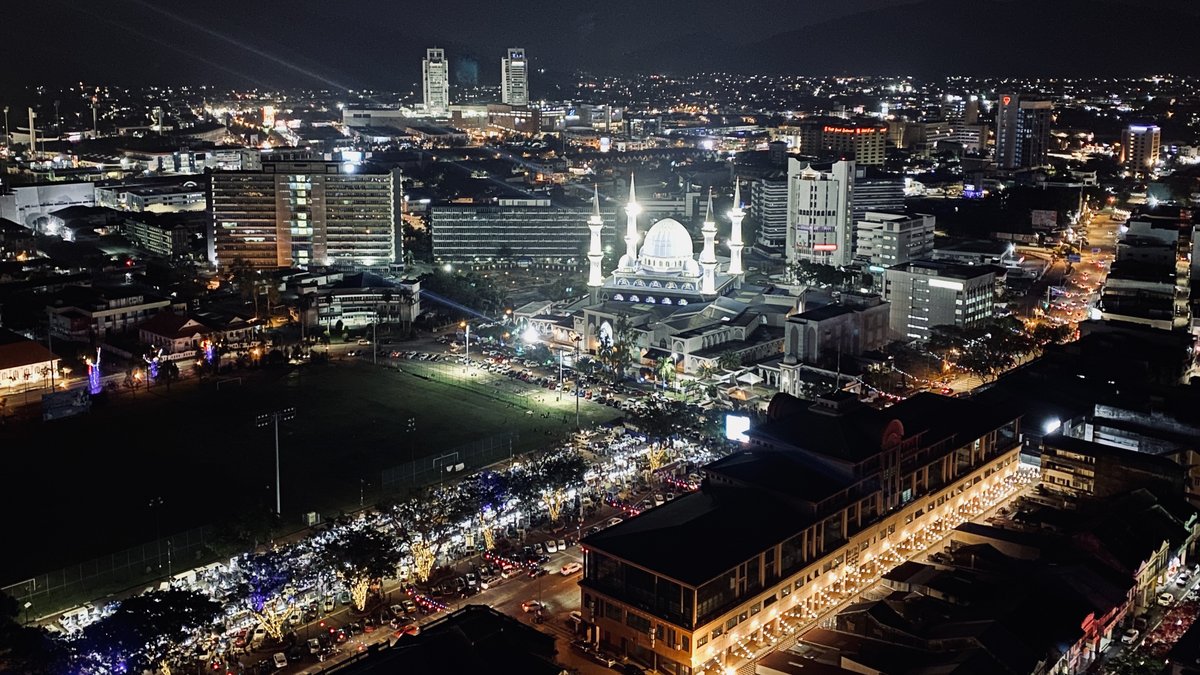
The mosque that stands here now is actually the second one on this site. The first — a wild, space-age geodesic dome completed in 1962 — leaked so badly during monsoon rains that Pahang demolished it in 1992 and started over. What replaced it is more restrained but arguably more confident: a single large blue dome flanked by four slender white minarets, designed by DZJ Architect and Associates and inaugurated in October 1994 with a guest imam flown in from Mecca's Grand Mosque. The dome's blue isn't static. Under midday sun it reads almost turquoise; at golden hour, as light rakes in from the east, it shifts toward violet. After dark, floodlights turn the whole composition into something closer to a stage set — the white minarets glowing against black sky, the dome suspended above them like a held breath. Stand on Padang MBK, the big civic field to the south, and you get the full symmetry: four minarets framing the dome with the kind of geometric precision that makes you reach for your phone camera even if you'd sworn you wouldn't.
The Prayer Hall Interior
Remove your shoes at the entrance — robes are provided if your clothes don't cover shoulders and knees — and the first thing you'll notice is the temperature drop. High ceilings and polished floors pull the equatorial heat out of your body in seconds. The palette inside is deliberately quiet: neutral walls, soft blue carpet underfoot, hints of green. No gilt, no excess. The original 1962 mosque had a concrete dome engineered to suppress echo, and though no one has confirmed the current building inherited that acoustic design, the effect is similar. Stand in the centre of the main hall and speak. Your voice doesn't bounce; it dissolves. During prayer, the collective murmur of recitation and the soft shuffle of feet on carpet fill the space without ever becoming noise. Look up. The transition from plain walls to the dome overhead is the best interior view — the geometric patterns tighten as they climb, and the calligraphy woven into the design isn't decorative filler. Each inscription carries specific Quranic meaning, though few visitors pause long enough to notice.
Sunset from Padang MBK — The Visit That Costs Nothing
You don't need to go inside to experience this mosque at its most powerful. Walk to Padang MBK — the open field beside the mosque where locals jog, children fly kites, and food trucks park on weekends — and arrive about twenty minutes before Maghrib prayer. The light does its work on the dome. Then the azan begins, broadcast from the minarets, and for a few seconds the kite strings, the traffic on Jalan Mahkota, the vendor calling out satay prices — all of it recedes. The call to prayer doesn't compete with the city. It absorbs it. Even if you never step inside, this is the moment that stays. Afterward, linger: the illuminated mosque against the night sky is a different building entirely, and the Kuantan River Esplanade is under ten minutes on foot. The mosque also functions quietly as a wayfarers' rest — showers, clean ablution areas, baby changing facilities — a generosity most travel guides never mention.
Plan your visit
Getting There
The mosque sits on Jalan Mahkota in central Kuantan — most city-centre hotels are within walking distance. Grab is the easiest option if you're coming from further out. By bus, the nearest stop is UOB Bank, roughly a two-minute walk away; check the Moovit app for current route numbers. If you're driving, arrive early on Fridays — parking fills fast when half the city shows up for Jumu'ah prayers.
Opening Hours
As of 2026, the mosque is open daily from 05:00 to midnight. Non-Muslim visitors should time their arrival between prayers — five daily prayer sessions temporarily close the main hall. Friday midday (roughly 12:30–14:00) is the busiest window; avoid it unless you specifically want to witness the scale of communal worship. No seasonal closures, though the monsoon season from November to February brings downpours that make the open courtyards less pleasant.
Time Needed
A quick loop of the exterior and entrance hall takes 20–30 minutes. To properly absorb the prayer hall, upper gallery, and gardens — and to photograph the blue dome from every angle you'll inevitably want — allow 45 minutes to an hour. The adjacent Sultan Haji Ahmad Shah Royal Museum Complex adds another 30–45 minutes if you pair them, which you should.
Cost
Entry is completely free. No tickets, no booking system, no audio guide to upsell you. Walk in, walk out. The mosque provides modest-dress coverings at no charge if you arrive underprepared, which is generous given how many state mosques in Southeast Asia have started charging a small fee for loaner robes.
Photo Gallery
The stunning Masjid Sultan Ahmad Shah stands as a prominent architectural landmark in Kuantan, Malaysia, known for its elegant blue domes and minarets. · Phalinn Ooi from Kuala Lumpur, MalaysiaA close-up view of the intricate tile work and Arabic calligraphy adorning the entrance of the Masjid Sultan Ahmad Shah in Kuantan, Malaysia. · Phalinn Ooi from Kuala Lumpur, MalaysiaThe stunning Masjid Sultan Ahmad Shah stands as a prominent landmark in Kuantan, Malaysia, showcasing beautiful Islamic architectural details. · Phalinn Ooi from Kuala Lumpur, MalaysiaA close-up view of the intricate Islamic architectural details and geometric patterns adorning the facade of the Masjid Sultan Ahmad Shah in Kuantan, Malaysia. · Phalinn Ooi from Kuala Lumpur, MalaysiaThe grand entrance of Masjid Sultan Ahmad Shah in Kuantan, Malaysia, showcases stunning Islamic architectural details and elegant blue tile work. · Phalinn Ooi from Kuala Lumpur, MalaysiaThe stunning Masjid Sultan Ahmad Shah in Kuantan, Malaysia, showcases beautiful Islamic architecture with its iconic blue domes and towering minarets. · Phalinn Ooi from Kuala Lumpur, MalaysiaThe stunning Masjid Sultan Ahmad Shah in Kuantan, Malaysia, showcases beautiful Islamic architecture with its iconic blue domes and elegant minarets. · Phalinn Ooi from Kuala Lumpur, Malaysia
History
Same Ground, Three Mosques
Friday prayers have been offered on this patch of Jalan Mahkota through at least three generations of buildings. Before the concrete dome, a wooden mosque stood here on what was then called Wall Street — no surviving record tells us when it was founded or who built it. The function has never changed. The architecture keeps failing and being reborn.
Kuantan's growth tracks the growth of this site. A wooden structure served a kampung. A modernist dome built in 1962 served a growing district town, holding roughly 2,000 worshippers. A state mosque completed in 1993 serves a state capital ten times that size. The congregation has outgrown every building placed in front of it.
The turning point
A Sultan's Name on a Building He Never Saw
Sultan Ahmad al-Mu'azzam Shah was born in 1836 into a Pahang torn between rival claimants. He fought his brother Mutahir in the Pahang Civil War from 1857 to 1863 — a conflict where losing meant exile or death, and winning meant forging a modern sultanate from feudal chaos. He won. But the sovereignty he built was curtailed almost immediately by British colonial administration, and by the 1890s a British Resident effectively governed his state while he retained only the formalities of rule. He died in 1914, his dynasty intact but his power hollowed out.
Nearly five decades later, the first mosque on this site was built in 1962 and records confirm it was inaugurated on 28 August 1964 by his grandson, Sultan Abu Bakar. Another three decades passed. The dome cracked, the rains poured in, and the building came down. His great-grandson, Sultan Haji Ahmad Shah, inaugurated the replacement on 21 October 1994 — closing a dynastic arc spanning four generations and 158 years. According to reports, the Imam of the Great Mosque of Mecca, Syaikh Muhammad bin Abdullah as-Sabil, attended the ceremony.
The naming was deliberate. Pahang chose to honour not a recent benefactor but the founder of the sultanate itself — the man who had fought a civil war to make Pahang a sovereign state. Every Friday prayer offered under this dome is, in a quiet way, a continuation of that original claim to independence.
What Changed: From Rocket Ship to Revival
The 1962 mosque looked like nothing else in Malaysia — a 50-metre thin-shell concrete dome that sources describe as geodesic, paired with a single minaret locals compared to a rocket. It was post-independence optimism poured into concrete, a deliberate break from colonial-era vernacular architecture. By 1992, tropical monsoons had won. The dome leaked so badly that engineers declared it beyond repair, and the entire structure was demolished. DZJ Architect and Associates replaced it with the opposite: four classical minarets rising 55 metres each, a traditional dome, and an aesthetic that signals permanence over experimentation. The space age gave way to a revival style so conservative it could have been built three centuries ago.
What Endured: The Padang, the River, the Prayer
Strip away the architecture and the site itself tells a single, unbroken story. The mosque still faces the padang — Kuantan's central field — just as the wooden original did. The Kuantan River still curves past to the east. The qibla orientation, locked to Mecca, anchors every iteration of the building to the same compass bearing. Worshippers still gather on Fridays in a density that would be recognisable to anyone who prayed under the geodesic dome or the wooden roof before it. Three buildings have risen and fallen here. The congregation has never left.
Tips for visitors
Dress Code Enforced
Women need a headscarf, long sleeves, and full-length skirt or trousers. Men need long trousers and covered shoulders — no shorts. Shoes come off before entering the prayer hall. The mosque provides cover-up garments free of charge, but wearing your own is more comfortable and avoids the one-size-fits-nobody poncho situation.
Shoot It at Night
The blue dome photographs well anytime, but after dark the illuminated exterior is genuinely striking — multiple visitors single out the night view as the best shot in Kuantan. During the day, sunrise and sunset light on the four minarets gives you the warm tones. Never photograph people in active prayer, and leave the drone in your bag — religious sites in Malaysia are effectively no-fly zones.
Eat Like Kuantan Does
Skip anything tourist-facing and head to Kedai Kopi Baging for nasi lemak or nasi dagang at breakfast — budget prices, under RM10. For nasi kerabu with that distinctive blue-tinted rice, locals recommend Restoran Cucu Tok Merah (RM10–20). Jungle Food Court covers everything else with diverse stalls if you can't decide.
Dodge the Monsoon
March through October gives you dry skies and comfortable photography conditions. November to February brings sudden, heavy East Coast rain that can briefly flood the open courtyards and parking areas. The mosque stays open regardless, but your exterior shots will suffer and the walk from any parking spot becomes an adventure.
Pair with the Museum
The Sultan Haji Ahmad Shah Royal Museum Complex sits right next door — a cluster of restored neo-colonial buildings from 1910–1912 currently undergoing phased heritage restoration. Walk between both in under five minutes. Together they tell the story of Pahang's ruling dynasty from two very different architectural angles.
Friday Is Not Your Day
Unless you want to witness the sheer volume of a state mosque at peak capacity, avoid the Friday 12:30–14:00 window entirely. Parking vanishes, surrounding streets jam, and the prayer hall is off-limits to casual visitors. Any other day of the week gives you a quieter, more contemplative experience with the architecture.
Where to Eat
local_dining
Don't Leave Without Trying
Ikan Patin Tempoyak — freshwater patin fish in fermented durian sauce, Kuantan's signature dishIkan Patin Gulai — patin fish in rich, spiced curryNasi Kerabu — blue rice with fresh herbs, a Kelantanese specialty popular across PahangIkan Bakar Petai — grilled fish with stink beans, an East Coast Malaysian favoriteRoti Canai — crispy, flaky flatbread served with dhal curryRendang — slow-cooked meat in coconut and spice pasteGulai — aromatic curry, often with chicken or beefSatay — grilled meat skewers with peanut sauce
CAFE de' MASJID
local favorite
Malaysian Cafe€€star5.0(2)
Order: The cafe's location right at the mosque complex makes it perfect for a casual meal after prayers. Expect simple, honest Malaysian fare — nasi lemak, roti canai, and local beverages that hit the spot.
This is where locals actually eat when visiting Masjid Sultan Ahmad Shah — it's integrated into the mosque complex itself, making it the most authentic post-prayer dining experience in the area. Perfect for a quick, satisfying meal without pretense.
Order: The roti canai is the star here — crispy, flaky, and served with rich dhal curry and sambal that packs genuine heat. Order extra to dip into the curry; locals do.
This is a no-frills, authentic warung where roti canai is treated as a craft. The 'Warisan' (heritage) in the name is earned — this is how it's been made for years, and that consistency is why people keep coming back.
Order: Order whatever the daily specials are — 'Resepi Bunda' means 'Mother's Recipe,' and the kitchen cooks like someone's grandmother who knows exactly what comfort tastes like. Expect rendang, gulai, and sambal that taste like home.
This is genuine home cooking in a government complex setting. The name says it all: these are family recipes executed with care, not shortcuts. It's the kind of place where food tastes like it was made with intention.
Order: Ola bola — the Malaysian street snack of crispy fried dough balls filled with peanut and sugar, sometimes served with condensed milk or chocolate. It's sweet, indulgent, and exactly what the name promises.
Sitting at Dataran Jam Masjid (the mosque square), this is a proper local snack spot with views of the religious heart of Kuantan. It's casual, affordable, and captures the informal eating culture of the area perfectly.
checkMost local warungs and cafes near the mosque operate during morning and early afternoon hours — plan your meal accordingly, especially if visiting after Friday prayers.
checkCash is preferred at smaller establishments; not all accept cards.
checkThe government complex area (Kompleks Pentadbiran Kerajaan Negeri Pahang) has several dining options clustered together, making it easy to explore multiple spots in one visit.
checkRespect prayer times when dining near the mosque — service may be limited during Maghrib (sunset) and Isyak (night) prayers.
Food districts:Kompleks Pentadbiran Kerajaan Negeri Pahang (Government Complex) — cluster of authentic local eateries and cafes serving civil servants and mosque visitorsJalan Haji Abdul Aziz — traditional Malay dining corridor with home-cooking style restaurantsDataran Jam Masjid (Mosque Square) — casual snack and cafe culture with views of the mosque
Restaurant data powered by Google
Frequently asked
Is Masjid Sultan Ahmad Shah in Kuantan worth visiting?
Yes — it's Pahang's state mosque and the defining landmark of Kuantan's skyline, with a blue dome visible across the city. The building you see today is actually the second mosque on this site; the first was a space-age geodesic dome from 1962 that had to be demolished in 1992 because it leaked catastrophically during monsoon rains. The current 1994 structure was designed as a deliberate rejection of that modernist experiment, and the contrast between what was and what is gives the place a quiet architectural drama most visitors never suspect.
Can you visit Masjid Sultan Ahmad Shah for free?
Completely free, no ticket or booking required. Non-Muslim visitors are welcome during non-prayer times, and the mosque provides robes and headscarves at the entrance if you arrive without modest clothing. Just remove your shoes before entering the prayer hall — the polished floors and soft blue carpet inside are cool underfoot, a relief from Kuantan's tropical heat.
What is the best time to visit Masjid Sultan Ahmad Shah?
Sunset is the answer, and it's not even close. The blue dome shifts colour as golden-hour light hits it from the east, and when the azan rings out across the adjacent Padang field, the whole civic centre pauses. Morning visits before 11 AM are best for a calm, uncrowded interior. Avoid Friday midday entirely — Jumu'ah prayers pack the mosque and surrounding streets.
How long do you need at Masjid Sultan Ahmad Shah?
About 30 minutes for the exterior and a quick look inside; 45 to 90 minutes if you want to explore the prayer hall, the upper gallery, and the grounds properly. The mosque also contains a library, lecture rooms, and a dedicated marriage-ceremony hall that most visitors walk straight past. If you time it for sunset, budget an extra 20 minutes just to watch the light change on the dome from the Padang field.
How do I get to Masjid Sultan Ahmad Shah from Kuantan city centre?
You're probably already close — the mosque sits on Jalan Mahkota in the heart of Kuantan's civic district, within walking distance of most city-centre hotels. The nearest bus stop is UOB Bank, about a two-minute walk away. Grab is the easiest option if you're further out; search for "Masjid Negeri Pahang." Parking exists nearby but fills fast during Friday prayers, so arrive early or skip the car.
What should I not miss at Masjid Sultan Ahmad Shah?
Stand in the centre of the main prayer hall and listen — the acoustics are engineered to absorb echo, a design concern inherited from the original 1962 mosque whose dome amplified sound uncomfortably. Most visitors also miss the nikah room, a dedicated wedding-ceremony space tucked inside the complex. And come back after dark: the illuminated dome and four minarets against the night sky are a different building entirely from the daytime version.
What is the dress code for Masjid Sultan Ahmad Shah?
Shoulders and knees covered for everyone — long sleeves and long trousers for men, headscarf and full-length modest dress for women. If you show up in shorts and a tank top, don't worry: the mosque keeps robes and scarves at the entrance and will lend them to you. Shoes come off before the prayer hall; the marble tiles outside can burn bare feet at midday, so move quickly or wear thin socks.
Who is Masjid Sultan Ahmad Shah named after?
Sultan Ahmad al-Mu'azzam Shah, the first modern Sultan of Pahang, who lived from 1836 to 1914 — not the recent Sultan Ahmad Shah, as most visitors assume. He fought a six-year civil war against his own brother to establish the Pahang sultanate, then spent his final decades watching British Residents govern his kingdom. The mosque named after him was inaugurated 48 years after his death, by his great-grandson, closing a dynastic loop that spans four generations.
Sources & attribution14
Researched and written by the Audiala editorial team from historical records, architectural archives, and local expertise. Last updated April 2026.
Wikipedia — Sultan Ahmad Shah Mosque — Construction timeline (1962 original, 1991–1993 rebuild), architect (DZJ Architect and Associates), inauguration dates, geodesic dome description, and historical naming context
Mosqpedia — Sultan Ahmad 1 State Mosque — Capacity (10,000 worshippers), minaret height (180 feet), confirmation of demolition year (1992) and architect
Travel Malaysia — Sultan Ahmad Shah Mosque — Detailed sensory descriptions of the interior, time-of-day experience, dome colour at sunset, acoustic quality, and visitor practicalities
Kupi.com — Architectural style description, calligraphy and geometric pattern details, cultural significance as Kuantan's crown jewel
TripAdvisor — Masjid Sultan Ahmad Shah — Visitor reviews confirming robes provided at entrance, walking access from hotels, and general sentiment (4.7/5 rating)
Airial Travel — Aggregated visitor ratings, local reviewer comments on musafir facilities, Ramadan atmosphere with Sultan's public iftar
Moovit — Nearest bus stop (UOB Bank, 2-minute walk) and public transit routing
MyMuslimTrip — Detailed description of original 1960s mosque architecture, pendentive dome acoustics, and original capacity (2,000 worshippers)
Islamic Tourism Centre Malaysia (ITM 2024) — Mosque featured as Islamic Tourism Month venue, confirmation of naming after first Sultan of Pahang, architectural style characterisation
Sinar Harian — World Quran Hour (WQH) Pahang hosted at the mosque
The Star — Adjacent Sultan Haji Ahmad Shah Royal Museum Complex undergoing heritage restoration (November 2024)
Saved and recently read places — kept on this device only.
Photo credits (12)
Kuantan (6202475817) — Phalinn Ooi from Kuala Lumpur, Malaysia — CC BY 2.0 (https://creativecommons.org/licenses/by/2.0/) — Source: https://commons.wikimedia.org/wiki/File:Kuantan_(6202475817).jpg
Kuantan (6202500439) — Phalinn Ooi from Kuala Lumpur, Malaysia — CC BY 2.0 (https://creativecommons.org/licenses/by/2.0/) — Source: https://commons.wikimedia.org/wiki/File:Kuantan_(6202500439).jpg
Kuantan (6202519575) — Phalinn Ooi from Kuala Lumpur, Malaysia — CC BY 2.0 (https://creativecommons.org/licenses/by/2.0/) — Source: https://commons.wikimedia.org/wiki/File:Kuantan_(6202519575).jpg
Kuantan (6203049918) — Phalinn Ooi from Kuala Lumpur, Malaysia — CC BY 2.0 (https://creativecommons.org/licenses/by/2.0/) — Source: https://commons.wikimedia.org/wiki/File:Kuantan_(6203049918).jpg
Kuantan (6202485663) — Phalinn Ooi from Kuala Lumpur, Malaysia — CC BY 2.0 (https://creativecommons.org/licenses/by/2.0/) — Source: https://commons.wikimedia.org/wiki/File:Kuantan_(6202485663).jpg
Kuantan (6202452545) — Phalinn Ooi from Kuala Lumpur, Malaysia — CC BY 2.0 (https://creativecommons.org/licenses/by/2.0/) — Source: https://commons.wikimedia.org/wiki/File:Kuantan_(6202452545).jpg
Kuantan (6202446185) — Phalinn Ooi from Kuala Lumpur, Malaysia — CC BY 2.0 (https://creativecommons.org/licenses/by/2.0/) — Source: https://commons.wikimedia.org/wiki/File:Kuantan_(6202446185).jpg
Kuantan (6202569781) — Phalinn Ooi from Kuala Lumpur, Malaysia — CC BY 2.0 (https://creativecommons.org/licenses/by/2.0/) — Source: https://commons.wikimedia.org/wiki/File:Kuantan_(6202569781).jpg
Kuantan (6202968822) — Phalinn Ooi from Kuala Lumpur, Malaysia — CC BY 2.0 (https://creativecommons.org/licenses/by/2.0/) — Source: https://commons.wikimedia.org/wiki/File:Kuantan_(6202968822).jpg
Kuantan (6202983102) — Phalinn Ooi from Kuala Lumpur, Malaysia — CC BY 2.0 (https://creativecommons.org/licenses/by/2.0/) — Source: https://commons.wikimedia.org/wiki/File:Kuantan_(6202983102).jpg
Kuantan (6202954608) — Phalinn Ooi from Kuala Lumpur, Malaysia — CC BY 2.0 (https://creativecommons.org/licenses/by/2.0/) — Source: https://commons.wikimedia.org/wiki/File:Kuantan_(6202954608).jpg
Kuantan (6203052496) — Phalinn Ooi from Kuala Lumpur, Malaysia — CC BY 2.0 (https://creativecommons.org/licenses/by/2.0/) — Source: https://commons.wikimedia.org/wiki/File:Kuantan_(6203052496).jpg
Strictly necessary cookies keep the site working. Analytics (PostHog, Google Analytics) measures how each visitor uses our pages. Marketing loads YouTube videos and walking-route maps without a tap and lets Google Analytics set advertising cookies. We never sell your data. You can change this any time from the footer.
Analytics and marketing cookies are optional and only load if you agree. Details under Customize.
Privacy
Cookie preferences
Pick what you're okay with. You can change this any time from the footer.
Strictly necessary
Always on
Sign-in, language, navigation. Always on.
Product analytics
PostHog (EU) and Google Analytics record which pages you view and how you use them, under a random identifier stored in your browser. Helps us see which pages work and which need fixing. Google's ad personalisation stays off. No selling.
Marketing
Loads YouTube videos and the walking-route maps (OpenFreeMap) without a tap; without it, they load only when you tap them. If analytics is also on, Google Analytics may set advertising cookies. Ad personalisation stays off.