
Architectural Origins and Design
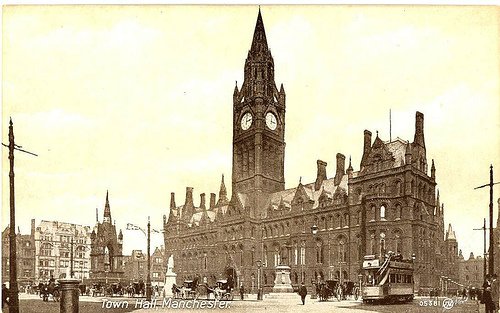
Manchester Town Hall is widely regarded as one of the UK’s finest examples of Victorian neo-Gothic architecture. Alfred Waterhouse’s winning design—selected in a competition that drew 137 entries—blends grandeur with functionality and was completed in 1877 at a cost of nearly £1 million (over £100 million today) (inostalgia.co.uk; manchestermagazine.co.uk).
The building’s exterior, constructed from Spinkwell sandstone, features ornate carvings, gargoyles, and an 85-meter clock tower. The central clock tower, home to the Great Abel bell, dominates Manchester’s skyline and remains a focal point for both civic life and photography (wikipedia.org). Interior highlights include:
- The Great Hall Renowned for its vaulted ceilings, mosaic floors, and twelve Ford Madox Brown murals depicting key moments in Manchester’s history (inostalgia.co.uk).
- Stained Glass Windows Designed by Heaton, Butler & Bayne, featuring symbolic motifs such as the Manchester bee, representing industry and community spirit.
- Innovative Structure Early use of steel framing allowed for expansive interior spaces, while advanced heating, ventilation, and fireproofing systems reflected contemporary technological progress (manchestermagazine.co.uk).
Historical Significance and Civic Role
Since its inauguration, Manchester Town Hall has functioned as the administrative heart of the city, housing the City Council and hosting countless civic events, royal visits, and public celebrations (Manchester News). The Great Hall’s murals chronicle Manchester’s evolution—from Roman outpost to industrial titan—highlighting the city’s transformative role in British and global history.
The building’s status as a Grade I listed structure underscores its national importance, both architecturally and historically (Secret Manchester). Its civic spaces have witnessed political milestones and have been a platform for social reform, activism, and community gatherings.
Restoration and Preservation Efforts
By the early 21st century, Manchester Town Hall required urgent restoration due to structural and safety concerns. The "Our Town Hall" project, launched in 2018, represents a £429.8 million investment in safeguarding the building’s future (Business Live). The restoration encompasses:
- Structural Repairs Over 500 timber windows restored, stonework and roofing repaired, and outdated infrastructure replaced.
- Modernization Upgrades to heating, electrical, and fire safety systems.
- Accessibility Enhancements Addition of ramps, elevators, and accessible restrooms.
- Public Engagement Creation of a new, free Visitor Experience to interpret the building’s history and significance (Secret Manchester; manchester.gov.uk).
The project has also expanded Albert Square, pedestrianizing the area and restoring the Grade II-listed Albert Memorial, enhancing the civic realm for all.
Social and Cultural Impact
Manchester Town Hall has long served as a symbol of the city’s resilience and community spirit. The restoration project has been a catalyst for local skills development, with 45% of the workforce drawn from Greater Manchester and hundreds of new jobs created (I Love Manchester). The Town Hall’s collections—sculptures, paintings, civic gifts, and artifacts—reflect Manchester’s global connections and diverse communities (Manchester City Council).
Essential Visitor Information
Visiting Hours and Tickets
- Current Status Manchester Town Hall remains closed for restoration, with reopening planned for summer 2026.
- Anticipated Hours Monday–Saturday, 10:00 AM–5:00 PM (to be confirmed).
- Tickets Entry to public areas and the new Visitor Experience will be free. Some special events or guided tours may require advance booking and a nominal fee (manchester.gov.uk).
Current Access and Viewing
While interior access is currently unavailable, visitors can admire the Town Hall’s exterior from Albert Square. As restoration progresses, more of the square will reopen, offering excellent photo opportunities (Manchester Pocket Guide). Guided walking tours often include the Town Hall as a highlight, providing historical and architectural context.
Accessibility
Upon reopening, Manchester Town Hall will feature step-free access, elevators, accessible restrooms, and dedicated services for visitors with disabilities. For specific needs, contact the visitor services team in advance.
Visitor Services and Practical Tips
- Location Albert Square, central Manchester—easily accessible by tram (Metrolink), bus, or on foot.
- Nearby Attractions Manchester Central Library, John Rylands Library, the Midland Hotel, and the vibrant Northern Quarter (PlanetWare).
- Events Albert Square regularly hosts festivals, markets, and public events, offering additional reasons to visit.
Manchester Town Hall in Popular Culture
The Town Hall’s neo-Gothic grandeur has made it a favored filming location, often standing in for the Palace of Westminster and other historic landmarks in:
- Films Sherlock Holmes (2009, 2011), The Iron Lady (2011), Victor Frankenstein (2015), and more (Study Abroad Foundation; Manchester Evening News).
- Television A Very English Scandal (2018), Peaky Blinders, and Last Tango in Halifax (Visit Manchester; Secret Manchester).
Its cinematic legacy enhances its appeal for both history buffs and film enthusiasts.
Frequently Asked Questions (FAQ)
Q: When will Manchester Town Hall reopen?
A: The building is scheduled to reopen in summer 2026 after restoration (Business Live).
Q: Are tickets required?
A: Entry to public areas and exhibitions will be free; some guided tours or events may require advance booking.
Q: Is the Town Hall accessible to wheelchair users?
A: Yes, with step-free access, elevators, and accessible facilities planned as part of the restoration.
Q: Can I photograph inside the Town Hall?
A: Photography will be permitted in most public areas; some restrictions may apply during special events.
Q: How do I get there?
A: Centrally located in Albert Square, the Town Hall is easily reached by Metrolink tram, bus, or nearby train stations.