Destinations Portugal

Portugal.

Lisbon 12 cities

Portugal compresses a startling amount into a small map: tiled capitals, monastic silence, surf beaches, vineyard valleys, and islands with their own weather logic. Few countries change character this quickly and still feel coherent.

Get the app Cities in Portugal
Portugal
Portugal
Lisbon
Capital
12
Cities
Spring and early fall (April-June, September-October)
best season
7-12 days
trip length
Euro (EUR)
currency

EntrySchengen rules apply for many non-EU visitors

01 An introduction

verified

PA Portugal travel guide should start with a correction: Portugal isn't one trip. Lisbon, Porto, the Algarve, and Funchal each run on different light and appetite.

Portugal makes sense once you stop flattening it into beach posters and tram photos. Lisbon gives you Manueline stone, steep miradouros, and pastéis de nata eaten hot at the counter; 40 minutes away, Sintra turns theatrical with pine mist, turreted palaces, and gardens designed by people who believed restraint was optional. Go north and Porto trades polished prettiness for granite, port lodges, iron bridges, and a riverfront shaped by commerce before cameras. Then the country folds inward: Coimbra keeps its university rituals, while Évora holds Roman remains, whitewashed lanes, and Alentejo heat that changes the pace of an entire afternoon.

That range is why a useful Portugal travel guide thinks in regions, not slogans. Faro opens the Algarve, but the south is more than sand; it is clam dishes, salt pans, orange groves, and towns built to throw back the sun. Braga and Guimarães carry church facades, dynastic memory, and the early grammar of the Portuguese state, while Aveiro brings canals and moliceiro boats without pretending to be anyone else's copy. Óbidos still sits inside its walls, Beja anchors the deep Alentejo, and Funchal adds volcanic slopes and Atlantic gardens that make mainland Portugal feel almost restrained.

Foodie History Buff Photography Hotspot Outdoor Adventure Budget Friendly

A History Told Through Its Eras

Castles, Cloisters, and the Slow Birth of Portugal

From Frontier to Kingdom, c. 200 BCE-1249

A hill above the Tagus, a Roman harbor, a wind coming off the Atlantic: long before Portugal had a crown, it had a position. Olisipo, the city that would become Lisbon, entered imperial maps because ships could anchor there and goods could move inland. Empires noticed that sort of thing.

Then came the great relay of rulers. Suebi, Visigoths, Muslim dynasties, Christian counts: each left walls, place names, habits of irrigation, and ways of praying. Ce que l'on ignore souvent, c'est que medieval Portugal was not born in a single heroic sunrise; it was assembled from contested river valleys, marriages, sieges, and documents drafted by men who knew a frontier can turn into a throne.

The key scene lies near Guimaraes in 1128, at Sao Mamede. Afonso Henriques, still more rebellious son than settled ruler, broke with his mother Teresa and the Galician faction around her. Family quarrel? Of course. But in Europe, family quarrels have a habit of becoming states.

In 1143, the Treaty of Zamora gave that ambition diplomatic form, and in 1179 the papal bull Manifestis Probatum gave it sacred legitimacy. Portugal was now more than a county with good cavalry. It had a king, a language hardening into itself, and a political instinct sharpened by permanent danger.

When Faro fell in 1249 and the Algarve was secured, the Reconquista inside present-day Portugal was effectively complete. That did not end the story. It gave the kingdom a coastline, and that coastline would soon tempt it toward the sea with consequences far beyond Lisbon or Coimbra.

Afonso Henriques stands in bronze as the first king, but behind the statue one glimpses a hard young nobleman who fought his own kin before he ever fought for posterity.

Tradition says Afonso Henriques was so physically formidable that later chronicles turned him into almost a giant, which is what kingdoms do when they need a founder larger than life.

The Dynasty That Refused to Die, Then Turned Toward the Ocean

Dynastic Survival and Atlantic Ambition, 1249-1498

In 1383, the throne fell vacant and Portugal lurched toward disaster. Streets in Lisbon filled with rumor, fear, and calculation; Castile pressed its claim, and the kingdom looked one marriage away from disappearance. The future of Portugal was argued not only in council chambers but in bedrooms, convents, and alleyways.

The answer came at Aljubarrota in 1385. Joao, Master of Avis, illegitimate son of a king and therefore a most inconvenient candidate, defeated a far stronger Castilian force with English allies and tactical discipline. It is one of those moments when a nation survives by nerve, mud, and timing.

Ce que l'on ignore souvent, c'est that dynasties are saved as much by administrators and widows as by horsemen. Queen Philippa of Lancaster brought not just prestige but a court culture of discipline, piety, and education. Their children, the so-called Illustrious Generation, would carry Portugal out of defensive survival and into dangerous ambition.

Then comes 1415, and Ceuta. A North African port, white walls in the heat, young princes hungry for glory: the capture of the city announced that Portugal no longer wished merely to exist. It wished to reach, measure, trade, convert, and control.

Prince Henry the Navigator never captained the whole epic the way legend suggests, but under his patronage routes lengthened, charts improved, and horizons shifted. By the time Vasco da Gama reached India in 1498, the kingdom that had once feared being swallowed by Castile had learned to swallow distance instead. The sea became both opportunity and trap.

Joao I, born outside the safest line of succession, built legitimacy the old-fashioned way: by winning a battle no one thought he should survive.

At Batalha Monastery, founded in thanks for Aljubarrota, the unfinished chapels remain open to the sky, as if the dynasty wished to leave one stone unruly in memory of the danger it escaped.

Pepper, Gold, and the Price of Greatness

Empire, Spices, and Splendor, 1498-1580

Picture the Ribeira in Lisbon in the early 16th century. Crates of pepper, cinnamon, porcelain, coral, letters sealed with wax, sailors burnt dark by months at sea, clerks bent over ledgers that smelled of salt and ink. This was not romance. This was logistics turned into empire.

Vasco da Gama's arrival in India opened a route that changed the balance of trade, and suddenly Lisbon became one of Europe's counting houses. Manuel I dressed the kingdom in stone as if architecture itself could proclaim dominion: the Jeronimos Monastery in Belem, the Tower of Belem, the rope, sphere, and coral motifs of the Manueline style. Even ornament here speaks of ships.

But what glittered also bled. Carreira da India voyages killed men by storm, scurvy, and bad water; fortresses from Goa to Malacca were expensive to hold; and court magnificence depended on violence at a distance. Ce que l'on ignore souvent, c'est that the empire was kept alive by exhausted pilots, not just radiant kings.

Then enters Sebastiao, the boy-king raised on visions of crusade and destiny. In 1578, at Alcacer Quibir in Morocco, he vanished in catastrophe, leaving corpses, confusion, and one of the great political voids in European history. No wife, no heir, no tidy ending.

That disappearance did something stranger than defeat. It produced Sebastianism, the stubborn hope that the lost king would return on a misty morning to redeem the nation. When a country begins waiting for a ghost, you may be sure the next chapter will be difficult.

Sebastiao was less the golden monarch of legend than a solitary young man intoxicated by prophecy, raised to believe fate would obey him.

So many false Sebastiaos appeared after 1578 that Portugal spent decades arguing over whether a dead king might still come back in disguise.

A Lost Crown, a Recovered Throne, and a City Shaken to Its Foundations

Union, Restoration, and the Earthquake Century, 1580-1822

In 1580, Philip II of Spain took the Portuguese crown, and the kingdom entered the Iberian Union. On paper, Portugal kept its laws and institutions. In practice, being tied to Habsburg wars made Portuguese trade and colonies targets for Dutch and English rivals, and resentment thickened like storm air.

Restoration came in 1640 with a palace coup in Lisbon so swift it still feels theatrical. The conspirators pushed Miguel de Vasconcelos from a window, proclaimed Joao IV king, and reopened the old national drama: how to remain distinct beside a larger neighbor. A duke became a monarch because the moment demanded nerve more than ceremony.

Then the ground itself intervened. On 1 November 1755, All Saints' Day, Lisbon shook, burned, and drowned; churches collapsed during Mass, candles started fires, and the Tagus carried in the tsunami. Few scenes in European history are more terrible: bells, smoke, screaming, and a capital broken in an hour.

Sebastiao Jose de Carvalho e Melo, later the Marquis of Pombal, answered with cold efficiency. His famous order, usually paraphrased as 'bury the dead and feed the living,' tells you everything about the man. He rebuilt downtown Lisbon on rational lines, tested anti-seismic designs, and used catastrophe to tighten royal power with a severity that made him admired and feared in equal measure.

But the empire had already shifted west. Brazil mattered more and more, gold reshaped ambitions, and when the royal court fled Napoleon for Rio de Janeiro in 1807, Portugal discovered that its monarchy could survive by leaving the kingdom. That reversal prepared the crisis of empire and identity that would follow independence in Brazil in 1822.

The Marquis of Pombal was no salon philosopher in silk; he was an authoritarian fixer who treated ruins as an opportunity to remake both a city and a state.

Pombaline builders reportedly used marching troops around model structures to test how buildings might behave under shock, an 18th-century rehearsal for earthquake engineering.

From Broken Empire to Carnations in the Rifle Barrels

Revolution, Dictatorship, and Democracy, 1822-1986

The 19th century opened with humiliation and argument. Brazil was gone as a colony, liberalism and absolutism fought through Portugal's drawing rooms and battlefields, and the monarchy staggered on through debt, faction, and exhausted prestige. You can feel that fatigue in old palaces: gilded surfaces, thinning authority.

By 1908, the dynasty was living on borrowed time. King Carlos I and his heir Luis Filipe were assassinated in Lisbon's Terreiro do Paco, shot in public carriage as the court returned to the city. It is a brutal scene, almost operatic, and one that made the monarchy's end a matter of schedule rather than doubt.

The Republic was proclaimed in 1910, but stability did not follow. Coups, financial strain, and political violence opened the path to Antonio de Oliveira Salazar, whose Estado Novo wrapped censorship, Catholic conservatism, colonial stubbornness, and police surveillance in the language of order. Ce que l'on ignore souvent, c'est that dictatorships often look tidy from a postcard; daily life beneath them is made of whispers.

The spell broke on 25 April 1974. Young officers, tired of colonial wars in Africa and of a regime that had outlived its century, moved against the state; civilians placed carnations in rifle barrels, and one of Europe's most graceful revolutions entered memory by way of a flower. Portugal went from fear to argument almost overnight, which is to say it became democratic in the messiest and healthiest way.

Democracy then had to learn administration, Europe, and modern prosperity. Entry into the European Economic Community in 1986 did not erase old wounds, but it gave Portugal a new frame after empire, after dictatorship, after ghosts. The country that had once looked outward to command oceans now looked outward to negotiate its place in Europe, and cities such as Porto, Coimbra, Braga, Evora, and Faro began telling older stories to new listeners.

Salazar liked to appear modest, almost clerical, which made his long command more chilling: the quiet man at the desk who rationed freedom for decades.

The Carnation Revolution takes its name from the flowers handed out by a restaurant worker, Celeste Caeiro, who gave red carnations to soldiers when celebrations for her workplace were cancelled that same day.

The Cultural Soul

A Mouth Full of Sea Salt

Portuguese in Portugal does not arrive. It condenses. In Lisbon, whole syllables vanish between the teeth; in Porto, the sentence seems to keep one hand in its pocket; in Coimbra, vowels blur like breath on tram glass. Brazilian Portuguese sings its way into the room. European Portuguese lowers its voice and makes you lean closer.

One word haunts the country: saudade. Foreigners translate it as nostalgia because foreigners are in a hurry. Saudade is more exact and more dangerous. It is the pleasure of missing what shaped you, whether that missing belongs to a sailor, a widow, a student on the steps in Coimbra, or a man in Faro staring at winter water.

Then comes the small social trap called você. In Portugal, that neat little pronoun can sound chilly, or worse, administrative. Better to say bom dia, then ask for what you need with a full sentence, or let the other person lead. A country can hide its etiquette inside grammar. Portugal does.

Salt, Egg, Cinnamon, Repeat

Portuguese food behaves like an archive. Monasteries left sugar and egg yolks in absurd quantities; the Atlantic delivered cod, sardine, octopus, and an appetite for brine; the countryside answered with black pork, olive oil, cabbage, and bread dense enough to survive weather and argument. On the table, history stops posing and starts feeding you.

Bacalhau is the national paradox. Portugal fishes your imagination in cold northern waters it does not own, salts the catch, then cooks it as if the fish had been born in a convent kitchen in Lisbon. Bacalhau a Bras arrives as shreds, eggs, potatoes, olives, parsley: humble nouns, imperial satisfaction. Pastel de nata performs the opposite miracle. Butter, flour, sugar, yolk, heat. One bite, then the shell fractures like thin ice.

The best meals often look almost severe. A bowl of caldo verde in Braga. Clams in garlic and cilantro in Lisbon. Roasted suckling pig outside Aveiro. Duck rice in Coimbra. The Portuguese understand a fact most nations keep forgetting: appetite is not greed. Appetite is a form of intelligence.

When the Room Learns to Bleed

Fado is not sad music. Sadness is cheap. Fado is disciplined longing sung under rules so strict that the feeling has nowhere to hide. In Lisbon, especially in Alfama and Bairro Alto, the first signal is often not the singer but the silence that falls before the singer opens her mouth. Knives pause. Glasses wait. Even bad tourists understand that speaking over fado is a form of illiteracy.

The Portuguese guitar looks delicate until it starts cutting. Twelve strings, pear-shaped body, metal brightness. Then the voice enters, and the room changes temperature. Amalia Rodrigues made this art impossible to ignore; younger singers keep testing how much of the old ache can survive microphones, festivals, fashion, irony. More than you would think.

Coimbra keeps its own branch of the religion. Fado there belongs to students, capes, river mist, ceremony. The male voice often leads, and the mood is less tavern than nocturnal vow. Lisbon seduces. Coimbra keeps watch. Same wound, different posture.

Ink with a Taste for Exile

Portuguese literature rarely trusts comfort. Luis de Camoes turned empire into verse and shipwreck into biography. Fernando Pessoa solved the problem of being one man by becoming several, then gave Lisbon a permanent population of ghosts. Jose Saramago wrote sentences that move like weather fronts and judge everyone. This is not a canon built to flatter the reader. Good.

Pessoa matters because he understood the city as multiplication. Walk through Lisbon and you feel it: Baixa for daylight geometry, Chiado for wit, Belem for ceremony, each district speaking a different self. The writer's heteronyms were not a trick. They were an urban fact carried to its logical conclusion.

Then the universities join the conspiracy. Coimbra teaches rhetoric, melancholy, and the architecture of ambition. Porto gives prose a harder jaw. Evora adds heat, stone, and theological patience. A language does not produce its literature alone. Streets, staircases, and boarding rooms do half the work.

Stone That Refuses Modesty

Portugal builds like a nation that has seen both fog and empire. Romanesque churches in the north keep their walls thick and their temper suspicious. Manueline architecture does the opposite: it erupts. Ropes become stone, coral becomes ornament, armillary spheres bloom on portals, and suddenly a doorway in Lisbon or Belem looks as if a fleet had run aground on it and decided to turn into lace.

Tiles change everything. Azulejos are not decoration in the modest sense of the word. They cool façades, record patterns of trade, defend churches from blankness, and teach light how to behave. In Porto, blue-and-white panels can make a station wall read like a public epic. In small towns, a barber shop front may carry more visual wit than a museum in richer countries.

Sintra, naturally, goes mad in public. Palaces there stack Gothic gestures, Moorish fantasy, painted ceilings, theatrical towers, damp gardens, and noble excess with a composure that should be illegal. Portugal's best architecture often knows one exquisite truth: restraint is noble, but exuberance leaves a longer memory.

Courtesy with a Blade Hidden in Silk

Portuguese manners look soft until you misunderstand them. People greet before they ask. They thank before they refuse. They can appear reserved for ten minutes and generous for three hours. The first exchange in a cafe matters: bom dia, eye contact, then your order. March straight to the noun and you sound as if you learned social behavior from a vending machine.

Meals have rank. Lunch still carries weight, especially outside the most touristed parts of Lisbon and Porto. Bread appears first, but it is not always free. Coffee arrives short, dark, and decisive; after lunch, many people want an espresso, not a bucket. The table teaches scale.

Hospitality here does not perform itself loudly. A host may press more food on you with a sentence that sounds almost stern. A waiter may seem dry, then remember your usual order on day two. Portugal likes form. Inside that form, warmth accumulates. Slow fire cooks best.


02 What Makes Portugal Unmissable.

castle

Kingdom in Stone

Portugal's history is legible in masonry: Roman remains in Évora, fortress walls in Óbidos, palace fantasy in Sintra, and the founding myths of Guimarães. You don't have to imagine the past here; it keeps interrupting the present.

restaurant

Atlantic Table

The cooking is blunt in the best way: grilled fish, bacalhau in more forms than anyone needs, caldo verde, clams with garlic, and pastries that justify a detour. Lisbon and Porto may get the headlines, but the country's appetite runs from Minho soup pots to Algarve seafood.

wine_bar

Wine With Geography

Portuguese wine tastes tied to place rather than fashion, whether you're drinking port by the Douro-linked cellars of Porto, a sharp Vinho Verde in the north, or a heavier Alentejo red near Évora and Beja. Madeira's legacy also lingers in Funchal, where fortified wine still carries the island's Atlantic identity.

hiking

Atlantic Variety

This is a country of short distances and sharp contrasts: cooler green north, hotter southern plains, cliff-lined coasts, and volcanic islands far out in the Atlantic. You can move from city streets to surf, vineyards, or levada walks without wasting whole days in transit.

palette

Cities With Character

Portugal's cities do not blur into one another. Lisbon climbs and flashes with tile, Coimbra feels academic and ceremonial, Braga is steeped in church grandeur, Porto is muscular and river-bound, and Aveiro shifts the mood with water, salt, and Art Nouveau facades.

03 Cities in Portugal.

12 cities — start with the ones we'd send you to first.

Lisbon
01 261 guides

Lisbon

The afternoon light hits the azulejos on a 17th-century façade and for a second you understand why people keep falling in love with a city that was almost wiped off the map in 1755.

Sintra
02 32 guides

Sintra

On the ridge above Lisbon, the morning fog peels back to reveal turrets painted the color of coral—Sintra is where Europe’s architects let their dreams run uphill.

Porto
03

Porto

A granite city stacked above the Douro where port-wine lodges line the opposite bank and every alley smells faintly of river and roasting coffee.

Évora
04

Évora

A Roman temple stands intact in the middle of a working Alentejo market town, surrounded by whitewashed streets that have barely changed since the 15th century.

Faro
05

Faro

Most visitors sprint through to reach beach resorts, missing a walled old town reflected in a lagoon and a bone chapel assembled from the skulls of 1,200 Franciscan monks.

Coimbra
06

Coimbra

Portugal's Oxford — a medieval university founded in 1290 crowns a hill above the Mondego, and students still wear black capes to lectures.

Braga
07

Braga

The most devoutly Catholic city in Portugal, where Baroque stairways climb a forested hillside to a pilgrimage church and the market sells the best bread in the north.

Guimarães
08

Guimarães

The city where Portugal was born — or so the locals insist — with a 10th-century castle, a royal palace, and a medieval center so intact it embarrasses the rest of Europe.

Aveiro
09

Aveiro

Flat-bottomed moliceiro boats painted with folk motifs navigate canals through a low-lying city whose Art Nouveau train station is one of the finest in the country.

All 12 cities

04 Regions.

Lisbon

Lisbon Coast

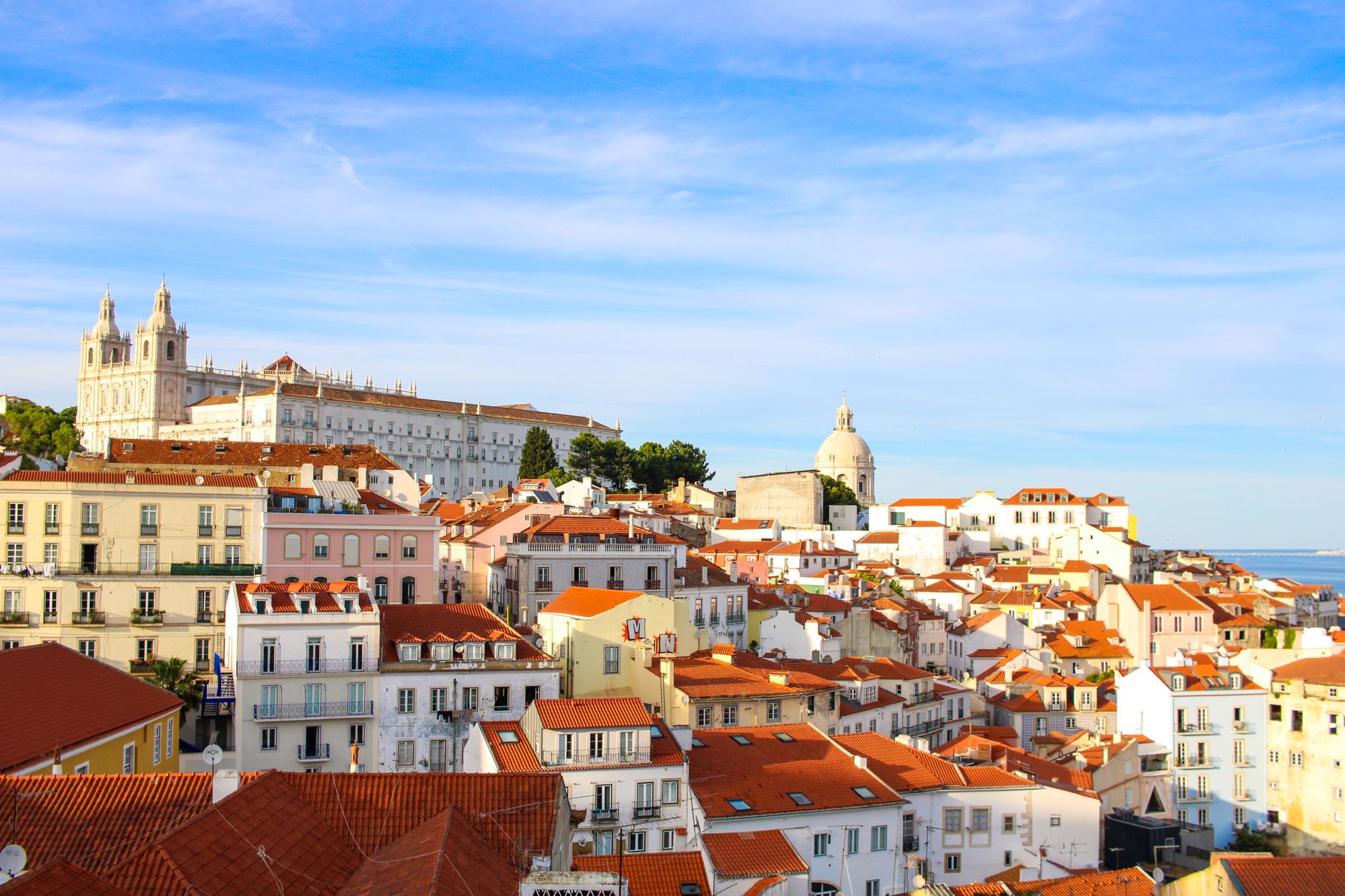
Lisbon is where Portugal shows its imperial vanity and its habit of turning steep inconvenience into urban charm. The surrounding belt gives you three very different moods within easy reach: royal Sintra in the hills, surf beaches on the Atlantic edge, and Óbidos with its tidy walls and ginjinha bars that look innocent until the second glass.

Lisbon Sintra Óbidos Belém Cascais
Porto

Northern Cities and Minho

The north is denser, rainier and more muscular than postcard Portugal usually admits. Porto has warehouses, granite churches and steep riverfront energy; Braga and Guimarães push the story backward into baroque Catholicism and early nation-building, while the whole region eats as if restraint were a foreign idea.

Porto Braga Guimarães Douro Valley Bom Jesus do Monte
Coimbra

Central Portugal

Coimbra sits between the north and the south and behaves like both: scholarly, formal, then suddenly earthy once dinner arrives. This region suits travelers who want stone monasteries, student traditions, river landscapes and smaller cities where you can still hear your own footsteps after dark.

Coimbra Aveiro University of Coimbra Bussaco Conímbriga
Évora

Alentejo

The Alentejo runs on space, heat and patience. Évora gives you Roman masonry, convent sweets and serious historical weight, while Beja and the surrounding plains strip Portugal down to cork oaks, olive groves, long roads and lunches that begin modestly and do not end in a hurry.

Évora Beja Monsaraz Chapel of Bones Alqueva
Faro

Algarve

The Algarve is more than golf packages and summer apartment keys. Faro has a real old town and a working city behind the airport shuffle, while the wider coast swings between lagoon islands, fishing harbors and cliffs that look absurdly polished in late-afternoon light.

Faro Ria Formosa Tavira Lagos Sagres
Funchal

Madeira

Madeira feels separate from mainland Portugal in the useful way islands often do: steeper, greener, more theatrical, less interested in your timetable. Funchal is the base, but the real personality comes from levada walks, black volcanic rock, terrace farming and roads that seem to have been designed by someone with a grudge against flat land.

Funchal Monte Câmara de Lobos Pico do Arieiro Laurisilva Forest

05 Top Monuments in Portugal.

Queluz-Belas Train Station

Sintra

Royal gardens start a short walk from this commuter stop, where suburban Sintra replaces postcard fantasy and daily life runs beside palace history.

Caparica E Trafaria

Trafaria

Praça Da Figueira

Apelação

Padrão Dos Descobrimentos

Lisbon

Igreja De Santa Luzia

Apelação

Edifício Pedro Álvares Cabral , Antigos Armazéns Frigoríficos Do Bacalhau, Actual Museu Do Oriente

Lisbon

Restauradores Square

Apelação

Alcântara

Apelação

Church of Santa Engrácia

Apelação

Gibalta Lighthouse

Lisbon

Cabo Raso Lighthouse

Sintra

Fado Museum

Lisbon

Cais Das Colunas

Lisbon

World of Discoveries

Porto

Santa Maria Hospital

Lisbon

Jardim Do Torel

Lisbon

Mira De Aire

Amiais De Baixo

Cabo Da Roca Lighthouse

Sintra

06 A Kingdom at Europe's Edge, Always Watching the Sea

From Roman port to democratic republic, Portugal keeps remaking itself without ever quite abandoning its ghosts.

  1. account_balance
    205 BCERoman Lusitania

    Olisipo enters the Roman orbit

    Roman control over the future Lisbon anchors the western edge of Iberia to imperial trade and administration. Portugal does not yet exist, but one of its future capitals is already learning how power moves through ports.

  2. swords
    139 BCERoman Lusitania

    Viriathus is killed

    The Lusitanian leader, later recast as a symbol of resistance, is remembered less for triumph than for betrayal. Portugal would repeatedly return to that theme: courage undone not by battle alone, but by treachery.

  3. shield
    409Post-Roman Iberia

    Suebi cross into Iberia

    As Roman authority frays, Germanic powers move into the peninsula and redraw loyalties. The western territories enter a long age of shifting rule before any Portuguese crown appears.

  4. mosque
    711al-Andalus

    Muslim conquest reshapes Iberia

    Islamic expansion transforms much of the peninsula, including lands that would later become Portugal. Cities, agriculture, language, and urban life absorb influences still visible in the south, from Faro to the Alentejo.

  5. castle
    868County of Portucale

    County of Portucale takes shape

    A Christian frontier county emerges in the north around Porto and Guimaraes. It is still a marchland, not a kingdom, but the name that will become Portugal is now attached to territory and rule.

  6. swords
    1128Founding Monarchy

    Battle of Sao Mamede

    Afonso Henriques defeats forces aligned with his mother Teresa near Guimaraes. The scene feels intimate and dynastic, yet it marks the beginning of a separate political path for Portugal.

  7. gavel
    1143Founding Monarchy

    Treaty of Zamora

    Afonso Henriques gains diplomatic recognition as king, giving hard military fact a legal frame. Portugal begins to appear in Europe not just as a frontier but as a kingdom.

  8. church
    1179Founding Monarchy

    Papal recognition confirms the crown

    The bull Manifestis Probatum strengthens the legitimacy of the Portuguese monarchy. In medieval Europe, divine paperwork mattered almost as much as cavalry.

  9. flag
    1249Reconquest Completed

    The Algarve is secured

    With the capture of Faro, Portuguese control over the south is effectively completed. The kingdom now possesses the coastline that will one day push it toward the Atlantic world.

  10. military_tech
    1385Avis Dynasty

    Aljubarrota preserves independence

    Joao of Avis defeats Castilian forces and saves Portugal from dynastic absorption. The victory becomes one of the country's sacred historical scenes: improbable, muddy, and decisive.

  11. sailing
    1415Avis Dynasty

    Ceuta is taken

    Portugal captures Ceuta in North Africa, signaling a turn from continental defense to overseas projection. Expansion now has a harbor, a target, and a taste for distance.

  12. travel_explore
    1498Age of Discoveries

    Vasco da Gama reaches India

    The sea route to India changes trade across Europe and lifts Lisbon into a new rank of power. Riches pour in, but so do imperial commitments that will exact their own price.

  13. edit
    1524Age of Discoveries

    Luis de Camoes is born

    The poet who will later turn Portuguese expansion into epic literature enters the world during the kingdom's imperial ascent. His work would praise glory while hinting at the vanity beneath it.

  14. person_search
    1578Late Avis Crisis

    Sebastiao disappears at Alcacer Quibir

    The young king vanishes in Morocco, leaving no heir and a nation ready to believe in miracles. From this disaster comes both dynastic collapse and the messianic dream of Sebastianism.

  15. hub
    1580Iberian Union

    The Iberian Union begins

    Philip II of Spain takes the Portuguese crown, joining the kingdoms under Habsburg rule. Portugal keeps institutions of its own, but its empire is dragged into wider conflicts it did not choose.

  16. restart_alt
    1640Braganza Restoration

    The Restoration of independence

    A palace coup in Lisbon ends sixty years of dynastic union with Spain and places Joao IV on the throne. Portugal reasserts itself with remarkable speed and theatrical confidence.

  17. waves
    1755Pombaline Reform

    The Lisbon earthquake devastates the capital

    On All Saints' Day, earthquake, fire, and tsunami destroy much of Lisbon and shock all of Europe. Out of ruin comes the rebuilt Baixa and the hard-edged authority of the Marquis of Pombal.

  18. flight_takeoff
    1807Napoleonic Crisis

    The royal court flees to Rio de Janeiro

    As Napoleonic forces invade, the Braganza monarchy escapes across the Atlantic. Few European kingdoms have ever preserved themselves by moving their capital overseas.

  19. public
    1822Liberal Monarchy

    Brazil becomes independent

    Portugal loses the colony that had grown into the empire's center of gravity. The shock deepens the kingdom's political struggles and reopens the question of what Portugal now is without its grandest possession.

  20. warning
    1908Late Constitutional Monarchy

    King Carlos I is assassinated

    The king and his heir are shot in Lisbon, a public act of violence that strips the monarchy of any remaining sense of permanence. The old order does not recover.

  21. how_to_vote
    1910First Republic

    The Republic is proclaimed

    The monarchy falls and Portugal enters republican experiment with more idealism than stability. In the years that follow, coups and crisis wear down the promise of the new regime.

  22. policy
    1933Estado Novo

    Salazar's Estado Novo is formalized

    Antonio de Oliveira Salazar builds an authoritarian regime on censorship, conservatism, and colonial persistence. It will last decades, appearing orderly from afar and claustrophobic from within.

  23. local_florist
    1974Democratic Transition

    The Carnation Revolution

    Military officers overthrow the dictatorship and civilians place carnations in soldiers' rifles. Portugal's road back to democracy begins with one of modern Europe's rare revolutions remembered for restraint rather than blood.

  24. handshake
    1986European Portugal

    Portugal joins the European Economic Community

    Entry into the European project gives the country a new political and economic frame after empire and dictatorship. Portugal turns outward again, this time not as conqueror but as partner.

07 The story of Portugal.

01c. 200 BCE-1249

Castles, Cloisters, and the Slow Birth of Portugal

From Frontier to Kingdom

Afonso Henriques stands in bronze as the first king, but behind the statue one glimpses a hard young nobleman who fought his own kin before he ever fought for posterity.

A hill above the Tagus, a Roman harbor, a wind coming off the Atlantic: long before Portugal had a crown, it had a position. Olisipo, the city that would become Lisbon, entered imperial maps because ships could anchor there and goods could move inland. Empires noticed that sort of thing.

Then came the great relay of rulers. Suebi, Visigoths, Muslim dynasties, Christian counts: each left walls, place names, habits of irrigation, and ways of praying. Ce que l'on ignore souvent, c'est que medieval Portugal was not born in a single heroic sunrise; it was assembled from contested river valleys, marriages, sieges, and documents drafted by men who knew a frontier can turn into a throne.

The key scene lies near Guimaraes in 1128, at Sao Mamede. Afonso Henriques, still more rebellious son than settled ruler, broke with his mother Teresa and the Galician faction around her. Family quarrel? Of course. But in Europe, family quarrels have a habit of becoming states.

In 1143, the Treaty of Zamora gave that ambition diplomatic form, and in 1179 the papal bull Manifestis Probatum gave it sacred legitimacy. Portugal was now more than a county with good cavalry. It had a king, a language hardening into itself, and a political instinct sharpened by permanent danger.

When Faro fell in 1249 and the Algarve was secured, the Reconquista inside present-day Portugal was effectively complete. That did not end the story. It gave the kingdom a coastline, and that coastline would soon tempt it toward the sea with consequences far beyond Lisbon or Coimbra.
Did you know

Tradition says Afonso Henriques was so physically formidable that later chronicles turned him into almost a giant, which is what kingdoms do when they need a founder larger than life.

021249-1498

The Dynasty That Refused to Die, Then Turned Toward the Ocean

Dynastic Survival and Atlantic Ambition

Joao I, born outside the safest line of succession, built legitimacy the old-fashioned way: by winning a battle no one thought he should survive.

In 1383, the throne fell vacant and Portugal lurched toward disaster. Streets in Lisbon filled with rumor, fear, and calculation; Castile pressed its claim, and the kingdom looked one marriage away from disappearance. The future of Portugal was argued not only in council chambers but in bedrooms, convents, and alleyways.

The answer came at Aljubarrota in 1385. Joao, Master of Avis, illegitimate son of a king and therefore a most inconvenient candidate, defeated a far stronger Castilian force with English allies and tactical discipline. It is one of those moments when a nation survives by nerve, mud, and timing.

Ce que l'on ignore souvent, c'est that dynasties are saved as much by administrators and widows as by horsemen. Queen Philippa of Lancaster brought not just prestige but a court culture of discipline, piety, and education. Their children, the so-called Illustrious Generation, would carry Portugal out of defensive survival and into dangerous ambition.

Then comes 1415, and Ceuta. A North African port, white walls in the heat, young princes hungry for glory: the capture of the city announced that Portugal no longer wished merely to exist. It wished to reach, measure, trade, convert, and control.

Prince Henry the Navigator never captained the whole epic the way legend suggests, but under his patronage routes lengthened, charts improved, and horizons shifted. By the time Vasco da Gama reached India in 1498, the kingdom that had once feared being swallowed by Castile had learned to swallow distance instead. The sea became both opportunity and trap.

Did you know

At Batalha Monastery, founded in thanks for Aljubarrota, the unfinished chapels remain open to the sky, as if the dynasty wished to leave one stone unruly in memory of the danger it escaped.

031498-1580

Pepper, Gold, and the Price of Greatness

Empire, Spices, and Splendor

Sebastiao was less the golden monarch of legend than a solitary young man intoxicated by prophecy, raised to believe fate would obey him.

Picture the Ribeira in Lisbon in the early 16th century. Crates of pepper, cinnamon, porcelain, coral, letters sealed with wax, sailors burnt dark by months at sea, clerks bent over ledgers that smelled of salt and ink. This was not romance. This was logistics turned into empire.

Vasco da Gama's arrival in India opened a route that changed the balance of trade, and suddenly Lisbon became one of Europe's counting houses. Manuel I dressed the kingdom in stone as if architecture itself could proclaim dominion: the Jeronimos Monastery in Belem, the Tower of Belem, the rope, sphere, and coral motifs of the Manueline style. Even ornament here speaks of ships.

But what glittered also bled. Carreira da India voyages killed men by storm, scurvy, and bad water; fortresses from Goa to Malacca were expensive to hold; and court magnificence depended on violence at a distance. Ce que l'on ignore souvent, c'est that the empire was kept alive by exhausted pilots, not just radiant kings.

Then enters Sebastiao, the boy-king raised on visions of crusade and destiny. In 1578, at Alcacer Quibir in Morocco, he vanished in catastrophe, leaving corpses, confusion, and one of the great political voids in European history. No wife, no heir, no tidy ending.

That disappearance did something stranger than defeat. It produced Sebastianism, the stubborn hope that the lost king would return on a misty morning to redeem the nation. When a country begins waiting for a ghost, you may be sure the next chapter will be difficult.

Did you know

So many false Sebastiaos appeared after 1578 that Portugal spent decades arguing over whether a dead king might still come back in disguise.

041580-1822

A Lost Crown, a Recovered Throne, and a City Shaken to Its Foundations

Union, Restoration, and the Earthquake Century

The Marquis of Pombal was no salon philosopher in silk; he was an authoritarian fixer who treated ruins as an opportunity to remake both a city and a state.

In 1580, Philip II of Spain took the Portuguese crown, and the kingdom entered the Iberian Union. On paper, Portugal kept its laws and institutions. In practice, being tied to Habsburg wars made Portuguese trade and colonies targets for Dutch and English rivals, and resentment thickened like storm air.

Restoration came in 1640 with a palace coup in Lisbon so swift it still feels theatrical. The conspirators pushed Miguel de Vasconcelos from a window, proclaimed Joao IV king, and reopened the old national drama: how to remain distinct beside a larger neighbor. A duke became a monarch because the moment demanded nerve more than ceremony.

Then the ground itself intervened. On 1 November 1755, All Saints' Day, Lisbon shook, burned, and drowned; churches collapsed during Mass, candles started fires, and the Tagus carried in the tsunami. Few scenes in European history are more terrible: bells, smoke, screaming, and a capital broken in an hour.

Sebastiao Jose de Carvalho e Melo, later the Marquis of Pombal, answered with cold efficiency. His famous order, usually paraphrased as 'bury the dead and feed the living,' tells you everything about the man. He rebuilt downtown Lisbon on rational lines, tested anti-seismic designs, and used catastrophe to tighten royal power with a severity that made him admired and feared in equal measure.

But the empire had already shifted west. Brazil mattered more and more, gold reshaped ambitions, and when the royal court fled Napoleon for Rio de Janeiro in 1807, Portugal discovered that its monarchy could survive by leaving the kingdom. That reversal prepared the crisis of empire and identity that would follow independence in Brazil in 1822.

Did you know

Pombaline builders reportedly used marching troops around model structures to test how buildings might behave under shock, an 18th-century rehearsal for earthquake engineering.

051822-1986

From Broken Empire to Carnations in the Rifle Barrels

Revolution, Dictatorship, and Democracy

Salazar liked to appear modest, almost clerical, which made his long command more chilling: the quiet man at the desk who rationed freedom for decades.

The 19th century opened with humiliation and argument. Brazil was gone as a colony, liberalism and absolutism fought through Portugal's drawing rooms and battlefields, and the monarchy staggered on through debt, faction, and exhausted prestige. You can feel that fatigue in old palaces: gilded surfaces, thinning authority.

By 1908, the dynasty was living on borrowed time. King Carlos I and his heir Luis Filipe were assassinated in Lisbon's Terreiro do Paco, shot in public carriage as the court returned to the city. It is a brutal scene, almost operatic, and one that made the monarchy's end a matter of schedule rather than doubt.

The Republic was proclaimed in 1910, but stability did not follow. Coups, financial strain, and political violence opened the path to Antonio de Oliveira Salazar, whose Estado Novo wrapped censorship, Catholic conservatism, colonial stubbornness, and police surveillance in the language of order. Ce que l'on ignore souvent, c'est that dictatorships often look tidy from a postcard; daily life beneath them is made of whispers.

The spell broke on 25 April 1974. Young officers, tired of colonial wars in Africa and of a regime that had outlived its century, moved against the state; civilians placed carnations in rifle barrels, and one of Europe's most graceful revolutions entered memory by way of a flower. Portugal went from fear to argument almost overnight, which is to say it became democratic in the messiest and healthiest way.

Democracy then had to learn administration, Europe, and modern prosperity. Entry into the European Economic Community in 1986 did not erase old wounds, but it gave Portugal a new frame after empire, after dictatorship, after ghosts. The country that had once looked outward to command oceans now looked outward to negotiate its place in Europe, and cities such as Porto, Coimbra, Braga, Evora, and Faro began telling older stories to new listeners.

Did you know

The Carnation Revolution takes its name from the flowers handed out by a restaurant worker, Celeste Caeiro, who gave red carnations to soldiers when celebrations for her workplace were cancelled that same day.

08 The cultural soul.

language

A Mouth Full of Sea Salt

Portuguese in Portugal does not arrive. It condenses. In Lisbon, whole syllables vanish between the teeth; in Porto, the sentence seems to keep one hand in its pocket; in Coimbra, vowels blur like breath on tram glass. Brazilian Portuguese sings its way into the room. European Portuguese lowers its voice and makes you lean closer.

One word haunts the country: saudade. Foreigners translate it as nostalgia because foreigners are in a hurry. Saudade is more exact and more dangerous. It is the pleasure of missing what shaped you, whether that missing belongs to a sailor, a widow, a student on the steps in Coimbra, or a man in Faro staring at winter water.

Then comes the small social trap called você. In Portugal, that neat little pronoun can sound chilly, or worse, administrative. Better to say bom dia, then ask for what you need with a full sentence, or let the other person lead. A country can hide its etiquette inside grammar. Portugal does.

cuisine

Salt, Egg, Cinnamon, Repeat

Portuguese food behaves like an archive. Monasteries left sugar and egg yolks in absurd quantities; the Atlantic delivered cod, sardine, octopus, and an appetite for brine; the countryside answered with black pork, olive oil, cabbage, and bread dense enough to survive weather and argument. On the table, history stops posing and starts feeding you.

Bacalhau is the national paradox. Portugal fishes your imagination in cold northern waters it does not own, salts the catch, then cooks it as if the fish had been born in a convent kitchen in Lisbon. Bacalhau a Bras arrives as shreds, eggs, potatoes, olives, parsley: humble nouns, imperial satisfaction. Pastel de nata performs the opposite miracle. Butter, flour, sugar, yolk, heat. One bite, then the shell fractures like thin ice.

The best meals often look almost severe. A bowl of caldo verde in Braga. Clams in garlic and cilantro in Lisbon. Roasted suckling pig outside Aveiro. Duck rice in Coimbra. The Portuguese understand a fact most nations keep forgetting: appetite is not greed. Appetite is a form of intelligence.

music

When the Room Learns to Bleed

Fado is not sad music. Sadness is cheap. Fado is disciplined longing sung under rules so strict that the feeling has nowhere to hide. In Lisbon, especially in Alfama and Bairro Alto, the first signal is often not the singer but the silence that falls before the singer opens her mouth. Knives pause. Glasses wait. Even bad tourists understand that speaking over fado is a form of illiteracy.

The Portuguese guitar looks delicate until it starts cutting. Twelve strings, pear-shaped body, metal brightness. Then the voice enters, and the room changes temperature. Amalia Rodrigues made this art impossible to ignore; younger singers keep testing how much of the old ache can survive microphones, festivals, fashion, irony. More than you would think.

Coimbra keeps its own branch of the religion. Fado there belongs to students, capes, river mist, ceremony. The male voice often leads, and the mood is less tavern than nocturnal vow. Lisbon seduces. Coimbra keeps watch. Same wound, different posture.

literature

Ink with a Taste for Exile

Portuguese literature rarely trusts comfort. Luis de Camoes turned empire into verse and shipwreck into biography. Fernando Pessoa solved the problem of being one man by becoming several, then gave Lisbon a permanent population of ghosts. Jose Saramago wrote sentences that move like weather fronts and judge everyone. This is not a canon built to flatter the reader. Good.

Pessoa matters because he understood the city as multiplication. Walk through Lisbon and you feel it: Baixa for daylight geometry, Chiado for wit, Belem for ceremony, each district speaking a different self. The writer's heteronyms were not a trick. They were an urban fact carried to its logical conclusion.

Then the universities join the conspiracy. Coimbra teaches rhetoric, melancholy, and the architecture of ambition. Porto gives prose a harder jaw. Evora adds heat, stone, and theological patience. A language does not produce its literature alone. Streets, staircases, and boarding rooms do half the work.

architecture

Stone That Refuses Modesty

Portugal builds like a nation that has seen both fog and empire. Romanesque churches in the north keep their walls thick and their temper suspicious. Manueline architecture does the opposite: it erupts. Ropes become stone, coral becomes ornament, armillary spheres bloom on portals, and suddenly a doorway in Lisbon or Belem looks as if a fleet had run aground on it and decided to turn into lace.

Tiles change everything. Azulejos are not decoration in the modest sense of the word. They cool façades, record patterns of trade, defend churches from blankness, and teach light how to behave. In Porto, blue-and-white panels can make a station wall read like a public epic. In small towns, a barber shop front may carry more visual wit than a museum in richer countries.

Sintra, naturally, goes mad in public. Palaces there stack Gothic gestures, Moorish fantasy, painted ceilings, theatrical towers, damp gardens, and noble excess with a composure that should be illegal. Portugal's best architecture often knows one exquisite truth: restraint is noble, but exuberance leaves a longer memory.

etiquette

Courtesy with a Blade Hidden in Silk

Portuguese manners look soft until you misunderstand them. People greet before they ask. They thank before they refuse. They can appear reserved for ten minutes and generous for three hours. The first exchange in a cafe matters: bom dia, eye contact, then your order. March straight to the noun and you sound as if you learned social behavior from a vending machine.

Meals have rank. Lunch still carries weight, especially outside the most touristed parts of Lisbon and Porto. Bread appears first, but it is not always free. Coffee arrives short, dark, and decisive; after lunch, many people want an espresso, not a bucket. The table teaches scale.

Hospitality here does not perform itself loudly. A host may press more food on you with a sentence that sounds almost stern. A waiter may seem dry, then remember your usual order on day two. Portugal likes form. Inside that form, warmth accumulates. Slow fire cooks best.

09 Notable Figures.

Afonso Henriques

1109-1185First king
Founder of the kingdom

Portugal begins with his impatience. He fought at Sao Mamede not as a museum piece but as an ambitious son breaking from his mother's orbit, then spent years turning battlefield success into papal recognition and a crown that others would have denied him.

Joao I

1357-1433King of the House of Avis
Saved Portugal's independence in the 1383-1385 crisis

He was the inconvenient candidate: illegitimate, politically risky, and exactly what the hour required. After Aljubarrota he became the king who proved Portugal could survive dynastic panic without becoming Castile's appendix.

Infante Dom Henrique

1394-1460Prince and patron of voyages
Associated with the early Atlantic expansion

History turned him into 'Henry the Navigator,' which flatters the certainty of the enterprise. The real man was a prince of calculation and obsession, using court patronage, pilots, and information to push Portugal farther down the African coast while rarely resembling the simple heroic portrait.

Vasco da Gama

c. 1460s-1524Navigator
Opened the sea route from Portugal to India

He did not merely sail far; he changed the arithmetic of power. Lisbon's wealth, anxiety, and imperial swagger in the 16th century all smell faintly of the route he forced open, along with the violence that made it pay.

Luis de Camoes

c. 1524-1580Poet
Gave Portugal its epic voice

Camoes turned the kingdom's voyages into literature grand enough to flatter a court and mourn a nation at the same time. In Os Lusiadas, Portugal becomes both destiny and warning, which is why he still sounds less like a school monument than a witness with mixed feelings.

Sebastiao I

1554-1578King
His disappearance triggered a dynastic crisis and a national myth

He chased glory into Morocco and left Portugal with a vanished body and a dangerous dream. Few monarchs have ruled so briefly yet lingered so long in the imagination; the missing king became more politically useful dead than alive.

Marquis of Pombal

1699-1782Statesman and reformer
Directed the rebuilding of Lisbon after 1755

When Lisbon fell, he did not speak like a philosopher. He acted like a man who intended to master disaster, rebuild the capital on stricter lines, and use the rubble to discipline enemies, from aristocrats to Jesuits.

Maria II

1819-1853Queen
Figure of the liberal monarchy after the civil wars

She spent her life in a kingdom where constitutional theory arrived with bayonets attached. Behind the ceremonial image stands a young queen forced to embody reconciliation in a country that kept preferring faction.

Antonio de Oliveira Salazar

1889-1970Dictator
Ruled Portugal's Estado Novo

He cultivated the look of a cautious accountant, which was part of his strength. Under that clerical sobriety sat censorship, colonial war, and a regime so disciplined in tone that many outsiders missed how much fear it required.

Amalia Rodrigues

1920-1999Fado singer
Turned Portuguese melancholy into a national voice

Amalia did for saudade what monarchs once did for heraldry: she gave it a face and a sound. Her Lisbon was not the postcard city but the city after dark, where longing, class, and pride could fit inside one held note.

10 Suggested Itineraries.

3 days

3 Days: Lisbon Palaces and Walled Towns

This is the compact first trip that actually works: a base in Lisbon, a day in Sintra for palace drama and forest air, then Óbidos for whitewashed lanes inside a medieval wall. Distances are short, train connections are easy, and you spend time looking rather than commuting.

LisbonSintraÓbidos
Best for: first-timers, couples, short city breaks
7 days

7 Days: Porto to the Historic North

Start in Porto for riverfront grit and port lodges, then move south and north in a clean rail loop through Aveiro, Coimbra, Braga and Guimarães. The route makes sense on the map and in the story it tells: trade, university life, baroque churches and the political cradle of Portugal.

PortoAveiroCoimbraBragaGuimarães
Best for: history lovers, rail travelers, second-time visitors
10 days

10 Days: Alentejo Plains to Madeira Cliffs

Begin in Évora and Beja, where whitewashed streets, Roman traces and slow lunches set the pace, then continue south to Faro before flying out to Funchal. It sounds like two trips stitched together, but that contrast is the point: inland Portugal's dry stone quiet against Madeira's volcanic green and ocean drop-offs.

ÉvoraBejaFaroFunchal
Best for: return visitors, food travelers, travelers mixing mainland and island Portugal
14 days

14 Days: Slow Portugal by Rail and Sea

Use Lisbon, Coimbra and Faro as three long stays instead of a box-ticking sprint. The rhythm works well for two weeks: museums and miradouros in Lisbon, bookish old streets in Coimbra, then Atlantic light and beach days around Faro, with room for day trips and weather changes.

LisbonCoimbraFaro
Best for: slow travelers, remote workers, travelers who prefer fewer hotel changes

11 Taste the Country.

Pastel de nata

Counter. Standing. Morning or late afternoon. Cinnamon. Powdered sugar. Coffee. Two bites. Burnt fingertips. No fork.

Bacalhau a Bras

Lunch. Family table or neighborhood tasca. Fork only. Salt cod, eggs, fried potato, black olives, parsley. Beer or white wine.

Caldo verde

Night. Winter. Village feast, Sunday table, wedding hour after midnight. Bowl, spoon, bread. Shared with cousins, neighbors, strangers.

Francesinha

Porto. Noon or hangover hour. Knife, fork, surrender. Bread, steak, linguiça, melted cheese, hot sauce, fries. Eaten with friends who enjoy excess.

Amêijoas a Bulhao Pato

Late lunch near the coast. Clams, garlic, olive oil, cilantro, lemon. Bread in the broth. Hands busy. Conversation paused.

Leitao da Bairrada

Sunday drive from Aveiro or Coimbra. Roast suckling pig, sparkling wine, orange slices. Family table. Crisp skin first, then silence.

Ginja in a chocolate cup

Obidos. Short stop, cold street, sweet heat. Sour cherry liqueur. One swallow. Another if the day turns theatrical.

14Before you go

Practical Information

passport

Visa

Portugal is in the Schengen Area. EU citizens can enter freely, while US, Canadian, UK and Australian passport holders can usually stay visa-free for up to 90 days within any rolling 180-day Schengen period; passports should be valid for at least three months beyond your planned departure.

euro

Currency

Portugal uses the euro. Cards work almost everywhere in Lisbon, Porto and Faro, but small village cafés, markets and family-run tascas still reward anyone carrying €20-50 in cash.

flight

Getting There

Most long-haul travelers arrive through Lisbon Airport, with strong European links through Porto and beach-season traffic through Faro. Funchal is the obvious gateway for Madeira, and domestic flights make the mainland-island split easy when time matters more than scenery.

train

Getting Around

Trains are the best value on the main spine: Lisbon to Porto takes about 3 hours on Alfa Pendular, and Lisbon to Faro about 2 hours 45 minutes. Use buses for smaller towns and a rental car for the Alentejo, inland Algarve and rural Minho, where public transport thins out fast.

wb_sunny

Climate

April to June and September to October are the sweet spots for most of Portugal: warm days, thinner crowds, lower room rates. The north around Porto and Braga is cooler and wetter, while Faro stays sunnier longer, and Funchal keeps mild temperatures through most of the year.

wifi

Connectivity

Mobile coverage is strong across the mainland and good in Madeira, with 4G and 5G easy to find in cities and along major rail routes. Free Wi-Fi is routine in hotels, cafés and airports, but if you are driving remote Alentejo back roads or hiking above Funchal, download maps first.

health_and_safety

Safety

Portugal is one of the safer countries in Europe for day-to-day travel. The main nuisance is pickpocketing on Lisbon trams, in station halls and around crowded viewpoints, while summer heat and Atlantic surf warnings matter more than violent crime.

15 Tips for visitors.

Book trains early

Advance fares on CP trains can be much cheaper than buying on the day, especially between Lisbon and Porto. Buy the long-distance legs first, then build hotels around them.

Carry some cash

Use cards in cities, but keep small notes and coins for rural cafés, local markets and old-school snack bars. Portugal is modern, just not uniformly cashless.

Read the couvert

Bread, olives and cheese placed on the table are usually not free. If you do not want them, say so early; if you eat them, they appear on the bill.

Use rail on the spine

Lisbon, Coimbra, Aveiro and Porto connect well by train, and the journey is usually easier than driving into old centers. Save the rental car for the Alentejo or smaller coastal stretches.

Reserve summer early

Faro and the wider Algarve get expensive fast from late June through August. If you want beach access without paying peak rates, aim for May, early June or late September.

Keep greetings formal

English is common in tourism, but a polite 'bom dia' or 'boa tarde' changes the tone immediately. In Portugal, courtesy still opens doors faster than confidence.

Respect Atlantic water

The sea may look calm from the sand and still carry hard pull and cold water. Watch local flag warnings, especially on west-facing beaches and exposed Algarve coves.

Explore Portugal with a personal guide in your pocket

Your personal curator

The whole Portugal,
told well.

Audio guides for 1,100+ cities across 96 countries. History, stories, and local insight — offline ready.

The Audiala app

16 Frequently asked

Do US citizens need a visa for Portugal in 2026?

Usually no, for short stays. US passport holders can generally enter Portugal visa-free for up to 90 days within a rolling 180-day period across the Schengen Area, but passport validity and entry rules should be checked again before departure.

Is Portugal expensive for tourists compared with Spain or France?

Portugal is usually cheaper than France and often a bit cheaper than Spain, though Lisbon, Porto and the Algarve in summer narrow the gap. Budget travelers can still manage on roughly €40-55 a day outside peak season, while mid-range comfort usually starts around €90 a day.

How many days do you need in Portugal?

Seven to ten days is the useful minimum if you want more than one region. Three days works for Lisbon and Sintra, but Portugal gets better once you add either the north around Porto and Coimbra or the south through Évora and Faro.

Is it better to fly into Lisbon or Porto?

Lisbon is better for first trips and long-haul arrivals because it has more connections and easier access to Sintra and central Portugal. Porto makes more sense if your trip is focused on the north, wine country or a short city break.

Can you travel around Portugal without a car?

Yes, if you stay on the main corridor. Lisbon, Coimbra, Aveiro, Porto, Braga, Guimarães and Faro are all manageable by train or intercity bus, but the Alentejo countryside and smaller beach areas are much easier with a car.

What is the best month to visit Portugal?

May and September are the strongest all-round choices. You get warm weather, longer days and lighter crowds than July and August, while the north is greener than high summer and the Algarve is still hot enough for beach time.

Is Portugal safe for solo female travelers?

Yes, generally very safe by European standards. The real precautions are the ordinary ones: watch bags on Lisbon trams, avoid leaving valuables in rental cars, and take heat and coastal conditions seriously.

Do I need cash in Portugal or can I pay by card everywhere?

You can pay by card in most hotels, restaurants and transport hubs, especially in Lisbon, Porto and Faro. Cash still helps in village cafés, markets, older family-run places and anywhere that gives you the look reserved for people trying to tap a €1.20 coffee.

17 Sources & attribution

Last reviewed