What the Bab Doukkala Grand Mosque Is
At the heart of Marrakesh’s Bab Doukkala district, the Bab Doukkala Grand Mosque is a place of worship and a landmark of Morocco’s Saadian-era heritage and Islamic architecture. It serves the local Muslim community and remains part of the district’s daily life, history, and traditions.
The mosque stands beside Bab Doukkala gate, near the medina’s markets and artisan workshops. Its surrounding complex includes a traditional hammam, public fountain, library, and madrasa. For further reading, see Morocco.com, Introducing Marrakech, and Visit Marrakech.
History and Significance
The mosque was commissioned by Sultan Moulay Abdallah al-Ghalib (r. 1557–1574) during the Saadian dynasty’s expansion and constructed between 1557 and the early 1570s. It served the spiritual and practical needs of travelers and locals in Marrakesh’s northwestern medina (Morocco.com). It is also described as having been commissioned by Massouda Bent Ahmed Al Wazkitiya (Hespress).
Serving the expanding northwestern neighborhoods of 16th-century Marrakesh, the mosque became a center for prayer, education, and community gatherings, particularly for merchants and travelers entering through Bab Doukkala gate. The district remains a focal point of the medina, anchoring its markets and traditional crafts (Introducing Marrakech; Grantourismotravels).
The mosque hosts daily and Friday prayers and plays a central role during Ramadan and Eid. It also supports religious education and charity, particularly during Ramadan. The mosque provides designated areas for men and women, and women’s participation is emphasized during festivals. Special prayers and community gatherings take place during Ramadan and Eid al-Adha (GPSMyCity; Malika In Morocco).
The mosque’s architecture contributes to Marrakesh’s UNESCO World Heritage status (Introducing Marrakech). Urban development and tourism pose preservation challenges, while local preservation efforts continue. Restoration supported by the Moroccan Ministry of Culture and local authorities focuses on the stucco, wooden ceilings, and minaret (Archnet).
What to See
The mosque’s Maghrebi-Andalusian design features a hypostyle prayer hall with rows of columns and horseshoe arches, inspired by Almohad mosques. Red sandstone, carved stucco, and zellij tilework are among its architectural details (Archnet).
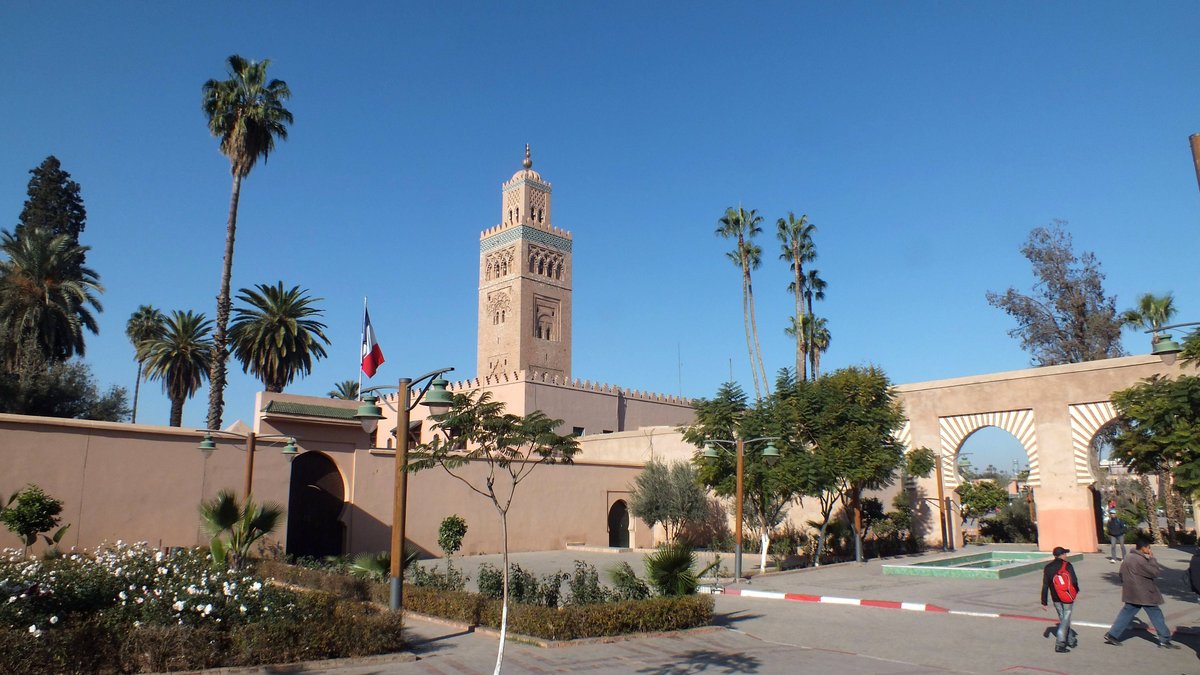
- Minaret A prominent square tower at the mosque’s northeast corner, visible throughout the medina. It has green tiles, geometric and stepped motifs, lambrequin arches, and brass spheres at its top.
- Courtyard Nearly square and surrounded by arcades, the spacious, tree-shaded courtyard is centered on a historic fountain.
- Mihrab The niche indicating the qibla is decorated with intricate stucco and tilework.
- Decorative work Zellij mosaics use green, blue, and white; stucco and plaster feature arabesques and calligraphy; carved cedar is used for doors and the minbar.
- Ablutions house A separate facility with a courtyard, roofed gallery, pavilion over a water basin, and a traditional wooden ceiling. Its detailed woodwork and zellij are also noted (Archnet).
The original complex also included a madrasa, hammam, and public fountain, reflecting the mosque’s role as a religious and social hub.
Practical Visiting Information
Hours and access
- Worshippers The mosque is open daily for the five prayers and Friday Jumu’ah.
- Non-Muslim visitors The prayer hall is reserved for Muslims. Access to the exterior and courtyard is possible outside prayer times.
- Exterior visiting hours One schedule gives 8:00 AM–6:00 PM; another describes exterior and courtyard visits as taking place during daylight hours. Early morning or late afternoon is generally recommended, outside prayer times.
- Tickets No ticket is required to admire the exterior, courtyard, or public fountain.
- Tours Local providers offer guided walking tours that include the mosque and nearby attractions. Tours are recommended for historical insight and help navigating the medina.
Location and accessibility
The mosque is centrally located in the medina, beside Bab Doukkala gate and near the bus station. It is reachable on foot from central Marrakesh or by public transport (Wise Visitor). The neighborhood connects historic sites with modern districts. The medina’s uneven streets may be challenging for visitors with mobility impairments; assistance is recommended.
Nearby restrooms are available; visitors are advised to carry essentials. The historic fountain is a landmark and a stop on the medina’s traditional water route (Visit Marrakech).
Tips for Visitors
- Plan a visit around prayer times.
- Dress modestly: cover shoulders and knees; women should carry a headscarf or scarf.
- Muslims entering prayer areas should remove their shoes.
- Photography is permitted outside; avoid photographing worshippers.
- The area is generally safe, but remain alert for pickpockets, especially near transport hubs (Wise Visitor).
- Community-led tours and educational programs offer ways to learn about the mosque’s history.
- Ramadan and Eid are particularly vibrant, with community prayers and celebrations.
- Official tourism sites and the Audiala app are among the suggested resources for current information.
Nearby Places
The surrounding district offers Bab Doukkala souks, artisan workshops, and bakeries. Nearby sites include Mouassine Mosque, Koutoubia Mosque, and Ben Youssef Madrasa. The traditional water route is another way to explore the neighborhood (Visit Marrakech).
FAQ
Can non-Muslims enter the prayer hall?
No. The prayer hall is reserved for Muslims, but visitors may view the exterior and courtyard outside prayer times.
Are tickets required?
No tickets are required for the exterior, courtyard, or public fountain.
When can visitors see the exterior and courtyard?
One schedule lists 8:00 AM–6:00 PM; another describes visits during daylight hours. Visits are generally recommended outside prayer times, especially in the early morning or late afternoon.
Are guided tours available?
Yes. Local guides offer walking tours that include the mosque and nearby attractions.
What should visitors wear?
Dress modestly and cover shoulders and knees. Women should carry a headscarf or scarf.