€3-€4.50 adults / €1.50 children 6-14 / Free under 6 / Free Berlin residents
Access
No elevator; 204 steep spiral stairs, not wheelchair accessible
Best season
Spring–Autumn (April–October)
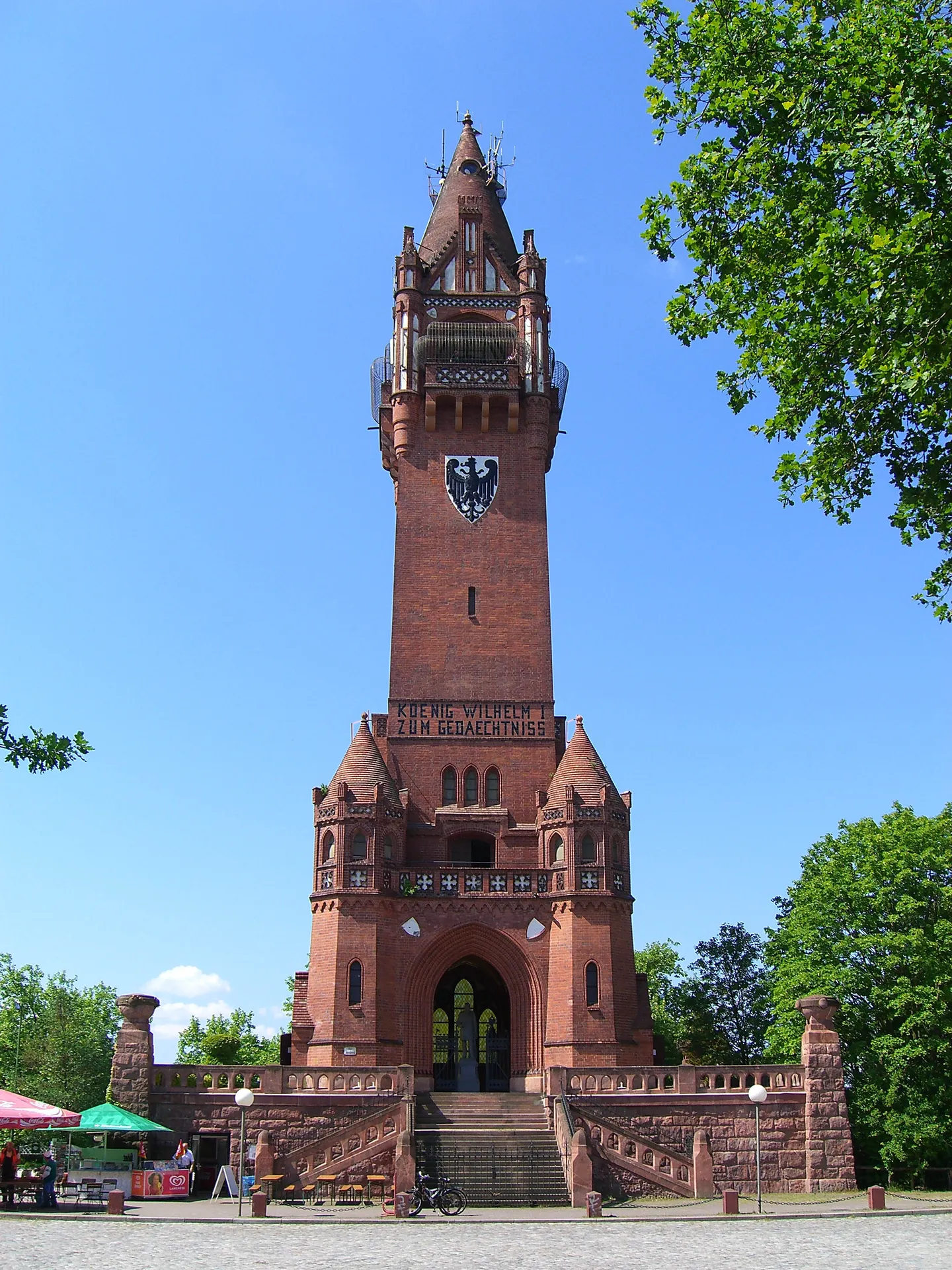
The teacher of Hitler's favorite sculptor carved a marble Kaiser Wilhelm I for this tower in 1902 — and nobody can say where that statue is today. Grunewald Tower rises 55 metres of red brick above a forest on the western edge of Berlin, Germany, disguised as a scenic lookout but built as a war memorial to the three conflicts that forged the German nation. Climb the 204 spiral stairs for the view over the Havel. Linger in the domed hall at the base for the stranger story.
Most Berliners call it the Grunewaldturm and most visitors arrive expecting a forest folly with a café. Neither is quite right. Franz Schwechten — the same architect who drew the Kaiser Wilhelm Memorial Church — designed this tower to commemorate a dead emperor and three wars of unification, and the building still carries that purpose if you know where to look.
The approach helps. From Berlin-Grunewald S-Bahn station you walk fifteen minutes through what used to be royal hunting forest before a brick Gothic silhouette breaks through the pines. Sailboats tack across the Havel below. The air smells of resin and lake water. Then you step inside and the temperature drops into a Neo-Byzantine mosaic hall most people rush past on their way to the staircase.
Go slowly. The ceiling is the point. So is the dual-eagle heraldry on the exterior walls and an inscription that credits a district council rather than the Kaiser who was supposed to be honoured. The tower hides its politics in plain brick.
Researched by the Audiala editorial team from historical records, architectural archives, and local expertise.
What to see
The Memorial Hall Most Climbers Skip
Everyone charges straight for the staircase. Don't. Step into the Gedenkhalle at the tower's base and look up first — August Oetken's neo-Byzantine mosaic ceiling, executed in 1902 by Puhl & Wagner (Berlin's premier glass-mosaic firm, the same workshop behind the Kaiser Wilhelm Memorial Church), glows gold even on overcast afternoons. Below it stands Ludwig Manzel's life-size Carrara marble of Wilhelm I, frozen mid-contrapposto, bright white against the gilt overhead. Four cast-iron relief plaques added in 1908 occupy the corners: Roon, Moltke, Bismarck, Prince Friedrich Karl — the Wilhelmine military-political quartet rendered in dark oxidized iron. Run your fingertips across Bismarck's profile; the patina is 117 years old and still dimensional enough to cast shadow. The hall takes five minutes. Most visitors give it thirty seconds, which is how you tell the tourists from the readers.
204 Steps and the Stained Glass Nobody Notices
The spiral staircase is narrow, steep, and tighter than you expect — brick walls close in, the geometry forces constant circular reorientation, and the air cools noticeably as you climb. Most people stare at their feet. Don't. Franz Schwechten, the architect who also designed the Kaiser Wilhelm Memorial Church on Breitscheidplatz, inset Art Nouveau stained glass at several landings, and on bright afternoons colored light pools on the brick wall opposite the window. Pause at each slit. The landscape reveals itself in altitude slices — Havel water, then forest canopy, then sky — building the payoff before you see it whole. The ironwork bannister is worn smooth by 126 years of hands; the acoustics echo every footstep back at you in the stone column. Ten minutes up, slightly longer down because your legs will protest. No elevator. Wear decent shoes.
The 36-Metre Deck and the Golden Hour Trick
Schwechten put the observation platform 36 metres above the ground and 86 metres above the Havel — enough to clear the Grunewald canopy entirely. On clear days you can see the Fernsehturm northeast and Potsdam roughly 20 kilometres southwest; in autumn the forest below burns gold, orange, red in a single unbroken dome the size of 3,000 football pitches. Time it for sixty minutes before sunset. The west-facing view over the Havel catches the light at a low angle, water turns liquid bronze, and the beer garden below ([[Kaisergarten]], arguably Berlin's most scenic) starts to clink with evening glassware. The wire safety mesh at the platform edge will frustrate your camera — shoot through the grid or angle around the corner posts. Before you leave, walk the west facade at ground level and read the inscription: "Der Kreis Teltow baute mich 1897" — the district of Teltow built me in 1897. The tower speaks in first person to the river it has watched for 128 years.
Plan your visit
Getting There
S-Bahn S3 or S9 to S Heerstraße (about 30 minutes from Alexanderplatz), then bus 218 toward Pfaueninsel to the Grunewaldturm stop — two minutes on foot from there. Bus 218 runs every 20–30 minutes, so check the BVG app before you set off. By car, head for Havelchaussee 61, 14193 Berlin via the A115 (AVUS); a free parking lot sits right at the base.
Opening Hours
As of 2026, the observation deck opens daily 11:00–18:00, with Fri–Sun often extending to 20:00 in peak summer. Hours are tied to the Kaisergarten restaurant below — if the kitchen shuts early for weather, the gate closes too. Call +49 015165210827 before a winter visit.
Time Needed
Plan 1.5–2 hours for the full visit: 10–15 minutes up the 204 spiral stairs, 20 minutes on the platform, then a beer at the Kaisergarten terrace. Stretch it to a half-day if you pair the tower with a Havelchaussee cycle or a walk to Lieper Bucht.
Tickets
As of 2026, adults pay €5, children 6–12 pay €3, and dogs climb free. No online booking — buy at the Kaisergarten counter (cash or card), and they unlock the gate at the staircase base for you.
Accessibility
The tower interior is not wheelchair accessible: 204 steep, narrow spiral stairs, no lift, and a tight spiral that's challenging even for sure-footed climbers. The ground-floor terrace and Kaisergarten beer garden are flat and step-free, so wheelchair users can still enjoy the Havel views from below.
Photo Gallery
Seen from Grunewald Tower, this wide panorama stretches across forest edges, farmland, and a broad horizon under gentle daylight. The elevated viewpoint reveals the quieter, greener side of the Berlin area. · MembethGrunewald Tower stands above Berlin's wooded shoreline, overlooking a lake dotted with sailboats. Soft daylight and open water give the landmark a calm, expansive setting. · H.HelmlechnerGrunewald Tower stands tall in Berlin's wooded Grunewald district, its red-brick facade framed by summer trees and clear blue sky. The bright light brings out the tower's ornate historic details. · TimesGrunewald Tower stands above a tree-lined approach in Berlin, its red-brick Gothic Revival form catching the clear daytime light. A lone figure at the entrance gives scale to the tall landmark. · KK nationsonlineA view of Grunewald Tower, Berlin, Germany. · Leonhard LenzGrunewald Tower stands above the treetops on Berlin's western edge, its red-brick silhouette set against a bright, cloud-filled sky. A few visitors are visible on the viewing platform near the top. · E-W
History
Three Wars, One Tower, a Missing Kaiser
The Teltow district council voted in 1897 to mark the hundredth birthday of Kaiser Wilhelm I with a tower on Karlsberg hill, 78.5 metres above the Havel. Schwechten drew the plans and Wilhelm II approved them in March of that year. Construction began that summer. The Kaiser-Wilhelm-Turm opened on June 9, 1899.
Records show the building was never really about a dead king. It was about legitimising the wars that made him one — and the men who fought those wars kept arriving at the tower long after the ribbon was cut.
The turning point
Ludwig Manzel and the Vanished Kaiser
Ludwig Manzel arrived at the tower in 1902 to install an over-life-sized marble statue of Wilhelm I in the memorial hall. He was 44, a sculptor on the rise, and the commission fit his register — grand imperial figuration, executed with Prussian Academy polish. He would go on to serve as President of the Prussian Academy of Arts from 1912 to 1915 and again from 1918 to 1920. His most consequential student, Josef Thorak, became Adolf Hitler's official sculptor. Manzel's last documented commission, completed shortly before his death on June 20, 1936, was a bronze medallion of Joseph Goebbels.
The marble Wilhelm he left behind is gone. No museum catalogue lists it. No surviving photograph pins it to a later location. Between the WWII damage to the tower's staircase and the Soviet occupation of this stretch of forest from 1945 to 1948, something happened to the statue — melted is unlikely (marble, not bronze), removed is possible, mislaid inside the lower rooms is the option locals whisper about. Scholars date the last reliable mention to pre-war guidebooks.
The turning point wasn't the statue's disappearance. It was September 15, 1948, the day West Berlin's Senate formally stripped the Kaiser's name from the building and renamed it Grunewaldturm. Berliners had already been calling it that since the early 1930s. The state was catching up to the street — mid-blockade, mid-airlift, deciding what a free city would honour and what it would quietly forget.
Schwechten, the Empire's House Architect
Franz Schwechten (1841–1924) built empires out of red brick. His Anhalter Bahnhof opened in 1880 as the largest railway station in Continental Europe. The Kaiser Wilhelm Memorial Church followed in 1895, the Grunewaldturm in 1899, the Kaiserschloss Posen in occupied Polish territory from 1905. Four monuments, one ideology. He died on August 11, 1924 — the day before his eighty-third birthday — in a Weimar Republic Berlin that had no further use for his style. His towers outlived the regime that commissioned them.
The Reliefs That Gave the Game Away
In 1908, nine years after the tower opened, four cast-iron relief plaques arrived on the exterior walls: Bismarck, Moltke, Roon, and Prince Friedrich Karl. These were the men who planned and executed the Danish War of 1864, the Austro-Prussian War of 1866, and the Franco-Prussian War of 1870–71. The timing matters. European tensions were climbing sharply and Wilhelm II was reinforcing his grandfather's militarist legacy as a message to contemporaries, not a tribute to the dead. Six years later the empire those reliefs celebrated marched into the First World War.
Tips for visitors
Ride the vintage 218
Bus 218 through Grunewald forest is an attraction in itself — occasionally a 1960s Traditionsbus runs the route with a conductor calling stops by hand. Check the Traditionsbus schedule if you want to time your visit to catch one.
Drink, don't dine
The Kaisergarten terrace has Berlin's best Havel view, but recent reviews flag small portions and €4 apple spritzers. Stick to a beer and pretzel on the terrace; for a proper meal head to Restaurant Scheune or back to Zehlendorf.
Shoot through the mesh
The observation deck is wrapped in wire safety mesh that wrecks wide shots. Press a 35–50mm lens right against the gaps, or shoot late afternoon when west light over the Havel hides the grid in glare.
Leave the drone
Grunewald is protected forest and Berlin has some of Germany's strictest drone rules — flying here needs a permit from the Berlin Brandenburg Film Commission. Hand-held cameras and tripods are fine inside and on the deck, no fee.
Slow down in the hall
Most visitors bolt past the Gedenkhalle at the base toward the stairs. Stop for August Oetken's Neo-Byzantine ceiling mosaics and Ludwig Manzel's 1902 marble Wilhelm I — the memorial hall is the real architectural payoff, not the view.
Come for sunset
The platform faces west over the Havel, so late afternoon to golden hour is when the lake lights up and the forest goes copper. Autumn adds foliage; winter visits risk a locked gate if the Kaisergarten closes early.
Make it a circuit
Locals don't treat the tower as a destination — it's one stop on a Havelchaussee loop. Pair it with a swim at Badestelle Kuhhorn, a walk to Lieper Bucht, or a bus ride onward to Pfaueninsel on the same 218.
Wear grip, not heels
The 204 spiral steps are narrow, worn smooth, and steep — trainers with grip beat leather soles. The forest approach from Nikolassee S-Bahn (35 minutes) gets muddy off Havelchaussee, so save the sandals for the terrace.
Where to Eat
local_dining
Don't Leave Without Trying
Currywurst — Grilled sausage with spiced tomato-curry sauce. Berlin's 1949 invention by Herta Heuwer.Döner Kebab — Berlin claims the invention (1972, Kadir Nurman). The city's best street food.Eisbein — Cured pork knuckle with sauerkraut and mushy peas. Hearty and traditional.Berliner Pfannkuchen — Jam-filled doughnut. Found in every bakery, year-round.Königsberger Klopse — Veal meatballs in creamy caper sauce. East Prussian origin, adopted as a Berlin classic.Berliner Weiße — Tart wheat beer served with raspberry or woodruff syrup. Summer staple.
Trattoria Toscana Berlin im Grunewald
local favorite
Tuscan Italian€€star4.8(565)
Order: Handmade calzone with fresh ingredients. Reviewers rave about the authentic Florentine bread (unsalted, a Berlin rarity) and the wood-fired fish soup.
This is Tuscany transplanted to Grunewald. Staff speaks Italian, the courtyard is genuinely beautiful, and they make pasta daily. The kind of place that reminds you why people love European food.
Order: A cold Pilsner and whatever's grilled—Currywurst, schnitzel, or seasonal fish. Beer garden classics, done well.
Literally beneath Grunewald Tower with lake views across the Havel. Where locals finish their runs, bring families on weekends, and settle in for hours. No pretense, just cold beer and good company.
Order: Schnitzel or fresh fish. The kitchen sources thoughtfully and portions don't disappoint. Their Italian wine list is an unexpected gem in a place this traditional.
Open from breakfast through midnight in a charming, old-school German space. Locals keep coming back for reliable food, genuinely warm service, and an actual terrace where you're welcome to linger.
Order: Currywurst (Berlin's 1949 invention) or schnitzel. Everything arrives piping hot, portions are generous, and they're patient with non-German speakers.
An authentic neighborhood spot right by the U-Bahn, with 2,300+ reviews from locals who keep returning. No tourism theatre—just real German food, efficient service, and fun people-watching from the terrace.
checkMost restaurants close on Monday (Ruhetag). Always check ahead, especially if planning a special dinner.
checkTip 10% in sit-down restaurants; service charge is never included. Tell your server the total you want to pay—they return change. This is normal, not rude.
checkCash is still king here, especially at traditional spots and beer gardens. Carry backup cash. Card acceptance has improved, but small family places can be cash-only.
checkPeak dinner hour is around 8pm. For walk-ins, come before 7pm or after 9pm.
checkGermans linger over meals—no one's rushing you. Say 'Guten Appetit' before eating; it's expected.
Food districts:Grunewald / Zehlendorf — Quiet, residential west Berlin. Lakeside beer gardens and traditional spots where locals actually eat.Dahlem — University neighborhood with casual cafés and family-run restaurants.Charlottenburg (northwest) — More refined and upscale for special occasions.Kreuzberg (east) — The city's most diverse food scene: Turkish, Korean, Middle Eastern, street food, Markthalle Neun Street Food Thursday.
Restaurant data powered by Google
Frequently asked
Is Grunewald Tower worth visiting?
Yes, if you pair it with a Havel forest walk or beer-garden stop rather than treating it as a standalone sight. The 55-metre brick Gothic tower gives one of Berlin's best forest-and-water panoramas, and Berlin.de itself files it as an Insidertipp. Skip it if stairs or remote transit deter you — it's 30 minutes from Alexanderplatz and 204 narrow spiral steps to the top.
How do I get to Grunewald Tower from Berlin?
Take S-Bahn S3 or S9 to S Heerstraße, then bus 218 direction Pfaueninsel to the Grunewaldturm stop. Total journey runs about 40 minutes from Alexanderplatz. Bus 218 only comes every 20–30 minutes, so check the BVG app before heading to the stop — missing it means a long wait in the forest.
How long do you need at Grunewald Tower?
Plan 1.5 to 2 hours for the full visit — tower climb, memorial hall, plus a drink at the Kaisergarten beer garden. A quick exterior-only stop takes 20 minutes. If you stretch it into a Havelchaussee walk or cycle toward Wannsee, budget 3 to 5 hours.
How much does it cost to climb Grunewald Tower?
Adult tickets are €5, children 6–12 pay €3, dogs go free. Cash and card accepted at the Kaisergarten restaurant counter — there's no online booking and no skip-the-line option. Tickets can only be bought on-site; staff then unlock the staircase gate.
What is the best time to visit Grunewald Tower?
One hour before sunset, looking west over the Havel — golden hour floods the river and forest with angled light. Autumn delivers the most dramatic view, with the Grunewald canopy turning gold and red below the observation deck. Winter gives maximum visibility to Potsdam and the Fernsehturm, with almost no crowds.
What should I not miss at Grunewald Tower?
August Oetken's Neo-Byzantine gold ceiling mosaics in the ground-floor memorial hall — most climbers rush past them on the way to the stairs. Also pause at the west facade inscription (the tower speaks in first person: 'Der Kreis Teltow baute mich 1897'), and notice the two different eagles: red Brandenburg facing the Havel, black Prussian facing the forest.
Is Grunewald Tower wheelchair accessible?
No. The 204 steep spiral stairs have no lift and the staircase is too narrow for assisted climbing. The ground-level Kaisergarten terrace is flat and accessible though, with Havel views and a self-service bistro — viable for a visit minus the observation deck.
Is the restaurant at Grunewald Tower any good?
Pay for the view, not the kitchen. The Kaisergarten terrace overlooking the Havel is genuinely scenic — Charlottenburg-Wilmersdorf Zeitung calls it Berlin's most beautiful beer garden — but recent Tripadvisor reviews flag small portions, high prices, and slow service. Stick to a beer and pretzel; head to Dahlem or Zehlendorf for a proper meal.
Sources & attribution35
Researched and written by the Audiala editorial team from historical records, architectural archives, and local expertise. Last updated April 2026.
Saved and recently read places — kept on this device only.
Photo credits (6)
Travel with Lenses — Pexels License (https://www.pexels.com/license/) — Source: https://www.pexels.com/photo/22574867/
Frederik Wrobel (@hanzune) — Pexels License (https://www.pexels.com/license/) — Source: https://www.pexels.com/photo/36435554/
Berlin Grunewaldturm — Times — CC BY-SA 3.0 (https://creativecommons.org/licenses/by-sa/3.0/) — Source: https://commons.wikimedia.org/wiki/File:Berlin_Grunewaldturm.JPG
Berlin Grunewaldturm 2012 — H.Helmlechner — CC BY-SA 4.0 (https://creativecommons.org/licenses/by-sa/4.0/) — Source: https://commons.wikimedia.org/wiki/File:Berlin_Grunewaldturm_2012.jpg
Grunewaldturm-Berlin — KK nationsonline — CC BY-SA 4.0 (https://creativecommons.org/licenses/by-sa/4.0/) — Source: https://commons.wikimedia.org/wiki/File:Grunewaldturm-Berlin.jpg
Berlin Grunewaldturm 2 — E-W — CC BY-SA 3.0 (https://creativecommons.org/licenses/by-sa/3.0/) — Source: https://commons.wikimedia.org/wiki/File:Berlin_Grunewaldturm_2.jpg
Strictly necessary cookies keep the site working. Analytics (PostHog, Google Analytics) measures how each visitor uses our pages. Marketing loads YouTube videos and walking-route maps without a tap and lets Google Analytics set advertising cookies. We never sell your data. You can change this any time from the footer.
Analytics and marketing cookies are optional and only load if you agree. Details under Customize.
Privacy
Cookie preferences
Pick what you're okay with. You can change this any time from the footer.
Strictly necessary
Always on
Sign-in, language, navigation. Always on.
Product analytics
PostHog (EU) and Google Analytics record which pages you view and how you use them, under a random identifier stored in your browser. Helps us see which pages work and which need fixing. Google's ad personalisation stays off. No selling.
Marketing
Loads YouTube videos and the walking-route maps (OpenFreeMap) without a tap; without it, they load only when you tap them. If analytics is also on, Google Analytics may set advertising cookies. Ad personalisation stays off.