A seafront gate that no longer faces the sea sounds like a trick, yet Bab Al Bahrain in Manama, Bahrain, lives on that exact contradiction. You come here for more than a photo under the arch: this is the point where dhow trade, colonial ambition, souq life, and modern reclamation all rub against each other. Stand beneath it, then walk into the old market, and the whole city starts to make sense.
Documented accounts place Bab Al Bahrain at the threshold of Manama Souq, but the better surprise is what used to lie on the other side. In the mid-20th century, the Gulf reached this very edge; today you face traffic, towers, and reclaimed land where boats once pulled in with cargo and gossip.
The building itself gives the game away. Look closely and you do not see a pure triumphal arch so much as two administrative wings stitched together by a ceremonial opening, which makes sense because official Bahraini sources say the site began as government offices before the famous gateway was added.
Visit for the architecture if you like, but stay for the argument inside the walls. Bab Al Bahrain keeps asking the same question: when a city remakes its shoreline, its politics, and even its idea of heritage, which version gets to call itself the original?
Researched by the Audiala editorial team from historical records, architectural archives, and local expertise.
What to see
The Main Arch and Lost Waterfront Axis
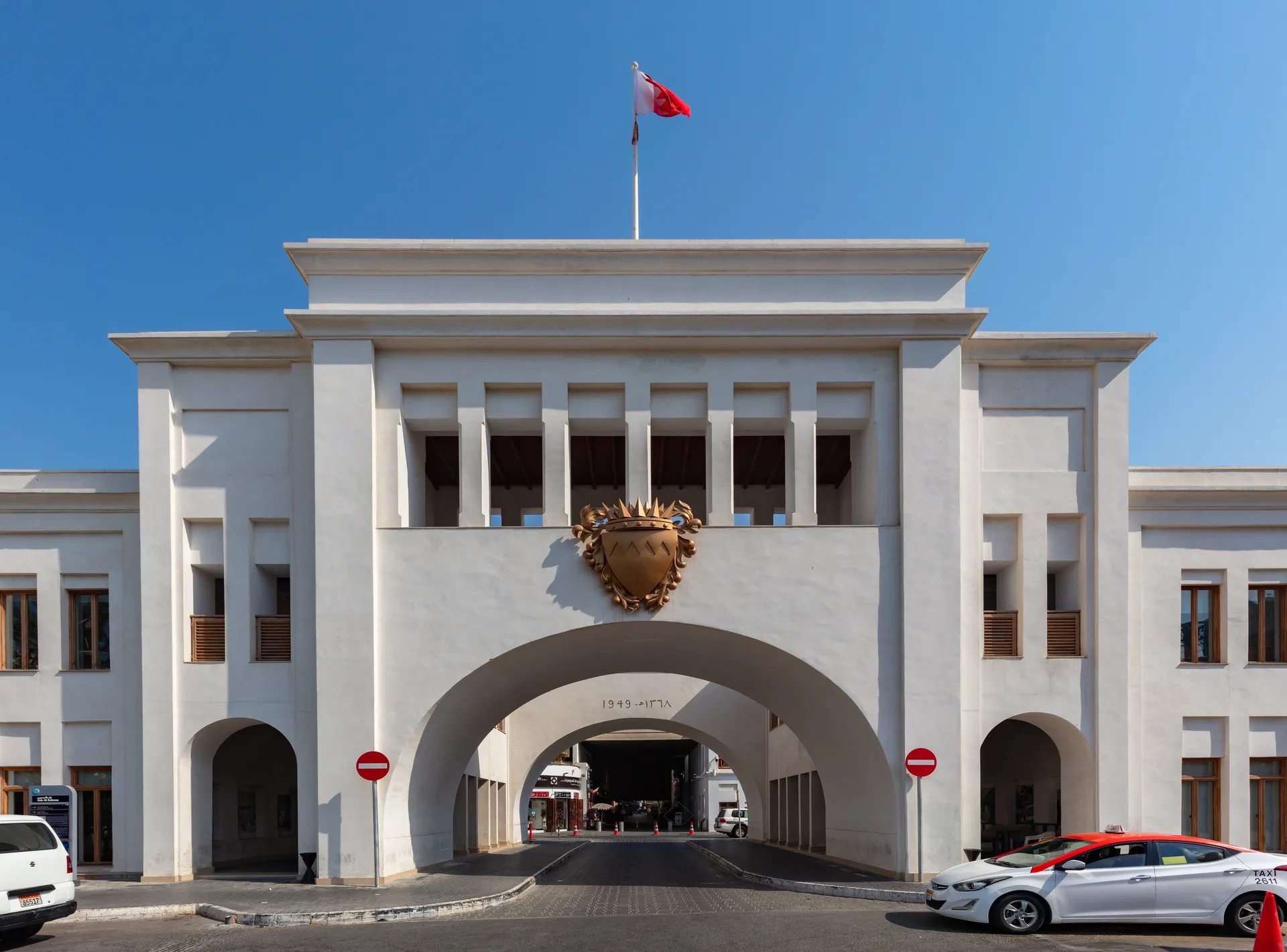
Bab Al Bahrain makes its best point before you even step through it: this pale gate opened in 1949 onto the sea, with dhows docking almost at its feet, and now the water sits several city blocks away beyond reclaimed land, glass towers, and the King Faisal Highway. Stand under the double arch in the late afternoon, when the cream facade picks up honey-colored light and the base tilework starts to show its geometric bite, and the whole place stops being a photo stop and becomes something stranger: a building still facing a harbor that no longer exists.
Behind the Gate: Bahrain Post Museum
Most people turn straight into the souq and miss the better move. Go behind the gate to the former Manama post office, where old scales, cancellation marks, vintage franking machines, and the story of Bahrain’s postal links sit in rooms that feel cooler, quieter, and faintly dusted with paper and metal, then climb to the terrace for the angle that explains the whole site at once. From up there, Bab Al Bahrain looks less like an ornament and more like what it was meant to be: the hinge between port, market, and government, with coffee cups replacing cargo.
Walk It Slowly: Arch, Souq, Coffee, Then Back Again
The right visit is a sequence, not a checklist. Enter through the arch, let the traffic noise fall away into cardamom coffee, perfume oil, hot bread, and the sharper smell of spice shops, pause at Haji’s Cafe or Café Naseef, then circle back toward the gate and look outward again; the contrast between modern Manama and the tighter grain of the souq lands hardest on the return. And if the heat is pushing 45°C in summer, do this in short bursts with long coffee stops; in winter, when evenings hover around 25°C, you can linger and watch the threshold do its old work.
Plan your visit
Getting There
Bab Al Bahrain sits on Government Avenue at the front edge of Manama Souq. From Manama Bus Terminal, official and live transit sources put the walk at about 7 to 8 minutes; bus lines including A1, A2, 12, 19, X2, and X3 stop near Bab Al Bahrain Station or Government Ave-2. If you're driving, Amakin’s Bab Al Bahrain 1 & 2 car park on Road 1507 runs 24/7 with 516 spaces, and Bahrain Financial Harbour is also close enough to reach on foot in about 5 to 10 minutes.
Opening Hours
As of 2026, Bahrain Tourism lists the Bab Al Bahrain and Manama Souq area as open daily from 8:30 AM to 10:00 PM. The Made in Bahrain shop inside the gate keeps split hours, 9:00 AM to 1:00 PM and 4:00 PM to 9:00 PM, with Friday reduced to 5:00 PM to 9:00 PM. Many independent souq shops still pause around midday, so the official headline hours can feel wider than the market’s actual rhythm.
Time Needed
Give the gate itself 15 to 30 minutes if you want a quick look and photos. A proper wander through the souq takes 1 to 2 hours, and half a day makes more sense if you add breakfast, sweets, and nearby stops like the Bahrain Post Museum or Kanoo Museum. The place works best slowly.
Accessibility
The easiest accessible approach is via Manama Bus Terminal, where official Bahrain Public Transport information confirms step-free access, accessible toilets, and buses with a driver-operated ramp plus wheelchair space. Around Bab Al Bahrain, the main experience stays at ground level, but the older souq lanes can tighten and crowd, with a stop-start flow that feels more like threading through a market than rolling through a plaza. I found no official Bab Al Bahrain page confirming lifts or site-specific accessibility features.
Cost & Tickets
As of 2026, Bab Al Bahrain and Manama Souq appear free to enter; I found no official ticket page, no booking system, and no gate fee. That matches local listings marking the site as free entry. Bus access is cheap too: Bahrain Public Transport fares are 275 fils with a GO Card, 300 fils on paper, with a 700 fils daily cap.
History
The Gate That Lost Its Shore
Bab Al Bahrain looks older than it is and simpler than it is. Official cultural sources document a government complex on the site in the 1920s, then a ceremonial gateway added in 1945, while later tourism material repeats 1949 as the completion or opening date. The contradiction matters. It tells you this landmark was assembled in layers, not born in a single grand moment.
Its setting changed even more violently than its facade. Documented records show the gate once faced Mina al-Manama and the Gulf itself; reclamation from the 1950s onward pushed the coastline north until a waterfront threshold became an inland monument, stranded like a pier with no water left beneath it.
The turning point
Charles Belgrave and the Public Face of Bahrain
Sir Charles Belgrave, Bahrain's British adviser from 1926 to 1957, had more at stake here than one handsome facade. Bab Al Bahrain formed part of his larger effort to give Manama a more ordered public face: administration, gateways, and the visual grammar of a modern capital under his influence. Documented sources credit him with the 1945 design idea, inspired in part by Mumbai's Gateway of India, which already tells you what kind of statement he wanted to make.
Then the meaning turned on him. By the 1950s, Belgrave had become a target of nationalist anger, and the polished gateway he helped bring into being began to read less like progress and more like the architecture of outside control. He left Bahrain in 1957. That was the turning point.
The gate survived because cities are good at reusing symbols they once resisted. Bab Al Bahrain kept its arch, lost its shoreline, gained Islamic-style alterations in the 1986 Silver Jubilee renovation, and then had some of those additions stripped back in the 2011 to 2013 restoration. Belgrave's authority vanished. His building stayed behind, arguing with every era that touched it.
A Waterfront That Vanished
Documented accounts describe Bab Al Bahrain as a literal edge between sea and souq, with dhows docking nearby and goods moving inland through the gate. That old geography is the emotional fact most visitors miss. What stands before you now is a former shoreline marker left inland by reclamation, which gives the place a faintly ghostly quality: the traffic noise is present, the salt-and-timber trading port is not.
Which Bab Al Bahrain Is the Real One?
The facade you see today is already an argument. Documented sources show a major 1986 renovation under Amir Shaikh Isa bin Salman Al Khalifa that added arches, arabesque latticework, and a more emphatically Islamic look; the later 2011 to 2013 restoration removed some of those changes to recover an earlier version. Scholars and preservationists still circle the same uneasy question: does authenticity live in the first design, the most loved version, or the one a later state decides to preserve?
Tips for visitors
Go After Four
Late afternoon is the sweet spot. The Made in Bahrain shop reopens at 4 PM, the light softens on the white facade, and the souq starts smelling like cardamom coffee, fried snacks, and warm bread instead of office-hour asphalt.
Ask Before Shooting
Casual photos of the gate are normal, but faces, vendors, and shop interiors are a different matter. Ask first, skip security-sensitive areas, and remember that commercial, educational, or media filming at Bahrain Authority heritage sites needs a permit.
Eat Old Manama
Skip the anonymous chain-coffee reflex. Go to Haji's Cafe for budget Bahraini breakfast, Naseef for the famous mango ice cream, or Cinnamon in the Souq for a more polished mid-range stop right by the gate.
ATM Street Sense
The main risk here is hassle, not drama: overpricing, hard sells, and the occasional person trying to steer you toward an ATM. Keep bargaining light, keep your phone close in crowded lanes, and walk away fast if anyone starts directing your cash withdrawal.
Pair It Properly
Bab Al Bahrain makes more sense as a threshold than a standalone monument. Pair it with the Bahrain Post Museum, Kanoo Museum, or a walk toward Financial Harbour, and the story clicks: old port city in front, glass towers behind.
Don't Bring Bags
No official luggage storage turned up for Bab Al Bahrain, Manama Souq, or Manama Bus Terminal. Travel light, because the gate was built as a civic front door, not a locker room, and dragging a suitcase through the souq will feel ridiculous within five minutes.
checkTry karak tea and fresh khaboos bread at any of the local cafes for a quick, authentic snack.
checkFor a full Bahraini breakfast, go for balaleet or machboos at a traditional souq cafe.
checkBahraini halwa is a must-try sweet, best enjoyed with Arabic coffee.
checkNaseef Restaurant is famous for its mango ice cream—a unique local treat.
Food districts:Manama Souq / Souq Bab Al Bahrain (spices, dates, nuts, halwa)Central Market and Fish Market (fresh fish, seafood auctions)
Restaurant data powered by Google
Frequently asked
Is Bab Al Bahrain worth visiting?
Yes, especially if you treat it as the front door to old Manama rather than a quick photo stop. The arch matters, but the real pull is what starts behind it: spice stalls, gold shops, cardamom coffee, and cafés like Haji's and Naseef. Go if you want the feeling of a trading city still doing business, with the added shock that this gate once faced the sea and now faces traffic and towers.
How long do you need at Bab Al Bahrain?
Plan on 1 to 2 hours for a good visit. Thirty minutes covers the gate and a few photos, but the place makes more sense if you walk into the souq, stop for coffee, and duck behind the gate to the Bahrain Post Museum terrace. Give it half a day if you want breakfast, museum time, and a slow wander through the market lanes.
How do I get to Bab Al Bahrain from Manama?
The easiest way is by bus or taxi into central Manama, then walking the last few minutes. Manama Bus Terminal is about a 7 to 8 minute walk away, and official and live transit sources place stops like Bab Al Bahrain Station, Government Ave-1, and Government Ave-2 right by the souq on routes including A1, A2, 12, 19, X2, and X3. If you're driving, the Bab Al Bahrain 1 & 2 car park runs 24 hours with 516 spaces.
What is the best time to visit Bab Al Bahrain?
Late afternoon into evening is the sweet spot. The cream facade catches better light then, the heat eases, and the souq feels more alive, with shops and cafés pulling people into the lanes after the workday. In summer, when Bahrain can hit 45°C, go after sunset; in fall and winter, around 25°C, you can linger much longer.
Can you visit Bab Al Bahrain for free?
Yes, Bab Al Bahrain and the souq are free to enter. I found no official entry fee, booking system, or timed-ticket setup, which fits the place: this is a public gateway into a working market, not a controlled museum hall. You only pay for what you buy, eat, or add on nearby.
What should I not miss at Bab Al Bahrain?
Don't stop at the arch. Walk through it slowly, look back to read the old port-to-market axis, then keep going to Haji's Café or Naseef, and slip behind the gate to the Bahrain Post Museum terrace for the best quieter view. Also look low: the base tilework and geometric details reward a closer look than the usual centered façade shot.
Sources & attribution18
Researched and written by the Audiala editorial team from historical records, architectural archives, and local expertise. Last updated April 2026.
Bahrain Tourism - Manama Souq — Provided official visitor framing for Bab Al Bahrain as the entrance to Manama Souq, plus current daily hours, nearby food stops, and the idea of the gate as part of a larger market district.
Bahrain Bus - Station Information — Confirmed Manama Bus Terminal as the nearest major public transport hub and documented station facilities and accessibility.
Moovit - Souq Bab Al Bahrain Transit Page — Provided recent route and stop information near Bab Al Bahrain, along with walking-time estimates from Manama Bus Terminal.
Bahrain Tourism - Haji's Cafe — Provided official details for one of the recommended traditional café stops in the souq area.
Bahrain Tourism - Cinnamon in the Souq — Provided official details for another nearby café and helped confirm the district works well as a longer food-and-walk stop.
Global Visa Corp - Bab Al Bahrain Photo Spots — Supported best-time-for-light guidance, viewpoint suggestions, and the recommendation to notice the base tilework and geometric detail.
Bahrain Tourism - Weather in Bahrain — Provided seasonal temperature context used to recommend evening visits in summer and longer daytime visits in cooler months.
Bab Al Bahrain, Manama, Baréin, 2024-08-18, DD 72 — Diego Delso — CC BY-SA 4.0 (https://creativecommons.org/licenses/by-sa/4.0/) — Source: https://commons.wikimedia.org/wiki/File:Bab_Al_Bahrain,_Manama,_Baréin,_2024-08-18,_DD_72.jpg
Strictly necessary cookies keep the site working. Analytics (PostHog, Google Analytics) measures how each visitor uses our pages. Marketing loads YouTube videos and walking-route maps without a tap and lets Google Analytics set advertising cookies. We never sell your data. You can change this any time from the footer.
Analytics and marketing cookies are optional and only load if you agree. Details under Customize.
Privacy
Cookie preferences
Pick what you're okay with. You can change this any time from the footer.
Strictly necessary
Always on
Sign-in, language, navigation. Always on.
Product analytics
PostHog (EU) and Google Analytics record which pages you view and how you use them, under a random identifier stored in your browser. Helps us see which pages work and which need fixing. Google's ad personalisation stays off. No selling.
Marketing
Loads YouTube videos and the walking-route maps (OpenFreeMap) without a tap; without it, they load only when you tap them. If analytics is also on, Google Analytics may set advertising cookies. Ad personalisation stays off.