Crathie Kirk
BallaterUnited Kingdom 57° N · 3° W Updated Aug 2026
Princess Anne married here in 1992 because the Church of Scotland allowed remarriage—and monarchs still worship as ordinary parishioners.
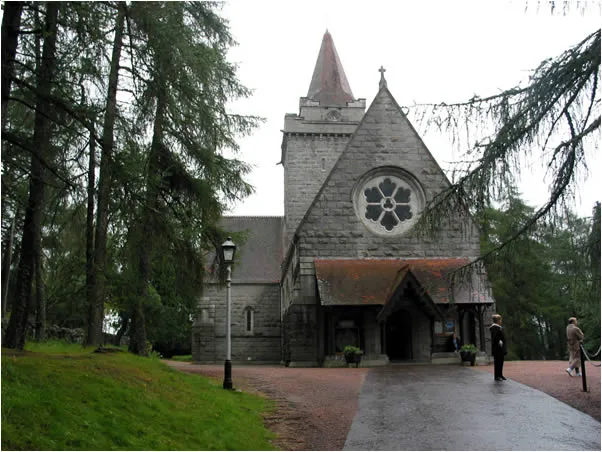 Photo: The original uploader was DanMS at English Wikipedia. · CC BY-SA 3.0
- Time needed
- 30-45 minutes
- Entry
- Free
- Best season
- April-October
Why does the Supreme Governor of the Church of England choose to worship in a Presbyterian parish kirk in the Scottish Highlands? Crathie Kirk, a modest granite cruciform church on the banks of the River Dee near Ballater, has no cathedral bells, no bishop's throne, no royal chapel status — yet for over 175 years it has been the spiritual home of the British monarchy, and the place where a queen buried a servant with words more intimate than most love letters.
Today the kirk sits quietly on the steep slope above the Dee, its grey Lochnagar granite walls weathered soft by Highland rain. On summer Sundays, the four bells donated by Princess Beatrice ring out across the valley, and you might see the royal family walking through the heavy timber doors alongside ghillies, foresters, and local farmers — no ceremony, no court protocol, just a congregation.
Step inside and the air smells of polished wood and cold stone. The communion table is carved from Caen stone and green marble from the sacred island of Iona. In the south transept, discreet carvings bear the ciphers of Victoria, Edward VII, George V, and George VI — the only hint that this unassuming parish church has hosted six generations of British sovereigns.
What to see
-
The Granite Nave and Victoria's Stained Glass
Push open the west door and the first thing that hits you is the scent of old pine, wax, and cold stone. Alexander Marshall Mackenzie designed this 1895 church to feel both sturdy and intimate: a steep hammerbeam roof in honeyed Scots pine floats above grey Aberdeenshire granite walls that glitter with mica on bright mornings. Walk to the crossing and run a hand over the hexagonal granite pulpit—a rare thing in Scotland, where church furniture is almost always timber. Queen Victoria gifted two of the lancet stained-glass windows, and when the afternoon sun slices through them, sapphire and ruby drops land on the flagstones like spilled sweets. -
The Old Kirkyard and John Brown's Grave
Most people never descend the slope from the 1895 kirk to the tumbled walls by the River Dee. That's their loss. The ruins of the 14th-century Church of St Monire stand waist-high in the grass, and through their empty windows you get the best view of the newer church above—a granite silhouette against Craig Gowan. Among the gravestones of gamekeepers and Balmoral servants sits John Brown's headstone, inscribed with an epitaph Queen Victoria composed herself. The Dee runs fast just beyond the wall, and if you stand quiet long enough, you can hear it under the wind in the Caledonian pines. -
Sunday Service at 11:30
From April to October, the kirk opens daily, but the real move is Sunday at 11:30 when the royals are in residence at Balmoral. No ropes, no reserved gallery—the King and Queen sit in a plain pew near the front, because Presbyterian worship doesn't do hierarchy. You can sit several rows behind them if you arrive early enough, though cameras stay in your pocket and the security presence is quiet but absolute. Afterwards, follow the A93 to the Balmoral gates, then walk back along the river path to the old kirkyard. The whole loop takes under an hour and leaves you with the uncanny sense that you've crashed a very private family ritual.
Plan your visit
- Getting There
- The kirk sits off the A93 in Crathie, roughly 7 miles west of Ballater and 9 miles east of Braemar. Stagecoach Bluebird buses 201/202 stop near the Crathie–Balmoral road junction, but service west of Ballater runs thin, so check the current timetable. Drivers park at the Crathie tourist car park by the Balmoral bridge and climb the short path to the church.
- Opening Hours
- As of 2026, general sightseeing runs April through October, roughly 10:00 to 16:00, with some seasons extending to 17:00. No general public visiting in winter apart from worship. Sunday services start around 11:30 and are open to all, but sightseeing pauses during worship. Royal visits in August–October can trigger unannounced closures.
- Time Needed
- Allow 20–30 minutes for the interior: royal pews, stained glass, and the communion table. A fuller 45–60 minutes gets you across the A93 to Old Crathie Kirkyard, where John Brown's grave and the ruined pre-Reformation chapel sit by the river.
- Accessibility
- The main entrance has ramped or level access, but the approach climbs a knoll on gravel paths that can challenge manual wheelchair users. The nave and centre aisle are level with wooden pews; no lifts inside. The old kirkyard across the road has uneven grass and tilted stones, moderate going for mobility aids.
- Cost & Tickets
- Entry is free; there are no tickets, booking slots, or fast-track queues. Donations for the 1895 granite building are encouraged inside the church.
Tickets & tours.
These are guided options from our partners — same price as booking direct.
Show 1 more
Prices are indicative — final pricing and availability are confirmed at checkout. Audiala may earn a commission from bookings made through these links.
History
The Queen's Kirk
Christian worship on this spot overlooking the River Dee is traditionally attributed to Saint Nathalan, a Pictish bishop who legend holds built a chapel here in the 9th century. The current building — the third on the site — was designed by Alexander Marshall Mackenzie and dedicated on 18 June 1895 in the presence of Queen Victoria herself.
But the history of Crathie Kirk is not really about architecture. It is about what happens when the most powerful woman in the world chooses to worship in an ordinary parish church — and what she buried in its kirkyard.
The turning point
The Servant and the Sovereign
To most visitors, Crathie Kirk appears as the royal family's quiet Highland church — granite walls polished by Deeside rain, royal initials carved with Victorian restraint in the south transept. A place of Sunday worship, nothing more.
But walk down the slope to the old kirkyard and you will find a headstone that does not fit the picture. It marks the grave of John Brown, a Balmoral ghillie, and it bears an inscription composed personally by Queen Victoria: "That friend on whose fidelity you count, that friend given to you by circumstance, over whom you have no competition, was to him more than a brother."
Brown was Victoria's closest companion after Prince Albert's death in 1861. Their relationship scandalized the court — the Prince of Wales despised Brown's influence and the intimate terms of their friendship. When Victoria died in January 1901, Edward VII launched a purge: he smashed statues, tore down plaques, and dispersed Brown's belongings across the Balmoral estate. The one thing he could not demolish was this gravestone, protected by the sacred ground of the kirkyard.
Now when you stand before that stone, you see not a servant's memorial but the last surviving monument to a relationship that nearly tore the royal family apart — hidden in plain sight, a hundred yards from where the king now takes communion.
The 1992 Remarriage Loophole
The Architect's Gamble
Tips for visitors
Sunday at 11:30
Arrive for the 11:30 service in August, September, or early October and you may share a pew with the royal family when Balmoral is in residence. Locals treat them as neighbours, not a photo opportunity—do the same.Silence in the sanctuary
Lower your voice inside the kirk; this is an active parish church, not a museum. Sightseeing chatter can drown the quiet that gives the granite interior its weight.Know the photo rules
Non-flash interior photos are usually fine outside services. During worship—and any royal presence—put the camera away. Drones are prohibited over the kirk and Balmoral estate.Beat the royal crowds
May and June tend to be quieter than August–October, when Balmoral residency brings tour buses and slowdowns along the A93. If you come in autumn, try a weekday before 10:30.Cross the A93 carefully
The road between the kirk and the old kirkyard is fast and winding. Use the marked pedestrian footpaths and avoid cutting straight across from the car park.No picnics inside
Do not bring food or drink into the sanctuary. Eat near the car park benches or at the seasonal visitor facilities around the Balmoral entrance, then walk up with clean hands.
Frequently asked
Is Crathie Kirk worth visiting?
Yes, particularly if you want royal history without the crowds of a palace. This is a working Church of Scotland parish church in grey Invergelder granite, built between 1893 and 1895 by Alexander Marshall Mackenzie. Queen Victoria worshipped here from 1848, Princess Anne married Timothy Laurence here in 1992, and the old kirkyard by the River Dee holds John Brown's grave with Victoria's own intimate epitaph.
How long do you need at Crathie Kirk?
Give it 45 to 60 minutes if you want the full story. A quick look at the nave, royal pew, and stained glass takes 20 to 30 minutes. The extra half hour gets you down across the A93 to the old kirkyard, where the ruins of St Monire's church and John Brown's gravestone sit on uneven turf by the river.
How do I get to Crathie Kirk from Ballater?
Drive west on the A93 for about 7 miles (11 km); the church sits on a knoll just before Balmoral. Stagecoach Bluebird buses 201 and 202 stop near the Crathie/Balmoral road junction, though the timetable west of Ballater is thin. Park at the Crathie visitor car park by the bridge and walk up the short path.
What is the best time to visit Crathie Kirk?
April to October, when the church is open to casual visitors. Go in spring or early summer for quiet contemplation, or between August and October if you want a chance of seeing the royal family arrive for the 11:30 Sunday service. Winter closes the doors to sightseers, though Sunday worship continues.
Can you visit Crathie Kirk for free?
Yes, entry is free, with donations encouraged for maintenance. You won't need a booking or a fast-track queue. You can also attend Sunday services for free, but sightseeing is not allowed during worship.
What should I not miss at Crathie Kirk?
Don't skip the old kirkyard downhill by the River Dee. John Brown's headstone carries an unusually personal epitaph written by Queen Victoria, and the ruined 14th-century St Monire's church frames a view back up to the 1895 granite kirk. Inside, look for the hexagonal granite pulpit and the stained-glass lancets Victoria gave as personal gifts.
Is Crathie Kirk open to the public?
Yes, from April to October, generally 9:30 or 10:00 until 4:00 or 5:00 daily. Year-round you can attend Sunday worship at 11:30, but not tourist sightseeing during services. Royal events or security closures can shut doors without much notice.
Sources & attribution 11
- Church of Scotland – The historic links between Crathie Kirk and the Royal Family — Royal worship history from 1848, 1893 foundation stone, 1992 Princess Anne wedding, September 2022 private service.
- National Churches Trust – Crathie Kirk — Seasonal opening hours and visitor access details.
- Queen Elizabeth Memorial – Crathie Kirk, Balmoral — Royal milestones, 1895 dedication, 1992 wedding, 2022 mourning service, and local fundraising history.
- Visit Cairngorms – Crathie Kirk — Setting, seasonal opening, Sunday service time, old kirkyard and St Monire ruins.
- Braemar and Crathie Parish – Crathie Kirk — Parish history, St Monire tradition, John Brown grave, united parish context.
- Gazetteer for Scotland – Crathie Church — Architectural style, granite materials, crossing tower, Alexander Marshall Mackenzie.
- Historic Environment Scotland – Crathie Parish Church (LB3007) — Category A listing, granite construction, hexagonal pulpit, boundary wall details.
- Crathie Opportunity Holidays – Location & Travel — Distance from Ballater, A93 route, Stagecoach bus services 201/202.
- TripAdvisor – Crathie Kirk Reviews & Kirkyard Logistics — Visitor time allocation, old kirkyard terrain, parking and walking approach.
- VisitAberdeenshire – Crathie Kirk — Architect, bell tower, stained glass gifts from Queen Victoria, Sunday service.
- Wikipedia – Crathie Kirk — Chronology of royal worship, 1893-1895 construction, 2022 royal service.
Built from cited sources · see the method · How we make our guides →
More in Ballater.
32 places to discover — a few worth pairing.


Pick up where you left off
Saved and recently read places — kept on this device only.
Photo credits (1)
- CrathieKirk01 — The original uploader was DanMS at English Wikipedia. — CC BY-SA 3.0 (https://creativecommons.org/licenses/by-sa/3.0/) — Source: https://commons.wikimedia.org/wiki/File:CrathieKirk01.jpg
Photos may have been resized or cropped.