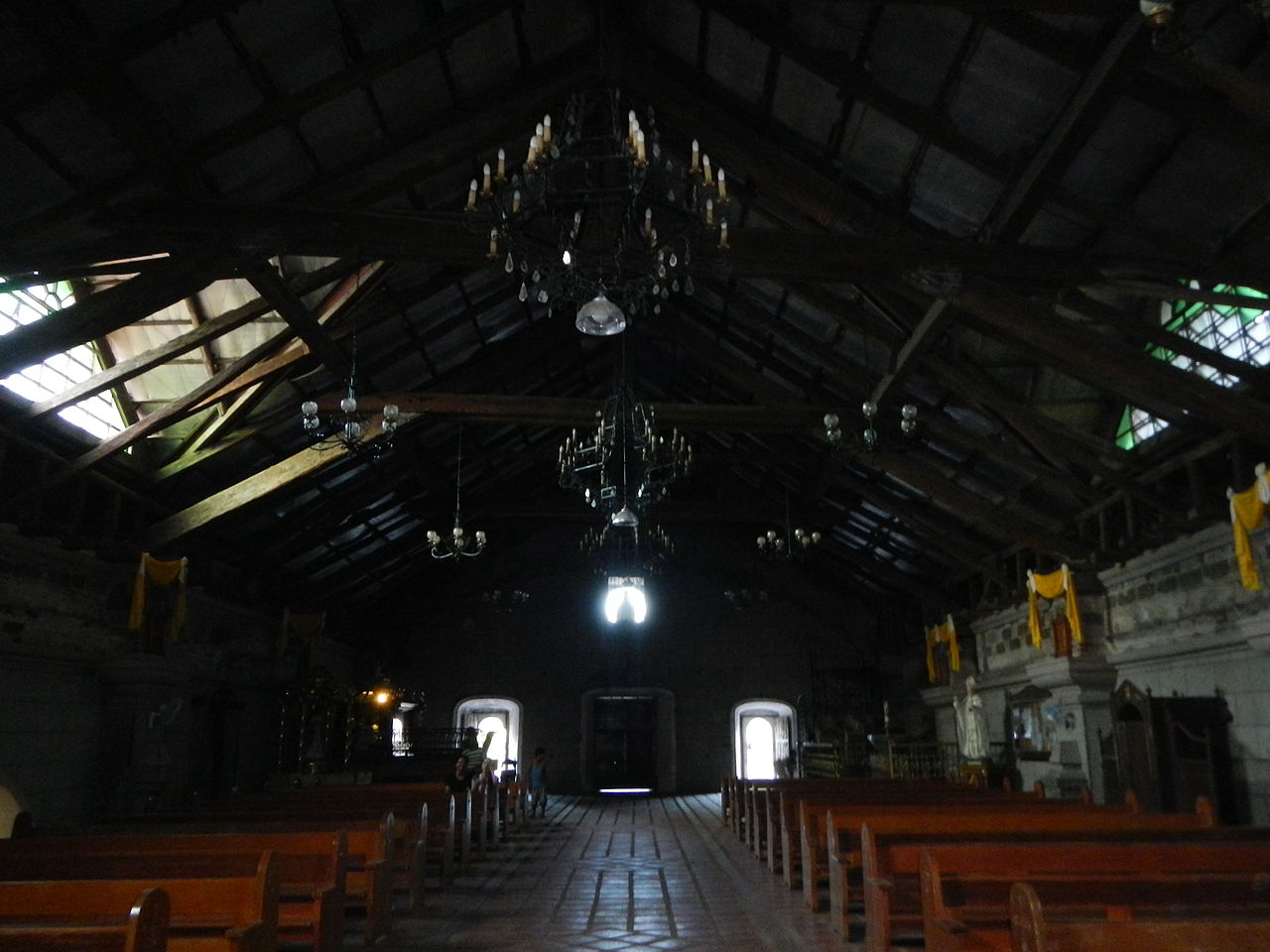
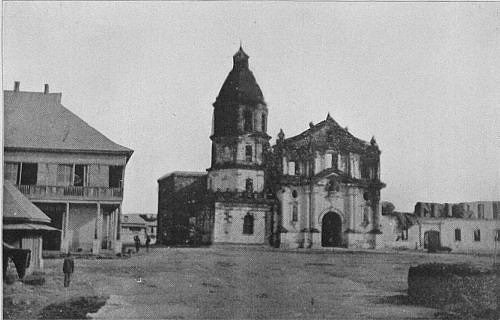
Visitors enter San Guillermo Parish Church in Bacolor, Philippines, through what used to be second-story windows — the original front door is still sealed beneath meters of hardened volcanic mud. Lahar flows from Mount Pinatubo swallowed the ground floor in 1995, four years after the eruption itself, and the congregation simply relocated the entrance upstairs. They never stopped holding Mass.
Most travelers expect ruins. San Guillermo is the opposite — an active parish where Sunday services fill the nave, where baptisms and weddings proceed on a floor that sits atop solidified volcanic debris. The old baptistry, once at the base of the bell tower, now lies somewhere beneath your feet.
What pulls people here is not disaster tourism, though the visual shock of a half-swallowed facade is hard to overstate. The real draw is the stubbornness of the place. A church that has been shaken apart by earthquakes, rebuilt twice, buried alive, and reopened within months tells you something about Pampanga that no museum exhibit can.
Bacolor sits on the flat lahar plain roughly 80 kilometers northwest of Manila — about 30 minutes from Angeles City by car. Arrive on a weekday afternoon and you may have the church almost to yourself. The silence hits differently when half the building has vanished underground.
Researched by the Audiala editorial team from historical records, architectural archives, and local expertise.
What to see
The Half-Buried Church
You walk through windows. That single fact rewires everything you think you know about San Guillermo. On September 3, 1995, a wall of volcanic mud from Mount Pinatubo buried the church up to its second story, swallowing the original doors under roughly six meters of lahar — taller than a two-story house laid on its side. What were once upper-level windows became the new entrances, and the parish never relocated. Step inside and the nave feels compressed, its proportions wrong in a way your body registers before your brain catches up. The ceiling hangs low where it once soared. But look toward the altar: a gold-leafed Baroque retablo, excavated from the mud and reinstalled under the dome, gleams with the same conviction it carried when the floor was six meters lower. The contrast is the point. Thick brick-and-stone walls — exposed where later plaster has pulled away — remind you this was a heavy colonial structure built in 1886 under Fr. Eugenio Alvarez, not the fragile curiosity it appears from outside. Above the facade cross, a Latin inscription still reads "Rex Regum Et Dominus Dominantium." Most visitors never look up to find it.
Museo de Bacolor & Recuerdos Sagrados
The old convent wing beside the church was converted into a museum that functions as both archive and reliquary. Ceilings hang so low that anyone around 170 centimeters tall will instinctively duck — a physical reminder that you're walking through what was once a second floor. Inside, old photographs of Villa de Bacolor show the town before Pinatubo erased its streets: colonial houses, wide plazas, a church that stood at its full height. Beside them sit the rescued objects — religious images, liturgical vessels, paintings — pulled from the lahar by parishioners who refused to let the mud have the last word. The effect is closer to a family attic than a polished gallery, and that's what makes it work. You can enter from outside or pass through from the church interior, and the second route is better: moving from the gilded retablo into these cramped, relic-filled corridors makes the scale of what was lost feel personal rather than statistical.
The Full Circuit: Facade to Campo Santo
Start at the front facade, where the building's truncated profile reads most clearly — a church that looks like it's sinking into the earth. Walk around to the rear exterior, where the altered height is even more dramatic and the exposed masonry reveals the structure's original mass. Then step inside for Mass or quiet contemplation; San Guillermo is an active parish, not a museum piece, and the sound of prayers under that compressed ceiling carries a weight no plaque can replicate. Pass through to the Recuerdos Sagrados museum, then exit toward the adjacent Campo Santo — the old cemetery that sits at the quietest edge of the complex, away from the facade where tour groups cluster. The whole loop takes under an hour, but give yourself longer. The bells, catalogued as heritage objects and known collectively as "Vox Dei," are worth seeking out. And if you visit during Holy Week, particularly Good Friday, the church hosts Pahalik rites and a procession featuring antique pasos — carved processional floats — that survived the lahar. The building transforms from contemplative ruin into something loud, crowded, and defiantly alive.
Plan your visit
Getting There
From Manila, take a provincial bus (Genesis, Victory Liner, or Philippine Rabbit) to San Fernando, Pampanga — roughly two hours depending on traffic. From San Fernando or SM Pampanga, hop a "Bacolor-Guagua-Betis" jeepney headed toward Bacolor. The church sits on Don Ceferino Joven in Cabambangan, about 190 meters from the jeepney terminal and 118 meters from the public market — close enough that you'll spot the half-buried facade before you need directions.
Opening Hours
As of 2026, the church opens daily from 6:00 AM to 11:30 AM, then again from 2:00 PM to 4:00 PM. It closes midday — plan around that gap or you'll find locked doors. During the annual Santo Niño exhibit (late January to early February), hours extend to 7:00 AM–7:00 PM. Expect larger crowds around the Feast of San Guillermo on February 10 and the La Naval fiesta on the third Sunday of November.
Time Needed
A quick visit — facade photos, a walk through the compressed interior, a moment to absorb the scale of what's buried — takes 20 to 30 minutes. Give yourself 45 to 75 minutes if you want to see the parish museum, the partially buried cemetery behind the church, and the adoration chapel. Bacolor as a half-day side trip works well, but the church alone doesn't need more than an hour.
Accessibility
The lahar burial means you enter at what used to be the upper window level — the choir loft is now ground floor. At least one passage requires stooping, and the interior ceiling feels unusually low because several meters of the church remain underground. Wheelchair access is undocumented and likely difficult without assistance. No elevators exist on site.
Photo Gallery
The historic interior of San Guillermo Parish Church in Bacolor, Philippines, features a dramatic wooden vaulted ceiling and traditional wooden pews. · Ramon FVelasquezThe historic San Guillermo Parish Church in Bacolor, Philippines, stands as a resilient landmark known for its unique architecture and history. · Carl Flores TrinidadThis commemorative metal plaque honors the officers and directors of the Centro Catolico who oversaw the construction of the perimeter fence at San Guillermo Parish Church in Bacolor, Philippines. · Ralff Nestor NacorThe historic San Guillermo Parish Church in Bacolor, Philippines, known for its unique architecture and resilient history. · Ralff Nestor NacorThe stunning, intricately decorated altar of the historic San Guillermo Parish Church in Bacolor, Philippines. · Ralff Nestor NacorThe historic San Guillermo Parish Church in Bacolor, Philippines, showcases stunning Baroque architecture adorned with festive star-shaped lanterns. · Ramon FVelasquezThe historic San Guillermo Parish Church in Bacolor, Philippines, stands as a resilient landmark with its weathered stone facade and distinctive red roof. · Ralff Nestor Nacor
History
What the Mud Left Standing
Augustinian friars established a parish in Bacolor around 1576, making San Guillermo one of the older churches in Pampanga. The town had been founded two years earlier under Don Guillermo Manabat, and for a brief spell during the British occupation of Manila, Bacolor served as the seat of the Spanish colonial government-in-exile under Simón de Anda y Salazar, from October 1762 to May 1764.
The church that stands today is not the original. An earthquake destroyed an earlier structure in 1880, and local government records describe a rebuilding under Fr. Eugenio Alvarez in 1886 — though some sources point to yet another reconstruction in 1897 under Fr. Manuel Diaz, and the exact sequence remains unsettled. What is clear: the building that faced the lahar had already survived at least two catastrophic rebuildings.
The turning point
The Priest Who Stayed
When Fr. Nestor G. Tayag Jr. was assigned to San Guillermo in mid-1995, he inherited a parish still recovering from Mount Pinatubo's 1991 eruption. According to a 2001 account in the Philippine Star, he arrived on June 24, 1995 — barely three months before the worst lahar event would rewrite the church's geometry entirely.
The lahar of 1995 did not strike like a wave. It was slower and more absolute — a grinding flow of volcanic sediment and rainwater that rose past the church doors, climbed the walls, and stopped only at the windowsills, sealing the nave's lower half in hardened mud. Church authorities considered abandoning the parish entirely.
Tayag refused. He celebrated Mass in a makeshift tent with the buried facade as his backdrop, then led volunteers in excavating and reassembling the church's carved retablos piece by piece — not as museum artifacts, but as working altar furnishings. By November 1995, according to one contemporary account, the La Naval procession was held again at the half-buried church, turning San Guillermo from a disaster site into a declaration that Bacolor was not finished.
A Wartime Capital's Parish
Between October 1762 and May 1764, Bacolor was the most politically important town in the Philippines outside Manila. When the British seized the capital during the Seven Years' War, Spanish governor Simón de Anda y Salazar retreated to Bacolor to run a government-in-exile — and San Guillermo's parish complex sat at the center of that improvised wartime administration. A royal decree elevated Bacolor to a villa in November 1765, formally recognizing the role the town had played.
La Naval and the Cookie That Replaced Jewels
The feast of La Naval has been celebrated in Bacolor since 1786, honoring Nuestra Señora del Santísimo Rosario. According to local tradition, devotees too poor to offer jewels to the Virgin created a pastry instead — the Dulce Prenda, named after a Spanish farewell hymn to Mary. The original processional image ended up at the museum of De La Salle University-Dasmariñas in Cavite after the Pinatubo displacement, and local leaders have appealed for its return; the venerada image, kept for veneration rather than procession, remains inside San Guillermo.
Tips for visitors
Dress for a Parish
This is a working Catholic church with regular Masses, weddings, and Holy Week processions — not a ruin you're exploring. Cover your shoulders and knees, remove hats inside, and keep your voice low if worshippers are present.
Photography Etiquette
Casual phone photos outside of services seem widely accepted — visitor galleries and even wedding shoots confirm this. But for tripods, flash, drones, or anything commercial, ask at the parish office first. Step aside during liturgy.
Eat Kapampangan
Granda's Sweet Delicacies near the church sells mamon tostado and suman banos — Bacolor's pasalubong staples. For a proper sit-down meal, Apag Marangle serves classic Kapampangan dishes at mid-range prices (around PHP 200–499). Diosdado is the splurge option at roughly PHP 800–1,000 per person.
Know the Real Date
Many guides say the church was buried in the 1991 Pinatubo eruption. Wrong by four years. The volcano erupted on June 15, 1991, but the lahar flow that swallowed the church hit on September 3, 1995. And it was lahar — volcanic mudflow — not lava. Locals notice when visitors get this wrong.
Time Your Arrival
Morning light hits the facade best and the church opens at 6:00 AM, when the air is cooler and the crowds thinnest. Avoid the midday closure (11:30 AM–2:00 PM) and the wet season's heaviest months — Bacolor's lahar-altered terrain can get tricky in heavy rain.
Watch Your Belongings
No tourist-scam scene here — Cabambangan's population is barely 500 people. But petty theft does occur: in January 2026, religious items were stolen from inside the church itself. Keep bags close and don't leave valuables unattended in parked vehicles.
Where to Eat
local_dining
Don't Leave Without Trying
Sisig — chopped pork with liver and spices, a Pampanga iconBuro — fermented fish, best with grilled or fried fish on the sideKare-kare — peanut stew with meat and vegetablesLengua — braised beef tongue, tender and richCaldereta — tomato-based stew with meat, hearty and warmingSans rival — cashew-layered pastry, Pampanga's most famous sweetSylvanas — chocolate-covered meringue roll, another local classicTamales and suman — steamed rice cakes, often sold as breakfast or snacks
Kapampangan Asan Pakamalan
local favorite
Kapampangan / Filipino€€star4.2(35)directions_walkRight across San Guillermo Parish Church
Order: Order the caldereta — it's the standout dish here. Pork dishes and sisig are also solid bets if you want authentic Kapampangan fare without the fuss.
This is the most church-adjacent full restaurant in the area, and the easiest proper sit-down meal after visiting San Guillermo. It's where locals go for real Kapampangan cooking, not tourist versions.
Pizza / Quick Bite€star4.5(4)directions_walkNear San Guillermo Parish Church
Order: Go for the pepperoni or beefy mushroom — straightforward, reliable pies. Hawaiian-style is also on the menu if you're feeling adventurous.
Best option if you want something fast and easy right around the church area instead of committing to a long lunch. Late hours (until 2 AM) make it perfect for an evening bite after exploring.
Order: Specific menu details are sparse, but as a local eatery, the daily specials and house rice dishes are your best bet — this is where you eat what's fresh.
A no-frills neighborhood spot that serves honest Filipino food to locals. It's the kind of place you stumble into when you want real food, not a restaurant experience.
checkKapampangan Asan Pakamalan is directly across the church — no need for a tricycle if you're visiting San Guillermo.
checkDanda's Pizza stays open until 2 AM, making it a solid late-night option after evening exploration.
checkBudget PHP 400–600 per person for a full meal at Kapampangan Asan Pakamalan; quick bites at Danda's run PHP 200–350 for a pizza.
checkThe Bacolor Public Market in Poblacion has food stalls for okoy, panara, and other street bites if you want to explore beyond sit-down restaurants.
Food districts:San Guillermo area — church-adjacent restaurants and quick bitesCabambangan / Poblacion — where the public market and local food stalls cluster
Restaurant data powered by Google
Frequently asked
Is the Sunken Church of Bacolor worth visiting?
Yes — San Guillermo is one of the most physically disorienting heritage sites in the Philippines, and it takes about an hour to absorb properly. You enter through what used to be upper-story windows because lahar from Mount Pinatubo buried the original ground floor in 1995. The church is not a ruin: Masses still happen, gilded retablos rescued from the mud glow under the dome, and a small museum holds photographs and sacred objects pulled from the debris.
How do I get to San Guillermo Church Bacolor from Manila?
Take a provincial bus to San Fernando, Pampanga — operators include Genesis, Victory Liner, and Philippine Rabbit — then catch a jeepney on the Bacolor-Guagua-Betis route or hire a tricycle for the last stretch. The church sits on Don Ceferino Joven street in Cabambangan, about 190 meters from the Bacolor Jeepney Terminal and right beside the public market. No train or metro reaches Bacolor directly.
Can you visit Bacolor Church for free?
San Guillermo is a working parish church with free walk-in access — no tickets, no timed entry, no booking system. The attached museum and Santo Niño exhibits have also been reported as free. A donation is appropriate but not required.
What are the opening hours of San Guillermo Parish Church Bacolor?
The church is open daily from 6:00 AM to 11:30 AM and again from 2:00 PM to 4:00 PM, based on current Tripadvisor and Waze listings. During feast days — February 10 for San Guillermo and the third Sunday of November for La Naval — expect longer hours and larger crowds. The midday closure means afternoon visitors should plan to arrive after 2:00 PM.
How long do you need at San Guillermo Church Bacolor?
A focused visit takes 20 to 30 minutes; a thorough one with the museum, cemetery, and exterior walkabout runs 45 to 75 minutes. The real time sink is processing what you're seeing — the entrance you duck through was a window, the floor you stand on buries the original nave, and the building's entire vertical logic has been rewritten by volcanic mud. Bacolor as a half-day trip from San Fernando or Angeles works well.
What should I not miss at the Sunken Church of Bacolor?
Pay attention to the entrance itself: you are walking through former upper-story windows, which means the original doors are still buried meters below your feet. Inside, the gold-leafed main retablo and pulpit were dug out of lahar and reassembled by parishioners — look for the contrast between the compressed, low ceiling and the rich gilding. The Recuerdos Sagrados de Bacolor museum in the old convent wing holds before-and-after photographs and salvaged sacred objects that most quick visitors skip entirely.
What is the best time to visit San Guillermo Church Bacolor?
The dry season from November through April gives you the clearest views of the buried facade and surrounding lahar terrain. For atmosphere, Holy Week transforms the church with Good Friday processions featuring antique Kapampangan pasos saved from the disaster — but expect crowds. February 10, the Feast of San Guillermo, brings the parish to life with local devotion to "Apung Gemung," the Kapampangan name for the patron saint.
Was Bacolor Church buried by the Mount Pinatubo eruption?
Not exactly — and this is the detail most visitors get wrong. Mount Pinatubo erupted on June 15, 1991, but San Guillermo was buried by lahar flows in 1995, four years later. Lahar is a fast-moving slurry of volcanic debris and rainwater, not lava. The mud swallowed the lower half of the facade, turned doors into subterranean relics, and pushed the functional floor level up by several meters.
Sources & attribution26
Researched and written by the Audiala editorial team from historical records, architectural archives, and local expertise. Last updated April 2026.
Saved and recently read places — kept on this device only.
Photo credits (14)
Bacolor Church, Pampanga, Jun 2024 (1) — Ralff Nestor Nacor — CC BY-SA 4.0 (https://creativecommons.org/licenses/by-sa/4.0/) — Source: https://commons.wikimedia.org/wiki/File:Bacolor_Church,_Pampanga,_Jun_2024_(1).jpg
San Guillermo Parish Church - Bacolor, Pampanga, Philippines — Jimvikipedia — CC BY-SA 4.0 (https://creativecommons.org/licenses/by-sa/4.0/) — Source: https://commons.wikimedia.org/wiki/File:San_Guillermo_Parish_Church_-_Bacolor,_Pampanga,_Philippines.jpg
Bacolor Church Interior, Pampanga, Jun 2024 — Ralff Nestor Nacor — CC BY-SA 4.0 (https://creativecommons.org/licenses/by-sa/4.0/) — Source: https://commons.wikimedia.org/wiki/File:Bacolor_Church_Interior,_Pampanga,_Jun_2024.jpg
Jf9312San Guillermo Parish Archives Museum fvf 01 — Judgefloro — CC BY-SA 4.0 (https://creativecommons.org/licenses/by-sa/4.0/) — Source: https://commons.wikimedia.org/wiki/File:Jf9312San_Guillermo_Parish_Archives_Museum_fvf_01.JPG
Bacolor Cemetery — Elmer B. Domingo — CC BY-SA 4.0 (https://creativecommons.org/licenses/by-sa/4.0/) — Source: https://commons.wikimedia.org/wiki/File:Bacolor_Cemetery.jpg
Back Side of Half-Buried San Guillermo Parish Church - panoramio — Carl Flores Trinidad — CC BY-SA 3.0 (https://creativecommons.org/licenses/by-sa/3.0/) — Source: https://commons.wikimedia.org/wiki/File:Back_Side_of_Half-Buried_San_Guillermo_Parish_Church_-_panoramio.jpg
Aguillermochurchjf — Ramon FVelasquez — CC BY-SA 3.0 (https://creativecommons.org/licenses/by-sa/3.0/) — Source: https://commons.wikimedia.org/wiki/File:Aguillermochurchjf.JPG
Bacolor Church Centro Catolico Marker — Ralff Nestor Nacor — CC BY-SA 4.0 (https://creativecommons.org/licenses/by-sa/4.0/) — Source: https://commons.wikimedia.org/wiki/File:Bacolor_Church_Centro_Catolico_Marker.jpg
Bacolor Church Altar, Pampanga, Jun 2024 — Ralff Nestor Nacor — CC BY-SA 4.0 (https://creativecommons.org/licenses/by-sa/4.0/) — Source: https://commons.wikimedia.org/wiki/File:Bacolor_Church_Altar,_Pampanga,_Jun_2024.jpg
Aguillermobacolorjfa — Ramon FVelasquez — CC BY-SA 3.0 (https://creativecommons.org/licenses/by-sa/3.0/) — Source: https://commons.wikimedia.org/wiki/File:Aguillermobacolorjfa.JPG
Bacolor Church (rear), Pampanga, Jun 2024 — Ralff Nestor Nacor — CC BY-SA 4.0 (https://creativecommons.org/licenses/by-sa/4.0/) — Source: https://commons.wikimedia.org/wiki/File:Bacolor_Church_(rear),_Pampanga,_Jun_2024.jpg
Bacolor Church Historical Information, Pampanga — Ralff Nestor Nacor — CC BY-SA 4.0 (https://creativecommons.org/licenses/by-sa/4.0/) — Source: https://commons.wikimedia.org/wiki/File:Bacolor_Church_Historical_Information,_Pampanga.jpg
Bacolor Church 2 — Elmer B. Domingo — CC BY-SA 4.0 (https://creativecommons.org/licenses/by-sa/4.0/) — Source: https://commons.wikimedia.org/wiki/File:Bacolor_Church_2.jpg
Bacolor Church Welcome Arch, Pampanga, Jun 2024 — Ralff Nestor Nacor — CC BY-SA 4.0 (https://creativecommons.org/licenses/by-sa/4.0/) — Source: https://commons.wikimedia.org/wiki/File:Bacolor_Church_Welcome_Arch,_Pampanga,_Jun_2024.jpg
Strictly necessary cookies keep the site working. Analytics (PostHog, Google Analytics) measures how each visitor uses our pages. Marketing loads YouTube videos and walking-route maps without a tap and lets Google Analytics set advertising cookies. We never sell your data. You can change this any time from the footer.
Privacy
Cookie preferences
Pick what you're okay with. You can change this any time from the footer.
Strictly necessary
Always on
Sign-in, language, navigation. Always on.
Product analytics
PostHog (EU) and Google Analytics record which pages you view and how you use them, under a random identifier stored in your browser. Helps us see which pages work and which need fixing. Google's ad personalisation stays off. No selling.
Marketing
Loads YouTube videos and the walking-route maps (OpenFreeMap) without a tap; without it, they load only when you tap them. If analytics is also on, Google Analytics may set advertising cookies. Ad personalisation stays off.