Place
Mexico Updated Oct 2026
In Santiago de Querétaro, Mexico, a Spanish street grid gives way without warning to Indigenous winding lanes, while 18th-century pink-stone arches stride across the city’s edge. The aqueduct’s 74 arches rise more than 28 meters, roughly the height of a nine-story building.
 Photo: Omar Espino / Pexels
Built from cited sources · see the method · How we make our guides →
The UNESCO-listed Historic Monuments Zone covers 203 blocks and contains more than 1,400 listed buildings. Spanish colonial streets meet the winding lanes of Otomí and Chichimeca quarters, with leafy plazas breaking up the stone.
Querétaro’s churches reward a slower look: at the former Convento de San Agustín, now MAQRO, sculpted stone figures support a courtyard arcade of elaborate arches. At Teatro de la República, the National Anthem debuted in 1854, Maximilian’s trial took place in 1867, and the 1917 Constitution was drafted and promulgated.
The city’s history isn’t sealed behind façades; it still turns up at the table and in old factories. Mercado de la Cruz serves enchiladas queretanas and gorditas de migajas, while the 19th-century textile works at Hércules now pour craft beer and host music.
Not every monument, just the ones we'd walk you past ourselves.
Where to wander, by quarter — each with its own rhythm.
Before you go
From Otomí communities to the making of modern Mexico
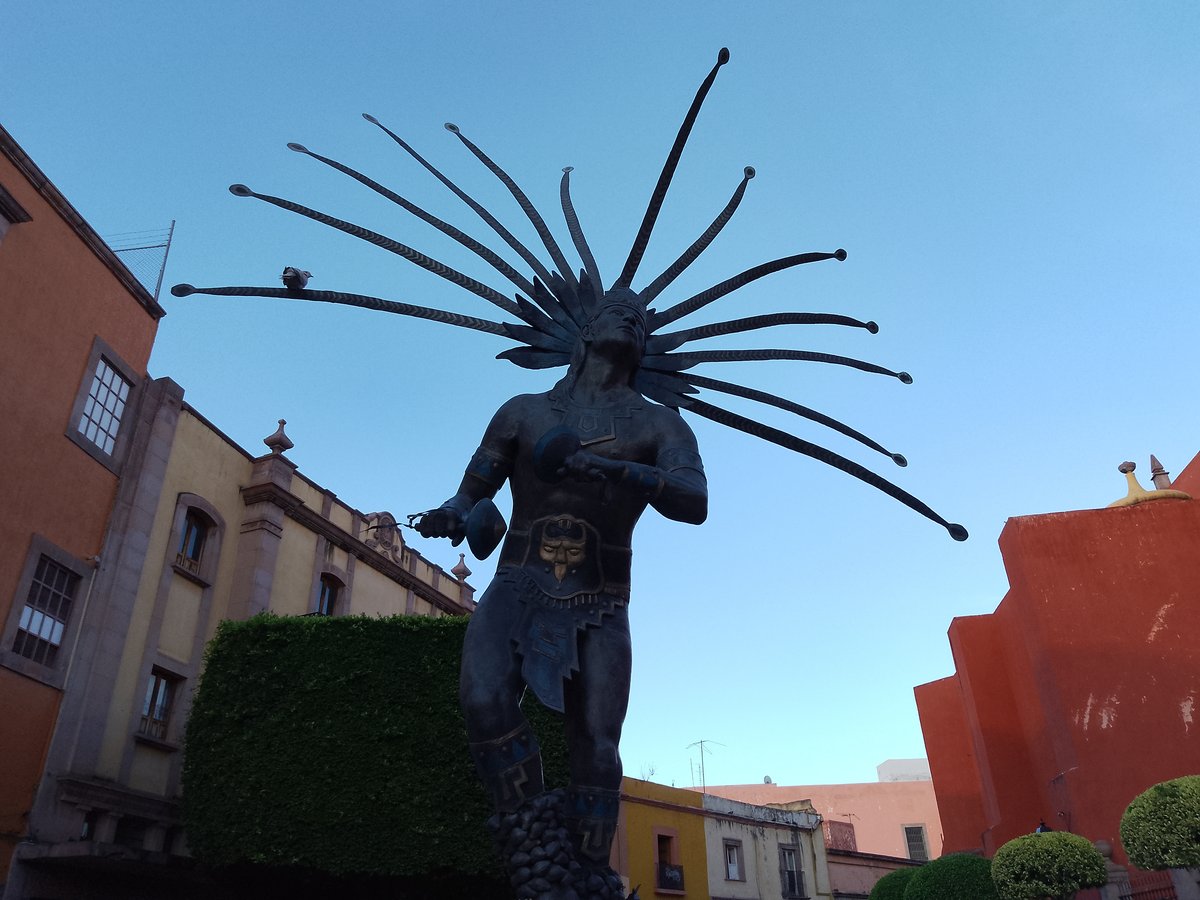
Long before Santiago de Querétaro appeared on Spanish maps, the Bajío valley held Otomí farming communities alongside Chichimeca groups who moved through this frontier. Their paths and settlements formed the human geography on which the colonial city would later be laid.
Colonial chronicles place the founding of Santiago de Querétaro on July 25, 1531, after Otomí leader Conín and Spanish forces defeated Chichimeca opponents at Sangremal Hill. Tradition tells of a sudden eclipse, a luminous cross, and an apparition of Saint James; the story belongs to faith and memory, not verified battlefield evidence.
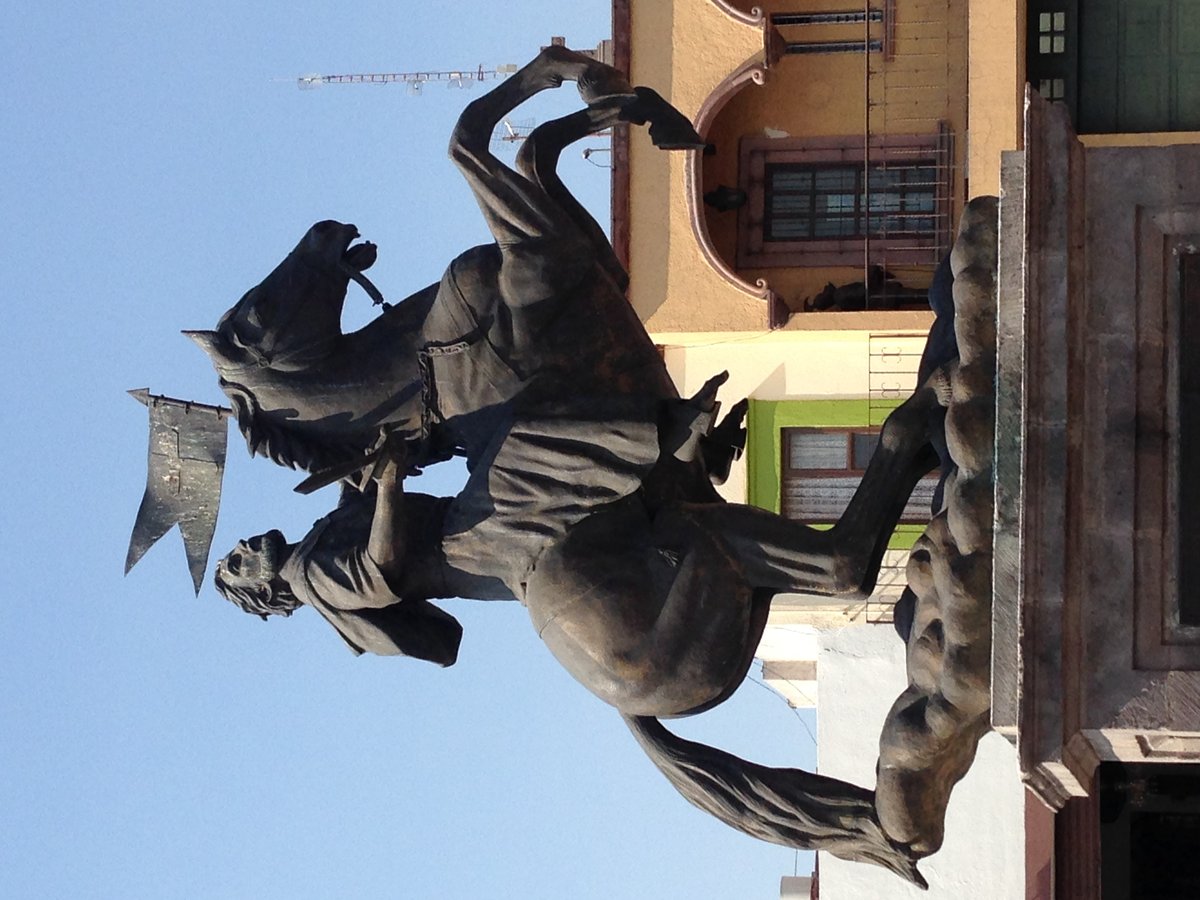
Otomí leader Conín, baptized as Fernando de Tapia, negotiated an alliance with the Spanish and helped establish the settlement that became Querétaro. His role is a reminder that the city’s founding was also an Indigenous act of political calculation, not simply a Spanish arrival.
Franciscan construction began around 1540 on the complex that would become the city’s first major monastic center. Work continued for generations, and the church and convent eventually anchored religious life near the growing colonial streets.
A devastating cocoliztli epidemic swept central Mexico between 1545 and 1548, striking Indigenous communities across the region. In Querétaro, disease and population loss altered the lives of the Otomí and other peoples whose labor and knowledge had shaped the new town.
Construction began on the Templo y Convento de la Santa Cruz atop Sangremal Hill, the site associated with the city’s foundation. In 1683, the convent became home to a College of Propaganda Fide, training missionaries for work across the Americas.
The aqueduct commissioned for Querétaro brought spring water from La Cañada toward the convent of Santa Cruz and the city’s public fountains. Its monumental section stretches about 1.3 kilometers through 74 pink-stone arches, some more than 28 meters high—roughly the height of a nine-story building.
Juan Antonio de Urrutia y Arana, Marquis of the Villa del Villar del Águila, backed the aqueduct project that began in 1726. His money helped turn a practical need—clean water—into the landmark that still draws the eye across the eastern approach to the city.
Augustinian friars built the Templo y Ex-Convento de San Agustín between 1731 and 1745. Its courtyard, crowded with carved figures, caryatids, and stone arches, shows how colonial builders made even a cloister feel theatrical.
Santa Rosa de Viterbo took shape as one of Querétaro’s most ambitious churches, associated with architect Ignacio Mariano de las Casas. Flying buttresses brace its exterior, while carved and gilded altarpieces catch the light inside.
Architect and painter Francisco Eduardo Tresguerras brought his neoclassical style to Querétaro with the design of the Neptune Fountain. The sculpted figure and clean lines marked a turn away from the dense ornament of the city’s Baroque churches.
The Fuente de Neptuno added a new civic accent to Querétaro’s streets, its stone figure set against the older colonial fabric. Designed by Tresguerras, it made classical restraint visible at a city corner rather than behind a church façade.
In Querétaro, meetings disguised as literary gatherings brought together people plotting against Spanish rule, including Miguel Hidalgo, Ignacio Allende, and the Domínguez household. When authorities uncovered the plan in September, a warning sent from the city helped push the insurgents to launch the uprising at Dolores on September 16.
Josefa Ortiz de Domínguez, known as La Corregidora, was confined to her home when royalist searches threatened the conspiracy. She found a way to alert the insurgents, turning the rooms of the Casa de la Corregidora into the starting point of a message that changed the timing of Mexico’s independence revolt.
After U.S. forces captured Mexico City during the Mexican-American War, President Manuel de la Peña y Peña moved the national government to Querétaro. For a time, the city’s plazas and government rooms became the working center of a republic under immense pressure.
On May 19, Mexico’s Congress ratified the Treaty of Guadalupe Hidalgo in Querétaro; the exchange of ratifications followed on May 30. The agreement ended the war with the United States and ceded a vast northern territory, giving the city a place in one of Mexico’s hardest political reckonings.
The neoclassical Teatro Iturbide opened in 1852, giving Querétaro a formal stage for public ceremony and performance. The building would later host events that reached far beyond the city, and its name would change to Teatro de la República.
Republican forces led by General Mariano Escobedo surrounded Querétaro from March 6 to May 15, trapping Emperor Maximilian and his remaining supporters inside. The siege ended when Colonel Miguel López opened a route into the defenses near the convent of Santa Cruz, and the imperial position collapsed.
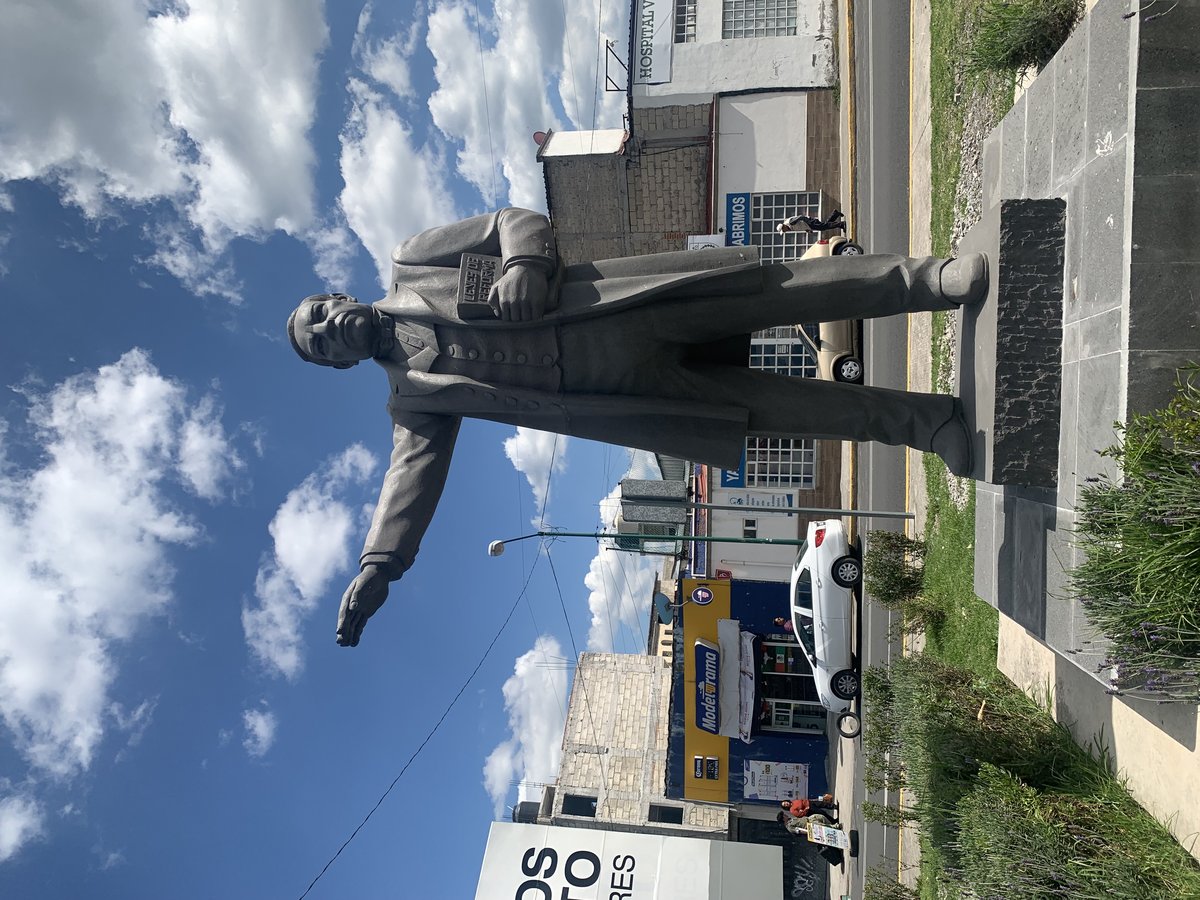
After a court-martial held at the Teatro Iturbide, Maximilian, Miguel Miramón, and Tomás Mejía were shot by firing squad on Cerro de las Campanas. The executions restored the republic under Benito Juárez; the hill’s Austrian chapel, built decades later, still marks the uneasy memory of that morning.
Revolutionary leader Venustiano Carranza designated Querétaro as the provisional capital and convened a constituent congress there. Delegates arrived at the Teatro Iturbide to argue over the future of a country still remade by revolution.
Mexico’s new constitution was promulgated at the Teatro Iturbide, later renamed the Teatro de la República. Its provisions on secular education, land and national resources, and workers’ rights made the city the setting for a document that reshaped public life across the country.
From the 1960s onward, manufacturing expanded around Querétaro, bringing work in metalworking, automotive parts, appliances, and food processing. New industrial districts and fast-growing suburbs began to press against a historic center still organized around colonial plazas and narrow streets.
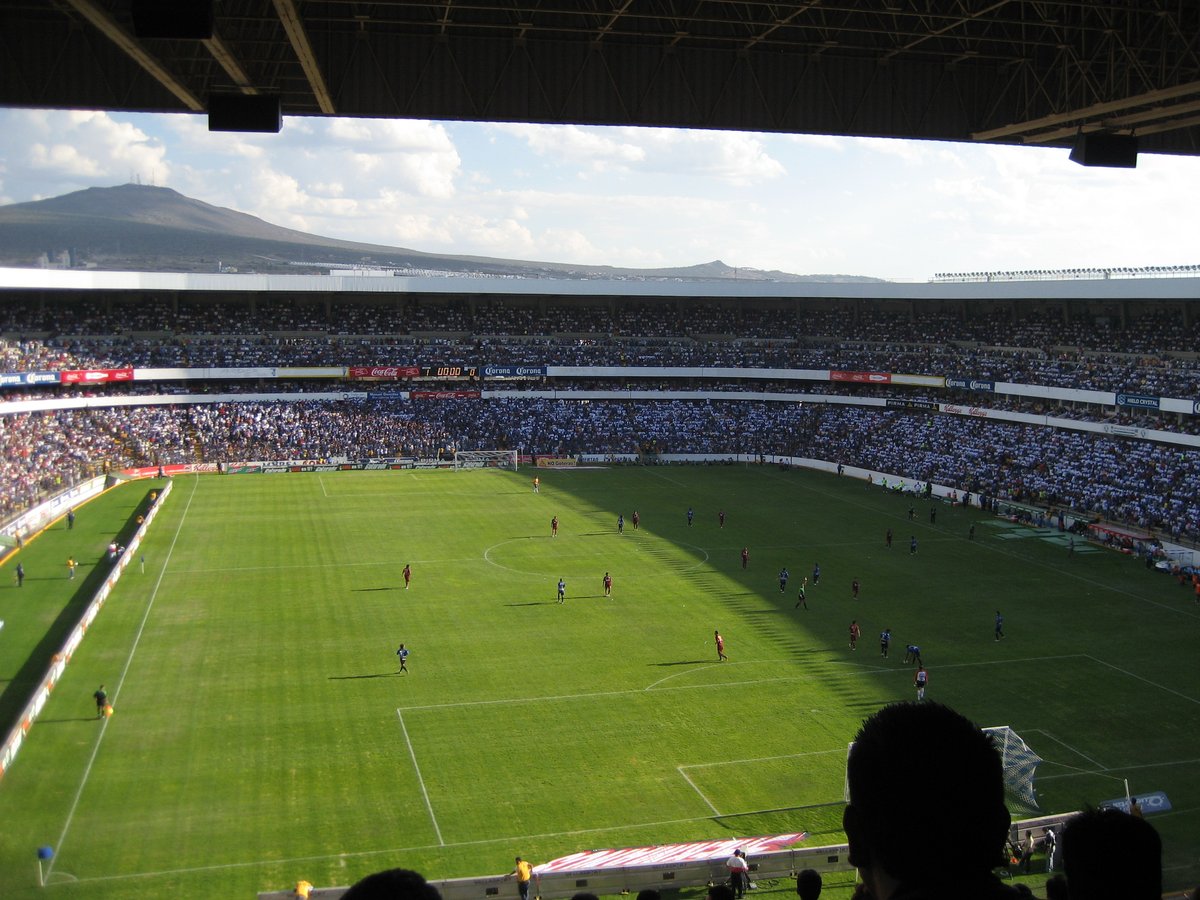
Estadio Corregidora was built in 1985 for the 1986 FIFA World Cup. The stadium hosted group matches and a Round of 16 game in which Spain beat Denmark 5–1, bringing a global sporting crowd to a city better known for its older political stages.
UNESCO inscribed Querétaro’s Historic Monuments Zone as a World Heritage Site in 1996. Its listed buildings reveal an unusual city plan: the straight Spanish grid meets the winding routes of Indigenous quarters, often within a few steps.
Querétaro developed into a major hub for aerospace manufacturing, information technology, and data centers, alongside its established industrial base. Aircraft components now leave the region from a city whose earlier prosperity depended on the routes that carried silver and water.
Painter Santiago Carbonell, who made Querétaro his home after moving to Mexico in 1986, established a museum bearing his name in the historic center in 2014. Its presence adds a contemporary artistic address to streets more often associated with colonial stonework and national political history.
Independence heroine · 1768–1829
Lived at Casa de la Corregidora and joined the Independence conspiracy
From Casa de la Corregidora, where she lived as the corregidor’s wife, Ortiz de Domínguez took part in the conspiracy that helped launch Mexico’s fight for independence. She might recognize how Querétaro still keeps public life close to its central plazas, even as her former home serves as a government palace.
Emperor of Mexico · 1832–1867
Tried and executed in Querétaro
After his court-martial in Querétaro, Maximilian was executed with generals Miguel Miramón and Tomás Mejía at Cerro de las Campanas on June 19, 1867. The hill is now a park; one can imagine him startled by families walking there within sight of the chapel marking his final hours.
President of Mexico · 1859–1920
Called the Constitutional Congress that met in Querétaro in 1916–1917
Carranza brought Mexico’s Constitutional Congress to Querétaro, where delegates debated and promulgated the 1917 Constitution at Teatro de la República. He might be surprised by how ordinary the street outside feels today, with cafés and traffic where a defining national argument once took place.
Where locals actually book dinner — not the tourist menus.
Small things that change how the city treats you.
The city, as it actually looks.


Yes, especially if you like cities where architecture and political history share the same streets. The UNESCO-listed center pairs colonial plazas and churches with the 74-arch aqueduct, while local markets offer Querétaro dishes such as enchiladas queretanas.
Plan on 2–3 days for the historic center, its museums and the aqueduct. Add a day if you want to visit Cerro de las Campanas at an unhurried pace or take a trip to Bernal or the wine region.
QRO is about 30–35 km southeast of the center, and an authorized taxi is reported to cost MXN 250–350. A scheduled bus runs to the main bus terminal for less, but departures are limited; check the timetable before you fly.
Walk the historic center, using its pedestrian andadores to link plazas, churches and museums. QroBus serves the wider city, while Uber and DiDi are options for longer trips; Querétaro has no metro.
The historic center is generally regarded as a safer area for visitors, but normal city precautions still apply. Keep valuables out of sight on crowded buses, use an app ride or authorized taxi late at night, and avoid unfamiliar outer suburbs after dark.
Yes: many plazas and outdoor landmarks are free, and the researched prices for some local museums range from MXN 30 to 90. A standard QroBus fare is listed at MXN 11; check current prices and carry cash for markets and small stalls.
The trip usually takes about 2.5–3.5 hours from the Terminal de Autobuses de Querétaro. First-class operators include ETN and Primera Plus; check departure times and fares with the bus company.
12 places to discover
Saved and recently read places — kept on this device only.
Photos may have been resized or cropped.