History and Foundation
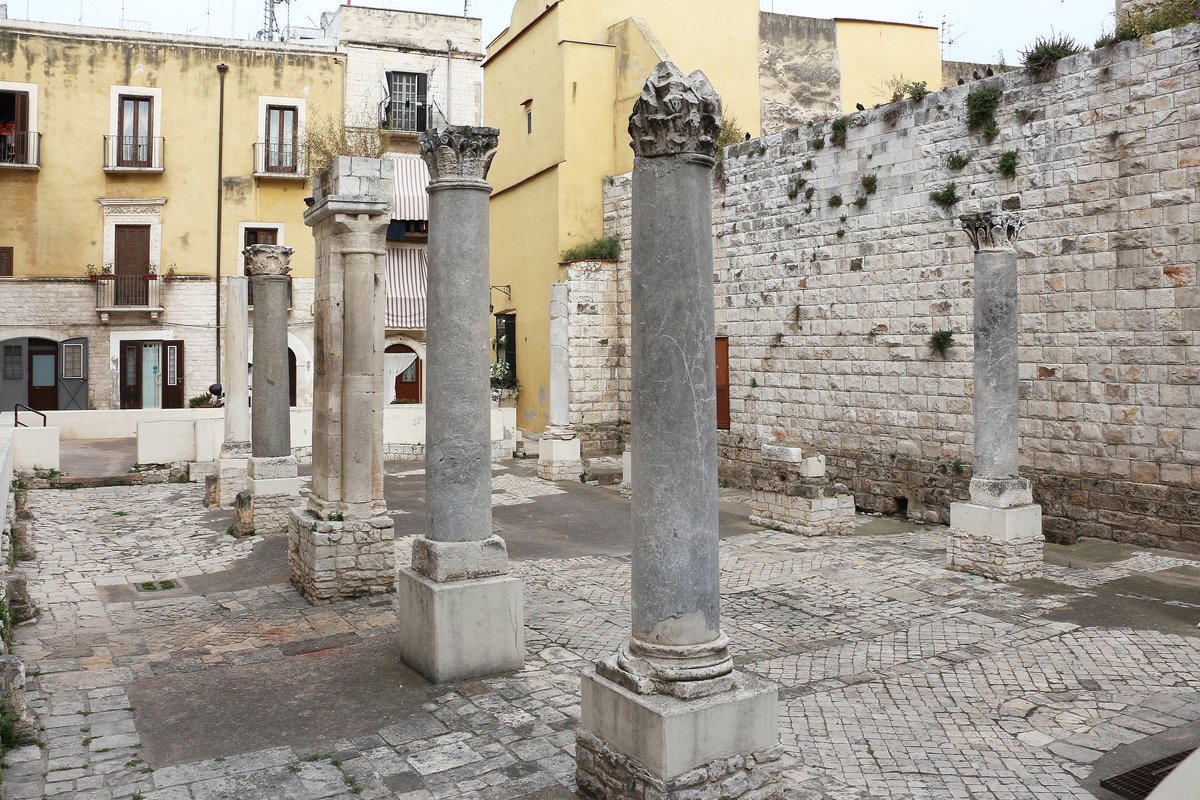
The basilica’s origins are rooted in a remarkable episode: the transfer of Saint Nicholas’s relics from Myra to Bari by a group of local merchants in 1087, safeguarding them from potential desecration (Russian Store; Spotting History). This event elevated Bari’s religious standing, establishing it as a major pilgrimage destination for both Roman Catholics and Eastern Orthodox Christians. Construction began on the ruins of the Byzantine Court of the Catapan, with the crypt consecrated by Pope Urban II in 1089 and the main church completed in 1197 (Visit Italy).
Architecture and Artistic Heritage
The basilica is a quintessential example of Apulian Romanesque architecture, mixing local, Byzantine, and Norman influences. Its fortress-like façade, constructed with pale local limestone, is punctuated by two massive towers and an ornate portal. The Latin cross floor plan features a spacious nave flanked by aisles, and the crypt—supported by 26 columns—houses the saint’s relics, drawing pilgrims year-round (ItalyScapes; Wikipedia).
Notable artistic elements include:
- The Cathedra of Abbot Elias A marble episcopal chair (1105) with intricate Romanesque carvings.
- The Ciborium The oldest in Apulia, decorated with mosaics and supported by elaborately carved columns.
- Mosaics Decorative floors in the presbytery and crypt, blending geometric and floral motifs.
- Renaissance Tomb of Bona Sforza A marble monument to the Queen of Poland, reflecting Bari’s European ties.
- Museo Nicolaiano Adjacent to the basilica, this museum displays religious art and artifacts, such as 12th-century candelabras (Jubilee ItaloTreno).
Religious and Cultural Significance
The Basilica of Saint Nicholas is a bridge between Western and Eastern Christianity, hosting both Catholic Masses and Orthodox liturgies. Since 1966, an Orthodox chapel in the crypt accommodates regular services in Greek, Russian, and other languages (Puglia Guys). The basilica is central to Bari’s identity and closely linked to the veneration of Saint Nicholas—a patron of children, sailors, and the city itself (Turist in Puglia). His legendary acts of charity are commemorated in local traditions, prayers, and even the city’s football stadium, reinforcing his ongoing cultural relevance.
Key Events and Festivals
The Feast of Saint Nicholas
Two major annual celebrations define the basilica’s calendar:
- May 7–9 The translation of the relics is reenacted with processions, a maritime parade, and the extraction of the “manna” (myron), a miraculous liquid believed to emanate from the saint’s bones (ItalyScapes; Puglia Guys).
- December 6 The saint’s feast day is marked by dawn Mass, processions, and local festivities that signal the start of the Christmas season (Turist in Puglia).
During these periods, Bari becomes a vibrant center of communal faith, attracting pilgrims and tourists from around the world.
Visitor Information
Visiting Hours
- Monday to Saturday 7:00 AM – 12:30 PM and 4:00 PM – 7:30 PM
- Sunday & Public Holidays 7:00 AM – 12:30 PM and 4:00 PM – 7:30 PM
Hours may extend during major festivals. Check the official website or local tourist offices before visiting.
Tickets and Entry
- Basilica Free admission; donations welcome.
- Crypt and Museo Nicolaiano Ticket required (approx. €5 for adults, discounts for students/seniors).
Guided Tours
- Available in several languages; recommended to book in advance through official channels or local tour operators.
Accessibility
- Ramps, elevators, and staff assistance ensure access for visitors with mobility challenges.
- Some historic sections (especially in the crypt) may have limited accessibility.
Location
- Situated in Bari Vecchia (Old Town), near Piazza San Nicola.
- Walking distance from Bari Centrale station; well-served by public transport and nearby parking.
Practical Tips
- Dress Code Modest attire (shoulders/knees covered); hats off inside.
- Etiquette Maintain silence, especially during services; photography without flash permitted, but restricted in certain areas.
- Best Times Spring and autumn for mild weather and fewer crowds; festival periods for rich cultural experiences.
- Local Cuisine Try local specialties such as orecchiette pasta, sgagliozze (fried polenta), and octopus sandwiches.
- Exploring Bari Vecchia Wander the old town’s narrow streets, visit nearby attractions (Norman-Swabian Castle, Lungomare promenade), and enjoy the local markets (True Italiani).
Frequently Asked Questions (FAQ)
Q: What are the Basilica of Saint Nicholas visiting hours?
A: Typically 7:00 AM – 12:30 PM and 4:00 PM – 7:30 PM daily; confirm before visiting.
Q: Is there an entry fee?
A: Entry to the basilica is free; tickets are needed for the crypt and museum.
Q: Are guided tours available?
A: Yes, in multiple languages, with advance booking recommended.
Q: Is the basilica accessible to people with disabilities?
A: Yes, with ramps, elevators, and assistance available.
Q: When are the main festivals?
A: May 7–9 (translation of relics) and December 6 (feast day).