Type 2+ letters to search all countries, cities, and places
/Ctrl KEsc
travel_explore
Type 2+ letters to search all countries, cities, and places
Press Enter to open the top result
Meenakshi Temple
Madurai·India·9° N · 78° E·Updated Apr 2026
Madurai still bends around Meenakshi: a temple where the goddess is queen, the streets form ritual rings, and painted towers rise over a crowded old bazaar.
Exactly 14 gopurams crowd the skyline of Meenakshi Temple in Madurai, India, a stone city inside a city where a warrior-queen still outranks her divine husband. You visit for the scale, yes, but also for the stranger fact beneath it: this is one of South India's great temple complexes, and its center of gravity is a goddess who gets crowned before she gets married. The corridors smell of camphor and jasmine, parrots flash green over sculpted towers, and old Madurai still seems to take its bearings from these walls.
The official name is Arulmigu Meenakshi Sundaraswarar Temple, though almost everyone calls it Meenakshi Amman Temple. It rises in the old core of Madurai, on the south bank of the Vaigai, where the streets still ripple outward in rings that echo the temple plan.
What makes this place more than a spectacle is the way myth, power, and daily worship keep colliding here. According to tradition, Meenakshi was born a Pandya princess, ruled as a conqueror, then met Shiva and married him; documented history tells a harder story of raids, rebuilding, royal ambition, caste conflict, fire, and court-watched restoration that still shapes the precinct now.
Come for the painted ceilings and pillar forests if you like. Stay because the temple changes your sense of what a sacred monument can be: not a relic sealed behind glass, but a living center where theology, city planning, and politics keep arguing in public.
Researched by the Audiala editorial team from historical records, architectural archives, and local expertise.
What to see
The Gopurams and the Outer Approach
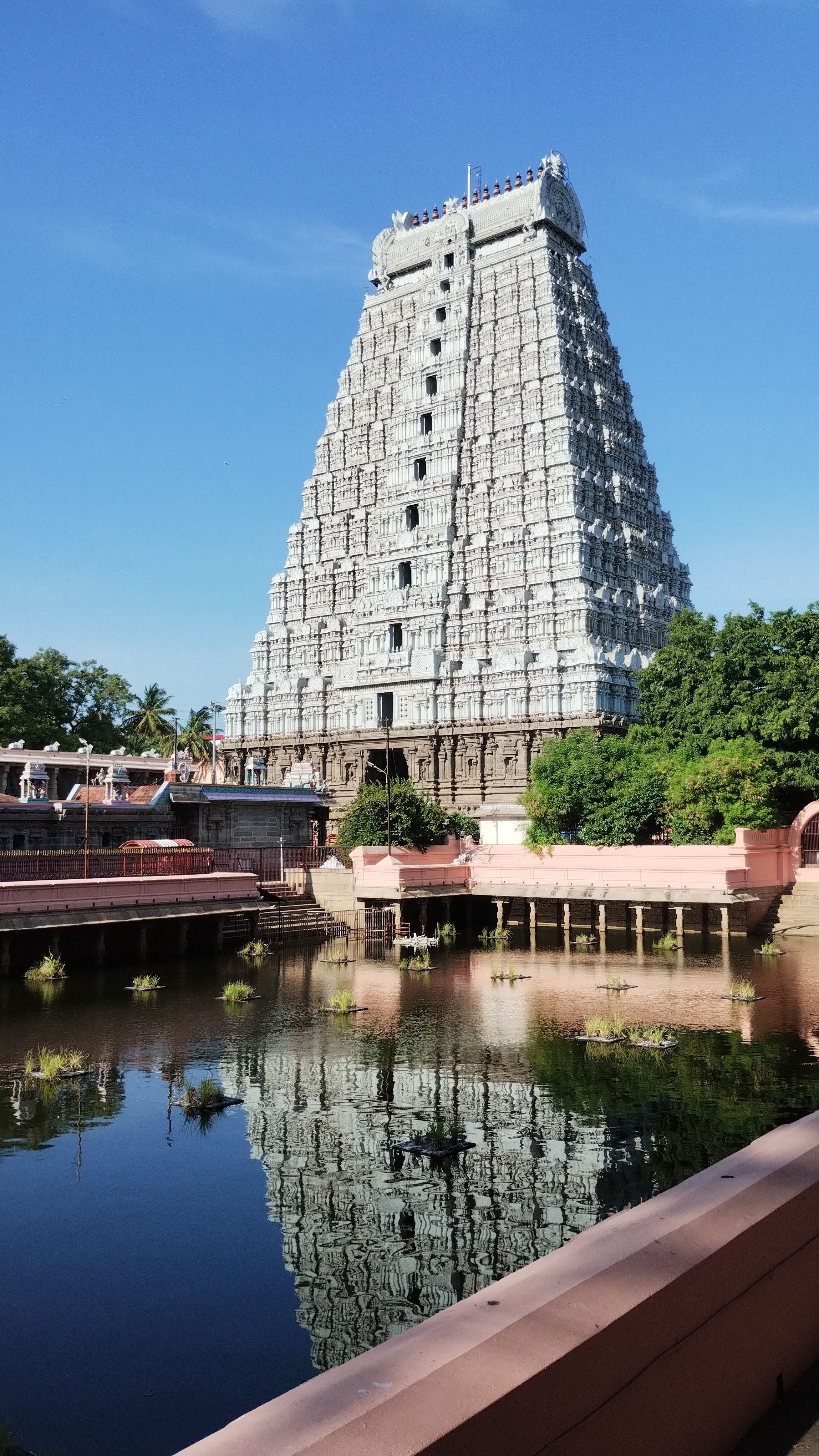
The shock comes before you enter. From the Chithirai and Masi streets of old Madurai, the temple rises like a painted cliff of gods, demons, guardians, and animals, with the south tower climbing about 51.9 meters, roughly the height of a 15-storey building dropped into a market of flower stalls, brass lamps, and banana leaves. Morning light does the towers a favor; the colors look sharper, the heat is still tolerable, and you notice that this is less a single monument than the stone engine that taught the whole city how to grow around it.
Golden Lotus Tank and the Thousand Pillared Hall
Inside, the temple plays a sly architectural trick on you: it pushes you through dim granite corridors, then suddenly releases you at the Golden Lotus Tank, where water, steps, and colonnades open the chest a little. Stay longer than most people do. The west side still holds fresco fragments that many visitors miss, and then the so-called Thousand Pillared Hall turns repetition into theater with 985 pillars, not 1,000, their stone ranks stretching away like a regiment that has learned perfect silence.
Follow the Temple When It Starts Moving
The best combined experience begins late, when the temple stops behaving like architecture and becomes ritual on the move. Start at the tank, slip through Kilikoondu Mandapam to look for the yali with a stone ball trapped in its mouth, then wait for the nightly Palliarai procession, when music from the nadaswaram reaches you before the priests do and Sundareswarar is ceremonially taken toward Meenakshi's chamber; the whole place shifts from carved museum-piece to living household, and that changes how every pillar reads after.
Plan your visit
Getting There
The temple stands on Chithirai Street in the old core of Madurai. As of 2026, Madurai Junction is 1.6 km away, about 20-25 minutes on foot via East Masi Street or a short auto ride; Periyar Bus Stand is roughly 1 km away, and the temple’s own transport page lists bus routes C3, C4, and 4 serving the area. Madurai Airport is 10.7 km out, usually 30-40 minutes by car depending on old-city traffic, which can knot up fast around the gopurams.
Opening Hours
As of 2026, the official hours are 5:00 AM-12:30 PM and 4:00 PM-10:00 PM, with a hard midday closure from 12:30 PM to 4:00 PM. Festival days can change the pattern; the temple posted a full daytime closure on April 4, 2026 for a procession, and Chithirai festival dates from April 18-30, 2026 bring heavier controls and longer waits.
Time Needed
Give it 45-90 minutes for darshan only on a lighter day, around 1.5-2 hours if you use the special entrance and still want a proper look around, and 2.5-4 hours for the full experience of shrines, tank, pillared halls, and the slow shock of those painted towers rising above the stone corridors. This place works best when you leave room to stop and listen; the sound of sandals slapping stone tells you as much as any plaque.
Accessibility
As of 2026, the official facilities list includes wheelchairs, a battery vehicle inside the complex, and a first-aid center; the wheelchair point is near the junction of West Aadi Street and South Aadi Street. Most corridors are broad and flat stone, but the distances are long, crowds can compress suddenly, and reporting in 2024 still noted gaps near the Annadhanam mandapam, so wheelchair users should expect uneven practical access rather than a fully smoothed route.
Cost & Tickets
General darshan is free as of 2026. Official fast-entry tickets cost ₹50 for one shrine or ₹100 for both Meenakshi and Sundareswarar, and the temple runs its own e-ticket portal; footwear storage is free, while the goods cloak room is ₹2 and the mobile-phone locker is ₹5.
Tickets & tours.
These are guided options from our partners — same price as booking direct.
Prices are indicative — final pricing and availability are confirmed at checkout. Audiala may earn a commission from bookings made through these links.
Photo Gallery
A view of Meenakshi Temple, Madurai, India. · Kumar AppaiahAn impressive aerial perspective of the Meenakshi Temple in Madurai, showcasing the sprawling historic complex nestled within the dense urban landscape. · Unknown authorUnknown authorA view of Meenakshi Temple, Madurai, India. · PrakashkumarA view of Meenakshi Temple, Madurai, India. · Drdippu
History
A Queen, A Raid, A Reckoning
The oldest truth here is slippery. Scholars date the surviving structural core largely to the 11th to 13th centuries, while the official temple tradition points to earlier literary praise in the 6th century; the cult is early, the stone you see is later, and the gap matters.
Then power stepped in. Malik Kafur's forces attacked Madurai in the early 14th century, and later rulers reopened, rebuilt, and enlarged the shrine until the Nayaks turned it into the theatrical mass of towers, halls, and processional axes that commands the city today.
The turning point
A. Vaidyanatha Iyer and the Door That Had Stayed Shut
On 8 July 1939, A. Vaidyanatha Iyer walked to Meenakshi Temple with a small group of Dalits and other supporters and crossed a line that had held for centuries. What was at stake for him was personal as well as political: his standing in orthodox society, his safety, and the risk of turning Madurai's most charged sacred space into a public test of whether caste exclusion would still rule at the goddess's threshold.
Records and later memorial accounts describe temple official R. S. Naidu arranging the entry. That was the turning point. No army forced the gate, no king issued an edict from a balcony; a controlled act of worship changed the argument from theory to fact, and the backlash outside the walls was fierce enough that opponents claimed Meenakshi herself had abandoned the temple.
The consequence lives on. Meenakshi Temple is not only a monument to kings and craftsmen; it is also one of the places where modern India fought over who counted, who could enter, and whether sacred authority would bend before equality.
The Temple the Nayaks Wanted the World to See
Documented government sources place the major expansion of the present complex in the 17th century under Thirumalai Nayak and his circle. The effect still lands hard: towers stacked like painted mountains, halls long as railway platforms, and a planned urban drama in which devotion and statecraft share the same stone stage. This was worship, yes. It was also a declaration of rule.
Names That Arrived Late
One of the sharpest surprises sits in the inscriptions. Reporting on inscription studies in 2019 and 2020 says older records do not use the famous names visitors expect, with the first inscriptional reference to "Meenakshi" appearing only in 1752 and "Sundareswarar" only in 1898. The goddess was not invented late; the public language around her changed over time, which tells you the temple's theology was still being shaped long after the granite stood in place.
Tips for visitors
Dress Respectfully
Wear clothing that covers shoulders and knees, and expect to remove your shoes before entry. Shorts, sleeveless tops, and revealing clothes can get you turned away; this is a working temple first, not a monument with incense added for effect.
Phone Lockers
Do not plan on using your phone inside. Mobiles are banned inside the temple, cameras are generally not allowed without prior permission, and drones near the complex have led to arrests, so use the official locker counters instead of arguing at the gate.
Ignore Middlemen
Use only official counters and the official temple booking portal for special entry or paid services. Random offers for faster darshan, pooja, or prasad tied to the temple name deserve suspicion; police have already booked a private trust for falsely advertising temple-linked services.
Eat Nearby
For a quick vegetarian stop after darshan, Murugan Idli Shop nearby is the dependable choice; SPS Tiffins on South Chitrai Street works for coffee, tiffin, and Jigarthanda, and Gopu Iyengars on West Chitrai Street is close enough that you can be seated before your feet stop complaining. Save the heavier Madurai classics like kari dosa or mutton chukka for later in the day and a short ride beyond the temple streets.
Beat The Crowds
Go at opening, or aim for the quieter gap between major puja windows rather than arriving in the middle of ritual peaks around 5:30 AM, 6:30-7:15 AM, 10:30-11:20 AM, 4:30-5:15 PM, 7:30-8:15 PM, and 9:30-10:00 PM. April festival days are a different beast entirely; by then the old city moves like a tide.
Pair It Well
Combine the temple with a walk through the old street rings rather than rushing straight back to your hotel. Pudhu Mandapam opposite the temple is in the middle of a long restoration story, and if you want to understand the city beyond devotion and stone, the wider Madurai page gives the next stops worth your time.
Order: Their paneer dishes and dal makhani are crowd-pleasers, but the thali is the real showstopper.
A beloved spot for North Indian vegetarian food, this place has been around forever and still draws massive crowds. The flavors are rich and comforting.
checkJigarthanda is Madurai’s signature drink—don’t leave without trying it.
checkMost South Indian restaurants serve food quickly, so expect minimal waiting.
checkFilter coffee is a must with any meal—it’s strong, sweet, and served in a metal tumbler.
Restaurant data powered by Google
Frequently asked
Is Meenakshi Temple worth visiting?
Yes, especially if you want a living temple rather than a museum piece. The painted gopurams rise about 51.9 meters, roughly the height of a 17-storey building, and inside the mood flips from bright market streets to cool granite halls, drumbeats, incense, and the sudden open calm of the Golden Lotus Tank. Go for the architecture, but stay long enough to notice that Madurai still moves around this temple as if the goddess runs the city.
How long do you need at Meenakshi Temple?
Give it 2.5 to 4 hours if you want more than a rushed darshan. An hour can cover the basics, but the temple is a stone city with major halls, twin shrines, the tank, long corridors, and ritual pauses that change the whole feel of the place. If you arrive during evening ceremonies, allow extra time because queues swell fast.
How do I get to Meenakshi Temple from Madurai?
From central Madurai, you can usually walk, take an auto-rickshaw, or use a short cab ride. Madurai Junction sits about 1.6 kilometers away, which is roughly a 20 to 25 minute walk, and Periyar Bus Stand is even closer at about 1 kilometer. The temple’s official address is Chithirai Street, Madurai 625001, right in the old commercial core.
What is the best time to visit Meenakshi Temple?
Early morning is best for color, cooler stone floors, and slightly lighter crowds. The towers catch cleaner light then, while evening gives you the stronger ritual atmosphere with lamps, music, and the nightly procession energy. Avoid the 12:30 PM to 4:00 PM closure, and think twice before festival days unless crowds are part of the reason you came.
Can you visit Meenakshi Temple for free?
Yes, general entry and regular darshan are free. The temple also offers paid special-entry lanes, currently ₹50 for one main shrine or ₹100 for both, which matters on crowded days when a free queue can eat up a large part of your morning. Phones and bags often need to go into deposit counters, so keep a little cash handy.
What should I not miss at Meenakshi Temple?
Don’t miss the Golden Lotus Tank, the Thousand Pillared Hall, and the evening ritual when Sundareswarar is ceremonially taken to Meenakshi’s chamber. Also look for the small details most people stride past: the yali with a rotating stone ball in its mouth, the surviving fresco fragments near the tank, and the Nataraja with his right leg raised instead of the usual left. Those details make the temple feel made by human hands, not by myth alone.
What is special about Meenakshi Temple?
Meenakshi Temple feels different because the goddess is the political and ritual center, not an afterthought beside Shiva. The present complex took shape largely under the Nayaks in the 16th and 17th centuries, but the site also carries older devotion, a 14th-century sack, a 1939 anti-caste temple-entry movement, and ongoing restoration ahead of the September 17, 2026 kumbhabhishekam. Few places show so plainly how architecture, power, devotion, and city life keep rewriting each other.
Sources & attribution41
Researched and written by the Audiala editorial team from historical records, architectural archives, and local expertise. Last updated April 2026.
Official HR&CE Meenakshi Temple Site — Official temple homepage used for current notices, general orientation, festival timing warnings, and temple naming.
Official Temple History — Official history page used for temple chronology, Nayak-period expansion, and legendary framing.
Official Temple Towers Page — Used for gopuram details, tower dates, and height information including the south tower.
Madurai District Government — Government overview used to confirm the temple’s 17th-century form and visitor orientation.
Tamil Nadu Tourism — State tourism source used for broad history and confirmation of the Malik Kafur damage and Nayak rebuilding period.
Encyclopaedia Britannica — Used for concise historical background and cross-checking early temple chronology.
Official Facilities Page — Used for wheelchair access, battery vehicle availability, footwear counters, goods storage, water points, and parking references.
Wikipedia - Meenakshi Temple — Used as a secondary orientation source for halls, tank, iconographic details, and named spaces; checked against official material.
Strictly necessary cookies keep the site working. Analytics (PostHog, Google Analytics) measures how each visitor uses our pages. Marketing loads YouTube videos and walking-route maps without a tap and lets Google Analytics set advertising cookies. We never sell your data. You can change this any time from the footer.
Analytics and marketing cookies are optional and only load if you agree. Details under Customize.
Privacy
Cookie preferences
Pick what you're okay with. You can change this any time from the footer.
Strictly necessary
Always on
Sign-in, language, navigation. Always on.
Product analytics
PostHog (EU) and Google Analytics record which pages you view and how you use them, under a random identifier stored in your browser. Helps us see which pages work and which need fixing. Google's ad personalisation stays off. No selling.
Marketing
Loads YouTube videos and the walking-route maps (OpenFreeMap) without a tap; without it, they load only when you tap them. If analytics is also on, Google Analytics may set advertising cookies. Ad personalisation stays off.