Introduction
At 5:47 a.m. in Dwarka, Bhart, the Arabian Sea takes a metallic sheen and a single conch blast ricochets off 43 m of carved limestone. Fishermen already weigh anchor while barefoot priests climb 56 steps to swap the temple flag for one that will shred again by dusk.
By mid-morning the air smells of clove, diesel, and drying bombil; by evening it’s incense, ghee, and salt. Every lane, wave, and prayer bell here argues about the same question: did Krishna’s city really drown just offshore, or has it simply learned to live half in water, half in story?
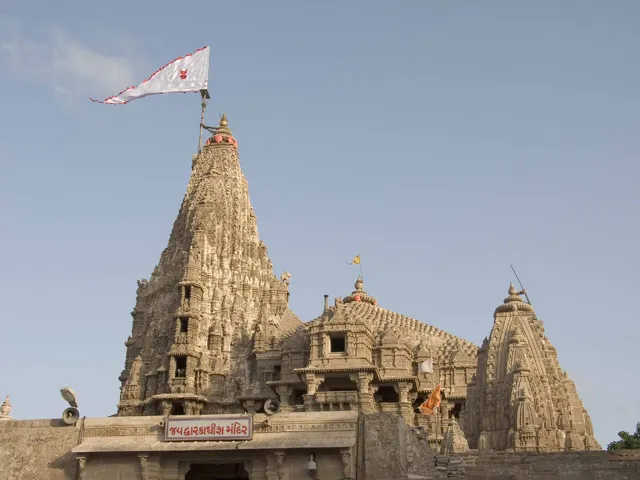
Dwarka doesn’t wait for you to believe. The Dwarkadhish Temple stands exactly where the creek gives up and becomes ocean—so close that during June’s highest tides the Bhadkeshwar Mahadev shrine 300 m west is ringed by chest-high water, turning the daily abhishek into a ceremony performed by the sea itself. Archaeologists resumed underwater surveys in February 2025, mapping walls five metres down; meanwhile, the bridge to Bet Dwarka opened in 2024 and the cable-stayed Sudarshan Setu now glows with verses from the Gita at night.
Expect contradictions. Within 300 m of the temple you can buy temple prasad, camel rides, and drone footage of your own devotion. Three kilometres north, Shivrajpur Beach flies the Blue Flag and runs dolphin-watching boats; three kilometres inland, the lanes of Teen Batti Chowk narrow so much that two scooters negotiate like nervous suitors. Dwarka rewards the visitor who can hold both registers—saffron-robed ascetics queuing for sugar-cane juice beside teenage boys streaming kirtan remixes from Bluetooth speakers.
Places to Visit
The Most Interesting Places in Dwarka
Dwarka
Dwarka, an ancient city on the western coast of India, is a destination of immense historical, cultural, and spiritual significance.
Dwarakadhish Temple
A 78-metre spire on 72 pillars, built over Krishna's legendary palace — drawing 500,000 pilgrims at Holi. One of Hinduism's four sacred Char Dham sites.
Rukmini Devi Temple
Nestled just 2 kilometers from the heart of Dwarka, Gujarat, the Rukmini Devi Temple is a beacon of ancient architecture and rich mythology.
Sudama Setu
Sudama Setu, a pedestrian suspension bridge in Dwarka, Gujarat, is not only an engineering feat but also a site of immense historical and cultural significance.
What Makes This City Special
Temple Built on the Sea
Dwarkadhish rises 43 m from the creek mouth, its sandstone walls 16 m above the tide line. Pilgrims enter through Swarg Dwar and leave via Moksha Dwar—an architectural reminder that the city is literally a threshold between worlds.
Island of Krishna’s House
Bet Dwarka still feels like a separate country after the 2024 cable bridge—boats nose into mangrove creeks and the Gurudwara serves langar to both Sikhs and saffron-clad sadhus. Archaeologists are diving offshore right now, looking for the sunken walls the poems insist are down there.
Lighthouse Views No One Uses
The 1962 Dwarka Point lighthouse is open on request; climb the 43 m tower and the whole town shrinks into a toy model of itself, temple spire and fishing trawlers lined up like chess pieces. Sunset from here beats every rooftop café, and you’ll share it with two guards and a rotating beam.
Historical Timeline
Seven Cities Beneath the Sea
Where Krishna's footsteps meet salt-crusted stone
Harappan Merchants Anchor Here
Pottery shards and stone anchors on Bet Dwarka prove traders knew this reef-sheltered cove four millennia ago. They unloaded carnelian beads and copper ingots while the tide lapped at hulls wider than a village street. The island would be abandoned, resettled, abandoned again—first cycle of many.
Krishna Founds His Island Capital
Legend says Krishna abandoned land-locked Mathura for this promontory licked by both river and sea. Engineers drove wooden piles into silt, raised golden walls, then watched the Arabian Sea swallow everything when the king departed for heaven. The story will be retold every dusk at Gomti Ghat.
A Copper-Plate King Signs His Name
Garulaka Simhaditya, son of Varahdas, issued the first document that actually says ‘Dwarka.’ The plate, found 300 km away in Palitana, records a land grant to Brahmins and proves the town already mattered enough to tax. Ink on copper beats myth on palm leaf.
Adi Shankara Establishes the Western Peeth
The philosopher-monk arrived barefoot, carrying only a staff and the conviction that truth is one. He installed a disciple as the first Shankaracharya of Dwarka, turning the fishing village into one of four compass-points of Hindu pilgrimage. The math still keeps its door facing the sea, waiting for the next wandering ascetic.
Sultan Mahmud Begada Burns the Temple
Gujarat’s army rode down the coastal track, torched the timber roofs of Dwarkadhish, and smashed the idol. Priests fled with the image across the creek to Bet Dwarka; the sanctum remained empty for decades. You can still see the scorch layer—thin black stratum—when monks replaster the walls each summer.
Vallabhacharya Hides the God
The theologian carried the Dwarkadhish image in a reed basket while camel caravans rattled past. He buried it in a step-well at Ladva, then retrieved it when the roads felt safe again. That rescue becomes the founding story of Pushtimarg Vaishnavism; pilgrims still touch the well’s rim before entering the sanctum.
Mirabai Walks into the Sea
The Rajput princess-poet left her in-laws, her palace, and her veils, arriving in Dwarka wearing only a saffron sari. She sang to the temple flag, then—locals insist—merged with the idol itself. Her verses echo every dawn aarti: ‘Mero mindo Govinddo, Dwarka ke raja.’
Stone Spire Rises 43 Meters
Masons reset the charred walls in pale limestone, carved 52 external pillars, and hoisted a flagpole taller than the lighthouse. The new Dwarkadhish temple faces west, straight into the sunset, as if challenging the sea to try swallowing it again. Fishermen use the silhouette to steer home; the flag is changed five times daily so the colors never fade.
Vagher Rebels Defy the British Gunboats
Jodha Manek’s warriors turned the coral-stone havelis into rifle pits while Royal Navy shells chipped the 600-year-old fort walls. The siege lasted seven monsoons; salt winds rusted Enfield barrels and prayer bells alike. When the rebellion finally collapsed, the East India Company annexed Okhamandal and taxed every temple lamp.
Excavators Find a Bronze Age Anchor
Archaeologist S. R. Rao lifted a 1.2-ton stone anchor from 12 meters down, its triangular perforations still threaded with barnacles. The discovery forced textbooks to admit Dwarka predated Krishna stories by a thousand years. Rao would spend the next thirty years diving after the rest of the sunken city.
Earthquake Jolts the Spire
At 8:46 a.m. the tectonic plate beneath Kutch slipped; tremors raced 300 km south and cracked the temple’s upper cornice. Monks evacuated the sanctum minutes before plaster rained onto the flagstones. Repairs took three years, every stone numbered, every crack filled with lime rich enough to sting a fingertip.
Devbhumi Dwarka District is Born
On Independence Day the government split Jamnagar district and gave the pilgrim coast its own bureaucrats, its own budget, its own letterhead. Suddenly Dwarka had a district court, a women’s college, and a highway bypass wide enough for four chariot processions side by side. The population sign at the bus stand still reads 38,873; the pilgrim counter spins past a million.
Sudarshan Setu Unites Island and Mainland
Prime Minister Modi cut the ribbon on India’s longest cable-stayed bridge—2.32 km of steel deck linking Okha port to Bet Dwarka. Pilgrims no longer queue for the 9 a.m. ferry; they drive across the sea in four minutes, windows down, salt spray on the windshield. The old boatmen now sell selfies instead of tickets.
Divers Return for the Seventh City
ASI’s new expedition carries sub-bottom profilers and autonomous robots to map what sonar suggests is a 9-hectare grid of walls 30 meters down. If they find it, the underwater bricks will be older than any standing structure on land. Every evening the team uploads footage; pilgrims crowd the cyber-café to watch live feed of barnacled doorways that might once have belonged to Krishna.
Notable Figures
Mirabai
1498–1546 · Bhakti poet-saintShe walked into Dwarka’s temple corridors singing Krishna’s name and, legend says, vanished into the idol’s heart. Today her verses echo at dawn aarti—devotees still hum them while queuing for darshan.
Adi Shankara
c. 700–750 · Advaita philosopherHe paddled ashore, argued the Vedas with local scholars, and left behind the western math that still decides temple doctrine. The monks will show you the raised platform where he supposedly debated 1,000 opponents in one afternoon.
Vallabhacharya
1478–1530 · Pushtimarg founderWhen armies approached, he ferried the Krishna image to Bet island and built a second shrine among the dunes. Ferry passengers today retrace his escape route—only now a bridge shortens the pilgrimage to twenty minutes.
Mahmud Begada
1459–1511 · Sultan of GujaratHis cannons cracked the original spire and pushed pillars into the sea; the current temple rose from those ruins. Local guides point to dark stones near the sanctum—said to be scorched by his torches.
Shikaripura Ranganatha Rao
1922–2013 · Marine archaeologistHe dove the creek mouth in the 1980s and hauled up Harappan weights, proving the sunken-city myth had bones. His notebooks sit in a small museum corner; ask the caretaker and he’ll unlock the cabinet for a quick look.
Photo Gallery
Explore Dwarka in Pictures
The tranquil waters of Dwarka, Bhart, reflect the soft glow of a setting sun, with fishing boats resting peacefully in the distance.
Mondalpooja · cc by-sa 4.0
A portrait of a visitor captured against the majestic backdrop of the historic Dwarka temple in Bhart.
Gohel Jigneshkumar · cc by-sa 4.0
A peaceful walk along the stone-pillared promenade in Dwarka, Bhart, overlooking the coastal landscape.
Saikumar45 · cc by-sa 4.0
A museum display case showcasing various terracotta pottery shards recovered from underwater excavations in the historic city of Dwarka, Bhart.
Adbh266 · cc by-sa 4.0
A moody, atmospheric view of high-rise residential architecture in Dwarka, Bhart, captured during a heavy rain shower.
Rrthakur22 · cc by-sa 4.0
A bustling commercial street scene in Dwarka, Bhart, showcasing a multi-story building with an ICICI Bank branch and various local retail storefronts.
Rrthakur22 · cc by-sa 4.0
A peaceful view of a green sports field set against a modern residential high-rise in the Dwarka neighborhood of Bhart.
Mritunjaysingh34 · cc by-sa 4.0
The vibrant nightlife of Dwarka, Bhart, comes alive with glowing storefronts and busy traffic under the evening lights.
Kprernak24 · cc by-sa 4.0
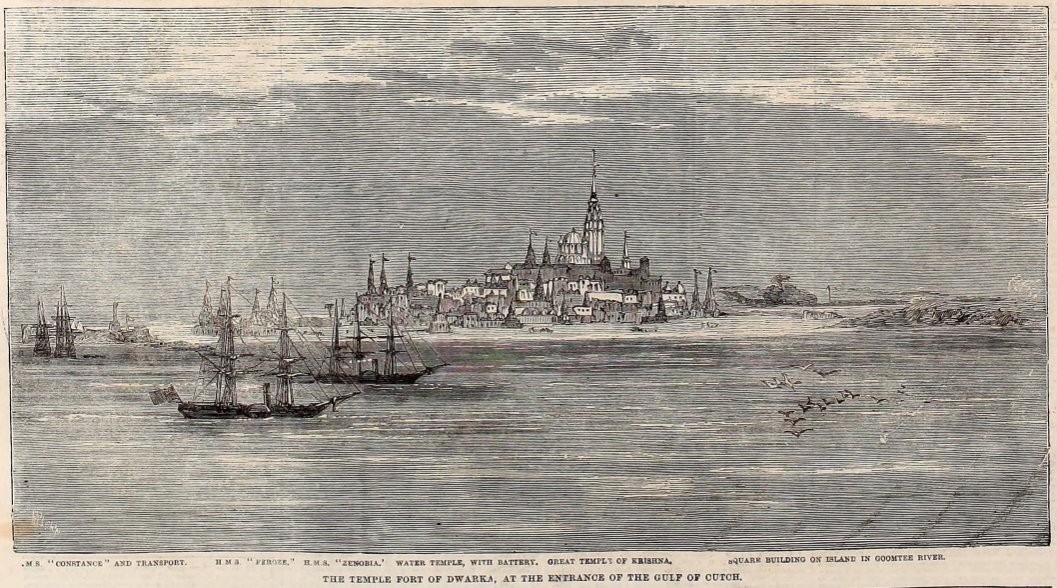
A 19th-century illustration depicting the majestic Dwarka temple fort in Bhart, framed by British naval vessels in the Gulf of Cutch.
Unknown artistUnknown artist, ILN Staff, after special artist correspondent, Unidentified contributor to The Illustrated London News · public domain
The bustling commercial district of Dwarka, Bhart, comes alive at night with glowing storefronts and busy city traffic.
Kprernak12 · cc by-sa 4.0
A well-maintained outdoor sports court in Dwarka, Bhart, equipped for basketball and badminton with residential buildings in the background.
Mritunjaysingh34 · cc by-sa 4.0
The iconic Dwarka lighthouse stands tall against a vibrant sunset, casting a peaceful reflection over the tidal pools along the Bhart coastline.
Sneha G Gupta · cc by-sa 4.0
Practical Information
Getting There
Jamnagar Airport (JGA) is 110 km away; Air India runs one daily direct to Mumbai, Star Air links Ahmedabad and Surat. Dwarka railway station (DWK) is on the Okha–Ahmedabad broad-gauge line. National Highway 947 feeds in from Jamnagar; state buses terminate at Dwarka GSRTC stand (enquiry 02892-234204).
Getting Around
No metro, tram, or city bike share exists. Temple core is walkable—Dwarkadhish to Sudama Setu is 1.8 km along the ghats. E-rickshaws charge ₹20–30 for hops within town; taxis to Nageshwar (16 km) or Okha jetty run ₹600–800 return. GSRTC day passes are for residents, not tourists—pay per ride.
Climate & Best Time
November–February: 19–29 °C, almost no rain, peak pilgrimage crowds. March turns hot (35 °C); April–May hit 40 °C and empty the lanes. Monsoon July–September brings 270 mm monthly downpours and humid 32 °C days—ghats get slippery, boats cancel, but hotel rates halve.
Safety
Gomti Ghat drownings prompted 2025 guard patrols and railings—still, don’t wade beyond the stepped zone. Keep shoes in temple lockers; the stone floors scorch after 11 a.m. Emergency numbers: Police 100, Okha Marine Police 02892-262396, District Control 02833-232002.
Where to Eat
Don't Leave Without Trying
Krishn vijay tea house
local favoriteOrder: Strong chai with local snacks; a proper Gujarati morning tea stop before temple rounds.
Opens at 6 AM, making it the local's choice for pre-dawn chai and breakfast. Long hours mean you can grab tea anytime between darshan sessions.
PREMJI PAN AND COLDDRINKS & TEA
quick biteOrder: Pan with tea, cold drinks on hot days; the kind of place locals actually use.
Open from 6:30 AM to 11:30 PM daily—basically covers every meal slot. Authentic local hangout with no tourist gloss.
JODHABHA MANEK CHOWK
quick biteOrder: Fresh bakery items and sweets; a Dwarka institution in the Manek Chowk area.
Located in the heart of Jodhabha Manek Chowk, this is where locals grab baked goods and sweets. The name itself is legendary in Dwarka's food landscape.
Jignesh g trivedi cake shop
quick biteOrder: Cakes and pastries; this is the real local bakery, not a chain.
A family-run cake shop near Jodhabha Manek Chowk with long hours (until 11 PM). Locals know this spot for genuine baked goods.
Cafester
quick biteOrder: Evening tea and snacks; a neighborhood cafe in the khau gali (food lane) area.
Tucked into Dwarka's famous khau gali food lane, Cafester is where locals grab evening chai and snacks. Perfect for post-dinner browsing.
THE WAFFLE .COM DWARKA
cafeOrder: Waffles and evening cafe snacks; a late-night option when other places close.
Opens at 5:45 PM and stays open until midnight—the go-to spot for late-evening dessert or snack after a long day of temple visiting.
Flavorfusion café
cafeOrder: Cafe standards—coffee, tea, light bites; this is the most-reviewed cafe in the verified data.
With 20 reviews and a perfect 5-star rating, Flavorfusion is clearly a favorite among repeat visitors. Located at Bhathan Chowk, it's a reliable neighborhood spot.
Nand Deluxe Pan Shop
quick biteOrder: Pan (betel leaf preparation) and quick snacks; a traditional Dwarka stop near the railway station.
A classic pan shop in the Ghanshyam Nagar area near the railway station—the kind of place that's been feeding travelers and locals for years.
Dining Tips
- check Dwarka's food scene is strongly vegetarian—expect pure-veg or veg-forward menus across the board.
- check Temple-area lanes (near Dwarkadhish Temple Road) are best for quick thalis, snacks, tea, and authentic local meals between darshan sessions.
- check Most cafes and quick-bite spots open early (6:00–6:30 AM) to catch the morning chai crowd; many stay open until 10:30 PM or later.
- check Cash is still common in smaller eateries, but most established restaurants accept digital payments and cards.
- check Dwarkadhish Market operates 7:00 AM–9:00 PM daily, with peak food activity 8:00 AM–12:00 PM and 5:00 PM–8:00 PM.
- check Shak Market Chowk on Gomati Road is best visited in the evening (around 5:00–9:00 PM) for snacks like kachhi dabeli.
Restaurant data powered by Google
Tips for Visitors
Watch the Ghat Edge
Gomti Ghat’s new safety rails can’t stop rogue waves; stay off the lowest three steps at high tide and keep phones in a zip pocket.
Temple Clock Rules
Dwarkadhish shuts 12:30-17:00 sharp. Line up by 11:30, exit by 12:15, or you’ll bake outside for four hours.
Cash for Boat
Bet Dwarka ferries and ghat camel rides are cash-only; carry ₹20-50 notes, no one breaks ₹500 on the jetty.
Eat Before 3 pm
Old-town thali houses roll up the steel lids at 3 pm; after that you’ll get only samosa and sweet shops until dinner.
Fly Jamnagar, Not Porbandar
Jamnagar has daily Air India and Star Air flights; Porbandar’s schedule is ghost-town territory. Pre-pay your taxi—no app cabs outside the gate.
Sunset from Sudama Setu
The pedestrian bridge closes at 19:30; be on it by 18:45 for temple-spire silhouettes without the selfie-stick crowd.
Explore the city with a personal guide in your pocket
Your Personal Curator, in Your Pocket.
Audio guides for 1,100+ cities across 96 countries. History, stories, and local insight — offline ready.
Audiala App
Available on iOS & Android
Join 50k+ Curators
Frequently Asked
Is Dwarka worth visiting if I’m not Hindu? add
Yes—come for the layered history, not just darshan. The 43-m spire rises straight from the Arabian Sea, archaeologists are still dredging up Harappan stones offshore, and the evening aarti is pure theatre even if you don’t know the prayers.
How many days do I need in Dwarka? add
Two full days cover the temple, ghat, Rukmini and Nageshwar; add a third if you want Bet Dwarka’s island vibe and the lighthouse coast without rushing the tide clock.
Can I drink alcohol in Dwarka? add
Gujarat is dry and Dwarka doubly so; tourist permits exist but are a paperwork maze. Plan on lassi and chaas—bars literally don’t exist inside the pilgrim core.
Is Dwarka safe for solo women? add
Yes, the pilgrim flow is constant and well-lit until 10 pm. Use the 181 women helpline if needed, and avoid the empty beach track south of Sudama Setu after the bridge shuts.
What’s the cheapest way to reach Dwarka? add
Take the overnight GSRTC sleeper bus from Ahmedabad (₹400-600) instead of flying to Jamnagar plus ₹2500 taxi. Dwarka bus stand is a 10-minute rickshaw from the temple gates.
When is the sea calm enough for Bet Dwarka boats? add
October to March usually glassy; June–September monsoon cancels half the sailings. Check wind at the Okha jetty notice board—if it’s fluttering, ferries stall.
Sources
- verified Devbhumi Dwarka District – Official Tourism Places — Hours, safety notices and ferry timings for temple, ghat and Bet Dwarka.
- verified IMD Dwarka Climate Table 1991-2020 — Monthly rainfall and temperature data used to set best-season advice.
- verified GSRTC Enquiry Numbers — Live bus station phone list for Dwarka, Okha, Jamnagar, Porbandar.
- verified Times of India – Gomti Ghat Safety Upgrade 2025 — Details on recent drowning incidents and new railings.
Last reviewed: