
Place
France Updated Oct 2026
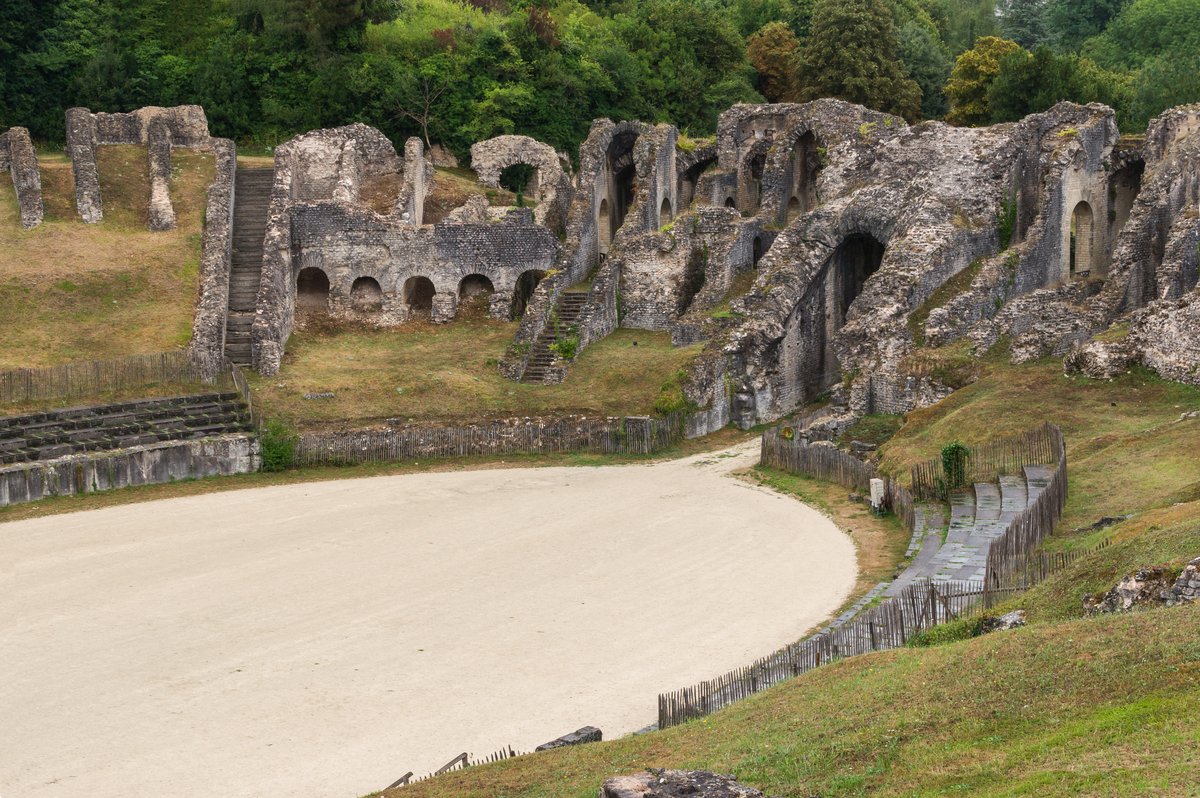
Saintes, France, keeps its Roman amphitheatre in a green valley, where the ruins feel less like a monument set apart than a piece of the town’s daily geography. The arena measures 126 by 102 metres—about the length of a football pitch—and once held as many as 15,000 spectators. At its eastern gate, gladiators entered; the western gate was known as the Gate of the Dead.
 Photo: Cobber17 · CC BY-SA 3.0
Built from cited sources · see the method · How we make our guides →
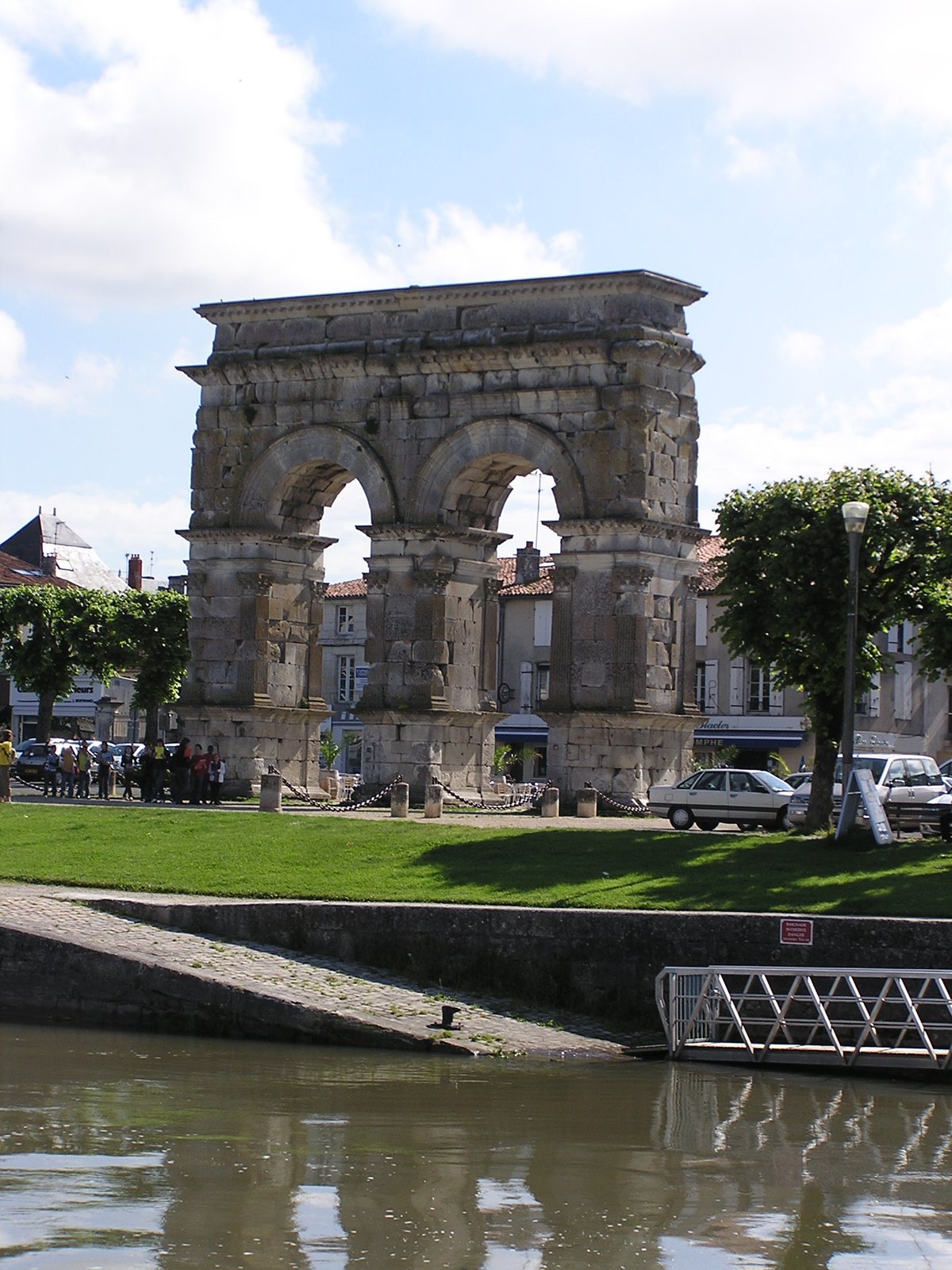
Roman Saintes still leaves its mark beside the Charente: the Arch of Germanicus, raised in 18–19 AD, once stood on the river crossing. In 1843, writer and heritage inspector Prosper Mérimée helped save it from demolition by having it moved stone by stone to Place Bassompierre.
The city’s later history is just as present in its churches. Saint-Eutrope’s vast Romanesque crypt shelters the saint’s sarcophagus, while the Abbaye aux Dames, founded in 1047, now fills its Romanesque church and courtyards with music, especially during the July Festival de Saintes.
On market mornings, the lanes around Saint-Pierre Cathedral smell of bread, seafood and ripe Charentais melons; across the river, the Abbaye aux Dames gives Saint-Pallais a quieter, village-like feel. Saintes is not a Roman site with a modern town attached: its past remains part of the town’s everyday rhythm.
Not every monument, just the ones we'd walk you past ourselves.



Where to wander, by quarter — each with its own rhythm.
Before you go
From a Celtic river country to a city remade by empire, faith, war, and water
Archaeological traces at Diconche, near modern Saintes, point to Neolithic settlement along the Charente basin. The river would draw people here long before a Roman street was laid.
Roman planners established Mediolanum Santonum among the Santones, giving the settlement the name of a central town on the plain. Linked to the Via Agrippa, it became an early capital of the province of Gallia Aquitania.
A double-arched monument rose at the Charente crossing, where the Via Agrippa reached the river. Its carved stone announced Roman authority to travelers arriving at Mediolanum.
An inscription identifies Rufus, a Romanized Gaul from the Santones, as the donor of the river arch. He dedicated it to Tiberius, Drusus, and Germanicus, setting local status in enduring stone.
Builders began Saintes’ amphitheatre under Tiberius and completed it during Claudius’s reign. Its oval arena measured 126 by 102 metres and could hold about 15,000 spectators; the eastern gate admitted processions, while the western gate carried away the dead.
An aqueduct carried spring water from Font Morillon, Le Douhet, and Vénérand toward the city’s fountains and baths. Ruins at Saint-Saloine still reveal part of the hot-room complex, where Roman bathers once moved from warm air into steam.
Christian tradition places Eutropius, remembered as Saintes’ first bishop, in the city around the mid-3rd century. The same tradition says he was martyred here; his cult later drew pilgrims to the basilica built over his reputed tomb.
After incursions and instability, Saintes contracted into a fortified settlement on the left bank of the Charente. Builders dismantled earlier monuments for stone, so pieces of the Roman city became part of its defenses.
Saintes passed from the Visigothic kingdom to Frankish control after Clovis defeated the Visigoths at Vouillé. The shift brought the town into the orbit of the Merovingian kingdom, though its Roman walls and churches remained part of daily life.
Viking raiders sailed up the Charente repeatedly, striking Saintes and its religious communities. Fires and looting left scars that written records rarely describe in detail, and early monastic archives were lost.
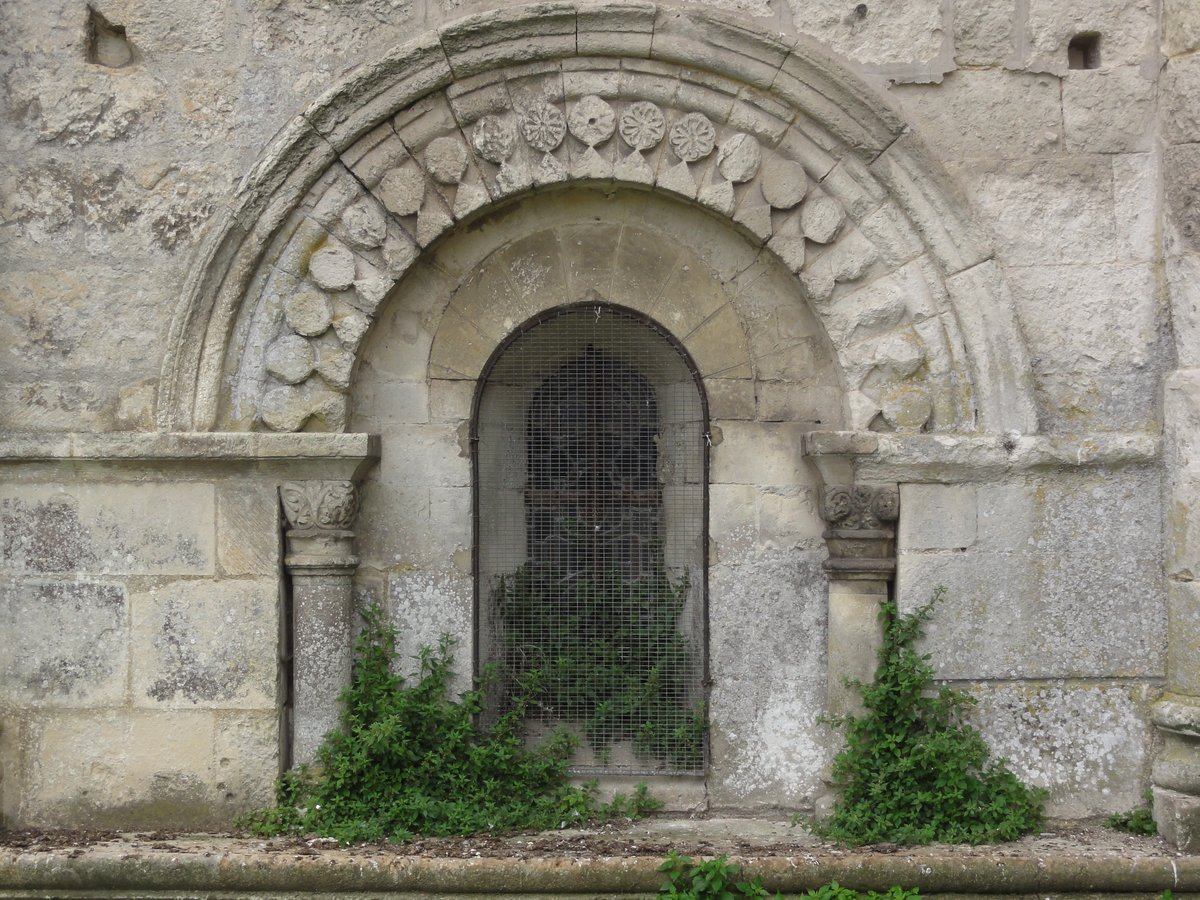
Count Geoffroy II Martel and his wife, Agnes of Burgundy, founded the Abbaye aux Dames, consecrated on 2 November 1047. Its church and convent gave Saintes a powerful Benedictine house run by women, with Romanesque stonework rising near the river.
Pope Urban II consecrated the rebuilt Basilica of Saint-Eutrope above the saint’s reputed tomb. Set on the Via Turonensis route to Santiago de Compostela, its crypt gave pilgrims a cool, low-ceilinged place to approach the relics.
Eleanor of Aquitaine’s marriage to Henry Plantagenet brought her lands, including Saintes, into the Angevin dominions. The Charente town now sat in the contested borderlands between English-held Aquitaine and the French crown.
Louis IX’s forces defeated Henry III and his allies at Taillebourg, then prevailed near Saintes. Henry fled toward Bordeaux, and Saintes surrendered to the French crown, checking English ambitions in Saintonge.
The Treaty of Brétigny ceded Saintes to Edward III, placing the town under Anglo-Gascon rule. On the Charente, a change of allegiance was not an abstraction: it meant new officials, new taxes, and fresh uncertainty for merchants.
Bertrand du Guesclin recovered Saintes for Charles V in 1372, during a wider French counteroffensive. The town’s return to the crown held through the final English defeat at Castillon in 1453.
Potter and naturalist Bernard Palissy spent years in Saintes trying to perfect his distinctive enamel glazes. He later recalled burning furniture and fuel in the search; the experiments made the town an early chapter in a career that reached the French court.
Peasants across Saintonge rose against the salt tax, the gabelle, in an uprising remembered as the Jacquerie des Pitauds. Constable Anne de Montmorency crushed the revolt, leaving a harsh warning about the cost of royal revenue in a salt-producing region.
During the Wars of Religion, Protestant troops captured Saintes and sacked the Romanesque Cathedral of Saint-Pierre. Its nave and vaults collapsed; rebuilding began in 1585, giving the church a later Gothic and Renaissance character.
Louis XIV revoked the Edict of Nantes, stripping French Protestants of legal protections. Huguenot artisans and merchants left Saintes for England, the Netherlands, and North America, taking skills and household knowledge with them.
Joseph-Ignace Guillotin was born in Saintes on 28 May 1738. A physician and later a deputy in Paris, he proposed a uniform mechanical method of execution in 1789; the device that adopted his name belongs to a far darker part of his legacy.
The Revolution made Saintes the first prefecture of the new Charente-Inférieure department. Monastic property was nationalized, the Abbaye aux Dames became a detention site, and old ramparts began to disappear from the city’s edges.
Napoleon transferred the department’s prefecture from Saintes to La Rochelle by imperial decree. Saintes remained a sub-prefecture, a political demotion that reflected the growing weight of the Atlantic port.
The river rose roughly seven metres above its ordinary level, isolating the Saint-Pallais quarter and swallowing low streets. The flood forced fresh arguments about bridges and river flow; in Saintes, water has always had a say in urban planning.
Writer and monuments inspector Prosper Mérimée opposed plans to demolish the Arch of Germanicus during work on the river crossing. Workers dismantled it stone by stone in 1843 and rebuilt it at Place Bassompierre in 1851, preserving an ancient gateway by moving it away from its original threshold.
Saintes became the headquarters of the Compagnie des Chemins de Fer des Charentes, bringing workshops, railway jobs, and a new industrial rhythm. The sound of repair work joined the city’s older mix of church bells and river traffic.
German forces had occupied Saintes since 1940, using its rail junction for military logistics. Allied bombs struck the railway workshops on 24 June; on 4 September, French Resistance forces liberated the city as German units withdrew toward the Atlantic coast.
The Festival de Saintes began as the Abbaye aux Dames entered a new life through restoration and music. Ancient stone that had served as convent, barracks, and prison became a resonant home for early and classical music.
Floodwater reached 6.35 metres on 9 December, submerging parts of the inner city and its commercial streets. Later peaks in 1994 and 2021 recalled the same uneasy fact: Saintes’ Roman monuments and modern neighborhoods share a river’s patience.
Work at the amphitheatre and Roman baths improved their preservation and public access over the years 2015 to 2023. In the arena, weathered stone and open sky still make the scale of Roman Saintes easier to grasp than any map can.
Physician and politician · 1738–1814
Born in Saintes
Guillotin was born in Saintes in 1738, long before his name became shorthand for an instrument he advocated as a more uniform method of execution. In a city where a Roman arena once staged public violence, that legacy sits uneasily beside the ancient stones.
Writer and heritage inspector · 1803–1870
Helped save the Arc de Germanicus in 1843
In 1843, Mérimée helped save the Arc de Germanicus by supervising its move, stone by stone, from the old bridge to Place Bassompierre. He might recognize today’s Saintes as a case for patient preservation, though the arch’s present setting is far from its original one.
Writer and journalist · 1925–2024
Kept a family home and wrote in Saintes
Chapsal kept her family’s mansion on Rue Saint-Maur, wrote there and helped create local literary salons. Saintes was not simply ancestral scenery for her; it was a working address, and its old streets would still offer material for another conversation.
Poet and playwright · 1877–1952
Died in Saintes
Known as Goulebenéze, Poitevin brought the Saintongeais dialect to audiences through poems and performances; he died in Saintes in 1952. He might listen to the city today for its local cadence before giving much thought to its monuments.
Where locals actually book dinner — not the tourist menus.
Small things that change how the city treats you.
The city, as it actually looks.


Yes, especially if Roman remains and Romanesque architecture interest you. Saintes pairs a 1st-century amphitheatre and the Arc de Germanicus with the vast crypt of Saint-Eutrope Basilica, all within a compact riverside city.
Plan two days for the main Roman sites, the old town and the abbey. A third day gives you time for a Charente river cruise, a longer museum visit or a cycle on La Flow Vélo.
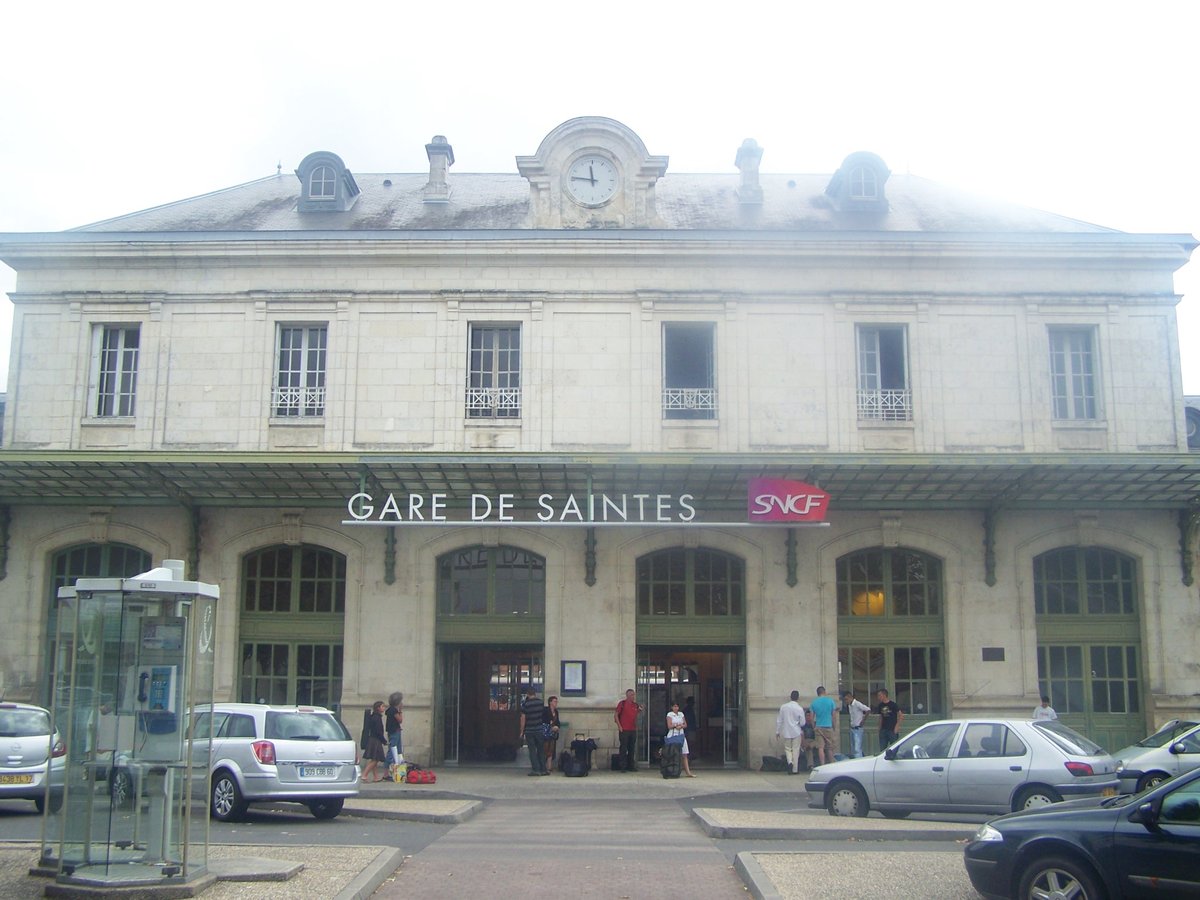
Regional TER trains connect Saintes with Bordeaux, La Rochelle, Royan, Angoulême and Niort. From Paris, plan on roughly 3–3.5 hours with a transfer at Niort or Angoulême; check current timetables before booking.
Yes. The historic centre is compact, and the main monuments are about 15–20 minutes apart on foot; BUSS local buses connect the station with the centre and other parts of town.
Saintes is generally safe for visitors, including solo travellers. Take ordinary precautions with valuables at busy markets and festivals, and stay alert near the station late at night.
The listed standard BUSS single ticket costs €1.20, with a €0.20 surcharge for an on-demand Allo'BUSS ride. Confirm the current fare on the BUSS website before travelling.
13 places to discover


Saved and recently read places — kept on this device only.
Photos may have been resized or cropped.