Archaeological Site of Carthage
Tunis GovernorateTunisia 36° N · 10° E Updated Apr 2026
Rome razed Carthage in 146 BC, then rebuilt it on the same ruins. Both cities now lie scattered across an upscale Tunis suburb facing coastal erosion.
- Time needed
- Full day
- Entry
- Multi-site pass required
- Best season
- Spring (March–May) or Autumn (Sept–Oct)
Rome destroyed Carthage so completely in 146 B.C. that historians still argue over what the original city actually looked like — and yet the Archaeological Site of Carthage, spread across the hills above the Gulf of Tunis in Tunisia, remains one of the most layered places on Earth. The paradox is this: the civilization Rome tried to erase entirely is the one that draws you here, but almost everything you can actually see with your eyes is Roman.
Stand on Byrsa Hill today and the Gulf of Tunis stretches blue and flat to the horizon. Below, the massive columns of the Antonine Baths — a 2nd-century Roman thermal complex once taller than a five-story building — lie toppled among wild grasses. Modern villas with white walls and bougainvillea crowd the edges of the archaeological zone. The TGM light rail deposits visitors steps from ruins older than the Roman Republic itself. Carthage is not a remote dig site; it is a suburb of Tunis, and the collision between the ancient and the mundane is constant.
What makes this place worth the trip is not a single monument but the sheer density of time compressed into one stretch of coastline. Phoenician burial urns sit in the same soil as Roman mosaics and the foundations of early Christian basilicas. The Punic ports — two artificial basins that once sheltered a war fleet capable of challenging Rome for control of the Mediterranean — are still visible as shallow lagoons, now ringed by reeds and apartment blocks.
You come to Carthage expecting grandeur. What you get instead is something stranger and more honest: a place where three thousand years of construction, destruction, and reconstruction have left a palimpsest so dense that every step forward is also a step down through centuries.
What to see
-
Antonin Baths
The Romans who built these baths in the 2nd century CE intended them to impress, and even as ruins they succeed. What remains is mostly the substructure — the bones beneath the skin — yet a single reconstructed column, standing roughly 15 meters tall (about as high as a four-story building), gives you the shock of original scale. The complex stretched across more than a hectare of coastline, making it the largest Roman bath complex in Africa and the third largest in the entire empire. Walk slowly through the exposed hypocaust system, where enslaved laborers once fed fires to heat the floors above; the walls down here are thick enough to sit on, and you can still trace the channels that carried hot air beneath the feet of Roman senators. Look for the ancient drainage channels that most visitors step right over — they're engineering marvels in their own right, carved with a precision that feels almost industrial. But the real reason to come is the setting. Stand at the seaward edge in late afternoon and the Mediterranean fills your peripheral vision, salt air mixing with the dry warmth radiating off limestone. The golden light catches that lone column against a backdrop of unbroken blue. This is the photograph of Carthage. -
Byrsa Hill and the National Museum
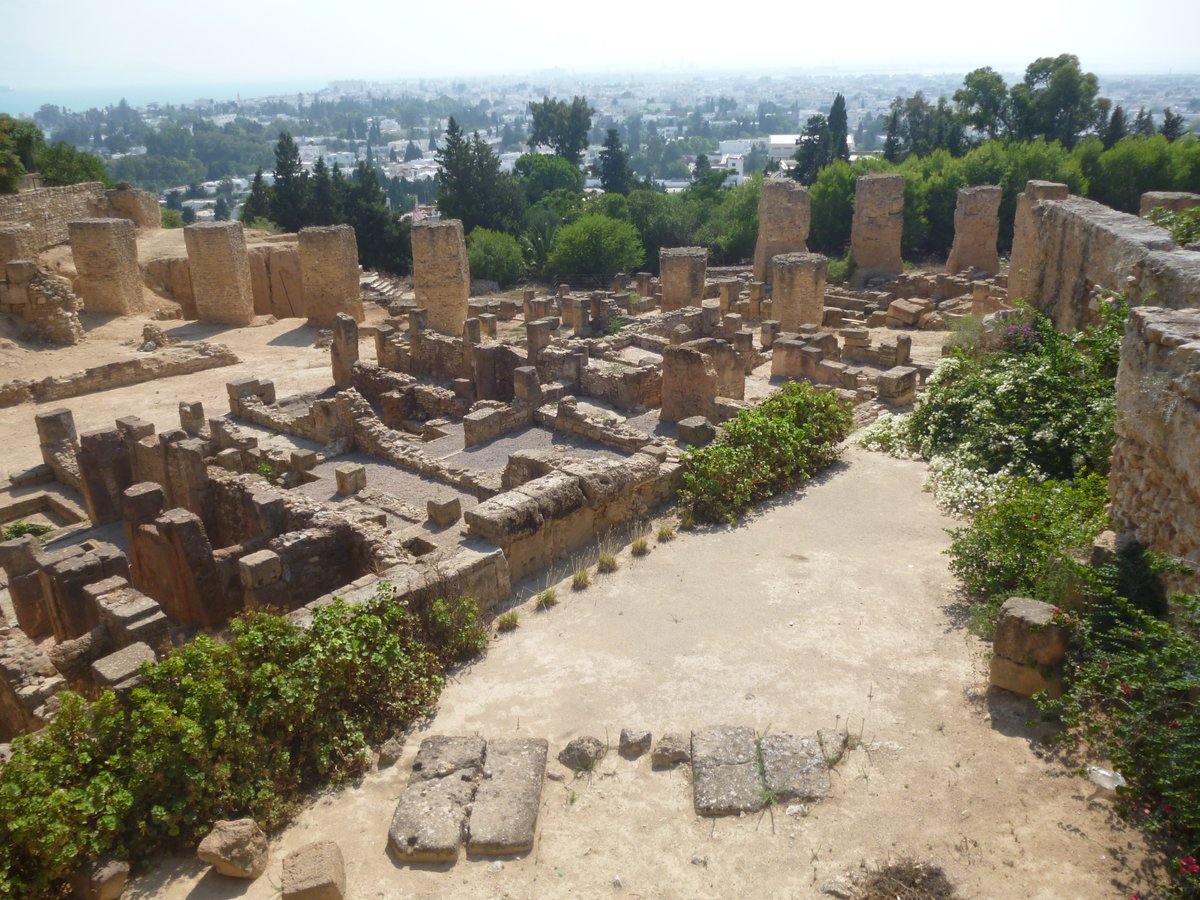
Byrsa Hill is where Carthage confesses its layered identity. Legend holds that Queen Elyssa-Dido founded the city here in the 9th century BCE by cutting an oxhide into strips thin enough to encircle the hilltop — a story that says more about Phoenician cunning than about real estate law. What you'll find today is a palimpsest: Punic residential foundations from the 2nd century BCE sit directly beneath Roman-era construction, the older walls built in Opus Africanum, a distinctly Punic technique of alternating massive upright and horizontal stone blocks that you won't see anywhere in Italy. The exposed Punic quarter on the hillside shows rooms barely wider than a hallway, packed tightly together on steep streets — a density that makes Manhattan look spacious. At the summit, the Carthage National Museum houses stelae from the Tophet, Roman mosaics, and Punic terracotta masks with expressions somewhere between grief and defiance. The collection is modest by European standards, and the building itself awaits renovation, but the rooftop terrace earns its climb. From here, the Gulf of Tunis opens in a wide arc, and you can trace the coastline from the old Punic port basins all the way toward the white facades of Tunis Governorate's modern sprawl. The wind up here carries the faint salt smell of the sea, and on clear days you understand exactly why every empire wanted this hill. -
The Tophet of Salammbô
This is the site most visitors find difficult. The Tophet — a sacred precinct dedicated to the gods Baal Hammon and Tanit — contains thousands of small stelae, stone markers that once stood over urns holding cremated remains. Many of those remains belonged to children. Scholars still debate whether the Tophet was a site of child sacrifice, as Roman writers claimed, or a cemetery for infants who died of natural causes; the evidence points in uncomfortable directions without settling the question. What's undeniable is the atmosphere. The precinct sits below street level, shaded by trees, and the density of stelae — some carved with the symbol of Tanit, a triangle topped by a circle and outstretched arms — gives the space a weight that the open-air bath ruins lack entirely. Cicadas drone. The air feels still. You're standing in a place that has provoked moral horror and scholarly argument for over two thousand years, and that tension still lives in it. Go in the morning, when tour buses haven't arrived, and give yourself twenty minutes of quiet. -
A Half-Day Walking Route Through Three Millennia
Carthage's ruins are scattered across a modern residential suburb, connected by quiet streets lined with bougainvillea and white-walled villas — which means you need a plan, not just a ticket. Start at the Tophet early, before the heat builds, then walk north along the edge of the ancient Punic ports. The two basins — one rectangular, one circular — are now placid pools fringed by reeds, but Punic Carthage docked 220 warships in the circular harbor alone, a fleet longer than the distance from one end of the basin to the other. From the ports, head uphill to Byrsa for the museum and the panoramic view. Save the Antonin Baths for late afternoon, when the coastal light softens and the crowds thin. Between sites, detour through the Quartier Magon, a residential area that most groups skip entirely; the mosaic floors here — geometric patterns in ochre, black, and white — survive in situ, exposed to the sky, and you can study them without a single other visitor in sight. The whole route covers about 3 kilometers on foot. Bring water, wear a hat in summer, and budget at least three hours. A multi-site ticket covers all the ruins and the museum — buy it at your first stop.
Plan your visit
- Getting There
- Take the TGM suburban train from Tunis Marine station (near Bab El Bhar) — it runs every 10–15 minutes and drops you at Carthage Hannibal or Carthage Présidence in about 30 minutes. Both stops put you within walking distance of the major ruins. Taxis from central Tunis cost roughly 10–15 TND and take 20 minutes outside rush hour, though the sites are spread across several kilometers of modern suburb, so you'll likely need a taxi between zones too.
- Opening Hours
- As of 2026, sites generally open daily from 08:00 to 17:00 in winter and 08:00 to 19:00 in summer. Hours can shift without much warning — confirm with your hotel or a local guide on the day, especially around public holidays or maintenance closures.
- Time Needed
- A focused visit hitting the Antonine Baths and Byrsa Hill takes 2–3 hours. To see the Tophet, Punic ports, Roman amphitheater, and the museum properly, budget 6–8 hours — the ruins are scattered across a modern town roughly 3 km end to end, so transit time between sites adds up fast.
- Accessibility
- The terrain is uneven, rocky, and often steep — loose gravel paths, exposed stone stairways, and no ramps at most ruin entrances. Wheelchair access is extremely limited across all zones. Some guided tour operators offer vehicle transport between sites, but the ruins themselves remain difficult for anyone with mobility challenges.
- Cost & Tickets
- As of 2026, a single all-inclusive ticket costs approximately 12 TND (under €4) and covers entry to all the scattered archaeological zones, including the Byrsa Hill museum. Buy it at the entrance gate of whichever site you visit first — there's no online booking system. Bring cash in dinars; card payment is unreliable at the gates.
History
Three Thousand Years of Building Over the Dead
According to tradition, Phoenician settlers from Tyre founded Carthage around 814 B.C., though contemporary archaeological evidence for that precise date remains thin. What is certain is that by the 6th century B.C., Carthage controlled trade routes from the Strait of Gibraltar to the coast of Libya, commanding a commercial empire that rivaled anything the Greek city-states could manage. Its navy was the largest in the western Mediterranean. Its merchants reached Britain for tin and West Africa for gold.
Rome destroyed all of it. The Third Punic War ended in 146 B.C. with the city burned, its population killed or enslaved, and its territory absorbed into the Roman province of Africa. A century later, Julius Caesar ordered a new Roman colony built on the same ground. Augustus completed it. That Roman city — Colonia Julia Carthago — became the second-largest city in the western empire, with a population approaching 500,000. Vandals seized it in 439 CE. Byzantines recaptured it in 534 CE. Arab forces took it for good in 698 CE. Each wave built on top of the last.
The turning point
The General Who Wept Over His Own Victory
The standard story of Carthage's fall goes like this: Rome besieged the city, Rome won, Rome razed it to the ground. A clean military triumph. But one detail from the ancient sources doesn't fit the narrative of triumphant conquest. Scipio Aemilianus, the Roman consul who commanded the final assault, stood on a hill overlooking the burning city and broke down in tears.
What was at stake for Scipio was not just a military campaign but a personal legacy. He was the adopted grandson of Scipio Africanus, the man who had defeated Hannibal decades earlier. The family name demanded that he finish what his grandfather started. By the spring of 146 B.C., after a grinding three-year siege, Roman soldiers fought street by street through the city toward Byrsa Hill. On the sixth day, the last Carthaginian survivors retreated to the Temple of Eshmoun at the summit. Rather than surrender, many chose to burn themselves alive inside it. Scipio watched the flames consume the temple — and then, according to the historian Polybius who stood beside him, he quoted Homer's lines about the fall of Troy. "A day will come," he said, "when sacred Troy shall perish, and Priam and his people shall be slain." He was speaking about Rome. The man who destroyed Carthage understood, in that moment, that the same fate could devour his own civilization.
Knowing this changes what you see on Byrsa Hill. The Roman structures that stand there now — the orderly grid of streets, the civic buildings — are not simply a replacement. They are a deliberate act of overwriting, laid down by the same empire whose greatest general suspected the whole project was temporary. He was right. The Roman city is gone too. What survives is the hill itself, and the Punic foundations buried beneath the Roman ones, visible in cross-section where archaeologists have cut trenches through the layers.
The Myth Rome Invented After the Fire
A City That Never Stopped Being Lived In
Tips for visitors
Skip Unofficial Guides
Self-appointed "guides" cluster near the Antonine Baths entrance, offering to show you secret ruins for a negotiable fee. Stick to the official ticketed sites — the "secrets" are usually just restricted areas you shouldn't be in.Photography Permits
Personal photography is fine everywhere, but tripods and drones require prior authorization from the AMVPPC (national heritage agency). Don't risk flying a drone near the Presidential Palace, which sits right in the archaeological zone.Eat in Sidi Bou Said
Skip the thin cafe options near the ruins. Walk or taxi 10 minutes to Sidi Bou Said for bambalouni — a crispy, sugar-dusted doughnut fried to order for under 1 TND. For a sit-down meal with Gulf of Tunis views, Café des Nattes is mid-range and has served mint tea since 1920.Go Early, Go Winter
Summer temperatures push past 35°C with almost zero shade across the ruins. Arrive at 08:00 opening for tolerable heat and empty paths. October through April offers the best balance of mild weather and soft Mediterranean light for photos.Download Offline Maps
Guidebooks suggest Carthage is one site. It's not — it's a dozen fragments scattered through a residential suburb with minimal signage between them. Download an offline map before you arrive, or you'll waste an hour looking for the Tophet.Taxi Between Zones
Walking from the Antonine Baths to the Tophet of Salammbô takes 25+ minutes on hot, shadeless streets. Taxis between sites cost 3–5 TND and save your energy for the actual ruins. Agree on the fare before getting in.
Frequently asked
Is the Archaeological Site of Carthage worth visiting?
Yes, but come with the right expectations — this isn't Pompeii. The ruins are scattered across a modern residential suburb rather than contained in one dramatic enclosure, so what you're really visiting is a 3,000-year palimpsest where Punic street grids hide beneath Roman roads and upscale villas crowd against ancient thermal baths. Hire a local guide or download an offline map, because without context, some sections look like unremarkable rubble. With context, you're standing on the spot where Scipio Aemilianus wept while quoting Homer as he watched a civilization burn.
How long do you need at the Archaeological Site of Carthage?
A focused visit to the Antonine Baths and Byrsa Hill takes 2–3 hours; a thorough exploration covering the Tophet, Punic ports, amphitheatre, and museum demands 6–8 hours. The sites are spread across the modern town, so factor in taxi or TGM train time between zones. Wear sturdy shoes — the terrain is uneven, dusty, and largely without shade.
How do I get to Carthage from Tunis?
Take the TGM suburban train from Tunis Marine station in downtown Tunis — it's the most reliable option. Get off at Carthage Hannibal or Carthage Présidence, both within walking distance of major ruins. The ride takes roughly 20–30 minutes. Taxis are cheap and useful for hopping between the more distant archaeological zones once you're there.
What is the best time to visit the Archaeological Site of Carthage?
Spring, between March and May, is ideal — manageable heat, green grass threading through the ruins, and wildflowers carpeting the open sites. Summer temperatures make midday visits punishing across these shadeless, open-air zones, so if you come in July or August, arrive at 8:00 AM or after 5:00 PM. Autumn and winter bring fewer crowds and occasional rain, which can turn paths muddy but gives you the rare gift of solitude among 2,800-year-old stones.
How much does it cost to visit Carthage ruins?
A single multi-site ticket costs approximately 12 Tunisian Dinars (roughly €3.50–€4.00), covering the Antonine Baths, Byrsa Hill, Roman villas, and other zones. Buy tickets at the entrance gates — there's no meaningful online booking system. Bring cash in local currency, as card payment isn't reliably available at the sites.
What should I not miss at the Archaeological Site of Carthage?
The Antonine Baths are the most visually striking ruin — stand at their seaward edge at sunset and watch golden light hit the lone reconstructed column against the Mediterranean. Byrsa Hill gives you the best panoramic view of the Gulf of Tunis and houses the National Museum's Punic artifacts. Don't skip the Tophet of Salammbô, a haunting precinct filled with ancient stelae that sits at the center of an unresolved scholarly debate about whether Carthaginians practiced child sacrifice or simply buried their infants there.
Is the Archaeological Site of Carthage wheelchair accessible?
The site is largely not wheelchair accessible. The terrain across most zones involves loose gravel, steep inclines, uneven stone paths, and stairs without ramps. Some guided tour operators advertise "accessible" options, but this typically refers to vehicle transport between sites rather than the ability to traverse the ruins themselves.
Can you visit Sidi Bou Said and Carthage in one day?
Absolutely — they're a short TGM train ride apart and pair naturally. Spend the morning at Carthage's ruins, then head to Sidi Bou Said in the afternoon for its blue-and-white streets, cliff-top cafés, and bambalouni (a sugary fried doughnut that locals treat as non-negotiable). Both sit within the same cultural protected zone, and the sensory contrast — sun-bleached archaeological rubble followed by painted doorways and jasmine-scented alleys — makes the combination stronger than either alone.
Sources & attribution 16
- UNESCO World Heritage Centre — Carthage — Primary source for founding history, cultural layers (Phoenician, Roman, Vandal, Byzantine, Arab), UNESCO inscription details, and site protection status.
- UNESCO Decision 47 COM 7B.180 — Details on the cancelled museum rehabilitation competition, current management by the National Heritage Institute, and urban encroachment issues.
- Weekly Historead — A Roman's Ironic Foreshadowing — Source for the account of Scipio Aemilianus weeping during the destruction of Carthage, the salt myth debunking, and the fall of the Byrsa in 146 B.C.
- The Arab Weekly — Carthage Festival Sparks Debate — Coverage of the International Festival of Carthage, its history since 1964, and the controversy over its impact on the Roman amphitheatre's structural integrity.
- The Art Newspaper — Ancient City of Carthage Under Threat from Climate Change — Reporting on climate change and coastal erosion threatening the seaside ruins.
- AsocialNomad — Visit Carthage Guide — Practical visitor information including ticket prices, on-site facilities, and cafe availability near the Antonine Baths.
- TripAdvisor — Site Archéologique de Carthage — Visitor reviews and practical details on ticket purchasing and site conditions.
- AudioTourista — How to Get to Carthage — Transportation details including TGM train stops and taxi options.
- ResearchGate — Materials and Reconstruction Techniques at the Aqueduct of Carthage — Technical details on construction materials (limestone, sandstone, lime mortar) and building techniques including Opus Africanum.
- Wander Woman — Carthage Ruins Tunisia Day Trip — Sensory and experiential details of visiting the site, including visual contrasts and ambient sounds.
- CBN News — Tunisia's Rich Christian Heritage — Information on the early Christian basilicas and the site's significance for Church history, including St. Cyprian.
- Penn Abroad — Living History in the Ancient City of Carthage — Details on the Ziara Show and contemporary Sufi cultural performances held at the site.
- Carthage Magazine — 10 Tunisian Myths Uncovered — Source for the legend of Queen Dido and the ox-hide founding myth.
- Take Your Backpack — Visit Carthage Archaeological Site — Practical insight on the fragmented, spread-out nature of the site and the need for transport between zones.
- MindTrip AI — Archaeological Site of Carthage — Accessibility warnings regarding uneven terrain, stairs, and wheelchair limitations.
- Daily Sabah — Tunisia's Carthage Festival — Additional details on the International Festival of Carthage's programming and cultural significance.
Built from cited sources · see the method · How we make our guides →
Pick up where you left off
Saved and recently read places — kept on this device only.
Photo credits (2)
- Magda Ehlers — Pexels License (https://www.pexels.com/license/) — Source: https://www.pexels.com/photo/6460892/
- Alex Azabache — Pexels License (https://www.pexels.com/license/) — Source: https://www.pexels.com/photo/14809514/
Photos may have been resized or cropped.