Lithuania

Lithuania fits an improbable amount into a small map: baroque Vilnius, Karaite Trakai, dune-swept Nida, and a history that keeps resurfacing in stone, pine, and amber.

Lithuania
Capital
Vilnius
Cities
3
Best season
Late spring to early autumn (May-September)
Trip length
5-9 days

Regions

  • Vilnius

    Vilnius and the Neris Valley

    Vilnius is where Lithuania feels most layered: Catholic, Jewish, Polish, Soviet, independent, all within a walkable old center. The wider Neris corridor adds two essential side trips, Trakai and Kernavė, which explain the country before it became a capital-city weekend break.
  • Kaunas

    Central Lithuania

    Kaunas has a sharper profile than Vilnius: interwar modernism, broad streets, a tougher civic self-image and less decorative charm. Nearby Rumšiškės gives the missing rural frame, with farmsteads, vernacular buildings and the kind of detail that makes city architecture make more sense.
  • Klaipėda

    Baltic Coast and Curonian Lagoon

    The coast changes character fast. Klaipėda is a working port with German traces and ferry logic, Nida feels stripped down and wind-shaped, while Palanga turns openly domestic and summery, with amber shops, beach promenades and a nightlife strip that does not pretend to be subtle.
  • Šiauliai

    Northern Lithuania

    Northern Lithuania is flatter, more agricultural and less polished, which is part of its force. Šiauliai works best as a base for the Hill of Crosses near Kryžkalnis, where faith, grief and political defiance sit in one unsettling landscape.
  • Druskininkai

    Southern Lithuania and Dzūkija

    Druskininkai is Lithuania at its most old-school therapeutic: spa hotels, mineral water, pine woods and the sense that fresh air is part of the treatment plan. This is good country for travelers who want walks, sanatorium-era architecture and a slower tempo than Vilnius or the coast.
  • Anykščiai

    Aukštaitija and the Lake Country

    Anykščiai sits in the northeastern lake-and-forest belt, where the country turns greener, softer and more rural. Come here for canoe water, wooden villages and the kind of landscape that explains why Lithuanian literature keeps returning to rivers, pines and weather.

Suggested Itineraries

  1. 3 days

    3 Days: Vilnius, Lakes and Hill Forts

    This is the smart short break for first-time visitors who want more than one old town. Start in Vilnius for Baroque streets and long evenings, then make easy hops to Trakai and Kernavė for castle walls, lakeside Karaite food and the oldest layers of Lithuanian statehood.

  2. 7 days

    7 Days: Kaunas to the Baltic Coast

    This route moves west in a clean line, with no backtracking and no wasted travel day. You get interwar Kaunas, the open-air folklore of Rumšiškės, port-city Klaipėda, the dunes of Nida and a final beach pause in Palanga.

  3. 10 days

    10 Days: Forests, Spa Towns and Northern Pilgrimage

    This one is for travelers who want Lithuania beyond the headline stops. Begin in Druskininkai for spa-town calm, swing north to Anykščiai for woods and river country, then continue to Šiauliai and nearby Kryžkalnis for the Hill of Crosses and the harder-edged history of resistance and memory.

Top Monuments in Lithuania

Plan your trip

Before you go

Visa
Lithuania is in Schengen. EU, EEA and Swiss travelers can enter under free-movement rules, while US, Canadian, UK and Australian passport holders can usually stay visa-free for up to 90 days in any 180-day period. As of 20 April 2026, ETIAS is not operating yet, but border officers can still ask for proof of accommodation, onward travel, funds and insurance.
Currency
Lithuania uses the euro. Cards work almost everywhere in Vilnius, Kaunas and Klaipėda, but carry €20-50 in cash for market stalls, rural stops, beach kiosks and the occasional paid toilet. A realistic daily budget is about €45-70 on a budget, €90-150 mid-range, and €180-320 or more if you want boutique hotels and better restaurants.
Getting There
Most visitors fly into Vilnius Airport, 7 km south of the center, or Kaunas Airport, which often has cheaper low-cost fares. Palanga Airport makes sense only if your trip is built around Klaipėda, Palanga or Nida. Overland arrivals also work well now that Vilnius has a direct daily train to Riga.
Getting Around
Use trains first on the big corridors: Vilnius-Kaunas, Vilnius-Klaipėda and Vilnius-Riga. Buses do the rest and are often the smarter choice for Trakai, Druskininkai, Šiauliai, Anykščiai and the coast. For the Curonian Spit, lake country and village-heavy routes, a rental car saves time.
Climate
Expect a cool transitional climate rather than Scandinavian extremes. July and August are the easiest months for beaches, ferries and long evenings, while May and September usually give better prices and fewer crowds in Vilnius, Kaunas and Trakai. Winter is cold, dark and workable, but you need proper boots, not optimistic sneakers.
Connectivity
Mobile coverage is strong and city-center Wi-Fi is easy to find in cafes, hotels and transport hubs. Lithuania is one of the easier Baltic countries for staying connected on the move, especially if you use Trafi for transit, LTG Link for trains and Bolt for urban rides. Remote rural stretches exist, but not for long.
Safety
Lithuania is generally safe for independent travelers, including solo visitors. The usual risks are practical ones: slick winter pavements, aggressive summer accommodation pricing in Nida and Palanga, and the occasional taxi or exchange-rate trap if you ignore apps and official payment terminals. Late at night in city centers, the same rule applies as anywhere else: keep your phone in your pocket and your judgment switched on.

Tips for visitors

  • Cash Still Helps

    Use cards by default, but keep small euro notes for kiosks, beach snacks, market stalls and rural buses. In restaurants, 5-10% is normal for good service, though some places already add a service charge.
  • Rail First

    Check LTG Link before you book a bus. The rail legs between Vilnius, Kaunas and Klaipėda are the least stressful way to cover distance, and the direct Vilnius-Riga train has made Baltic overland travel much easier.
  • Book Coast Early

    Reserve Nida and Palanga well ahead for July and August, especially for Friday and Saturday nights. Summer prices on the coast rise much faster than in Vilnius or Kaunas.
  • Install Three Apps

    If you do nothing else, download Trafi, LTG Link and Bolt. Those three cover most urban transit, train tickets and late-night rides without much fuss.
  • Eat By Region

    Order kibinai in Trakai, smoked fish on the coast and heavier potato dishes inland. Lithuania is not a country where the same menu tells the full story everywhere.
  • Rent For Rural Detours

    A car pays off for the Curonian Spit, Druskininkai, Anykščiai and small village stops that buses reach slowly. If you are from the US, carry an International Driving Permit with your license.
  • Winter Means Ice

    From December through February, sidewalks can be slick even when roads look clear. Pack shoes with grip and do not assume city paving stones in Vilnius or Kaunas will forgive bad footwear.
The story of Lithuania

Lithuania rewards travelers who like places with edges still intact. In Vilnius, church towers and courtyards crowd one of northern Europe's largest surviving medieval old towns, but the mood is less stage set than lived in: wet cobbles, peeling facades, cafe windows fogged in winter. Kaunas changes the register. Its interwar modernist blocks, built when the city served as temporary capital between 1919 and 1940, give the country a second architectural identity most first-time visitors never expect. Then you can reach Trakai in under an hour and find a 14th-century island castle sitting in a lake like a stubborn piece of dynastic theater.

The coast tells a different story. Klaipėda keeps one eye on its Prussian past, while Nida sits on the Curonian Spit, where pine forest, lagoon light, and dunes rising roughly 70 meters make the landscape feel almost stripped to its bones. Inland, Lithuania gets stranger and better. Kernavė holds five hill forts above the Neris valley and evidence of settlement stretching back 10,000 years. Near Šiauliai, the Hill of Crosses grows by accretion and refusal: crosses were bulldozed in the Soviet period, then planted again. Palanga brings amber, beaches, and summer noise. Druskininkai and Anykščiai slow things down with forest air, spa rituals, and lake-country detours.

c. 10000 BCE-1236

Amber in the Hand, Fire in the Forest

Picture a grave opened in western Lithuania: clay, bone, and in the dead person's hand a lump of amber the color of old honey. That is where the story begins, not with a palace or a charter, but with resin from prehistoric forests carried to the Baltic shore and treated as treasure long before Rome learned how to wear it.

What mattered here was water. The Nemunas and the Neris tied scattered settlements together, while the coast gave up amber after storms and sent it south along trade routes that reached the Roman world. Ce que l'on ignore souvent, c'est que Roman coins have turned up far from the Mediterranean in Lithuanian burial grounds, proof that this flat northern land already sat inside a much wider map of desire.

The people were Baltic, stubbornly so, speaking an ancestral tongue on the same soil for centuries while dynasties rose and vanished elsewhere. Lithuania enters written history in 1009 by way of violence: the Annals of Quedlinburg record the killing of Saint Bruno "on the border of Rus' and Lithuania." A country's first appearance in the archive is a death notice. One has seen gentler debuts.

By the 12th and early 13th centuries, sacred groves, hill forts, and local dukes still shaped life more than churches or courts. The future Lithuania was not yet a kingdom, but the pressure was building from every side. Crusading orders, Rus' princes, merchants, missionaries: all were closing in, and the scattered Baltic lands would soon need one ruler clever enough to turn survival into statehood.

1236-1387

Mindaugas, Murder, and the Fires of Vilnius

On 6 July 1253, a Baltic ruler who had played his enemies against one another placed a crown on his head. Mindaugas, baptized for reasons as political as pious, became the only king Lithuania ever had. You can almost hear the calculation behind the ceremony: accept Rome, blunt the crusaders, buy time.

Time, alas, was in short supply. A decade later Mindaugas was murdered, almost certainly in a dynastic plot layered with private insult and public fury, and Lithuania lurched back toward pagan rule. Ce que l'on ignore souvent, c'est how often medieval history turns on an intimate grievance: one tradition held that resentment over a wife helped sharpen the knives.

Then came the long, hard century of resistance. The Teutonic Knights pressed from the west under the banner of conversion, while Lithuanian rulers answered with raids, alliances, and the grim courage of places such as Pilėnai. In 1336, when defeat seemed certain, the defenders burned their goods, their fort, and themselves rather than submit. It remains one of Europe's bleakest scenes. No embroidered legend is needed.

The turning point arrived not in battle but in a marriage contract. In 1385 Grand Duke Jogaila agreed to marry Jadwiga of Poland, accept baptism, and tie Lithuania to the Polish crown. He became Władysław Jagiełło, and the pagan fires in Vilnius were extinguished. One era ended with a sacrament. Another opened with a bargain.

1387-1795

From Vilnius to the Black Sea, and Back Again

Stand for a moment in Vilnius and imagine the city not as a small capital but as the heart of the largest state in Europe. Under Vytautas the Great, the Grand Duchy of Lithuania stretched from the Baltic deep toward the Black Sea, a realm of Lithuanians, Ruthenians, Tatars, Jews, Poles, and many others held together by ambition, diplomacy, and the simple fact that geography had rewarded boldness.

The great triumph came in 1410 at Grunwald, or Žalgiris as Lithuanians still say with relish. The Teutonic Order, that relentless military machine, was broken in a single vast battle fought by the allied forces of Jogaila and Vytautas. Ce que l'on ignore souvent, c'est that Lithuanian cavalry used retreat itself as a weapon, drawing the enemy out before the trap snapped shut.

This was also a courtly world, and not only a military one. Vilnius gained churches, monasteries, schools, and a university in 1579; Trakai kept the memory of the grand dukes and the Karaim community they had brought from Crimea; statutes and chancelleries turned conquest into government. Yet the union with Poland kept deepening, culminating in the Commonwealth of 1569, magnificent and vulnerable in equal measure.

By the 18th century the old splendor had thinned. Nobles defended privilege while neighboring powers prepared the carving knife. When the partitions erased the Polish-Lithuanian Commonwealth in 1795, Lithuania did not vanish from memory, but it vanished from the map. That wound would shape the century to come.

Read 2 more chapters

1795-1940

The Nation Hidden in Prayer Books and Schoolrooms

After 1795, Lithuania lived under the Russian Empire, and the old aristocratic world began to fray. Manor houses still stood, Polish remained the language of much of the elite, and Vilnius still carried intellectual prestige, but imperial power tightened after each revolt. A university could be closed. A printing press could be seized. Memory, however, is difficult to police.

The 19th century remade the country from below. Peasants became citizens in waiting; priests, teachers, and book smugglers became unexpected agents of national survival. During the Lithuanian press ban from 1864 to 1904, books printed in Latin script were carried across the border from East Prussia and hidden under coats, in hay carts, and in cellars. Ce que l'on ignore souvent, c'est that schoolbooks could be treated almost like contraband jewels.

One place came to embody this stubbornness better than any speech could: the Hill of Crosses near Šiauliai. Crosses went up, were torn down, then rose again. Not for decoration. For defiance.

Independence arrived in 1918 in the wreckage of empires, fragile and exhilarating. When Vilnius was seized by Poland in 1920, Kaunas became the provisional capital and reinvented itself with brisk interwar confidence, ministries, boulevards, and modernist architecture. The republic was young, ambitious, and anxious. It had barely learned its own posture before the storms of 1940 returned.

1940-2004

The Country That Sang Its Way Back

The 20th century turned brutal with frightening speed. In 1940 Lithuania was absorbed by the Soviet Union; in 1941 came Nazi occupation and the near-destruction of Lithuanian Jewry, above all in Vilnius, once called the Jerusalem of the North; in 1944 the Soviets returned. One occupation followed another like doors slamming in a corridor.

Resistance did not end with the war. Partisans fought from forests through the late 1940s and early 1950s, living in bunkers, writing reports by lamplight, dying in skirmishes that felt hopeless and yet were not. They left a moral inheritance rather than a battlefield victory. Sometimes that is what history permits.

By the 1980s, protest had found a different register: public memory, forbidden flags, songs. In 1989 around two million people joined hands across Lithuania, Latvia, and Estonia in the Baltic Way, a human chain nearly 600 kilometers long. It was political theatre of the highest order, and perfectly serious.

On 11 March 1990 Lithuania declared the restoration of its independence, the first Soviet republic to do so. Moscow sent tanks in January 1991; civilians stood before them. The dead at the Vilnius TV Tower were mourned, and the state did not yield. From that moment the road ran toward NATO, the European Union, and a new chapter in which places like Klaipėda, Nida, and Kernavė could be read again not as outposts of survival but as parts of a country returned to itself.

Lithuania Between Forest Kingdom and Modern Republic

From amber routes and pagan rulers to the Baltic Way and the return to Europe

  1. c. 10000 BCE

    First Settlements in the Baltic Lowlands

    Human communities settle the lands that would become Lithuania after the last Ice Age. Rivers, forests, and amber-rich shores set the terms of life from the very beginning.

  2. 98 CE

    Tacitus Describes Amber Gatherers

    In Germania, Tacitus writes of the Aestii on the Baltic coast, usually linked to the wider Baltic world from which Lithuanians emerged. Rome desired the amber; the people who gathered it remained distant and half-understood.

  3. 1009

    Lithuania Appears in Writing

    The Annals of Quedlinburg record the death of Saint Bruno on the border of Rus' and Lithuania. A missionary's killing gives the country its first known appearance in the written record.

  4. 1236

    Battle of Saulė

    Lithuanian forces defeat the Livonian Brothers of the Sword, one of the major crusading orders in the Baltic. The victory strengthens the path toward political unification.

  5. 1253

    Mindaugas Crowned King

    Mindaugas receives a royal crown and becomes the only crowned king in Lithuanian history. The act brings Lithuania briefly into the Latin Christian world, though not for long.

  6. 1263

    Assassination of Mindaugas

    Mindaugas is murdered in a dynastic plot, and the fragile royal settlement collapses with him. Lithuania returns to pagan rule and resumes its hard contest with crusading powers.

Show the full timeline (22 moments)
  1. 1336

    Pilėnai Burns

    When the Teutonic Knights besiege Pilėnai, the defenders choose fire and death over surrender. The story becomes one of Lithuania's darkest and most enduring symbols of defiance.

  2. 1385

    Union of Krewo

    Jogaila agrees to marry Jadwiga of Poland, accept baptism, and join Lithuania to the Polish crown. One dynastic bargain changes the political future of Central and Eastern Europe.

  3. 1387

    Christianization of Lithuania

    Lithuania is officially Christianized, ending its status as Europe's last pagan state. Vilnius gains a bishopric, and the religious map of the country is redrawn for good.

  4. 1410

    Victory at Grunwald

    The forces of Jogaila and Vytautas crush the Teutonic Order at Grunwald, or Žalgiris. It is one of the great military victories in Lithuanian memory and a decisive shift in Baltic power.

  5. 1569

    Polish-Lithuanian Commonwealth Formed

    The Union of Lublin creates a commonwealth joining Poland and Lithuania in a new constitutional arrangement. It brings prestige and scale, but also a slower dilution of political independence.

  6. 1579

    Vilnius University Founded

    Vilnius University is established and becomes one of the major intellectual centers of the region. Learning, faith, and state ambition meet inside its courtyards.

  7. 1795

    Lithuania Disappears in the Partitions

    The final partition of the Polish-Lithuanian Commonwealth wipes Lithuania from the political map. The nation survives in language, memory, and local loyalties rather than in a state of its own.

  8. 1864

    Press Ban Begins

    After the failed uprising against Russian rule, Lithuanian publications in Latin script are banned. Book smugglers answer the empire with bundles of hidden newspapers and schoolbooks.

  9. 1918

    Act of Independence

    Lithuania declares independence in the aftermath of the First World War and the collapse of empires. A modern republic is born, vulnerable but determined.

  10. 1920

    Kaunas Becomes Provisional Capital

    After Vilnius falls under Polish control, Kaunas takes on the role of provisional capital. The city grows quickly into the administrative and architectural face of interwar Lithuania.

  11. 1940

    Soviet Annexation

    Lithuania is occupied and annexed by the Soviet Union under the terms shaped by Nazi-Soviet power politics. Deportations, censorship, and political terror follow.

  12. 1941

    Nazi Occupation and the Holocaust

    German occupation brings the destruction of Lithuania's Jewish communities, above all in Vilnius and Kaunas. One of Europe's richest Jewish cultures is shattered in a few terrible years.

  13. 1989

    The Baltic Way

    Lithuanians, Latvians, and Estonians join hands in a human chain stretching nearly 600 kilometers. The gesture is peaceful, theatrical, and impossible for Moscow to ignore.

  14. 1990

    Restoration of Independence

    Lithuania becomes the first Soviet republic to declare the restoration of its independence. The announcement is bold, risky, and irreversible.

  15. 1991

    January Events in Vilnius

    Soviet troops attack key sites in Vilnius, including the TV Tower, and civilians die defending the independence movement. The state holds its nerve, and the moral victory is complete.

  16. 2004

    Lithuania Joins NATO and the European Union

    Membership in NATO and the EU anchors Lithuania firmly in the western institutions it had sought since independence. The long return to Europe becomes a political fact.

Culture & food

  • language

    A Tongue Older Than Its Speakers

    Lithuanian does not sound ancient in the museum sense. It sounds alive, which is far stranger. On a trolleybus in Vilnius, you hear hard consonants strike glass and metal, then long vowels open like a curtain in a church that forgot to become secular.

    People know what their language has survived. That knowledge sits in the mouth. A simple "laba diena" can feel formal without being stiff, and the formal "Jūs" still keeps its coat buttoned. Older generations may answer in Russian, younger ones in English, but the first Lithuanian word changes the room. Silence loosens.

    This is a language that dislikes fluff. It goes for the exact noun, the clean verb, the sentence that can stand without decoration. Even its beautiful words carry discipline: "ilgesys" for longing with distance in it, "ramybė" for peace as inner weather, "darna" for right fit rather than easy harmony. A country reveals itself by what it names with precision.

    Listen in Kaunas station, on Platform 2, where departures click across the board and conversations stay low. Nobody performs charm. Better. Language here is not confetti. It is bread.

  • cuisine

    Potato, Rye, and the Seriousness of Sour Cream

    Lithuanian food begins where vanity ends. Potato, rye, beet, mushroom, pork, dill, curd, herring: this is the grammar. In another country these ingredients might apologize for themselves. Here they arrive with full civil rights.

    Take cepelinai. You cut into the dumpling and steam rushes out with the smell of pork, onion, and starch, while sour cream waits on top like a white seal of approval. After that, your afternoon belongs to the sofa or to a slow walk along the Neris in Vilnius. The dish has won.

    The great pink miracle is šaltibarščiai, cold beet soup with kefir, cucumber, dill, and egg, served with hot potatoes on the side as if temperature itself had become a table conversation. A bowl in summer, especially after a train ride or a beach wind from Klaipėda, feels less like lunch than a correction to your character.

    And then the rye bread. Dark, fragrant, faintly sour, heavy enough to make a point. Bread in Lithuania is never backdrop. It has moral authority. A country is a table set for strangers, and Lithuania sets it with black bread first.

  • literature

    Books Kept Beside the Icons

    Lithuanian literature has the habit of speaking softly while carrying history in both hands. Kristijonas Donelaitis wrote peasants, mud, seasons, weather, labor; the result is not rustic decoration but metaphysics in boots. Maironis turned land, faith, and yearning into a national pulse. Tomas Venclova reads Vilnius as if every street had two ghosts and three languages.

    You feel this literary temper in the cities themselves. Vilnius is written vertically, with church towers, courtyards, stairwells, and old inscriptions half hidden by plaster. Kaunas reads differently: interwar facades, straight lines, sudden confidence, the sentence of a republic trying to invent its own future before history interrupts again.

    Lithuanian prose and poetry keep memory close but do not sentimentalize it. That restraint matters. The country lost Jews, exiles, borders, names, sleep, and illusions, yet its writers rarely beg for pity. They observe. They insist. They return to the exact street, the exact date, the exact house.

    In that sense, the literature resembles a good host. It gives you a chair, pours tea, then tells you something you cannot unknow. No raised voice. No wasted word.

  • architecture

    Baroque Breathing Through Concrete

    Lithuania has the architectural indecency to make incompatible centuries coexist on the same block. In Vilnius, a Baroque church lifts its cream-colored shoulders beside a Soviet slab, and the quarrel does not end in ugliness. It becomes biography.

    The old town in Vilnius coils and opens, all courtyards, vaults, bell towers, and facades that seem to have learned movement from music. Then you go to Kaunas and the mood changes completely. Interwar modernism steps forward: clean lines, rational windows, staircases built for a nation that had just discovered the pleasures of self-definition. A country can have more than one face. Lithuania kept several.

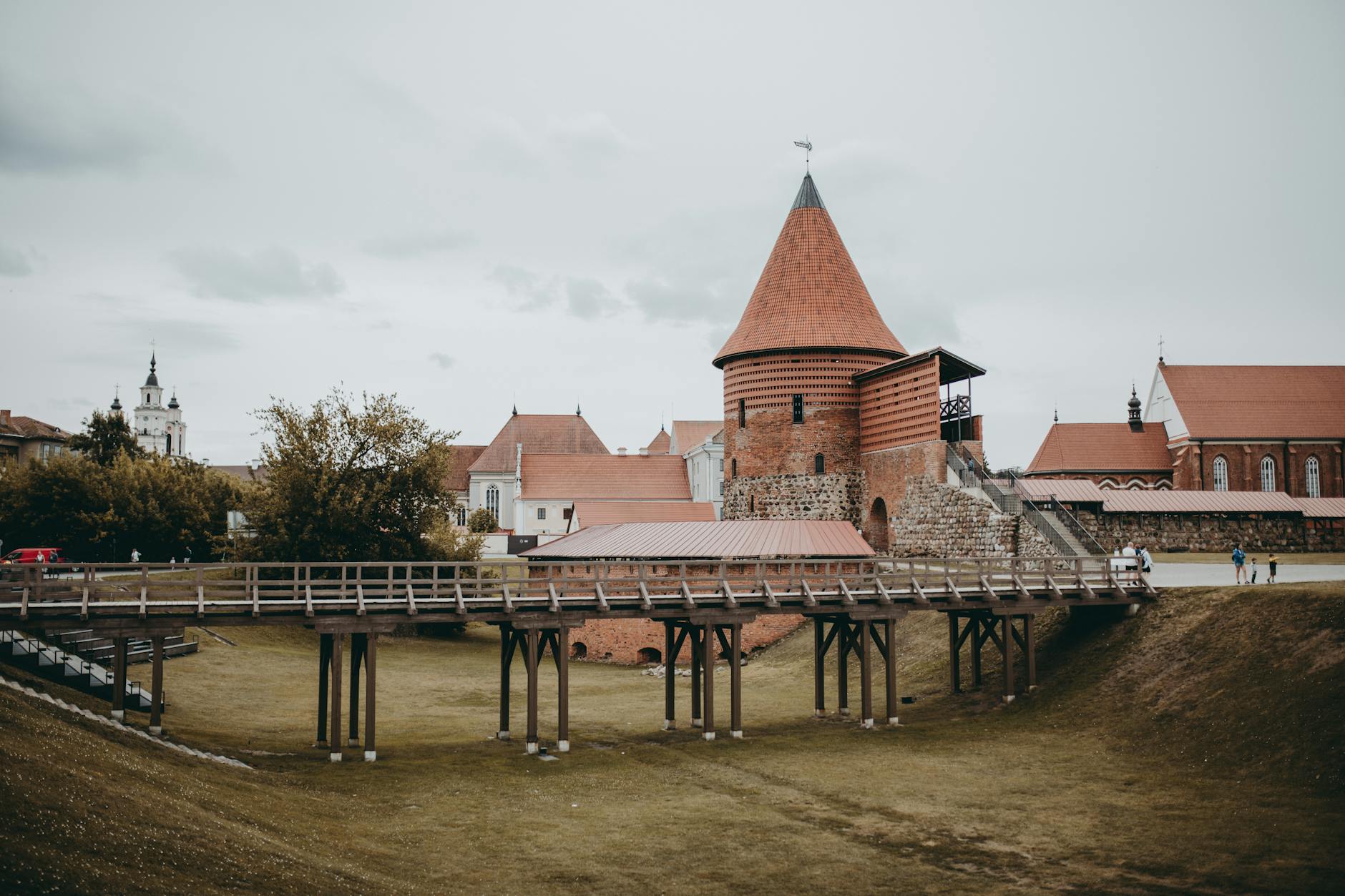
    Elsewhere the landscape edits the buildings. Trakai puts a brick castle in the middle of water as if defense had once been a theatrical art. Nida lets houses stay low, blue-shuttered, wind-aware, because dunes do not negotiate. Klaipėda keeps traces of Prussia in timber and brick, while Kernavė reduces architecture to earthworks and hill forts, proving that a mound can carry as much history as a cathedral.

    Nothing here feels neutral. A facade declares allegiance, survival, adaptation, or stubbornness. Even concrete becomes eloquent when winter light hits it at 3:15 in the afternoon.

  • etiquette

    The Courtesy of Not Overspeaking

    Lithuanian politeness can confuse visitors trained by louder cultures. Service may be calm, faces may stay composed, compliments may not arrive gift-wrapped. This is not coldness. It is a refusal to perform intimacy on command.

    Greet properly. "Laba diena" works almost everywhere, and formal address keeps its dignity with strangers, older people, and anyone whose first name you have not earned. The room warms by increments. Stay those increments.

    At the table, generosity appears without speechifying. More food arrives. Bread stays within reach. Someone asks once if you want tea, then simply puts the kettle on. In homes, shoes off is the safe instinct; in cafés, lingering is acceptable if you are actually present and not colonizing a chair with a laptop and a single espresso.

    The deepest courtesy may be this: people leave you space. They do not interrogate, crowd, or narrate themselves at you. In a world drunk on self-display, reserve can feel almost luxurious.

  • religion

    Crosses After the Bulldozers

    Lithuanian religion is less about piety as decoration than endurance as habit. Catholicism shaped feast days, kitchens, calendars, names, weddings, grief. But this is a country where faith also had to learn stubbornness under occupation, censorship, and the practical humiliations of the twentieth century.

    That is why the Hill of Crosses near Šiauliai matters so much. Crosses multiplied there not because anyone needed a tidy symbol, but because the site kept being flattened and kept returning. Wood, metal, rosaries, names, pleas, thanks. Bulldozers came. Then believers came back. One begins to understand devotion as repetition with splinters.

    In Vilnius, churches stack history in stucco and incense: Polish traces, Lithuanian prayers, Latin echoes, Jewish absence nearby, Orthodox domes entering the conversation from another century. The city never had the privilege of a single soul. It had many, often at odds, all audible.

    Even the nonreligious inherit the rhythm. Christmas Eve without meat. Poppy seeds. Candles. Bread broken with more solemnity than law requires. Ritual survives because the body remembers what ideology forgets.

Taste the Country

  • Cepelinai

    Sunday lunch. Family table. Knife cuts. Steam rises. Sour cream lands. Bacon and onion follow. Silence works.

  • Šaltibarščiai with hot potatoes

    Summer meal. Cold soup first. Hot potatoes beside the bowl, never inside. Spoon, fork, dill, laughter.

  • Kibinai in Trakai

    Train from Vilnius. Walk by the lake. Pastry burns fingers. Lamb or beef drips. Napkins fail.

  • Kepta duona with beer

    Evening table. Friends talk. Black bread fries, garlic clings, cheese sauce pools. Beer solves nothing and improves everything.

  • Kūčiukai in poppy-seed milk

    Christmas Eve. Bowl, spoon, patience. Biscuits soften, poppy seeds float, family stories return.

  • Ruginė duona with smoked fish

    Coast ritual in Klaipėda or Nida. Bread slices, butter spreads, fish flakes. Beer or tea follows. No garnish needed.

  • Šakotis at weddings

    Celebration cake. Knife saws through spikes. Coffee waits. Guests eat, watch, gossip, repeat.

Notable Figures

  • Mindaugas

    King of Lithuania · c. 1203-1263

    Mindaugas gave Lithuania its one and only crowned king, though he did it with the instincts of a survivor, not a saint. He accepted baptism when it served him, wore the crown when it protected him, and died in a murder that showed how unfinished the state still was.

  • Vytautas the Great

    Grand Duke · c. 1350-1430

    Vytautas made Lithuania enormous, but scale alone is not why his name endured. He turned Trakai into a dynastic stage, helped crush the Teutonic Order at Grunwald, and spent a lifetime reaching for a royal crown that never quite arrived.

  • Jogaila (Władysław II Jagiełło)

    Grand Duke of Lithuania and King of Poland · c. 1352-1434

    Jogaila changed Lithuania with a marriage contract and a baptismal name. His union with Jadwiga tied Lithuania to Poland, ended the last pagan kingdom in Europe, and set the course for centuries of shared history, compromise, and rivalry.

  • Barbara Radziwiłł

    Queen of Poland and Grand Duchess of Lithuania · 1520-1551

    Barbara Radziwiłł brought scandal, tenderness, and dynastic panic to the Lithuanian story. Her secret marriage to Sigismund II Augustus enraged the Polish court, which suspected ambition and poison in equal measure; Lithuania, naturally, adored the romance.

  • Jonas Basanavičius

    National revival leader and public intellectual · 1851-1927

    Basanavičius looked more like a doctor than a revolutionary, which he was, in part. Yet he spent decades collecting folklore, editing newspapers, and insisting that Lithuanian language and memory belonged in public life, not only in kitchens and prayer books.

  • Mikalojus Konstantinas Čiurlionis

    Painter and composer · 1875-1911

    Čiurlionis painted like a composer and composed like a mystic who had stared too long at pine forests and stars. In Lithuania he is not merely admired; he is treated as proof that a small nation can dream on a grand scale without becoming pompous.

  • Antanas Smetona

    Statesman and first president · 1874-1944

    Smetona stood at the birth of the republic and then bent it toward authoritarian rule, which is why Lithuanians remember him with mixed feelings. He helped build the state, certainly, but he also narrowed it, especially in the tense years when Kaunas served as the country's provisional capital.

  • Romain Gary

    Writer and diplomat · 1914-1980

    Romain Gary was born in Vilnius when the city belonged to a different political world, and he carried that layered origin all his life. Few writers better capture the restlessness of Eastern Europe, where identities overlap, migrate, and refuse to stay tidy.

  • Vytautas Landsbergis

    Independence leader · born 1932

    Landsbergis emerged from the world of musicology into the harsh theatre of Soviet collapse. He spoke with the cool stubbornness of a professor, then faced tanks with it, which turned out to be exactly the right quality for 1990.

Frequently asked

Do I need a visa for Lithuania in 2026?

Many travelers do not. EU, EEA and Swiss citizens travel under free-movement rules, and travelers from the US, UK, Canada and Australia can usually stay visa-free for up to 90 days in any 180-day Schengen period. As of 20 April 2026, ETIAS has not started yet, so you do not apply for it now.

Is Lithuania expensive for tourists?

No, not by Western European standards. Lithuania is still good value for hotels, food and transport, though summer weekends in Vilnius, Nida and Palanga can push room rates up quickly. Budget travelers can manage on about €45-70 a day if they keep accommodation simple.

What is the best way to travel around Lithuania?

Use trains on the main routes and buses for everything else. Vilnius, Kaunas and Klaipėda work well by rail, while places like Druskininkai, Anykščiai and many smaller towns are usually easier by coach or car. For the Curonian Spit, a car saves time but is not essential if you plan carefully.

How many days do you need in Lithuania?

Three days is enough for Vilnius with a side trip to Trakai, but a week gives you a much better read on the country. With 7 to 10 days, you can combine Vilnius or Kaunas with the coast, or build a slower route through Druskininkai, Anykščiai and Šiauliai.

Is Vilnius or Kaunas better for a first trip?

Vilnius is the better first base for most travelers. It has the deeper monument density, easier side trips to Trakai and Kernavė, and more direct international connections. Kaunas is stronger if you care about interwar architecture, lower-key evenings and quicker access west.

Can you visit the Curonian Spit without staying overnight in Nida?

Yes, but it works better as an overnight than a rushed day trip. You can reach the spit from Klaipėda and continue south, yet the place makes more sense when you have time for changing light, dune walks and the lagoon after the tour buses thin out.

Is Lithuania safe for solo female travelers?

Yes, generally. Vilnius, Kaunas and Klaipėda are manageable, public transport is easy to use, and the main precautions are ordinary urban ones: watch your drink, use licensed rides and avoid flashing valuables late at night. Winter ice is often a more real hazard than street crime.

What month is best for Lithuania?

August is the easiest all-round month. You get warm weather, long light, workable beach conditions and fewer weather surprises than June or early spring. May and September are the better-value alternatives if you care more about cities, forests and room prices than swimming.

Sources & attribution5
Photo credits (3)
  1. Nick — Pexels License (https://www.pexels.com/license/) — Source: https://www.pexels.com/photo/28384106/
  2. Paulina Lazauskaite — Pexels License (https://www.pexels.com/license/) — Source: https://www.pexels.com/photo/17766678/
  3. Agnė Kazakevičienė — Pexels License (https://www.pexels.com/license/) — Source: https://www.pexels.com/photo/18945848/

Photos may have been resized or cropped.