Full day (include Jaigarh Fort via connecting tunnel)
Entry
₹100 Indians / ₹500 foreigners; student discounts available
Best season
Winter (October–February)
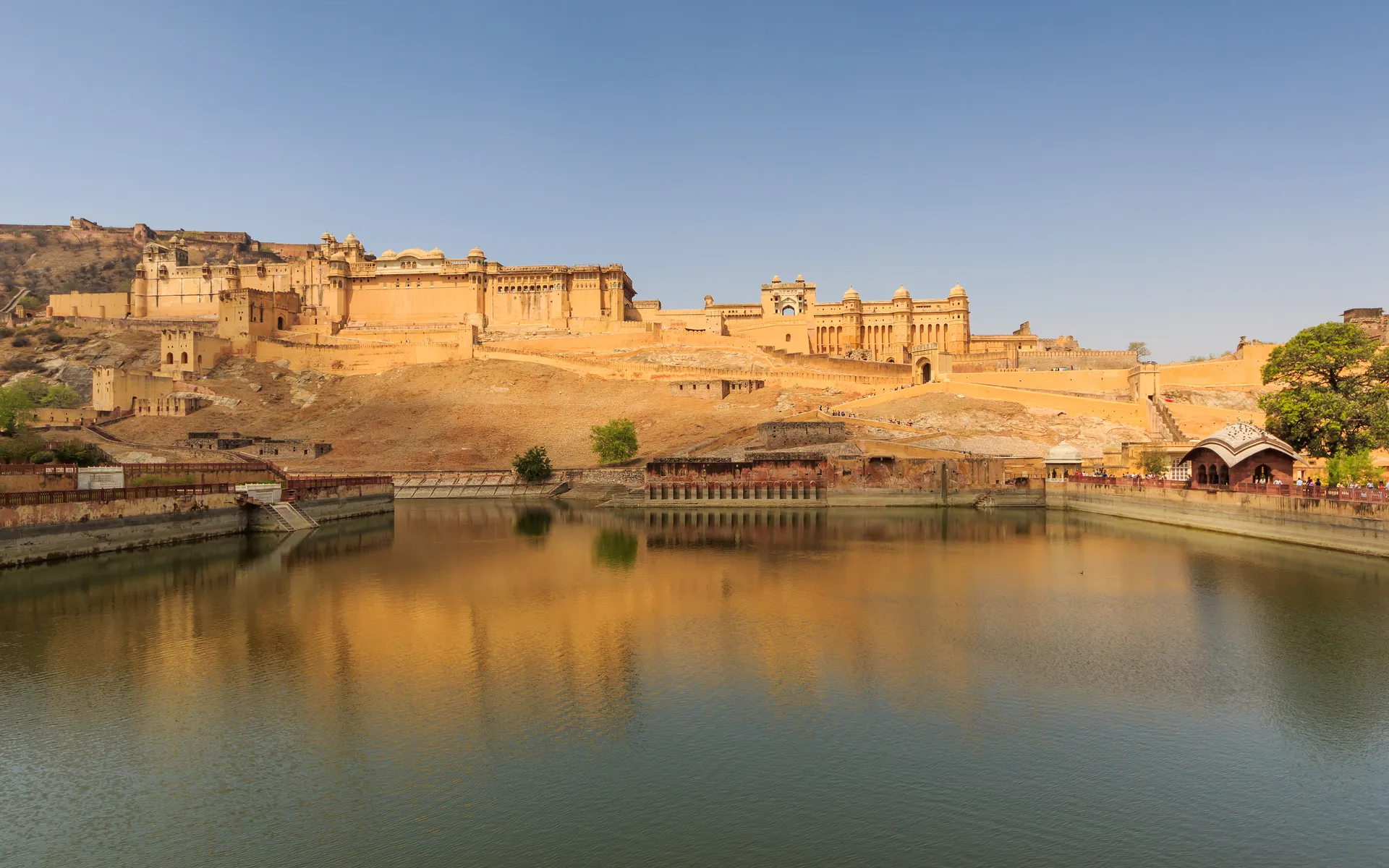
Why would a king abandon the most magnificent palace in Rajasthan — not because he lost it, but because he'd outgrown it? Amber Palace rises from the Aravalli hills 11 kilometers north of Jaipur, India, a honey-and-rose sandstone fortress reflected in the still waters of Maota Lake below. It is the place where Rajput military power married Mughal aesthetic refinement, and the result is one of the most architecturally layered buildings on the subcontinent — a palace that was deliberately left behind so a new city could be born.
What strikes you first isn't the scale, though the complex sprawls across the ridgeline like a small city. It's the light. Morning sun hits the pale stone and the whole structure glows amber — the color that may or may not explain its name. Step through the Suraj Pol gate and you enter a series of courtyards that grow progressively more private, more ornate, more hushed, following a Mughal planning principle where each threshold marks a deeper layer of royal intimacy.
The Sheesh Mahal gets the photographs, and it deserves them — thousands of convex mirror fragments set into the walls and ceiling so that a single candle flame fractures into a constellation. But the palace rewards patience more than spectacle. Underground tunnels run to the neighboring Jaigarh Fort, built for royal escape routes that were never needed. An active Hindu temple still draws daily worshippers who couldn't care less about the tourist traffic. Thirty-six workshops once operated inside these walls, producing everything from miniature paintings to gem-cut jewelry, making this less a residence than a self-contained economy perched on a hilltop.
And then there's the question that hangs over the whole place: in 1727, Sawai Jai Singh II packed up the court and moved it to a brand-new planned city on the plains below. Amber Palace wasn't sacked or burned. It was simply retired. That act of deliberate departure — choosing the future over the fortress — is what makes this place feel different from every other Rajput fort in India.
Researched by the Audiala editorial team from historical records, architectural archives, and local expertise.
What to see
Sheesh Mahal (Mirror Palace)
The Sheesh Mahal doesn't photograph well, and that's the point. Thousands of tiny convex mirrors — each no larger than a thumbnail — line the walls and ceiling of this chamber on the palace's upper level. They were designed for candlelight, not camera flash. When the Rajput court lit even a single flame here, the room erupted into a private constellation, turning the ceiling into a map of stars that moved with the flicker. Stand inside and you'll understand why Mirza Raja Jai Singh I commissioned it in the mid-17th century: this wasn't decoration, it was theater. The mirrors came from Belgium, carried overland across thousands of kilometers to end up embedded in plaster on a Rajasthani hilltop. Run your eyes along the joints where mirror meets carved alabaster and you'll notice the floral inlay work that most visitors walk right past — petals rendered in colored glass so fine they could pass for gemstone. The room is roughly the size of a modest apartment, maybe 8 meters across, which makes the effect more intimate than grand. Arrive before 9 AM if you want a few seconds alone with it.
The Four Courtyards and Diwan-e-Aam
Amber Palace is organized around four courtyards arranged in ascending order of privacy — a borrowed Mughal idea executed in distinctly Rajput sandstone. The first courtyard hits you with scale: a wide, sun-bleached expanse of red sandstone entered through the Suraj Pol (Sun Gate), where elephants once carried visiting dignitaries up the ramp. The Diwan-e-Aam, the Hall of Public Audience, occupies one edge of this space — a double row of 27 pillars holding up a sandstone canopy open on three sides, so that even commoners could approach the Maharaja without stepping indoors. The columns are rough-hewn compared to the marble refinements deeper inside, and that contrast is deliberate. Each successive courtyard grows quieter, cooler, more ornate. By the time you reach the fourth level — the zenana, or women's quarters — the stone shifts from red sandstone to white marble, the lattice screens (jalis) grow so fine they filter sunlight into soft geometric patterns on the floor, and the wind hums through the perforations like a low whistle. The temperature drops noticeably. The whole complex works like a sentence that begins with a shout and ends in a whisper.
The Tunnel to Jaigarh Fort and Panna Meena ka Kund
Most visitors treat Amber Palace as a self-contained experience and miss what surrounds it. A subterranean passage — roughly 2 kilometers long, taller than a person, and cut through solid rock — connects Amber to Jaigarh Fort on the ridge above. Built as an emergency escape route for the royal family, it's dimly lit and cool even in May, when the exposed ramparts above bake past 40°C. Ask your guide to point out the entrance near the upper courtyard; access varies by season, but when open, the walk through it reframes the entire complex as something military, not merely decorative. After the palace, walk 5 minutes downhill to Panna Meena ka Kund, an 18th-century stepwell whose 350-odd steps descend in perfect zigzag symmetry — like an M.C. Escher drawing rendered in honey-colored stone. You can only view it from the top now (the steps are closed for safety), but the geometry is best appreciated from above anyway. Go in late afternoon when the angled light carves deep shadows into each step. Between the tunnel and the stepwell, you'll leave Amber understanding that the Rajputs didn't just build palaces — they engineered entire hillsides.
Plan your visit
Getting There
Amber Palace sits about 11 km north of Jaipur's city center — roughly 30 minutes by Uber or Ola auto-rickshaw, depending on traffic. RSRTC buses run from Hawa Mahal to Amer village in about 20 minutes for a few rupees. A private car or taxi gives you the most flexibility, especially if you plan to combine with Jaigarh Fort, which connects to Amber via an underground tunnel.
Opening Hours
As of 2026, the fort is open daily from 8:00 AM to 5:30 PM, with last entry at 5:00 PM. No weekly closures. An evening Light and Sound show runs after sunset — check locally for the current schedule, as timings shift seasonally.
Time Needed
A brisk walk through the main courtyards and Sheesh Mahal takes 1.5 to 2 hours. To properly absorb the labyrinthine Zenana quarters, the Shila Devi Temple, and the views over Maota Lake, budget 3 hours or more. Add another hour if you walk the tunnel passage to Jaigarh Fort.
Tickets
As of 2026, entry costs ₹100 for Indian nationals and ₹500 for foreign visitors. Indian students pay just ₹20. A Composite Entry Ticket covers Amber plus Hawa Mahal, Jantar Mantar, and other Jaipur monuments — solid value if you're spending more than a day in the city. Buy tickets at the on-site counter or through the official Rajasthan Government Tourist Portal.
Accessibility
The fort is built into a hillside with steep stone ramps and uneven steps — wheelchair access exists in some sections but full independent navigation is not realistic. Wheelchair users should bring one or two helpers. The lower courtyards are the most manageable; the upper Zenana levels involve narrow passages and significant inclines.
History
The Prince Who Built a Palace Between Two Empires
The story of Amber Palace is really the story of a political tightrope. The Kachwaha Rajputs who built it were Hindu kings serving Muslim emperors, and the architecture records that tension in every archway and courtyard. The fort's earliest layers are attributed to Raja Man Singh I, who according to tradition began construction around 1592, though this date lacks confirmation across scholarly sources. What is documented is that the palace's most celebrated additions — the ornate halls, the gardens, the mirror-encrusted chambers — came a generation later under Mirza Raja Jai Singh I during the 17th century.
Before either man touched the site, it belonged to the Meena tribe. Local oral histories name a Meena king as the original founder, with some accounts placing initial structures as far back as 967 CE. The Kachwaha Rajputs displaced the Meena, and the official court records largely erased them. But the Meena remember. That contested origin is the first of many layers buried in the hillside.
The turning point
Mirza Raja Jai Singh I and the Art of Serving Two Masters
Most visitors assume Amber Palace is a Mughal building. The arched gateways, the symmetrical gardens, the geometric inlay work — it all reads as Mughal. And that's exactly what Mirza Raja Jai Singh I intended. He was a Rajput Hindu king who served as a military general under two Mughal emperors, Shah Jahan and then Aurangzeb. His survival depended on demonstrating loyalty through competence, and his palace was a political statement in stone: I am powerful enough to build in your style, sophisticated enough to improve upon it, and loyal enough that you should leave me alone.
But something doesn't add up. Look closely and the Hindu elements are everywhere — the Ganesh Gate, the Shila Devi Temple at the entrance, the layout following principles of Vastu Shastra rather than Persian garden geometry. Jai Singh I wasn't imitating the Mughals. He was performing a selective adoption, borrowing the visual language of empire while encoding his own religious and cultural identity into the bones of the structure. UNESCO's own documentation describes the architecture as 'eclectic,' a diplomatic word for a building that is deliberately two things at once.
The revelation changes what you see when you walk through. Every Mughal-style arch frames a Hindu deity. Every Persian-influenced garden leads to a Rajput audience hall. Jai Singh I built a palace that could be read differently by different audiences — reassuring to the Mughal emperor on a state visit, unmistakably Rajput to anyone who knew where to look. He died in 1667 having maintained his kingdom's autonomy through four decades of imperial service. The walls still hold both readings, if you know which layer to see.
Man Singh I: The General Who Started It All
Before Jai Singh I refined Amber into a diplomatic masterpiece, his predecessor Raja Man Singh I laid the foundations — both literally and politically. Man Singh was one of Emperor Akbar's most trusted generals, commanding Mughal armies across northern India and as far as Bengal. According to tradition, he brought the idol of Shila Devi back from Jessore (now in Bangladesh) after a military campaign and installed it in the temple that still operates inside the fort's walls. His alliance with Akbar set the template that would define the Kachwaha dynasty for over a century: serve the empire, keep your kingdom, build something extraordinary with the spoils. The palace he began — its exact start date unconfirmed but widely attributed to the 1590s — was the first permanent expression of that bargain.
Sawai Jai Singh II: The King Who Walked Away
The most radical act in Amber's history wasn't a battle or a coronation. It was an evacuation. In 1727, Sawai Jai Singh II — astronomer, mathematician, and arguably the most intellectually restless ruler in Rajput history — decided the cramped hilltop capital no longer served his ambitions. He commissioned a new city on the plains below, designed on a grid system informed by Vastu Shastra and European urban planning principles. Jaipur became one of India's first planned cities, and Amber Palace became a monument to the era that preceded it. The fort wasn't destroyed or repurposed. It was simply outgrown — a rare case in world history of a capital being retired by choice rather than conquest. The palace you visit today is essentially frozen at the moment of that departure, which is why it feels so complete and so empty at once.
Tips for visitors
Arrive at Opening
The fort faces east, so morning light floods the honey-colored sandstone courtyards and makes the Sheesh Mahal mirrors come alive. By 10 AM, tour bus crowds thicken and the heat becomes punishing — 8 AM entry buys you golden light and relative quiet.
Dress for the Temple
The Shila Devi Temple inside the fort expects covered shoulders and knees. Even if you're not planning to enter, the courtyard around it follows the same etiquette — carry a scarf or shawl to avoid being turned away.
No Flash in Sheesh Mahal
Flash photography is prohibited inside the Mirror Palace to protect the thousands of hand-cut convex mirrors, some dating to the 17th century. Tripods and drones require a separate permit from the Archaeological Survey of India. Your phone camera on night mode will do better than a flash ever could in there.
Dodge the Fake Guides
Unofficial "guides" near the parking lot will offer to show you secret tunnels, then steer you into commission-heavy gem shops selling overpriced or fake stones. If a driver insists on a stop at a "government-approved" jeweler, it almost certainly isn't. Hire guides only from the official ticket counter.
Eat Like Royalty (Or Not)
1135 AD, the restaurant inside the fort itself, serves upscale Rajasthani cuisine in a setting that earns its price tag — try the lal maas. For budget dal baati churma, the street stalls near Maota Lake parking are authentic but choose vendors with visible cooking fires and high turnover.
Don't Skip the Stepwell
Panna Meena ka Kund, an ancient symmetrical stepwell, sits a 5-minute walk from the fort's lower gate. You can't descend the steps anymore, but the geometric zigzag pattern viewed from above is one of the most photographed structures in Rajasthan — and it's free.
Where to Eat
local_dining
Don't Leave Without Trying
Rabdi Jalebi—creamy, syrup-soaked sweetness that's Jaipur's signature dessertChur Chur Naan—flaky, layered bread that melts on your tongueKulcha—stuffed flatbread, often filled with paneer or potatoThali—a complete platter with multiple curries, bread, and dalPaneer dishes—North Indian staple, rich and aromaticChicken curries—slow-cooked Mughlai preparations
1135 AD
fine dining
Indian & Mughlai€€€star4.3(1804)directions_walkInside Amber Palace complex
Order: Royal Mughlai curries and paneer dishes—the opulent setting inside the fort makes every plate feel ceremonial. Go for the rich, slow-cooked gravies that echo Jaipur's regal culinary heritage.
Literally inside the Amber Palace complex, this is where you eat *within* history rather than just looking at it. The ambiance of dining in a 16th-century fort with views of the courtyards transforms a meal into an experience.
Cafe & Bakery€€star3.6(437)directions_walkAt Mansingh Mahal exit of Amber Palace
Order: Fresh-baked pastries and filter coffee—perfect for a mid-sightseeing break. The chai and samosas are solid for a quick refuel between fort exploration.
Strategically placed at the Mansingh Mahal exit, this is your best bet for grabbing something without leaving the fort grounds. Reliable, clean, and won't slow you down if you're on a tight schedule.
checkKhau Galli near Amer is the street food hub—hit it for authentic, affordable local snacks like dosa and kulcha if you want to eat where locals actually go
checkMost restaurants near the fort cater to tourists; for genuine Jaipur flavors, venture down to the street stalls around the fort exits
checkArrive early for rooftop cafes if you want the best views; they fill up quickly during peak tourist season
Food districts:Khau Galli—the primary street food zone near Amer Fort for quick, authentic bitesJaleb Chowk—the main plaza inside Amber Palace, home to 1135 AD and tourist-oriented diningMansingh Mahal exit area—where quick cafes and bakeries cluster for fort visitors
Restaurant data powered by Google
Watch & Explore Amber Palace.
Took 137 Years to build this! Amber Palace Jaipur | Rajsthan| Ep.3| DR BRO
Dr Bro16 min1M
JAIPUR's Amber Palace & Forts 🇮🇳
Benjamin Jenks - American in India10 min8K
Explore Jaipur
Untold Story of Amer Fort | Jaipur | CB.DOC Originals Mini Documentary
Couple Book7 min51K
Frequently asked
Is Amber Palace in Jaipur worth visiting?
Yes — it's the single site in Jaipur that best reveals how Rajput kings lived, fought, and showed off. The Sheesh Mahal alone justifies the trip: thousands of tiny convex mirrors line the walls and ceiling, designed so that a single candle flame would replicate a star-filled sky. Beyond the famous rooms, the underground tunnel connecting Amber to Jaigarh Fort and the still-functioning 17th-century water harvesting systems give the place a depth that Jaipur's flatter monuments can't match.
How long do you need at Amber Palace?
Plan for at least 2.5 to 3 hours if you want to do more than photograph the courtyards. A rushed loop through the four levels takes 90 minutes, but you'll miss the Zenana's labyrinthine passages, the Shila Devi Temple where locals still worship daily, and the nearby Panna Meena ka Kund stepwell — a geometric marvel just outside the walls. If you add the connected Jaigarh Fort via the hilltop tunnel, budget a full day for the Amer area.
How do I get to Amber Palace from Jaipur?
Amber Palace sits about 11 km north of Jaipur's city centre — roughly the length of 110 football pitches laid end to end. RSRTC buses run from Hawa Mahal to Amer in about 20 minutes and cost next to nothing. Uber and Ola rickshaws are the most convenient option; a private car gives you flexibility to combine the visit with Jaigarh Fort and the Amer township without haggling at every stop.
What is the best time to visit Amber Palace?
Winter mornings between November and February, arriving by 8:00 AM. The sandstone walls trap and radiate heat like an oven in summer, making midday visits between April and June genuinely punishing. Early arrival also means you'll have the Sheesh Mahal's mirror-lit corridors mostly to yourself before the tour-bus crowds flood in around 10:00 AM. The golden hour before sunset offers the best photography from the ramparts overlooking Maota Lake.
Can you visit Amber Palace for free?
No, entry requires a ticket. Indian nationals pay around ₹100, foreign tourists around ₹500, and Indian students get in for roughly ₹20. A composite ticket covering multiple Jaipur monuments — Hawa Mahal, Jantar Mantar, and others — offers better value if you're spending several days in the city. Buy tickets at the on-site counter or through the official Rajasthan Government Tourist Portal to avoid inflated third-party prices.
What should I not miss at Amber Palace?
The Sheesh Mahal gets all the attention, and it deserves it — but don't leave without finding the underground escape tunnel to Jaigarh Fort, built so the royal family could vanish during a siege. The Shila Devi Temple near the Ganesh Gate is an active place of worship, not a museum exhibit, and the atmosphere shifts completely from tourist site to devotional space. Outside the walls, the 18th-century Panna Meena ka Kund stepwell is a staircase of perfect geometric symmetry that most visitors walk right past.
Should I take an elephant ride at Amber Palace?
Skip it. Local activists and many Jaipur residents oppose the rides on animal welfare grounds, and the practice is widely viewed within the city as an outdated tourist trap rather than any kind of authentic tradition. The elephants work in extreme heat on steep stone ramps, and the rides are overpriced relative to what you get — a slow, congested ascent you can walk in 15 minutes. Take the path on foot and you'll actually notice the architecture.
Are there scams to avoid at Amber Palace Jaipur?
Three to watch for. Unauthorized "guides" near the parking area will offer to show you secret tunnels, then steer you into commission-heavy gem shops — hire only government-approved guides at the official entrance. Drivers and guides who insist on a stop at a "government-approved" gemstone store are almost certainly earning a kickback; these shops are rarely government-run. And be cautious of inflated prices from third-party ticket sellers online — the official Rajasthan Tourism portal is the safest booking route.
Sources & attribution20
Researched and written by the Audiala editorial team from historical records, architectural archives, and local expertise. Last updated April 2026.
UNESCO World Heritage Centre — Hill Forts of Rajasthan — Confirmed 17th-century construction dates under Mirza Raja Jai Singh I, water harvesting systems, 36 karkhanas, and the fort's role within the Rajput-Mughal political alliance.
Rajasthan Tour Driver — Ticket pricing, evening Light and Sound show details, and monument timing information.
Rajasthan Tour Taxi — Composite ticket details, tantric curse legend, and 36 karkhanas cultural context.
FlyingScotsGirl / CommonWanderer — Practical transport advice (Uber/Ola), Suraj Pol and Chand Pol gateway details, and Panna Meena ka Kund stepwell recommendation.
Thrillophilia — Amer Fort — RSRTC bus route from Hawa Mahal to Amer including journey time and distance.
Amber Fort - Glass & Mirrored ceiling (3317095232) — McKay Savage from London, UK — CC BY 2.0 (https://creativecommons.org/licenses/by/2.0/) — Source: https://commons.wikimedia.org/wiki/File:Amber_Fort_-_Glass_&_Mirrored_ceiling_(3317095232).jpg
Strictly necessary cookies keep the site working. Analytics (PostHog, Google Analytics) measures how each visitor uses our pages. Marketing loads YouTube videos and walking-route maps without a tap and lets Google Analytics set advertising cookies. We never sell your data. You can change this any time from the footer.
Privacy
Cookie preferences
Pick what you're okay with. You can change this any time from the footer.
Strictly necessary
Always on
Sign-in, language, navigation. Always on.
Product analytics
PostHog (EU) and Google Analytics record which pages you view and how you use them, under a random identifier stored in your browser. Helps us see which pages work and which need fixing. Google's ad personalisation stays off. No selling.
Marketing
Loads YouTube videos and the walking-route maps (OpenFreeMap) without a tap; without it, they load only when you tap them. If analytics is also on, Google Analytics may set advertising cookies. Ad personalisation stays off.