Introduction
The Neckar River bends so sharply below Heidelberg that the castle ruins seem to hover in mid-air, their sandstone glowing like embers when the sun drops behind the Odenwald. One minute you're climbing 300-year-old steps that smell of damp limestone and linden blossom; the next you're inside a 2026 passive-house apartment block that sells craft coffee and prints zines about Roman archaeology. Germaniya keeps its oldest university here—1386, older than the Aztec Empire—but the real shock is how alive the place feels: 30,000 students arguing in 160 languages while a violinist busks beneath a Nazi-era amphitheatre no one quite knows how to talk about.
Heidelberg survived every major war by surrendering early, which is why the Altstadt still has candle-smoked student pubs where waiters in waistcoats slam Leberknödel onto oak tables first used in 1703. The same pragmatism built Bahnstadt, the world's largest passive-house district, where the air is so tightly controlled that opening a window is a political act. Between those two extremes sits a city that funds poetry vending machines on street corners and keeps a museum of psychiatric patient art next to the train tracks.
Walk the Philosophenweg at dusk and you'll see why Goethe called the view "half-mad with beauty"—red roofs jammed between green hills, the Old Bridge's 1786 arches mirrored in water, a falcon circling above the Thingstätte where 20,000 people once sang party hymns. Then descend into Untere Straße at 1 a.m.: sticky floors, 2 € Kölsch, a doctoral candidate explaining quantum entanglement to a brewmaster. Heidelberg doesn't do contradictions; it stacks them like nested dolls and hands them to you still warm.
Foodtour Heidelberg - was kann die Stadt wirklich? 🍕🍜🍫
DAAYLISHPlaces to Visit
The Most Interesting Places in Heidelberg
Theater & Orchester Heidelberg
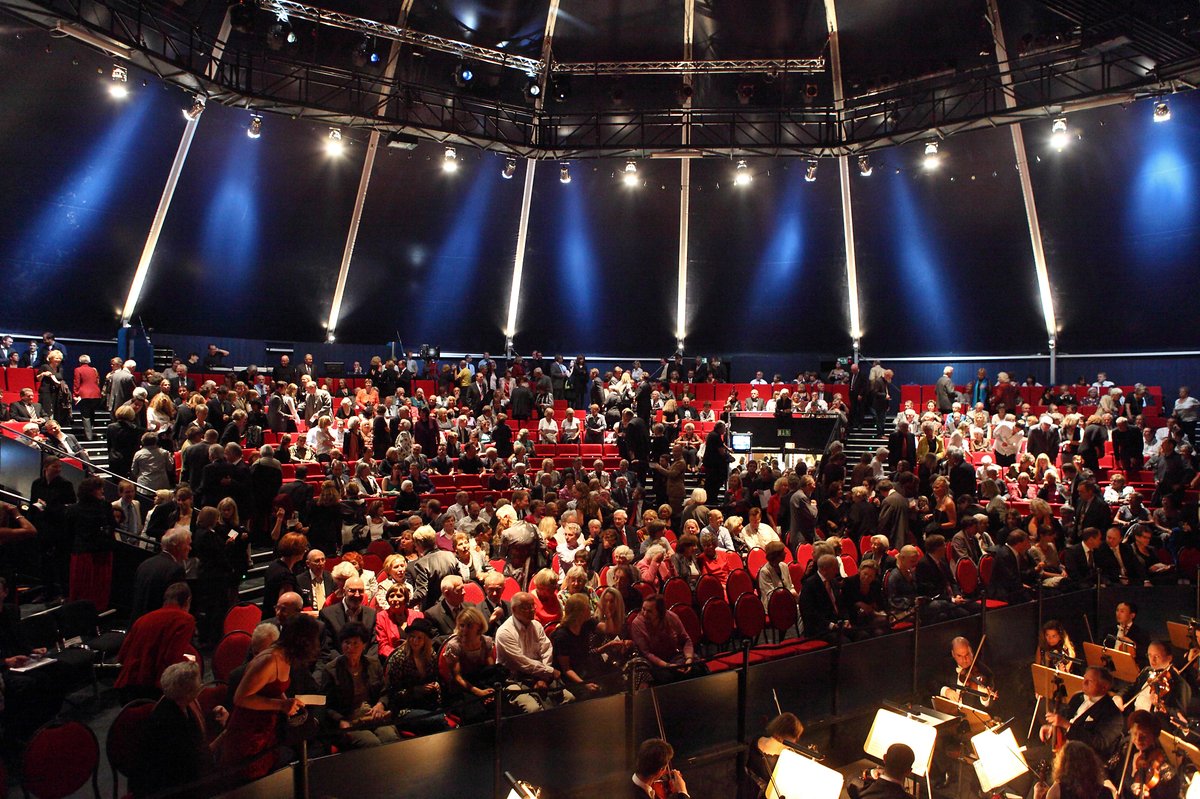
Nestled in the heart of Heidelberg, Germany, Theater & Orchester Heidelberg stands as a beacon of the city’s rich cultural heritage and vibrant performing…
Church of the Holy Spirit, Heidelberg
Nestled in the vibrant heart of Heidelberg’s historic Marktplatz, the Church of the Holy Spirit (Heiliggeistkirche) stands as a majestic emblem of the city’s…
Heidelberg University
Heidelberg University, officially known as Ruprecht-Karls-Universität Heidelberg, is Germany’s oldest and one of its most prestigious universities, founded in…
Kurpfälzisches Museum
Das Kurpfälzische Museum Heidelberg ist eine herausragende kulturelle Institution im Herzen der historischen Altstadt von Heidelberg, die Besuchern einen…
Old Bridge
The Old Bridge (Alte Brücke), officially known as the Karl Theodor Bridge, stands as one of Heidelberg’s most iconic and historically rich landmarks.
Heidelberg Academy for Sciences and Humanities
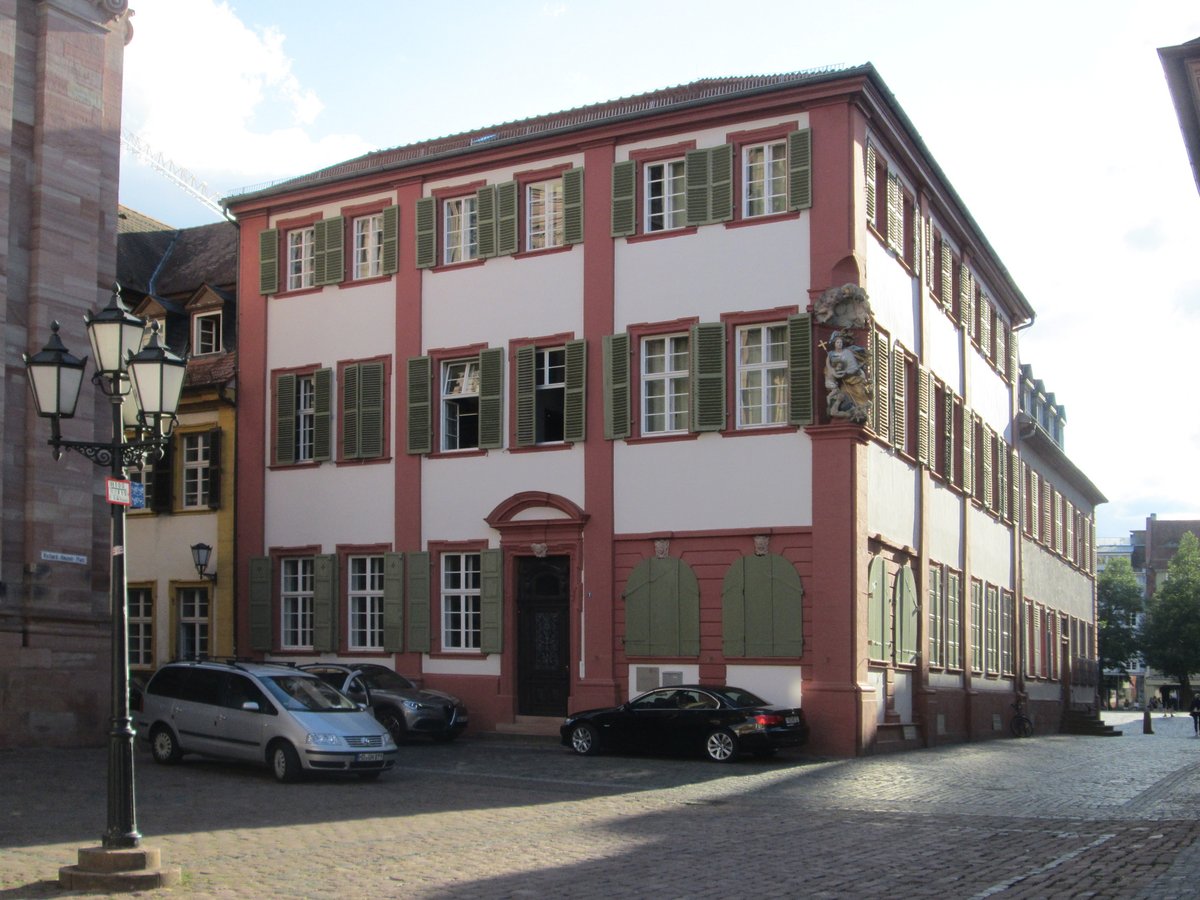
Situated in the historic heart of Heidelberg, Germany, the Heidelberg Academy for Sciences and Humanities (Heidelberger Akademie der Wissenschaften, HAdW)…
President Friedrich Ebert Memorial
Nestled in the heart of Heidelberg’s historic Altstadt, the President Friedrich Ebert Memorial stands as a poignant tribute to Germany’s first democratically…
Castle Rohrbach
Nestled in the picturesque Rohrbach district of Heidelberg, Germany, Castle Rohrbach offers visitors a unique and enriching experience that combines…
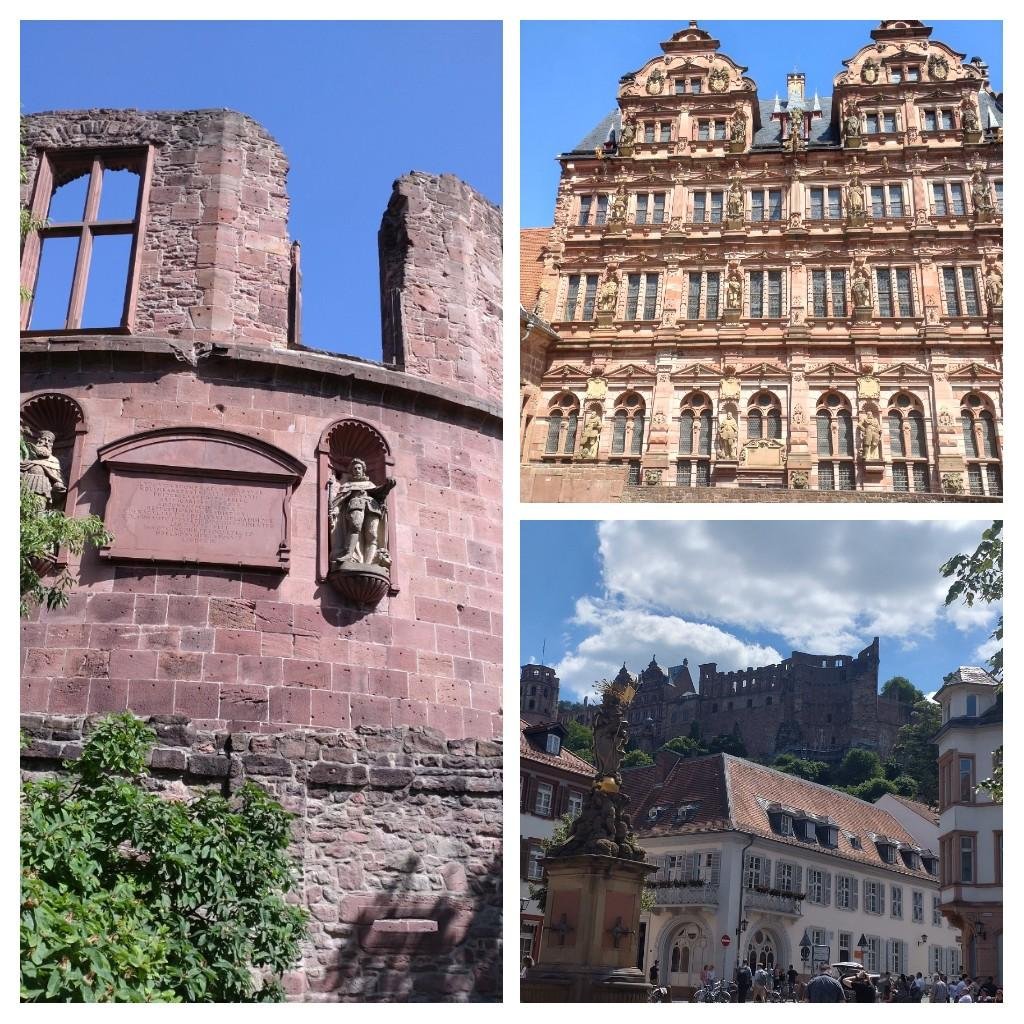
Heidelberg Castle
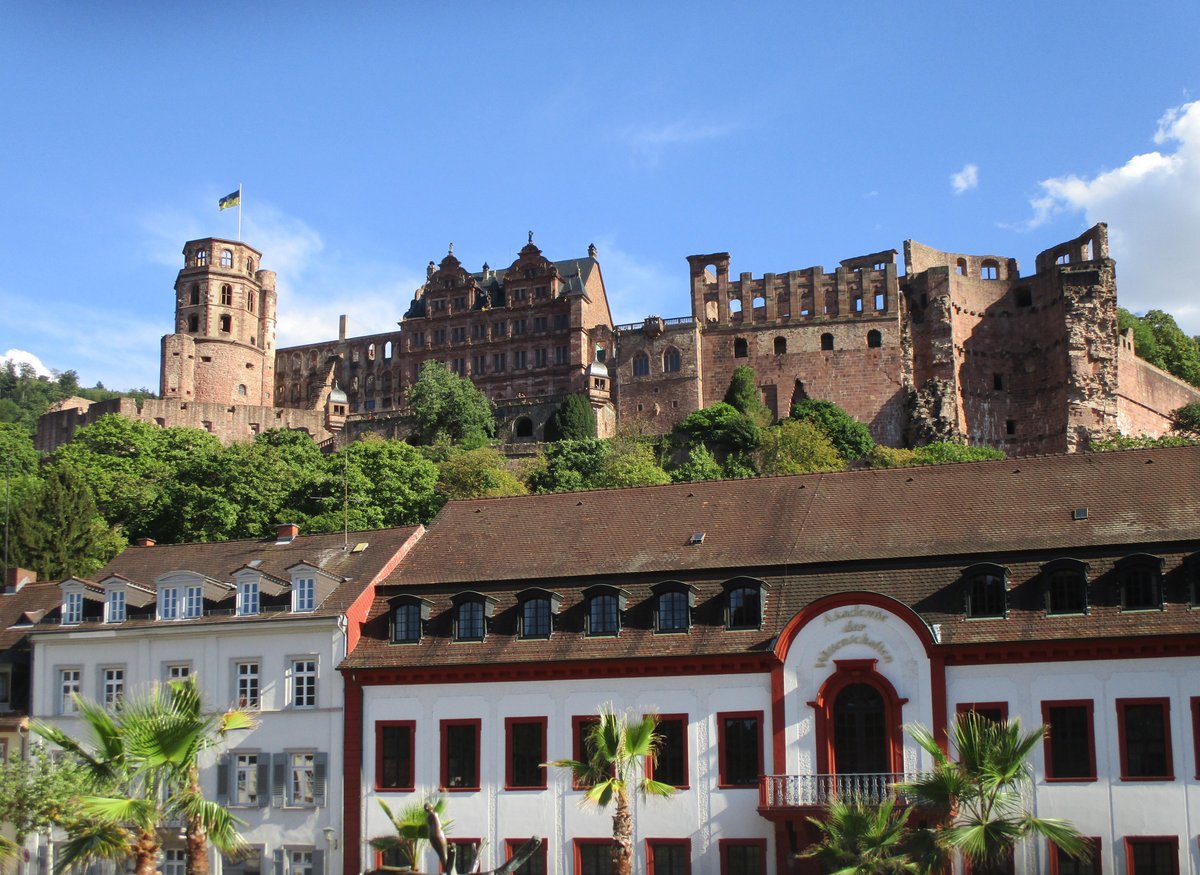
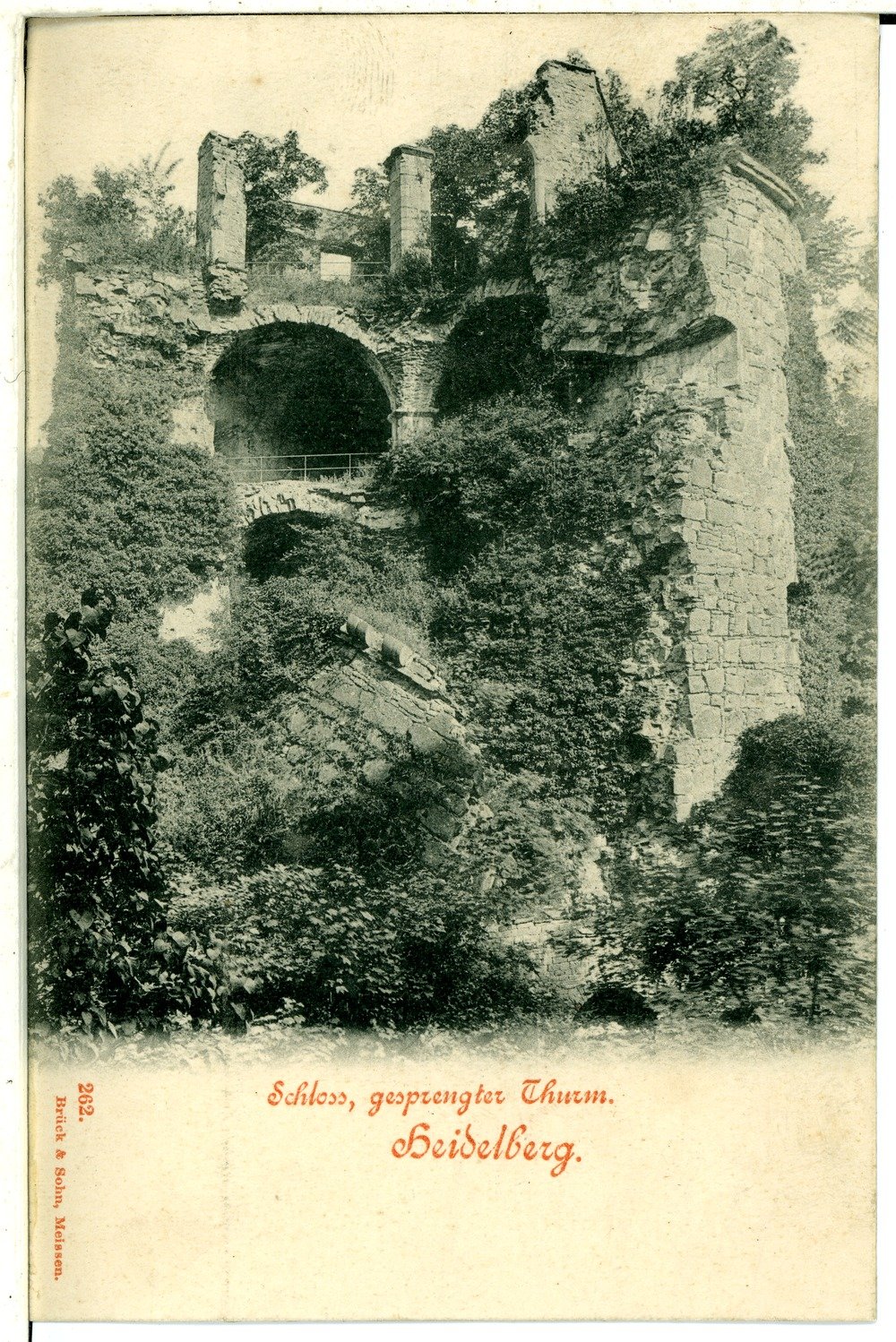
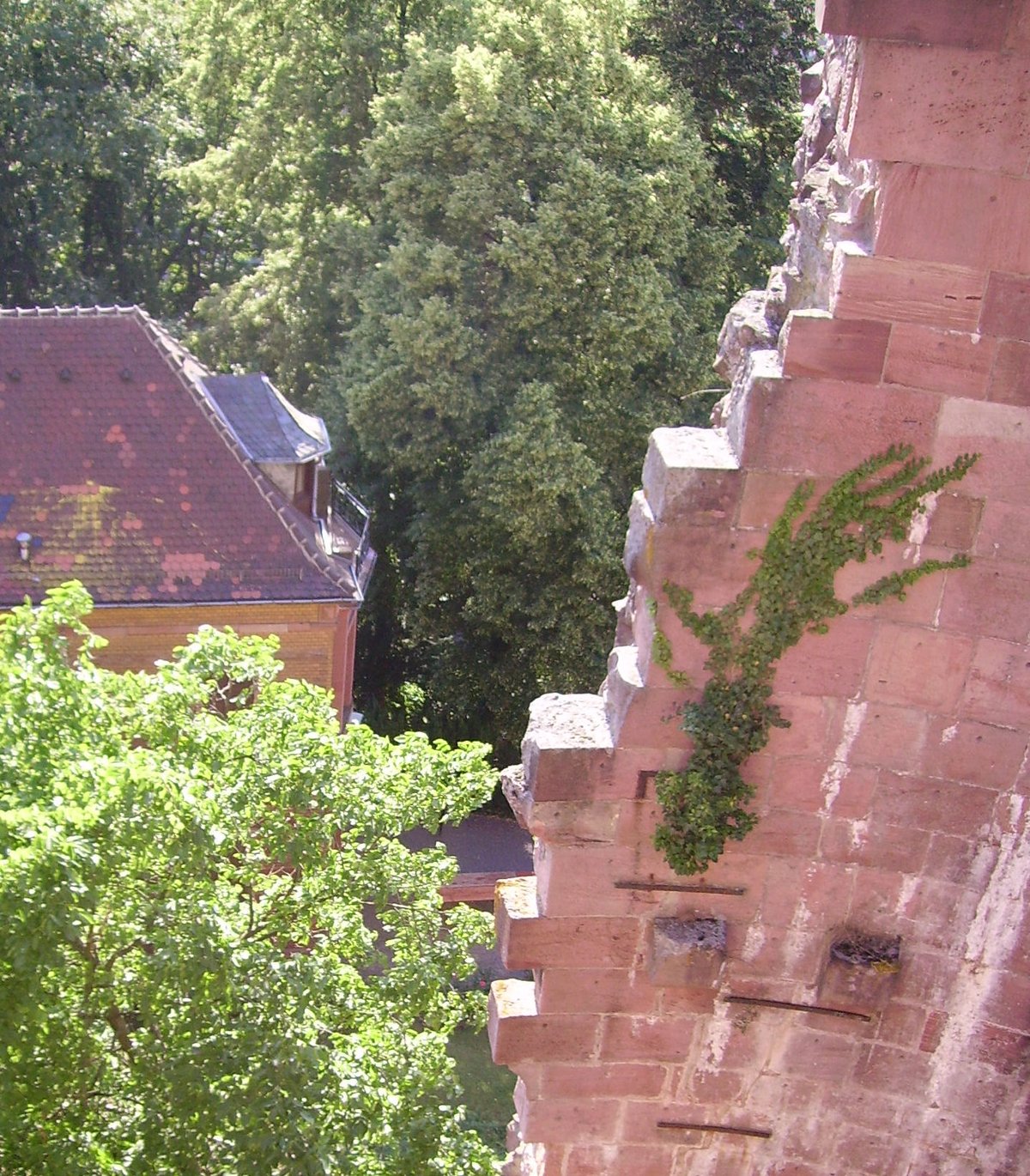
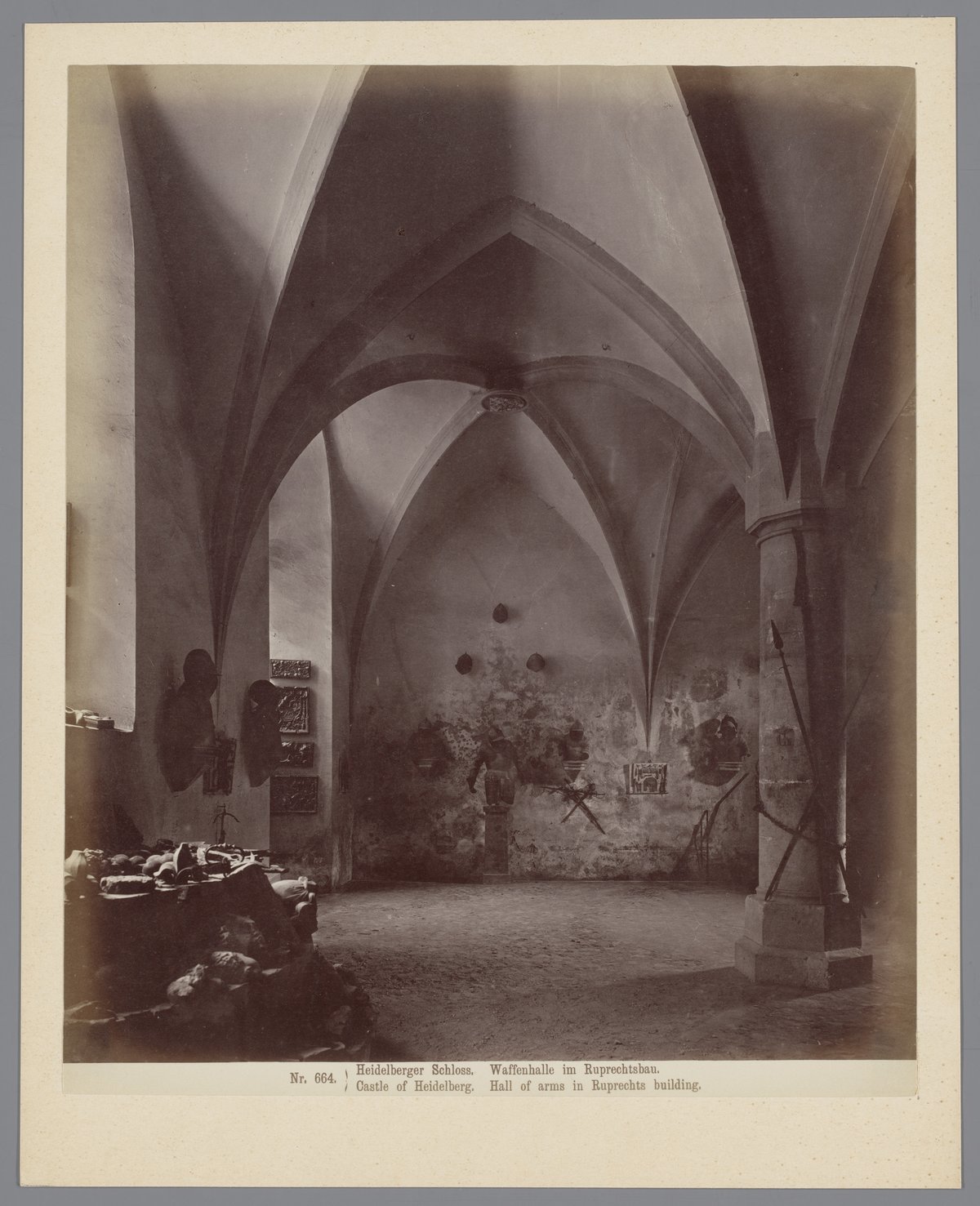
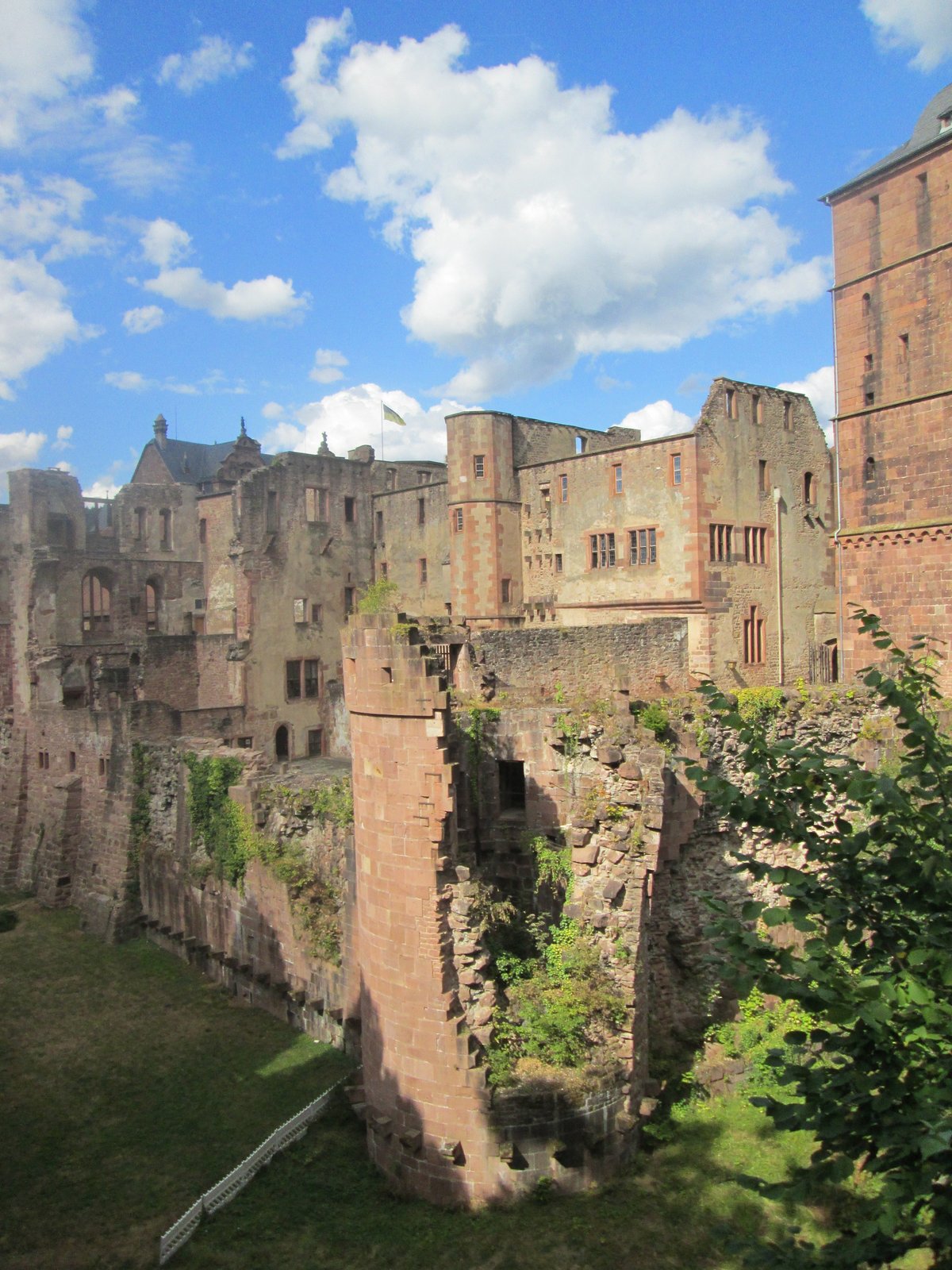
Heidelberg Castle, majestically perched on the northern slope of Königstuhl hill overlooking the Neckar River and the historic old town of Heidelberg, stands…
Landessternwarte Heidelberg-Königstuhl
Perched atop the scenic Königstuhl hill overlooking the historic city of Heidelberg, the Landessternwarte Heidelberg-Königstuhl (LSW) stands as a…
Heidelberg University Library
Heidelberg University Library (Universitätsbibliothek Heidelberg) stands as one of Germany’s oldest and most esteemed academic libraries, deeply rooted in the…
Astronomical Calculation Institute
Nestled in the historic and picturesque city of Heidelberg, Germany, the Astronomical Calculation Institute (Astronomisches Rechen-Institut, ARI) stands as…
What Makes This City Special
Castle in the Clouds
Heidelberg Castle is a sandstone giant that has been burning, exploding and crumbling since 1537. Ride the 1907 funicular up, then stand inside the 220,000-litre Great Barrel while the Neckar glints 80 m below.
Student Prison Graffiti
From 1778 to 1914, rowdy students were locked in a pastel corridor and told to decorate their cells. The result is 19th-century meme culture in chalk—caricatures, beer slogans, and the odd declaration of eternal love.
Philosophenweg at Golden Hour
The switch-backed path across the Neckar smells of wild grape and lime. When the sun drops behind the castle, the stones glow ochre and every photo looks like a Caspar David Friedrich painting.
UNESCO City of Literature
Heidelberg issues its own micro-press books and hosts 300+ readings a year. You can stumble into a cellar bar and find a poet translating Ginsburg to Swabian over a pint of unfiltered Hefeweizen.
Historical Timeline
Where the Neckar Learned to Remember
From jawbone to jet-setting: one river, many lives
The Mauer Jaw
A workman shoveling sand for a quarry near Mauer pulls up a massive human lower jaw. It is twice as old as Neanderthal man, proof that someone walked these slopes half a million years before the city had a name. Heidelberg begins as a story told in bone.
Romans Pitch Camp
Legionaries drive oak piles into the Neckar mud and throw up a wooden fort on today’s Neuenheim bank. Civilians follow—potters, brewers, bargemen—laying out a grid of streets that still underlie the modern tram tracks. Latin echoes in local place-names ever after.
Bergheim is Noted
A monk in Lorsch Abbey inks ‘Bergheim’ into a rent roll, the first written trace of settlement on the south bank. The hamlet clusters around a chapel where the Old Town market now spreads its stalls. Heidelberg is still a field of barley and a handful of huts.
Heidelberg Gets a Name
A parchment deed records land ‘in Heidelberch’. The Counts Palatine have started fortifying the ridge above; below, merchants draw lots for river-front plots. A town is born because someone bothered to write it down.
Wittelsbachs Take the Castle
Duke Ludwig of Bavaria marries into the Palatinate and moves his treasury up the hill. The fortress doubles in size overnight; red-white banners snap above the Neckar. For the next 600 years the family will treat the city as both jewel box and pawn.
Germany’s Oldest University Opens
Pope Urban VI signs the charter; lectures begin on 18 October in the Augustinian monastery. Ruprecht I lures scholars from Paris and Prague with the promise of free firewood and immunity from city taxes. Students riot, love, duel and—eventually—change Europe.
Luther Tests His Theses
Martin Luther faces the Augustinian chapter in the Church of the Holy Spirit and refuses to back down. The hall smells of tallow and sweat; his voice cracks but the words travel. Heidelberg becomes the first southern city to echo Wittenberg’s thunder.
The Heidelberg Catechism
Elector Frederick III’s theologians distill faith into 129 questions. Printed in the city’s new workshop on Hauptstraße, the booklet will shape Reformed churches from Dutch canals to American prairies. Locals still quote Question 1 on stormy Sundays.
Catholic Troops Storm the Castle
Tilly’s Spanish-German army breaches the walls after a ten-week siege. They loot 3 500 palatine manuscripts and 1 000 silver florins, then torch the library. The books sail down the Neckar and up the Rhine to Rome, trophies on oxcarts.
French Torches Raze the Town
Louis XIV’s engineers methodically burn Heidelberg house by house. Flames leap across the wooden bridge; sandstone cracks in the heat. When the smoke clears, only the church, the gate tower, and 300 desperate citizens remain amid 1 200 chimneys standing like headstones.
Capital Walks to Mannheim
Elector Karl Philipp packs the court archives onto barges and drifts downstream. Heidelberg keeps its university but loses the mint, the arsenal, the opera. Overnight the city turns from Europe’s stage into a quiet provincial professor with scars.
Lightning Strikes the Castle Twice
A summer storm hits the rebuilt east wing; gunpowder stores explode, roofs collapse. The elector shrugs and moves out for good. What was meant to be a residence becomes a ruin on purpose: nature finishes what Louis began.
Romantics Discover the Ruin
Clemens Brentano and Achim von Arnim hike up the vineyard terraces at dusk. They see broken arcades glowing pink and decide decay is more honest than grandeur. Their poems turn Heidelberg into the continent’s first Gothic souvenir.
Bunsen Lights the Lab
Robert Bunsen unpacks brass tubing and invents a burner that roars without soot. Students measure the spectrum of sodium in the new physics wing; orange light bounces off sandstone walls. Spectroscopy is born overlooking the same river Celts once cursed.
Mark Twain Rents a Room
Samuel Clemens takes quarters above today’s Café Weinstube, watches students duel on Untere Neckarstraße and files dispatches that turn the castle into America’s shorthand for Europe’s beautiful failure. Heidelberg enters English as an adjective for lost grandeur.
Books Burn on Universitätsplatz
Students stack 2 000 volumes—Freud, Marx, Remarque—douse them with benzene and strike matches. The rector watches from the balcony; the wind scatters charred pages into the fountain. 55 professors are gone by winter; the university loses its pulse.
Americans March In, Bridges Out
Wehrmacht engineers blow the Old Bridge at dawn on 29 March. At noon, GIs wade across the Neckar, rifles overhead. Heidelberg survives the war almost intact—Allied planners wanted it for headquarters, not rubble. The surrender papers are signed in the Stadthalle.
Campbell Barracks Becomes Pentagon-on-Neckar
The U.S. Army requisitions the former Wehrmacht barracks for European Command. Jeep traffic clogs Rohrbacher Straße; American kids learn German swearwords from local football clubs. The city grows bilingual signs and a Jazz club in the basement of the Pfalzbau.
EMBL Settles on the Hill
A fleet of refrigerated trucks carries centrifuges up to the new European Molecular Biology Laboratory at Meyerhofstraße. Post-docs from 17 nations sequence genes while the castle lights flicker below. Heidelberg trades muses for micro-pipettes without telling the tourists.
UNESCO Crowns the City of Literature
The badge arrives on a rainy December morning. Bookshops toast with Riesling; poets read in the Studentenkarzer where graffiti dates back to 1823. The honor feels overdue: every cobblestone here has been stepped on by someone who later won, or burned, a Nobel.
Notable Figures
Robert Bunsen
1811–1899 · ChemistHeidelberg’s chemistry labs glowed violet when Bunsen and Kirchhoff split light to discover cesium and rubidium. Today, students still picnic where his burner lit the first flame—on a bench outside the castle beer garden, oblivious to the spectral lines above their heads.
Mark Twain
1835–1910 · WriterTwain rented rooms above Steingasse while avoiding Hartford creditors; Heidelberg’s lazy Neckar currents became the raft chapters of A Tramp Abroad. He’d recognise the swan count and the castle ruin—only the selfie sticks would baffle him.
Hannah Arendt
1906–1975 · Political theoristArendt defended her dissertation on love under Karl Jaspers in a seminar room that still smells of chalk dust. She later called Heidelberg ‘the place I learned to think without guardrails’—a line now etched in German on the Old University courtyard wall.
Michael Fassbender
born 1977 · ActorBorn in the Heidelberg army hospital to a German mother and Irish father, Fassbender spent toddler years in nearby Walldorf before the family moved on. Locals like to claim his intensity was forged chasing sheep across the Königstuhl slopes—he just smiles and orders another local beer when asked.
Photo Gallery
Explore Heidelberg in Pictures
A picturesque view of a historic cobblestone street in Heidelberg, Germaniya, lined with traditional architecture, cozy cafes, and parked bicycles.
Alyona Nagel on Pexels · Pexels License
The iconic Heidelberg Castle stands majestically above the historic old town and the flowing Neckar River in Germaniya.
Kirandeep Singh Walia on Pexels · Pexels License
The historic red sandstone facade of Heidelberg Castle showcases stunning Renaissance architecture nestled among lush greenery in Germaniya.
Christina & Peter on Pexels · Pexels License
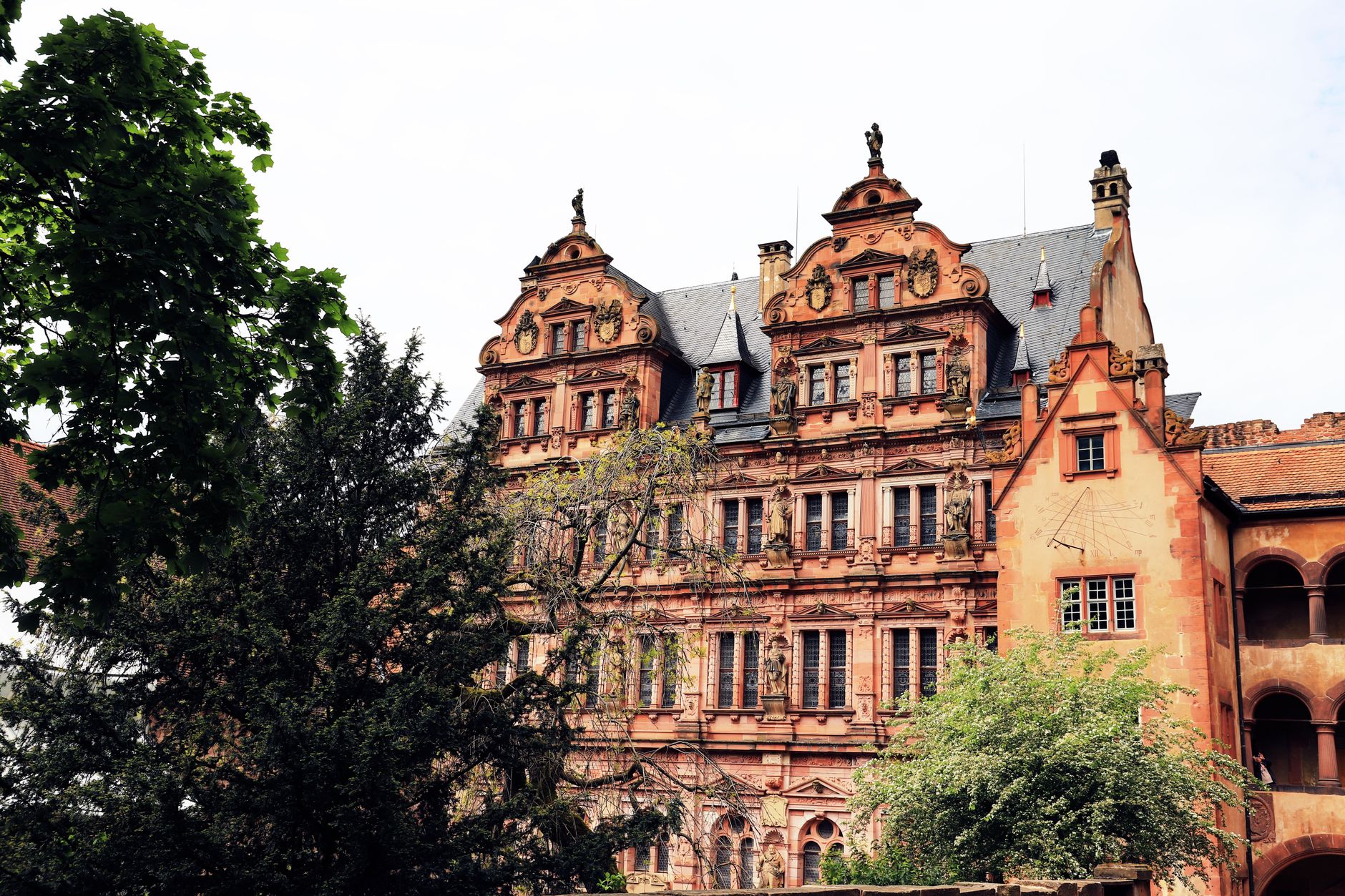
The ornate sandstone facade of Heidelberg Castle showcases the exquisite Renaissance craftsmanship found in Germaniya.
Ramon Karolan on Pexels · Pexels License
The historic Friedrich Building at Heidelberg Castle showcases stunning Renaissance architecture and detailed stone carvings in the heart of Germaniya.
Mayumi Maciel on Pexels · Pexels License
Practical Information
Getting There
Frankfurt Airport (FRA) is 55 min by direct regional train to Heidelberg Hbf; Stuttgart Airport (STR) needs 1 h 20 min via Stuttgart Hbf. Both stations sit under their terminals; no airport bus required. Drivers join the A5 at Heidelberg/Schwetzingen exit.
Getting Around
No subway—Heidelberg runs 6 tram lines and 30 city buses under the VRN network. A HeidelbergCARD (€25/1 day, €40/4 days) covers trams, buses, regional trains and the mountain funicular up to Königstuhl. VRNnextbike has 40 pick-up points; first 30 min free with card.
Climate & Best Time
January averages 3 °C, August 24 °C; rain is even across seasons. May–June and September give 15–22 °C walking weather with long light and fewer coach tours. July is warmest but also busiest; hotel prices drop 20 % after mid-September.
Safety
Heidelberg is low-violence, yet Bahnhofsvorplatz and Bismarckplatz have city-mandated video surveillance and a weapons-ban zone after dark. Pickpockets hit tram lines 21/24 during commuter rush—keep phones off outer pockets.
Where to Eat
Don't Leave Without Trying
Vetter's Alt Heidelberger Brauhaus
local favoriteOrder: House-brewed beer with pretzels, weisswurst, and the group 'Gaudi' pans — this is where locals actually drink.
Heidelberg's in-town brewery and the real deal for authentic German beer culture. Skip the tourist traps and come here where students and regulars have been since forever.
Coffee in
cafeOrder: Single-origin espresso or pour-over — these folks take their coffee seriously, not as an afterthought.
A no-nonsense specialty coffee spot on Plöck that gets it right. Perfect for morning ritual or an afternoon pick-me-up without the tourist theater.
Eiscafé PURO
quick biteOrder: House-made gelato — the flavors rotate but quality is consistent. Get a small and taste two or three.
Over 1,100 reviews speak to consistency and craft. This is where locals get serious gelato on Heidelberg's main drag.
Green Tea Cafe Konomi - Heidelberg
cafeOrder: Matcha or premium loose-leaf teas with light Japanese pastries or sweets — treat this as a proper tea ceremony, not a coffee shop.
A quiet, thoughtful escape on Plöck where tea is treated with the respect it deserves. Locals come here to slow down, not to Instagram.
Heart and Soul
cafeOrder: Coffee, simple breakfast, or homemade cakes — this is the kind of place that gets the basics right without pretension.
A genuine neighborhood spot in Bergheim where regulars outnumber tourists. This is what a good local cafe should feel like.
LINO'S Bar
local favoriteOrder: Cocktails made with care — ask the bartender what's good rather than ordering a tourist classic.
A serious cocktail bar in Bergheim with 459 reviews backing up the quality. This is where locals go when they want a real drink, not a theme-park experience.
Amoroso
cafeOrder: Espresso, gelato, or simple Italian pastries — this is a proper Italian spot, not a fusion experiment.
A slice of Italy in Heidelberg's old town with consistent quality and long hours. The kind of place where you can drop in anytime for a proper espresso.
Hotel Europäischer Hof Heidelberg
fine diningOrder: This hotel houses Die Kurfürstenstube, Heidelberg's Michelin-tracked fine-dining room — order the tasting menu or table-side steak tartare, Breton turbot, or salt-meadow lamb.
One of Heidelberg's established grand-hotel dining rooms with polished service and serious kitchen credentials. This is where you go for a special occasion done right.
Dining Tips
- check Weekly markets operate across the city — Altstadt Marktplatz on Saturday mornings (7:00–14:00) is the most central and popular.
- check Mahmoud's has two locations: Merianstr. 3 (touristy) and Bergheimer Str. 47 (less crowded) — both serve excellent falafel and shawarma.
- check Untere Straße is the local pub-and-snack strip where regulars drift for late drinks and bar food — it's more authentic than tourist-focused dining.
- check Most cafes in the old town don't take reservations — arrive early or expect a wait during peak hours.
- check German beer culture is serious here — order house beer by the half-liter (Halbe) and settle in.
Restaurant data powered by Google
Tips for Visitors
Dinner Early
Old-town kitchens open at 17:00–17:30; show up after 20:00 and the schnitzel is gone. Book ahead even for student pubs like Roter Ochsen.
Funicular Hack
Buy the combi ticket: castle courtyard + Molkenkur + Königstuhl for €12. It’s the same price as castle-only and saves a second queue.
Round-Up Tipping
Tell the server the total you want to pay—‘18, bitte’—when handing over cash. Leaving coins on the table looks touristy.
Castle Fire Nights
Illumination fireworks happen twice each summer (July & Sept). Arrive on the north bank by 21:30; the red-glow castle reflection is better than any postcard.
Philosophenweg Early
Be on the path before 08:00 and you’ll share the Neckar panorama with joggers, not bus groups. Sunrise lights the sandstone walls flame-orange.
Explore the city with a personal guide in your pocket
Your Personal Curator, in Your Pocket.
Audio guides for 1,100+ cities across 96 countries. History, stories, and local insight — offline ready.
Audiala App
Available on iOS & Android
Join 50k+ Curators
Frequently Asked
Is Heidelberg worth visiting or just a tourist trap? add
Heidelberg earns the hype. The castle ruins are genuine 13th-century stone, the university still enrolls 30,000 students, and you can drink local wine on terraces the Romantics actually wrote in. Stay east of the old town after dark and it feels like a living city, not a museum diorama.
How many days do I need in Heidelberg? add
Two full days cover castle, old town, Philosophenweg and a tavern night. Add a third if you want to hike Königstuhl, browse the Prinzhorn Collection or day-trip by train to Schwetzingen Palace.
Can you walk from Heidelberg station to the old town? add
Yes, 15 flat minutes straight down Kurfürsten-Anlage. If you’re loaded with bags, jump on bus 32 or 33; single ticket €2.50, drops you at Bismarckplatz on the edge of the pedestrian zone.
Is Heidelberg safe at night? add
Very. Even the student bar strip Untere Strasse empties peacefully around 02:00. Standard big-city rule: stick to lit streets, ignore the odd drunk freshman, and you’ll be fine.
Do I need cash in Heidelberg? add
Yes, plenty of taverns and bakeries are still cash-only or set a €10 card minimum. ATMs (Sparkasse, Volksbank) are everywhere, so don’t land with empty pockets.
Sources
- verified Heidelberg Marketing official site — Opening hours, ticket combos, festival dates and restaurant listings verified April 2026.
- verified Tourism Heidelberg – Sights — Details on castle funicular, Thingstätte history, Snake Path route and viewing times.
- verified Theater und Orchester Heidelberg — Schedules for Schlossfestspiele 2026 centenary and Stückemarkt theatre festival.
Last reviewed: