


Place
Germany Updated Apr 2026
Step off the train at Köln Hbf and the first thing that hits you is the sheer vertical audacity of the cathedral rising 157 metres straight out of the platform chaos. In Cologne, Germany, this Gothic monster has watched over a city that refuses to take itself too seriously. The contrast is perfect: stone that took 632 years to finish standing next to people who will buy you a Kölsch after five minutes of conversation.
 Photo: Thomas Wolf, www.foto-tw.de · CC BY-SA 3.0 DE
Built from cited sources · see the method · How we make our guides →
Cologne wears its layers openly. Roman sewer pipes sit beneath medieval churches which in turn sit beneath 1950s reconstructions that somehow feel lived-in rather than restored. Locals call their neighbourhoods Veedel and treat them with the loyalty usually reserved for football teams. The city’s famous openness isn’t marketing speak. It’s the practical result of having been flattened in the war and deciding not to rebuild the walls quite so high.
What moves you here is rarely the postcard view from the bridge. It’s the smell of incense and cold stone inside St. Gereon’s decagonal dome, the sound of a Köbes slamming down another 0.2-litre glass while pretending to be annoyed at you, and the realisation that this is a place that survived everything by choosing warmth over perfection.
Come for the cathedral if you must. Stay for the way the city quietly changes how you move through any city afterwards. Cologne doesn’t demand your awe. It simply refuses to let you remain a stranger.
Not every monument, just the ones we'd walk you past ourselves.


Where to wander, by quarter — each with its own rhythm.
Before you go
Curated from places in this city. Same price as official sites.




Prices shown are indicative — final pricing and availability are confirmed at checkout. Audiala may receive a commission from bookings made via these links.
From Roman colony to bombed ruin and back
Marcus Vipsanius Agrippa moved the Germanic Ubii tribe to the west bank. A fortified settlement appeared where nothing but marsh and forest had stood. The Romans already sensed the place would matter.
At the urging of Julia Agrippina, Emperor Claudius granted the settlement full colonial status. The city received her name: Colonia Claudia Ara Agrippinensium. Streets were laid in the rigid Roman grid that still dictates traffic today.
She was born here in the frontier settlement that would later bear her name. The girl who became Nero’s mother and one of Rome’s most powerful women never forgot her origin. Cologne still claims her as its most dangerous daughter.
Cologne appears in records as a bishopric. Christianity had already taken root among soldiers and merchants. The smell of incense began to compete with the scent of Rhine fish and Roman wine.
The last Roman defenders slipped away. Frankish kings made Cologne one of their residences. The city simply swapped one set of barbarian overlords for another and kept trading.
The emperor raised Cologne to archiepiscopal rank. From that moment the archbishops became the city’s de facto rulers, tax collectors, and military commanders. Their word was law for the next four centuries.
Archbishop Rainald brought the supposed relics of the Magi from Milan. Pilgrims flooded in. Cologne suddenly stood at the center of European devotion and the cathedral treasury grew rich beyond measure.
Fire destroyed the old cathedral. Work on the immense Gothic replacement started the same year. The cornerstone was laid while the city still smelled of smoke. It would take another 632 years to finish.
Citizens and their allies crushed the archbishop’s army. The prelate was forced to live outside the walls. Cologne effectively became a self-governing city that day, though it took another two centuries for the paperwork to catch up.
The city, not the church, established its own university. It became the fourth in the Holy Roman Empire. Scholars argued in the same streets where merchants counted barrels of herring.
After centuries of documented presence dating back to 321, the entire Jewish community was driven out. The medieval synagogue beneath today’s Rathaus was later turned into a chapel. The loss still echoes in the city’s oldest quarter.
Emperor Frederick III finally granted legal recognition of the independence Cologne had seized in 1288. The city answered only to the emperor. In practice it answered mostly to its own merchants.
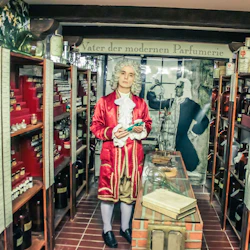
Johann Maria Farina created his revolutionary citrus-and-herb scent in a narrow house near the Rathaus. The perfume became the city’s most successful export since the Middle Ages. Napoleon later bathed in it by the liter.
An Italian immigrant from the Lake Como region settled in Cologne and changed the way the world smelled. His shop still stands. The recipe remains a family secret behind the same heavy wooden door.
Revolutionary armies occupied Cologne. The free imperial city ceased to exist overnight. Medieval privileges vanished, the university was closed, and Jews could finally stay overnight again.
After Waterloo the city passed to Prussia. Conservative Catholic Cologne suddenly found itself ruled by Protestant Berlin. The tension proved surprisingly fruitful.
A committee formed to organize the chaos. The first Rose Monday parade set off under Prussian eyes. Cologne turned its medieval mockery of authority into an annual civic ritual.
After 632 years the towers of Cologne Cathedral reached their intended height. The city celebrated while Prussian flags flew from the scaffolding. The building had outlasted every regime that started it.
A boy was born in a modest house in Cologne who would later run the city as mayor for sixteen years and then rebuild West Germany. The cathedral bells rang the day he arrived. He never stopped listening to them.
Kaiser Wilhelm II inaugurated the new steel bridge beside the cathedral. Its five arches still carry trains and lovers’ padlocks. The structure became the city’s most photographed silhouette.
The American company built its first European factory on the Rhine banks. Model Ts rolled out beside medieval church spires. The marriage of American capital and German engineering would survive everything that followed.
On the night of 30 May, 1,455 tons of bombs fell in ninety minutes. The old town burned for days. When the smoke cleared, only the cathedral still stood above the ruins, black and defiant.
American troops fought house to house through the shattered city in March. The population had shrunk from 800,000 to 40,000. The cathedral, miraculously spared, looked down on tanks rolling past its blackened walls.
The soldier-turned-writer came home to a city of rubble. He spent the rest of his life writing about what the war had done to ordinary people here. Cologne still reads him to remember.
The building that had watched over every transformation of the city received global recognition. Tourists now outnumber the medieval pilgrims by several orders of magnitude.
A subway tunnel project caused the city archive to cave in, killing two people and burying 1,000 years of documents under wet earth. Cologne lost part of its memory in a single morning.
Roman Empress · AD 15–59
Born here
She convinced her uncle Emperor Claudius to elevate her birthplace to Colonia Claudia Ara Agrippinensium, the only Roman colony named after a woman. Without her the city would not have received its first name. Today she would probably find the cathedral amusingly oversized compared with the modest Roman structures she knew.
Perfumer · 1685–1766
Created his signature scent here
In 1709 he mixed the first Eau de Cologne in a house near the cathedral. The light citrus scent became a European obsession. He would still recognise the fragrance museum that carries his name, though the crowds buying miniature bottles might surprise him.
First Chancellor of West Germany · 1876–1967
Born and served as mayor here
As lord mayor he rebuilt Cologne’s infrastructure and stubbornly refused to leave even when the Nazis stripped him of office. After the war he turned the ruined city into a symbol of new Germany before moving to Bonn. He would notice how many of his tram lines are still running.
Novelist and Nobel laureate · 1917–1985
Born and lived here
He wrote some of the sharpest postwar German literature while living among the rubble of his bombed hometown. His stories of ordinary people in destroyed Cologne still read true. The city’s direct, slightly cynical tone owes something to his voice.
Where locals actually book dinner — not the tourist menus.
Small things that change how the city treats you.
The city, as it actually looks.
Yes, if you like cathedrals that still feel alive, Romanesque churches older than most European capitals, and a city that refuses to be polished. The contrast between the Gothic tower and the relaxed pub life around it is hard to find elsewhere.
Three full days work for most people. One for the Dom, Altstadt and river loop, one for museums and the Romanesque churches, and one for a neighbourhood like Ehrenfeld or Belgian Quarter plus a day trip to Brühl. Four days feels generous.
The central tourist zone around the cathedral and Altstadt is safe at all hours. Pickpocketing happens on crowded trains and at the station at night. Standard big-city awareness is enough.
Buy a 24-hour KVB ticket or the KölnCard. The U-Bahn, trams and buses are frequent. Everything between the cathedral and Rheinauhafen is walkable in under 30 minutes.
April to June or September and October. Carnival in February is overwhelming but memorable. July and August get hot and the Christmas markets in December are crowded but atmospheric.
Brewery meals and Kölsch are cheap. Museum Ludwig or a tower climb cost around €15–18 each. Fine-dining at Ox & Klee is expensive. Overall it sits in the middle for German cities.
155 places to discover






Showing 1–48 of 155 places
Saved and recently read places — kept on this device only.
Photos may have been resized or cropped.