


Place
Italy Updated Oct 2026
At Porta all’Arco, weathered Etruscan heads look out from blocks of sandstone older than Rome’s empire. In Volterra, Italy, ancient gates open onto medieval lanes, and the wind off the Tuscan hills seems to move through both at once.
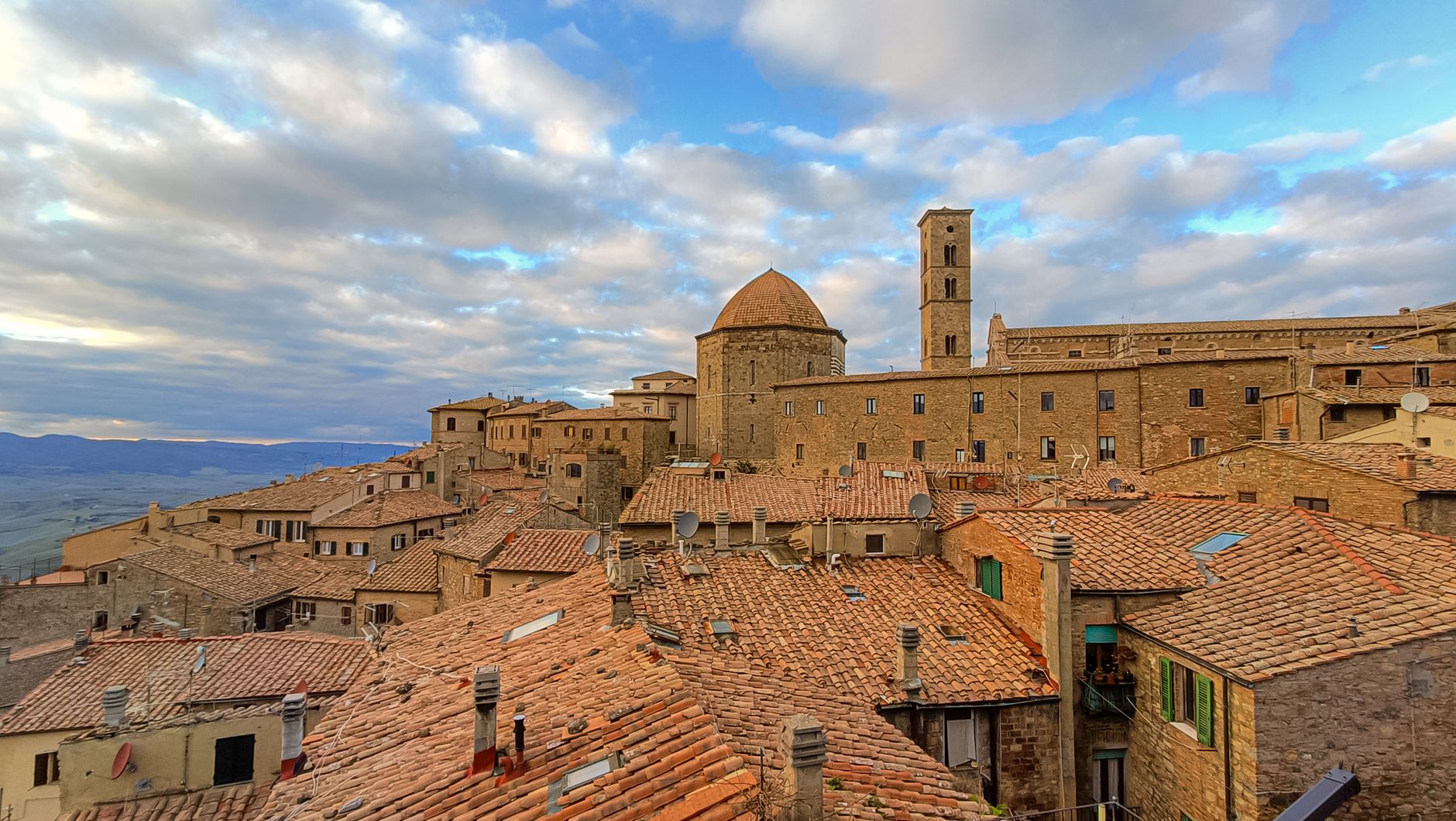 Photo: Alberto Brunello / Pexels
Built from cited sources · see the method · How we make our guides →
The Guarnacci Etruscan Museum gives this deep past a human scale: its 3rd-century BC bronze figure, L’Ombra della Sera, is startlingly slender, while the Urna degli Sposi shows an elderly couple sharing a banquet couch. More than 600 carved funerary urns fill the rooms; outside, alabaster workshops keep an ancient local craft in motion.
In Piazza dei Priori, the stone Palazzo dei Priori was begun in 1208 and completed in 1257, making it the oldest standing civic palace in Tuscany. Below the northern walls, the 1st-century BC Roman theatre descends into the hillside, its stone seating still legible against the sky.
Volterra’s history is not sealed behind its walls: the Medici fortress now houses a prison, where the Compagnia della Fortezza has made theatre with incarcerated actors since 1988. Between the fortress and the old center, order a bowl of zuppa alla Volterrana or pecorino delle Balze Volterrane; the town’s past feels less like a timeline than a daily ingredient.
Not every monument, just the ones we'd walk you past ourselves.


Where to wander, by quarter — each with its own rhythm.
Before you go
From Etruscan Velathri to a Tuscan hill town shaped by conquest and craft
By the late Bronze Age, people had settled on Volterra’s high sandstone plateau, above the Cecina and Era valleys. The height offered defensible ground, fertile country, and access to metals and salt.
Villanovan communities developed into the Etruscan city of Velathri, one of the leading centers of northern Etruria. Its tombs and early imports hint at far-reaching trade, while local families began shaping a city with power beyond its hilltop.
At its Etruscan height, Velathri enclosed about 116 hectares within a stone circuit roughly 7.3 kilometers long. Porta all’Arco, built from massive sandstone blocks and marked by three weathered heads, still gives a sense of the city’s guarded threshold; Etruscan artisans also carved local alabaster into funerary urns.
Velathri entered a treaty relationship with the expanding Roman Republic, surrendering much of its independence in foreign affairs while retaining local aristocratic rule. Rome’s influence arrived first through obligations and alliances, not the sudden erasure of Etruscan life.
During the Second Punic War, Volaterrae supplied grain, iron, and ship timber for Scipio Africanus’s campaign against Carthage. The contribution carried the city’s resources into a conflict fought far beyond Tuscany.
Volaterrae backed the Marian cause in Rome’s civil war, and Sulla’s forces besieged its defenses from 82 to 80 BCE. When the city capitulated, Sulla stripped it of municipal rights and seized surrounding land for veteran settlements.
In the Augustan age, the wealthy Caecina family helped build a Roman theatre into the slope at Vallebuona, where its stone seating could hold thousands. Centuries later, after performances ceased, baths spread across parts of the site; their ruins still press against the theatre’s curved tiers.
Aulus Persius Flaccus was born in Volaterrae into a prominent local family, then left for Rome as a boy to study rhetoric and Stoic philosophy. His sharp, compressed satires later took aim at greed and hypocrisy in the imperial capital, carrying a Volterran childhood into Roman literature.
As western Roman authority faltered, Volterra became the seat of a Christian diocese. The bishop’s presence gave the city a new center of power, one that would outlast the empire’s hold on Tuscany.
Camaldolese monks founded the Abbey of Saints Justus and Clement near the steep drop now known as Le Balze. Its position joined solitude to a sobering view of the ground slowly falling away beneath the city.
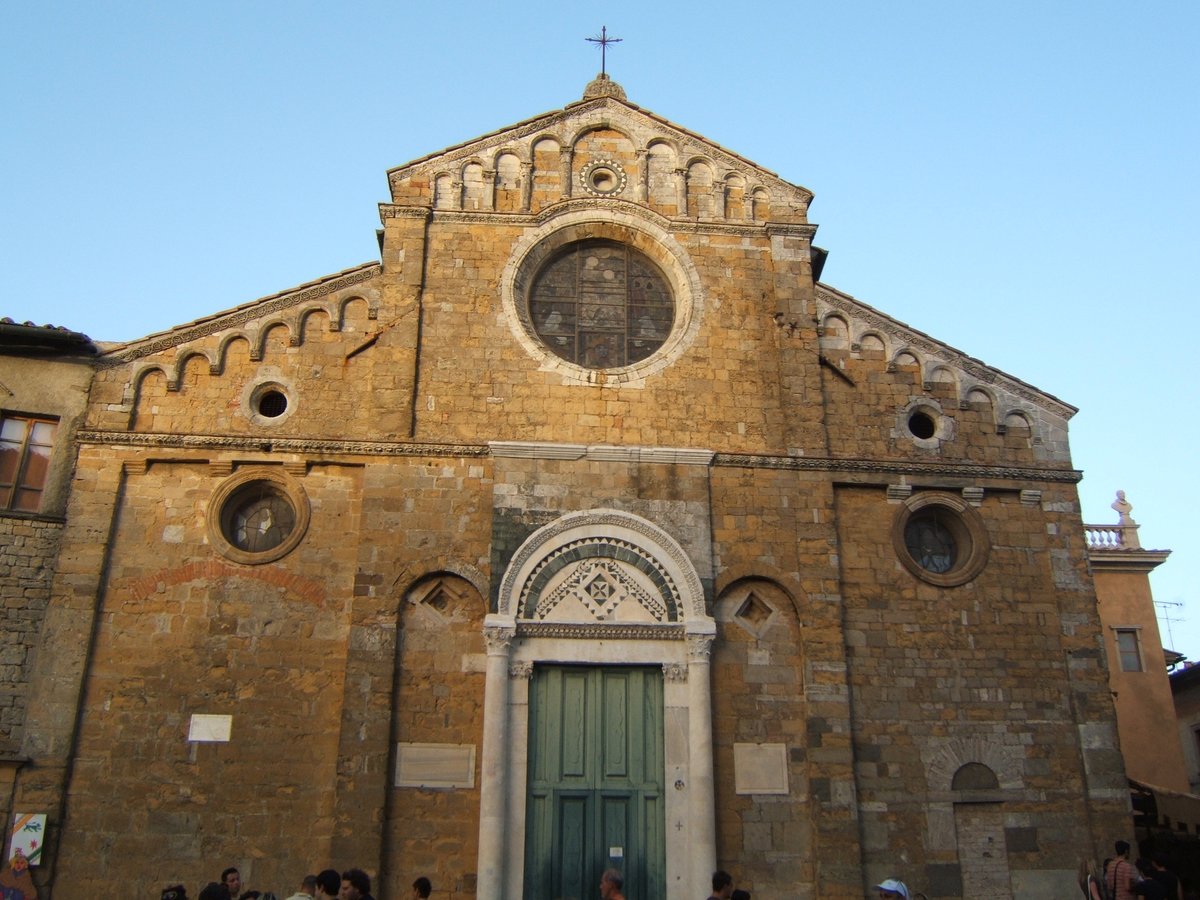
Pope Callixtus II consecrated the Cathedral of Santa Maria Assunta, a Romanesque church that anchored Volterra’s episcopal authority. Inside, later gilding and carved details softened the sober stone, but the building’s medieval bones remain plain to see.
By the late 12th century, Volterra’s citizens had established a free commune and begun limiting the bishop’s temporal rule. Civic authority took shape in councils and public offices, setting the stage for a town hall built to make that change visible.
Construction began on the Palazzo dei Priori in Piazza dei Priori, finishing in 1257 as the oldest surviving civic palace in Tuscany. Its stern stone front made municipal government part of the street; the building later served as a model for Florence’s Palazzo Vecchio.
Walter VI of Brienne, briefly ruler of Florence, imposed his authority on Volterra and built the Rocca Vecchia, or Cassero, to keep the city’s factions in check. The fortress left a hard-edged reminder that civic independence could be watched from above.
The Black Death struck Volterra, killing a large share of its population and shaking an already fragile economy. Behind the city’s walls, empty houses and interrupted trades weakened the commune’s ability to resist outside pressure.
The Belforti family’s signoria ended amid civic revolt and Florentine pressure. Volterra retained communal institutions, but its freedom of action narrowed as Florence’s influence grew.
A dispute over lucrative alum mines turned into revolt against Florence, and Lorenzo de’ Medici sent Federico da Montefeltro with an army to besiege the city. Volterra surrendered on June 16; two days later, troops sacked it, looting homes and churches before Medici forces began a new fortress to hold the city down.
Born in Volterra, Daniele Ricciarelli kept his hometown in his artistic name. He painted an early Massacre of the Innocents for the city’s church of San Pietro before building a career in Rome alongside Michelangelo.
Rosso Fiorentino painted his Deposition from the Cross for the Compagnia della Croce di Giorno in Volterra. The figures seem caught in a cold, unsettled light, far from the calm balance prized by earlier Renaissance painters.
After the Florentine Republic fell, Volterra came under the Medici state led by Cosimo I. In 1569, Tuscany became a grand duchy, formalizing a political order in which the old commune no longer ruled itself.
The Medici line ended with the death of Gian Gastone, and Volterra passed under Habsburg-Lorraine rule. The change of dynasty did not remove the Tuscan state, but it opened a new chapter in how its resources and institutions were managed.
Volterran prelate and antiquarian Mario Guarnacci donated his collection and library to the city, founding the Museo Etrusco Guarnacci. Its rows of funerary urns and the slender bronze known as L’Ombra della Sera gave Etruscan objects a public home rather than leaving them in private cabinets.
An earthquake struck the Pisan hills on August 14, damaging buildings around Volterra and destabilizing the cliffs at Le Balze. The Camaldolese monks abandoned the Abbey of Saints Justus and Clement, leaving its ruins exposed to the same erosion that had been reshaping the edge of the plateau for centuries.
Volterran voters backed the annexation of Tuscany to the Kingdom of Sardinia, soon part of unified Italy. The decision shifted sovereignty once more, this time from a regional grand duchy to a national state.
Volterra established a psychiatric hospital in the former convent of San Girolamo, an institution that grew into one of Italy’s largest asylums. Its history would be measured in thousands of patients, long corridors, and lives largely hidden from the city beyond its grounds.
As German forces retreated, local partisans fought rearguards in the surrounding hills and transport links were damaged. Allied troops liberated Volterra in early July, ending German occupation but leaving the region marked by the retreat.
Patient Fernando Oreste Nannetti, known as NOF4, engraved a sprawling work into the plaster wall of the asylum’s Ferri building with a belt buckle. The 180-meter line of words, diagrams, and imagined machinery turned a hospital wall into a work of outsider art—and a record of one man’s inner world.
Italy’s psychiatric reform, known as the Basaglia Law, led to the closure of Volterra’s asylum. The institution’s gates no longer defined the lives of its patients, though its buildings and Nannetti’s wall kept difficult questions in view.
After heavy winter rain, a roughly 30-meter section of medieval wall collapsed at Piazzale Mazzini. The fall made visible the ongoing struggle between stone and water at Volterra’s edge, where erosion has been claiming ground since antiquity.
Volterra was named the inaugural Tuscan Capital of Culture. The designation brought present-day attention to a city whose identity still rests on layers of Etruscan, Roman, medieval, and modern history.
Roman poet and satirist · 34–62
Born in Volterra and raised there until about age twelve
Persius left ancient Volaterrae for Rome at about twelve, carrying his Etruscan hometown into the sharp, austere satire that made him famous. He might be pleased that Volterra still makes antiquity feel close—and find plenty to satirize in the modern souvenir trade.
Renaissance painter and sculptor · c. 1509–1566
Born in Volterra
Ricciarelli carried his birthplace into his signature, becoming known as Daniele da Volterra after leaving to train and work elsewhere. His later nickname, Il Braghettone, came from painting modesty drapery onto Michelangelo’s Last Judgment; back in Volterra, he might be surprised to find that the nickname still competes with his art for attention.
Where locals actually book dinner — not the tourist menus.
Small things that change how the city treats you.
The city, as it actually looks.


Yes—Volterra brings Etruscan, Roman and medieval history together in a compact hilltop town. The Guarnacci Museum’s bronze Shadow of Evening and the Roman Theatre give the visit a different feel from a day spent only among Tuscan medieval towers.
Plan one full day for the historic center, its museums and the Roman Theatre. A second day gives you time to visit Le Balze or the Badia Camaldolese without rushing the town’s steep lanes.
Not directly to the town: Volterra has no mainline train station within its walls. A common public-transport route is a train from Florence to Pontedera, then Autolinee Toscane bus 500 to Volterra; check both schedules before you travel.
The compact historic center is best explored on foot, but expect slopes, stairs and uneven stone paving. If you arrive by car, park outside the ZTL; the underground Piazza dei Macelli car park has elevator or escalator access toward the center.
Volterra is generally a quiet and safe town for visitors, with violent crime rare. Take care on slick cobbles and near the eroded edges at Le Balze; the European emergency number is 112.
A 72-hour Volterra Card costs about €15–16 and can be worthwhile if you visit at least two included civic attractions. Restaurant menus commonly list a €1.50–€3 coperto per person, while parking rates are around €2 per hour; check current prices locally.
April to June and September to October are good months for walking and valley views, with milder temperatures than midsummer. July and August are hotter and busier, while November is the wettest month in the climate data provided.
11 places to discover
Saved and recently read places — kept on this device only.
Photos may have been resized or cropped.