

Place
Slovenia 已核实 Mar 2026
Most European capitals announce themselves with scale — wide boulevards, monumental squares, the sheer weight of imperial ambition. Ljubljana, Slovenia's compact capital, does the opposite. It pulls you inward: narrow riverbanks lined with café tables, a car-free center that feels more like an architect's living room than a city, and a hilltop castle you reach by funicular in under a minute.
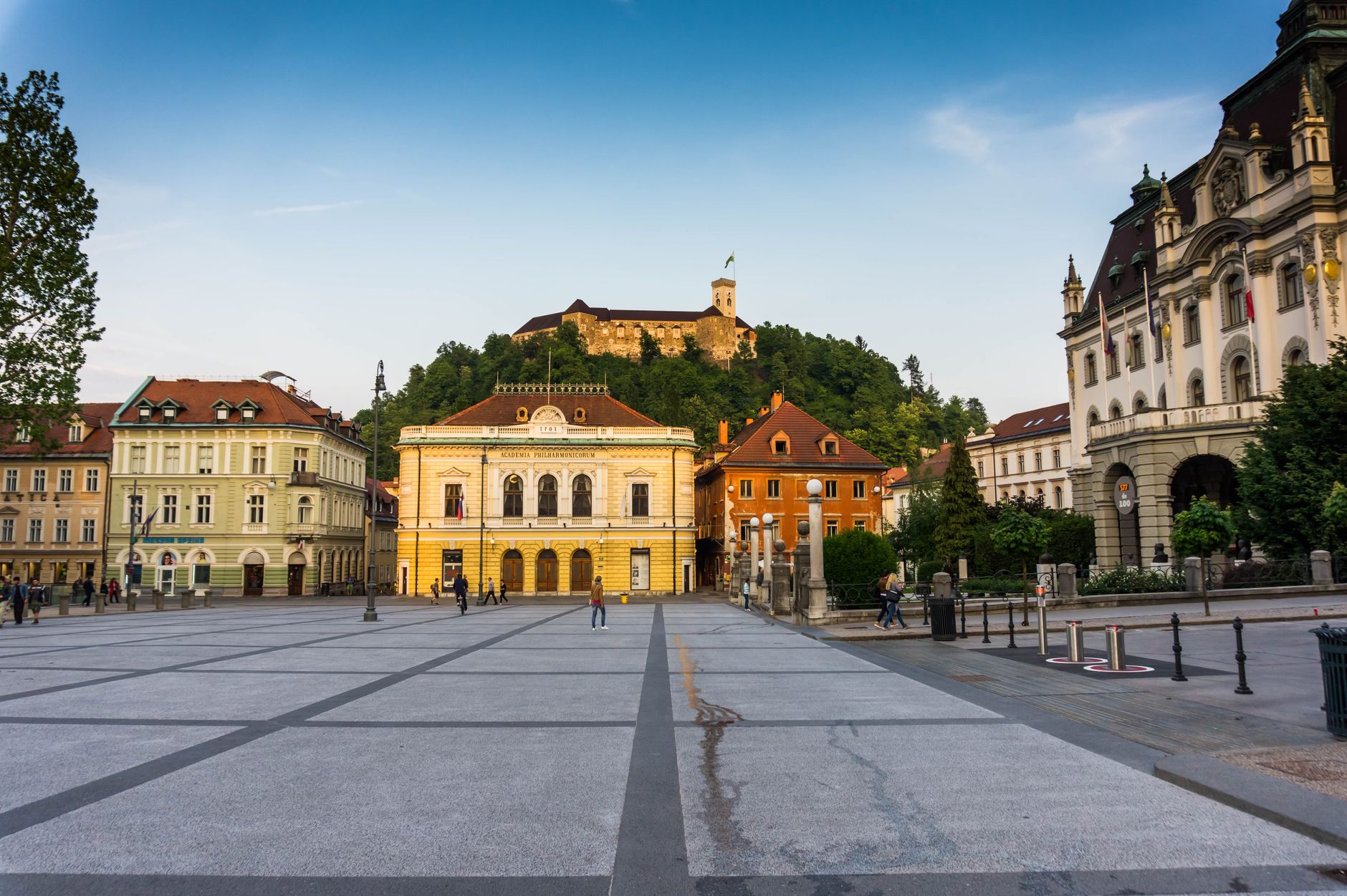 图片: Bogdan R. Anton / Pexels
内容来自注明出处的资料 · 查看方法 · 我们如何制作导览 →
The architect who shaped all of this was Jože Plečnik, and his influence on Ljubljana is so pervasive that UNESCO inscribed an entire network of his interventions — bridges, embankments, market colonnades, a cemetery, a church, a library — as a single heritage site. Where Gaudí gave Barcelona fantastical punctuation marks, Plečnik gave Ljubljana its grammar: the way the river meets the street, the way a bridge widens into a small square, the way a colonnade turns a market into a civic theater. Walk from the Triple Bridge to the Central Market on a Friday morning, when the Open Kitchen fills the embankment with smoke and conversation, and you are moving through his vision of a city built for human-paced life.
But Ljubljana is not a museum of one man's ideas. Beneath the medieval old town lie the stones of Roman Emona — wall fragments at Mirje, an archaeological park near Congress Square — giving the city a timeline that stretches back two thousand years. Above the Baroque facades of the cathedral and the Town Hall, the 1933 Nebotičnik skyscraper still offers one of the best panoramas in town, a reminder that this was once the tallest building in the Balkans. And at Metelkova, a former military barracks turned autonomous cultural zone, the walls are covered in murals and the clubs don't really start until midnight.
What makes Ljubljana genuinely unusual is the ratio of cultural density to physical size. The city hosts more than 14,000 events a year — opera, experimental theater, street performance, electronic music, graphic arts biennials — packed into a center you can cross on foot in twenty minutes. The rhythm here is not about ticking off sights. It is about slowing down: a long coffee, a market lunch, wine along the river as the light turns gold on the willows, then choosing between a concert at Križanke, a gallery opening at Cukrarna, or losing yourself in Metelkova's labyrinth after dark.
按区漫步——每个街区都有自己的节奏。
出发之前
From marsh dwellers and Roman legions to Plečnik's bridges and Europe's greenest city
Long before anyone imagined a city here, communities built wooden houses on stilts above the Ljubljana Marshes. They left behind the oldest known wooden wheel with an axle — about 5,200 years old — now one of Slovenia's most prized archaeological objects. These wetland settlements were eventually inscribed on the UNESCO World Heritage List in 2011, a quiet vindication for people who chose to live above water rather than on solid ground.
After decades of military encampment, Rome built Iulia Aemona as a proper town — paved streets, sewers, mosaics, even central heating. The population settled around 5,000 to 6,000, modest by imperial standards but enough to make it a real urban node on the road between Aquileia and Pannonia. Emona's stone walls and gridded layout set the template for a city that would be destroyed and rebuilt many times over.
The Huns swept through and left Emona in ruins. The Roman city never recovered in any meaningful sense. Within a century and a half, Slavic settlers would arrive and begin building something new around Castle Hill, effectively starting the city's history over from scratch. The Roman grid vanished under medieval growth, though fragments of Emona's walls still surface during construction projects today.
The settlement appears in documents as Laibach — the first written proof that the cluster of houses beneath the castle hill had become something worth naming. Within a century, the town would grow into three distinct cores: Stari trg, Mestni trg, and Novi trg, ringed by walls, entered through five gates, and linked by just two bridges over the Ljubljanica. Medieval Ljubljana was small, but it already had the river-and-castle geography that defines it today.
After Ottokar II of Bohemia's brief hold, the city passed to the Habsburg dynasty following the Battle of Marchfeld. It was the beginning of a relationship that would last until 1918 — more than six hundred years. By 1335, Ljubljana was capital of the province of Carniola, a role that gave it administrative weight but also locked it into a German-speaking imperial hierarchy that Slovene speakers would spend centuries pushing against.
The founding of the Diocese of Ljubljana elevated the town's status and turned the church of St Nicholas into a cathedral. Eight years later, Turkish raiders burned it. The present Baroque cathedral, built between 1701 and 1706, replaced what fire and time had consumed. The diocese gave Ljubljana spiritual authority to match its administrative role — a city that was both seat of government and seat of a bishop carried more weight in the Habsburg world.
A major earthquake shattered Ljubljana's medieval fabric and forced a wholesale reconstruction in Renaissance style. New walls went up, streets were replanned, and the city's appearance shifted from Gothic to something more consciously designed. It was the first of two earthquakes that would function as architectural reset buttons — each time, Ljubljana emerged looking like a different city entirely.
Primož Trubar published a Catechism and an Abecedary — the first printed books in the Slovene language, produced in the heat of the Protestant Reformation. Ljubljana became the nerve center of Slovene literacy: a school, a library, a printing house. Trubar explicitly used Ljubljana speech as his linguistic foundation, which means the standard Slovene language carries the sound of this city in its bones. The Counter-Reformation eventually shut it all down, but the books survived.
The founding of the Academia Operosorum signaled that Ljubljana wanted to be more than a provincial seat — it wanted intellectual life. Eight years later, the Academia Philharmonicorum followed, one of the earliest musical societies of its type outside Italy. Between the two academies and the Baroque rebuilding of St Nicholas Cathedral (1701–1706), the turn of the eighteenth century gave Ljubljana a cultural infrastructure that punched above its demographic weight.
The Venetian sculptor Francesco Robba spent years carving a fountain of three Carniolan rivers that became the city's finest piece of Baroque public art. Robba had moved to Ljubljana and made it his working home, producing sculpture for churches, palaces, and public spaces across the region. The fountain, finished around 1751, remains one of the clearest statements that this small Habsburg capital could attract and sustain serious artistic talent.
Born in 1800, Prešeren moved to Ljubljana at twelve and spent most of his life there, writing the poems that would make him Slovenia's national literary voice. His verse gave Slovenes a Romantic literature of European stature at a time when the language itself was fighting for recognition. Today the city's central square bears his name, his statue gazes across it, and a stanza from his poem became Slovenia's national anthem. No single person is more embedded in Ljubljana's public identity.
French forces occupied the city and made it the capital of the Illyrian Provinces — a brief but charged experiment. For the first time, Slovene was recognized as an official language in administration. Napoleon also established Ljubljana's first college and planted the seed for the Botanical Garden, founded in 1810. The French left in 1813, but the taste of linguistic and political recognition did not fade; it fed Slovene national aspirations for the rest of the century.
From January to May, the crowned heads and diplomats of post-Napoleonic Europe gathered in Ljubljana for the Congress of Laibach, one of the periodic summits that managed the continent's conservative order after Waterloo. For a few months, this small provincial capital hosted the business of empires. The congress left little lasting mark on the city's fabric, but it placed Ljubljana on the map of European diplomacy — briefly, vividly, and never quite again.
The opening of the rail connection to Vienna broke Ljubljana out of its geographic isolation and accelerated everything: industry, migration, ideas, nationalism. A sugar refinery, brewery, foundry, and textile works followed. By 1890 the city had modern waterworks, and by 1898 electric lighting and sewerage. The railway didn't just connect Ljubljana to Vienna — it connected it to the industrial nineteenth century.
The man who would reshape Ljubljana more than any earthquake was born there in 1872, the son of a carpenter. After studying under Otto Wagner in Vienna and teaching in Prague, Plečnik returned home in 1921 and spent three decades turning a modest Habsburg town into something singular — bridges, embankments, colonnades, a library, a cemetery, a market. His work was inscribed on the UNESCO World Heritage List in 2021. No other European capital of this size owes so much of its visual identity to one architect.
At 23:17 on April 14, an earthquake of roughly magnitude 6.1 struck Ljubljana, killing 21 people and damaging about 10 percent of the city's 1,400 buildings. Over a hundred aftershocks followed in the next days. But the reconstruction of 1896–1910, overseen by Mayor Ivan Hribar, rebuilt the city in Vienna Secession style and gave Ljubljana its second great architectural reset. What the earthquake took away in medieval fabric, it returned in Art Nouveau confidence.
Built in 1900–1901 as one of Europe's early large reinforced-concrete bridges, the Dragon Bridge became Ljubljana's most recognizable symbol almost immediately. Four copper dragons guard its corners — originally a Habsburg loyalty gesture, now simply the city's mascot. The bridge was both an engineering milestone and a piece of Art Nouveau sculpture, the kind of structure that makes you stop on the way somewhere else and stay longer than you planned.
After centuries as a provincial Habsburg capital denied its own university, Ljubljana finally established the University of Ljubljana in 1919, one year after the empire collapsed. The city had become the political and cultural center of the Slovene nation within the new Kingdom of Serbs, Croats and Slovenes. A university meant that young Slovenes no longer had to leave for Vienna, Graz, or Prague to get an education — the intellectual center of gravity shifted permanently.
In a burst of activity, Plečnik added two pedestrian bridges flanking the existing central bridge to create the Triple Bridge, then built the Cobblers' Bridge nearby, and began reshaping the Ljubljanica embankments into the tree-lined, café-bordered promenades that define the city today. By the time he finished the Central Market colonnade and the National and University Library in the early 1940s, Ljubljana had become an open-air gallery of one man's architectural vision.
Italian occupation forces ringed Ljubljana with a barrier of barbed wire, 206 guard towers and bunkers, patrolled by roughly 1,700 soldiers and police. For 1,170 days the city was a sealed cage. Around 150 hostages were shot within it; from the wider Ljubljana region, 25,000 to 30,000 people were interned. After Italy's capitulation in 1943, German forces took over until liberation on May 9, 1945. The Path of Remembrance and Comradeship now traces the exact line of the wartime fence — a 34-kilometer walking loop through suburban Ljubljana that most tourists never see.
The philosopher who would become the world's most famous living Slovenian was born in Ljubljana in 1949. He stayed, building the 'Ljubljana school' of psychoanalysis and Lacanian philosophy that drew international attention from the 1980s onward. Žižek made Ljubljana a place name in continental philosophy — proof that a city of 300,000 could generate ideas that traveled as far as any from Paris or Berlin.
After a brief ten-day war, Slovenia declared independence from Yugoslavia, and Ljubljana became the capital of a sovereign European state for the first time in its history. The transition was remarkably smooth compared to the bloodshed elsewhere in the former Yugoslavia. The city pivoted quickly from socialist federal capital to small European democracy, joining the EU in 2004 and the eurozone in 2007.
Artists and activists occupied a complex of abandoned military barracks near the train station and turned it into Metelkova, Ljubljana's autonomous cultural zone. Covered in murals, hosting concerts and exhibitions in repurposed cells and drill halls, Metelkova gave the city an edge that its elegant Plečnik-designed center didn't provide. It remains Ljubljana's clearest link to the punk and alternative energy of 1980s Yugoslavia — a deliberate counterweight to the postcard prettiness across the river.
The basketball prodigy who would become one of the NBA's brightest stars was born in Ljubljana and started playing organized ball in the city as a child before moving to Real Madrid's youth academy at thirteen. Dončić put Ljubljana on the global sports map in a way that few athletes from cities this size ever manage. For a generation of fans, his origin story begins here.
Ljubljana earned the European Green Capital title — the first city from the former Eastern Bloc to win it. The award recognized years of pedestrianizing the center, expanding cycling infrastructure, restoring the Ljubljanica riverbanks, and building waste management systems that pushed the city toward zero waste. The car-free core that visitors now take for granted was a deliberate political choice, made visible in closed streets and opened cafés. Green wasn't just branding; it was urban policy.
On July 31, selected works of Jože Plečnik in Ljubljana were inscribed on the UNESCO World Heritage List — recognition not of a single building but of an entire architectural vision applied across a city. The Triple Bridge, the Library, the Market, the embankments, the Žale cemetery: together they form one of the most complete examples of a single architect reshaping a national capital. Sixty-four years after Plečnik's death, the world formally agreed with what Ljubljana's residents already knew.
Architect · 1872–1957
Born here, reshaped the city 1920s–1950s
Plečnik returned to his native Ljubljana in 1921 and spent three decades turning it into his personal urban laboratory — redesigning bridges, embankments, markets, a cemetery, and a library into a connected human-scaled vision that UNESCO eventually recognized as a single masterwork. Walk from the Triple Bridge to the Central Market colonnade to the National Library and you're tracing one man's obsession with making a small city feel both ancient and radically modern. Today's pedestrianized, river-centered Ljubljana is essentially the city he imagined.
Poet · 1800–1849
Lived and worked here
Prešeren wrote the verses that became Slovenia's national anthem while living in Ljubljana, and the central square that bears his name — with his bronze statue gazing toward the window of his unrequited love Julija Primic — is still the emotional heart of the city. His poetry gave Slovenian its literary prestige at a time when the language had no state behind it. The square where locals meet, protest, celebrate, and people-watch is named for a man who died convinced he was a failure.
Writer · 1876–1918
Lived and worked here
Cankar is Slovenia's most important modern writer, and Ljubljana's largest cultural center — Cankarjev dom — carries his name. He wrote about poverty, class, and Slovenian identity with a sharpness that still unsettles, and his time in Ljubljana shaped much of that anger. The massive Ravnikar-designed congress center on Trg republike is an unlikely monument to a writer who spent much of his life broke.
Architect · 1907–1993
Worked here throughout career
If Plečnik gave Ljubljana its human-scaled old center, Ravnikar gave it its modernist civic face. His Trg republike complex and Cankarjev dom are the boldest pieces of socialist-era architecture in the city — monumental without being brutal, confident in their concrete geometry. He studied under both Plečnik and Le Corbusier, and the tension between those two influences plays out across Ljubljana's postwar skyline.
Painter · 1869–1943
Born and worked here
Jakopič led the Slovenian Impressionists who gave the country its first internationally recognized art movement, painting Ljubljana's light and landscape with a warmth that still defines how Slovenians see their own countryside. The Jakopič Gallery in Ljubljana's Šubičeva carries his name and continues to host major exhibitions. His canvases hang in the National Gallery a few hundred meters away — walk between the two and you're crossing the territory he made his own.
Fresco painter · 1668–1751
Worked here early 1700s
The Italian Baroque painter came to Ljubljana and covered the interior of St. Nicholas Cathedral with frescoes so vivid and spatially dizzying that they remain the most powerful single art experience in the old city. Look up in the nave and you see his work — illusionistic architecture dissolving the ceiling into painted sky. Ljubljana's Baroque identity owes more to this imported Italian than most visitors realize.
本地人真正会去订位的地方——而非游客菜单。
每年三月中旬至十月,每逢周五,中央市场廊柱下便会变身卢布尔雅那最热闹的户外美食集市。数十家本地餐厅设摊,摩肩接踵地挤在普莱车尼克设计的河畔拱廊之间。这里吃饭的是真正的卢布尔雅那人,竞争激烈造就了货真价实的水准,绝非专为游客打造的表演。
以白软干酪、龙蒿、核桃或罂粟籽为馅,卷成条状后水煮或烘烤,可作配菜,亦可当甜点。其中龙蒿口味(pehtranova)最具斯洛文尼亚特色——这种香草在欧洲其他地方几乎不以这种方式入馔,尝过一次便难以忘怀。
来自伊德里亚的小帽形面饺,传统上以土豆、洋葱和猪油为馅,淋上肉酱或黄油上桌。这道菜已获欧盟原产地保护认证,在卢布尔雅那各餐厅菜单上以本地骄傲的姿态出现——介于意大利馄饨与东欧饺子之间,却自成一格,独树一帜。
每逢斯洛文尼亚节庆必不可少的卷糕,一年四季在卢布尔雅那各面包店均有售卖。经典核桃馅带着微苦的浓郁香气;龙蒿和罂粟籽口味则更适合口味大胆者。在中央市场买一片尝尝,或在餐厅点来当甜点,都是不错的选择。
出自卢布尔雅那以南喀尔斯特高原的风干腌肉,完全靠博拉风的吹拂慢慢成就。这里的风干火腿比边境对岸的意大利同类更瘦、更有嚼劲——配上一杯Teran红酒,在老城任意一家认真的酒吧里小酌,是最地道的吃法。
以酸菜或芜菁、豆子和土豆慢炖至浓稠,汤匙插入几乎不倒。这是来自喀尔斯特和维帕瓦地区的冬日暖食,天气转凉后便会出现在卢布尔雅那的餐厅菜单上——朴实无华,却有一种直抵人心的踏实满足感。
斯洛文尼亚的橙酒传统——尤以戈里什卡·布尔达和维帕瓦谷地为盛——比当今全球自然酒热潮早了数百年。卢布尔雅那的老城周边藏着Tozd等一批认真的酒吧和葡萄酒商店,浸皮白葡萄酒与生物动力红酒一应俱全,价格之亲民,在巴黎或伦敦根本无从想象。
这道发源于附近布莱德的甜点如今已在卢布尔雅那各糕点店安营扎寨:酥脆千层酥皮夹着香草卡仕达酱与鲜奶油,表面撒上糖粉。构造简单,却做得分毫不差——配一杯浓咖啡,坐在河边露天咖啡座慢慢享用,再合适不过。
一些小事,会改变这座城市待你的方式。
这座城市真实的模样。


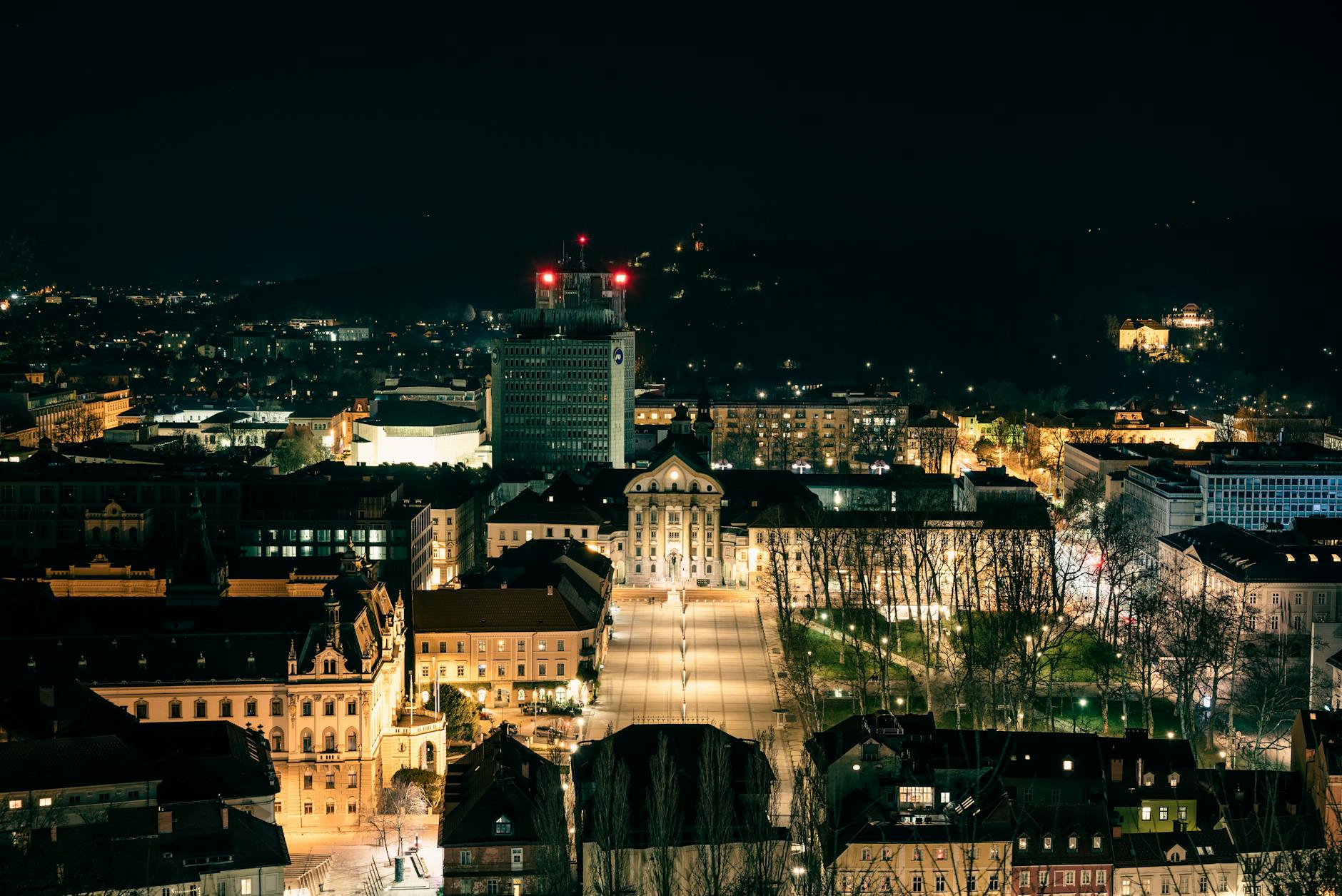


Yes — Ljubljana is one of Europe's most walkable and design-coherent small capitals. Jože Plečnik reshaped it the way Gaudí reshaped Barcelona, and the UNESCO-listed result is a city where bridges, markets, embankments, and churches form a single connected urban artwork. Add a car-free center, strong café culture, and easy day trips to Lake Bled and Postojna Cave, and you have a city that punches well above its size.
Two full days cover the Old Town, castle, Plečnik landmarks, Central Market, and river life comfortably. A third day lets you explore Metelkova, Tivoli Park, and museums like the City Museum or National Gallery. If you want day trips to Bled, Postojna, or the Soča Valley, plan four to five days with Ljubljana as your base.
Ljubljana Jože Pučnik Airport is 26 km from the center, about 20 minutes by road. Public buses run to the central bus station (platform 28) and now accept contactless cards on a pilot basis, though carrying cash is still smart. Shuttles like GoOpti and Nomago are reliable alternatives. Avoid unsolicited taxi drivers at the terminal — use only marked taxis from the official taxi area.
Ljubljana is notably affordable compared to Western European capitals. Bus rides cost €1.50, the BicikeLJ bike-share is €1 per week, and a solid lunch at a gostilna runs well under €15. Museum entries are modest, and free pleasures — the river embankments, Plečnik architecture walks, Tivoli Park — are the city's strongest draws anyway.
Start with štruklji (rolled dumplings) at Moji Štruklji under Plečnik's market arcades — they make over 20 versions daily. Try kranjska klobasa at Klobasarna for the classic Carniolan sausage. For a proper traditional meal, Vodnikov hram serves beef soup, žganci, and apple strudel. And don't skip Burek Olimpija, open 24/7 and a genuine local cult spot.
Very safe. Slovenia carries a U.S. State Department Level 1 advisory, and Slovenian police describe tourist-affecting crime as primarily property theft rather than violent crime. Standard city precautions apply: watch valuables in crowded transport hubs and restaurants, and use marked taxis. Emergency numbers are 112 for rescue/ambulance and 113 for police.
Essentially yes. The city center has been pedestrianized since 2007 and all major landmarks — the castle, Old Town, Dragon Bridge, Central Market, Tivoli Park — sit within easy walking distance of each other. For longer stretches, the BicikeLJ bike-share or LPP buses fill gaps cheaply. Free Kavalir electric shuttles also run through the pedestrian zone from 6am to 10pm for those with reduced mobility.
Late May through June is the sweet spot: warm days averaging 20°C, long daylight hours, and the outdoor café and market culture in full swing. July and August are hotter. September is pleasant but wetter (160mm of rain). Winter is cool and quiet, with average January temperatures around 1°C — good for museums and indoor culture without crowds.
7 个值得探索的地方
已保存和最近阅读的地点,仅保存在本设备上。
图片可能经过缩放或裁剪。