
Contents
- Introduction and Historical Context
- Urban Transformation of Kirchberg
- Architectural Significance
- Alcide De Gasperi’s Legacy
- Role in European Institutions
- Visiting Hours, Tickets & Accessibility
- Getting There and Parking
- Nearby Attractions
- Preservation & Historical Milestones
- FAQs
- Conclusion
- References
Urban Transformation of Kirchberg
Prior to the 1960s, Kirchberg was a rural plateau with farmland and small communities (wort.lu). The city’s growing role in European affairs, starting with the European Coal and Steel Community (ECSC) in 1952, prompted the government to urbanize the area and create space for European institutions. The Alcide De Gasperi Building was the centerpiece of this transformation, marking the beginning of Kirchberg’s evolution into a district of international significance (luxtimes.lu).
Architectural Significance
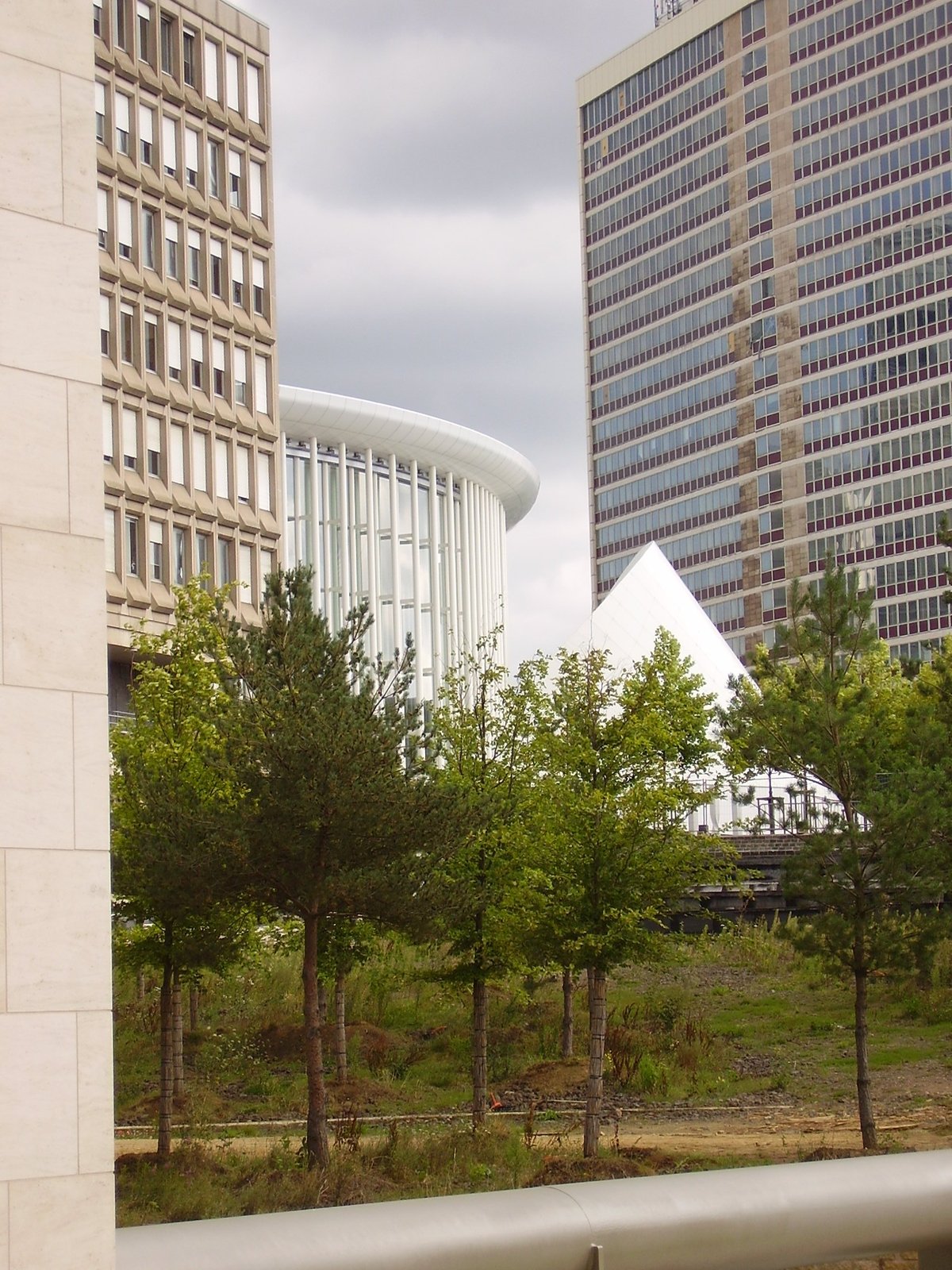
Designed by Michel Mousel and Gaston Witry, the Alcide De Gasperi Building rises 77 meters with 22 floors (fondskirchberg.public.lu). It was the tallest building in Luxembourg until 2008 and is an icon of 1960s modernism, using steel from Differdange to highlight the nation’s industrial roots. Its construction spurred the development of new roads, parking, and infrastructure, linking Kirchberg to the city center and Findel Airport (wort.lu).
Alcide De Gasperi’s Legacy
Alcide De Gasperi (1881–1954) was instrumental in the foundation of post-war European institutions, including the Council of Europe, the ECSC, and the European Economic Community (robert-schuman.eu). The building’s dedication reflects his vision of peace and prosperity through European cooperation.
Role in European Institutions
The Alcide De Gasperi Building has long served as the Secretariat of the European Parliament, underpinning Luxembourg’s role as an EU capital (fondskirchberg.public.lu). Its debating chamber hosted major parliamentary sessions until the chamber became too small for the expanding institution, leading to the construction of new facilities (luxtimes.lu).
Visiting Hours, Tickets & Accessibility
Public Access: The building is primarily an administrative office for EU institutions and is not generally open for public visits. However, special guided tours and open days may be organized, particularly during events such as European Heritage Days. Check official sources for updates.
- Typical Visiting Hours Guided tours by appointment only; open days announced in advance
- Tickets Free during open days; booking may be required
- Accessibility Fully accessible with elevators, ramps, and barrier-free pathways
For public events, exhibitions, or conferences, visitors can check the adjacent European Convention Center Luxembourg (ECCL) for schedules and requirements.
Getting There and Parking
- Location Avenue John F. Kennedy, Kirchberg, Luxembourg City
- Public Transport
- Tram: “Europaparlament / Parlement Européen” stop
- Bus: Multiple city and regional lines
- Funicular: Pfaffenthal–Kirchberg connects with CFL train station
- Car Ample parking in nearby lots (Virgule.lu)
- Accessibility Barrier-free access, elevators, and clear signage ensure comfort for all visitors
Nearby Attractions
Combine your visit with these neighboring sites for a full Kirchberg experience:
- European Court of Justice towers
- Robert Schuman Building
- Philharmonie Luxembourg (concert hall)
- Mudam Luxembourg (modern art museum)
- Luxembourg City Old Town (UNESCO World Heritage)
All are within walking distance, offering a rich overview of the city’s European and cultural heritage.
Preservation & Historical Milestones
The Alcide De Gasperi Building remained Luxembourg’s tallest structure until surpassed by the European Court of Justice towers in 2008 and 2019 (wort.lu). Ongoing discussions consider its preservation and potential adaptation to future urban needs (fondskirchberg.public.lu).
FAQs
Can I visit the Alcide De Gasperi Building anytime? No, public access is restricted. Guided tours and open days are occasionally organized; check official websites for updates.
Are tickets required? Entry is usually free during special events but may require registration.
Is the building accessible? Yes, with elevators, ramps, and barrier-free pathways.
How do I get there? Use tram, bus, or the funicular from the city center; car parking is available.
What else is nearby? European Court of Justice, Philharmonie Luxembourg, Mudam, and the historic city center.
Conclusion
The Alcide De Gasperi Building stands as a testament to Luxembourg’s vital role in European integration and urban development. Though primarily an administrative building, its architectural significance and historical legacy make it a noteworthy site for visitors interested in Luxembourg City’s heritage. Plan your visit by checking for guided tours and enjoy exploring the surrounding Kirchberg district’s rich cultural and institutional landmarks.
Plan Your Visit
For up-to-date information on special tours, open days, and nearby events, check the official Chamber of Commerce page and the Luxembourg City Tourist Office. Download the Audiala app for real-time notifications and explore more guides on Luxembourg’s historical and European sites.
References
- Visiting the Alcide De Gasperi Building: History, Tickets, and Luxembourg City’s Historic Sites, 2025, (wort.lu)
- Architectural and Urban Context of the Alcide De Gasperi Building, Fonds Kirchberg, 2025, (fondskirchberg.public.lu)
- Alcide De Gasperi’s Role in European Integration, Robert Schuman Foundation, 2025, (robert-schuman.eu)
- Luxembourg City Tourist Office – European Institutions and Landmarks, 2025, (Luxembourg City Tourist Office)
- Luxembourg Public – EU Institutions in Luxembourg, 2025, (Luxembourg Public)