
Signification historique et culturelle
Racines préhispaniques et lien avec les Chichimèques
Les origines de la danse des Concheros et du monument qui l'honore sont profondément ancrées dans les cultures indigènes du centre et du nord du Mexique. Contrairement à la croyance populaire, la tradition ne provient pas des Aztèques, mais des peuples Chichimèques, Otomis, Jonacs et Caxcans, réputés pour leur résilience face au pouvoir mexicain. Les Chichimèques, en particulier, ont façonné les aspects rituels et cosmologiques de la danse, qui était ancrée dans les cycles lunaires et stellaires, le culte des ancêtres et la géographie sacrée.
Querétaro, en particulier le Cerro de Sangremal et les sites environnants, est reconnu comme le berceau de la Danza Conchera. Ces lieux servaient de centres rituels pour des cérémonies élaborées, marquant les huit directions pour le culte des ancêtres et le renouveau annuel.
Transformation coloniale et syncrétisme
Avec la conquête espagnole, les rituels indigènes furent supprimés mais pas éteints. Les danses s'adaptèrent, mêlant la cosmologie préhispanique à l'iconographie catholique. La tradition des Concheros devint un exemple vibrant de syncrétisme, intégrant des références aux saints, à la Vierge de Guadalupe et au symbolisme chrétien. La "concha" (luth en carapace d'aumone, instrument de musique) émergea comme un instrument signature, symbolisant la fusion de la musique espagnole et du rituel indigène.
Évolution de la tradition
La tradition a continué d'évoluer tout au long des XIXe et XXe siècles. Après l'indépendance, les groupes de danse des Concheros se sont propagés à Mexico et au-delà, Querétaro restant un centre vital. Aujourd'hui, la danse sert à la fois de cérémonie spirituelle et de célébration de l'identité folklorique. Des événements annuels, notamment la Fiesta de los Concheros en septembre, attirent des centaines de danseurs et de spectateurs dans la ville.
Rituels, costumes et symbolisme
Les danses des Concheros forment des motifs circulaires complexes symbolisant l'unité et les cycles de la vie. Les cérémonies sont structurées autour d'une dualité—nocturne (féminine, jaguar, terre) et diurne (masculine, aigle, soleil)—reflétant les visions du monde indigènes et catholiques.
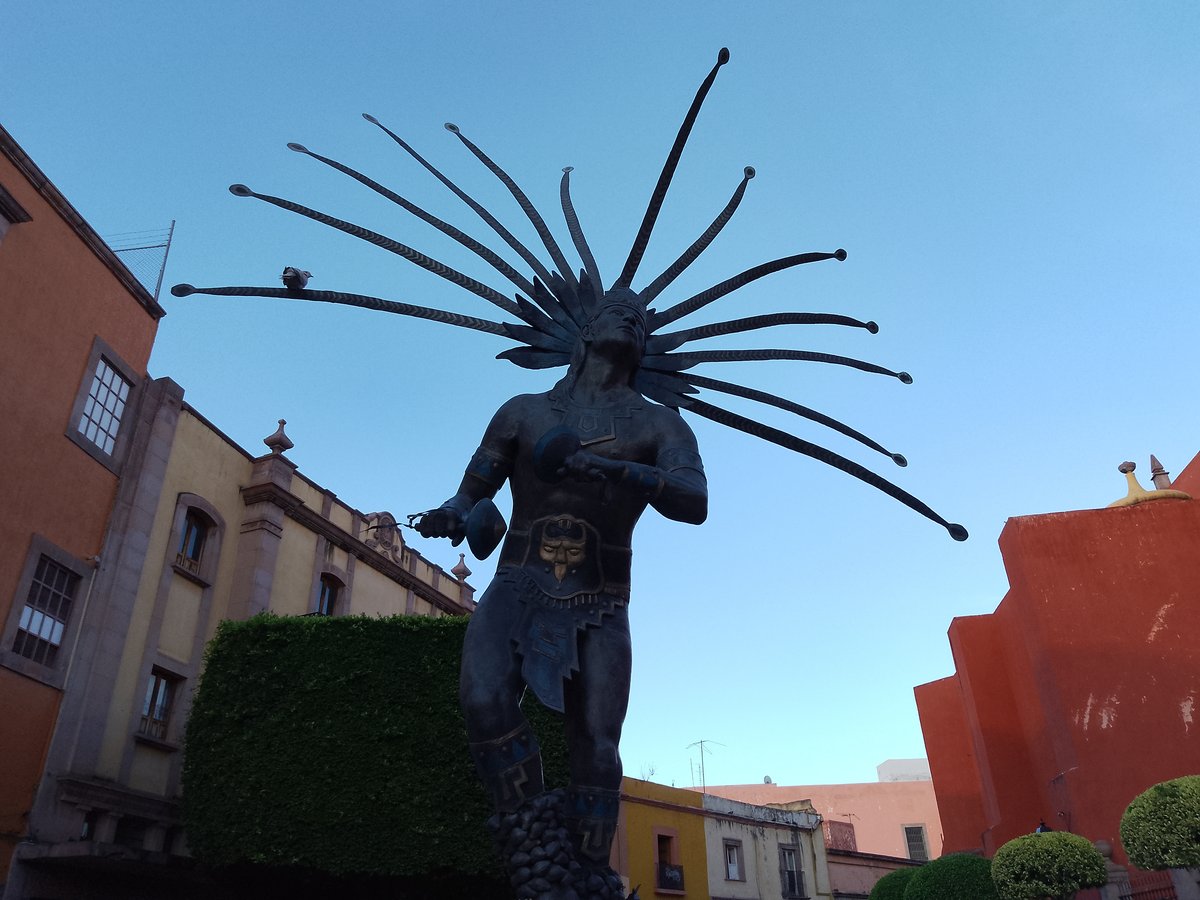
Les danseurs portent d'élégants couvre-chefs à plumes, des vêtements brodés et des parures telles que des coquillages et des clochettes. Le luth concha, les tambours et les hochets fournissent un accompagnement rythmique. Les rituels sont centrés sur l'axe du monde marqué par les brûleurs d'encens et les offrandes, avec des mouvements conçus pour invoquer la terre, le ciel et les esprits ancestraux.
Description et localisation du monument
Caractéristiques artistiques et symbolisme
Le Monumento A Los Concheros est une sculpture en bronze frappante représentant un danseur Conchero dans sa tenue cérémonielle complète, en pleine action, avec un grand couvre-chef à plumes et une tenue richement décorée. L'artisanat détaillé du monument honore à la fois les influences indigènes et catholiques, présentant souvent des instruments symboliques comme la concha ou un bâton cérémoniel. Les inscriptions ou reliefs à la base racontent la vision légendaire de 1531 sur le Cerro de Sangremal, qui a uni les communautés indigènes et espagnoles dans la paix.
La statue mesure environ 2,5 à 3 mètres de haut et est située dans une place paysagée avec des bancs et un éclairage nocturne, invitant à la réflexion et à la photographie.
Localisation exacte et accessibilité
Le monument est situé près du Jardín Zenea, au cœur du centre historique de Querétaro, classé au patrimoine mondial de l'UNESCO. Coordonnées : 20.5888° N, -100.3899° O. Il est accessible à pied depuis les hôtels centraux et les attractions, avec des options de parking public et de transport à proximité.
Attractions à proximité
Les sites notables accessibles à pied comprennent :
- Casa de la Corregidora Domicile de l'héroïne de l'indépendance Josefa Ortiz de Domínguez.
- Museo de los Conspiradores Axé sur l'histoire de l'indépendance.
- Templo y Convento de la Cruz Centre spirituel des Concheros.
- Jardín Zenea Place centrale avec musique live et événements.
Visiter le monument : Informations pratiques
Horaires de visite
Le monument se trouve sur une place publique et est accessible 24 heures sur 24, toute l'année. La meilleure expérience est pendant la journée ou en début de soirée, lorsqu'il est illuminé.
Billets et entrée
L'entrée est gratuite. Aucun billet n'est requis pour visiter le monument ou la place environnante.
Accessibilité
- Des chemins et rampes accessibles en fauteuil roulant sont disponibles.
- Certaines zones environnantes peuvent avoir un terrain inégal ; des chaussures confortables sont conseillées.
- Des toilettes publiques et des places assises ombragées sont à proximité.
Installations et commodités
- De nombreux restaurants, cafés et boutiques se trouvent à 2 à 5 minutes à pied.
- Les transports publics, les taxis et les parkings sont facilement accessibles.
Meilleurs moments pour visiter
- La Fiesta de la Santa Cruz à la mi-septembre est la période la plus animée, avec des processions et des performances de Concheros.
- Les premières heures du matin et les fins d'après-midi offrent la meilleure lumière pour la photographie et une atmosphère plus calme.
Sécurité et étiquette
- Le centre historique est sûr et bien surveillé.
- Pendant les festivals, soyez attentif à vos effets personnels.
- Respectez le monument et les cérémonies — ne grimpez pas et ne laissez pas de détritus, et observez les rituels calmement.
Événements spéciaux et festivals
Le point culminant est la Fiesta de los Concheros (12–15 septembre), où des centaines de danseurs en tenue complète exécutent des rituels sacrés et des processions. La région s'emplit de musique, d'encens et de costumes colorés, offrant un spectacle culturel inoubliable.
D'autres événements notables incluent la Fête de la Sainte Croix en mai et les festivités du Jour des Morts en novembre.
Foire Aux Questions (FAQ)
Q : Quels sont les horaires de visite du Monumento A Los Concheros ? R : Le monument est accessible 24h/24 et 7j/7 car il se trouve sur une place publique.
Q : Y a-t-il des frais d'entrée ou un billet requis ? R : Non, l'entrée est gratuite. Des événements spéciaux ou des visites guidées peuvent avoir des frais distincts.
Q : Des visites guidées sont-elles disponibles ? R : Oui, les offices de tourisme locaux et les guides proposent des visites à pied qui incluent le monument.
Q : Le monument est-il accessible aux personnes à mobilité réduite ? R : Oui, la place est accessible en fauteuil roulant, mais certaines zones peuvent avoir des chemins inégaux.
Q : Puis-je prendre des photos au monument ? R : La photographie est encouragée, mais soyez toujours prévenant pendant les cérémonies et demandez la permission pour les gros plans.
Durabilité et tourisme responsable
- Soutenez les artisans locaux en achetant de l'artisanat.
- Éliminez vos déchets de manière responsable et contribuez à préserver la région.
- Engagez-vous respectueusement envers les traditions : observez les rituels calmement et suivez les coutumes locales.
- Utilisez des guides locaux pour des aperçus plus approfondis et pour soutenir la communauté.
Résumé et recommandations
Le Monumento A Los Concheros est plus qu'une sculpture ; c'est un symbole vivant de l'héritage métis de Querétaro et de la résilience de la culture indigène. Visitez-le pendant la Fiesta de los Concheros pour une immersion culturelle complète, ou explorez-le toute l'année pour apprécier la signification artistique et spirituelle du monument. Complétez votre visite avec des sites historiques voisins et des visites guidées pour une meilleure compréhension de l'histoire stratifiée de Querétaro.
Pour rester informé des événements et des visites, consultez le Site Web officiel du tourisme de Querétaro, l'Institut National d'Anthropologie et d'Histoire (INAH), et téléchargez l'application Audiala pour du contenu curaté et des conseils de voyage.
Introduction
The Monumento A Los Concheros in Santiago de Querétaro stands as a profound symbol of indigenous heritage, resilience, and cultural significance. This monument pays homage to the Concheros dance tradition, a vibrant ritual that intricately weaves pre-Hispanic indigenous beliefs with Catholic influences, reflecting centuries of cultural syncretism. Rooted in the sacred geography and cosmology of the Chichimeca, Otomí, and other indigenous peoples of central Mexico, the Concheros dance emerged as a symbol of identity and spiritual continuity despite colonial pressures. The monument not only commemorates this enduring tradition but also serves as a living cultural hub where annual festivals, ceremonies, and performances breathe life into ancient practices.
This comprehensive guide details the monument's historical and cultural significance, artistic features, visitor information, location, and nearby attractions, ensuring an enriching experience for history enthusiasts, cultural explorers, and travelers alike.
Table of Contents
- Introduction
- Historical and Cultural Significance
- Rituals, Attire, and Symbolism
- Monument Description and Location
- Visiting the Monument: Practical Information
- Special Events and Festivals
- Frequently Asked Questions (FAQs)
- Sustainability and Responsible Tourism
- Summary and Recommendations
- References
Historical and Cultural Significance
Pre-Hispanic Roots and the Chichimeca Connection
The origins of the Concheros dance and the monument that honors it are deeply rooted in the indigenous cultures of central and northern Mexico. Contrary to popular belief, the tradition stems not from the Aztecs but from the Chichimeca, Otomí, Jonaz, and Caxcan peoples—groups recognized for their resilience against Mexica rule. The Chichimeca, in particular, shaped the ritualistic and cosmological aspects of the dance, which was anchored in lunar and stellar cycles, ancestor veneration, and sacred geography.
Querétaro, especially the Cerro de Sangremal and surrounding sites, is acknowledged as the birthplace of the Danza Conchera. These locations served as ritual centers for elaborate ceremonies, marking the eight directions for ancestor worship and annual renewal.
Colonial Transformation and Syncretism
With the Spanish conquest, indigenous rituals were suppressed but not extinguished. Instead, the dances adapted—blending pre-Hispanic cosmology with Catholic iconography. The Concheros tradition became a vibrant example of syncretism, incorporating references to saints, the Virgin of Guadalupe, and Christian symbolism. The “concha” (armadillo-shell lute) emerged as a signature instrument, symbolizing the fusion of Spanish music with indigenous ritual.
Evolution of the Tradition
The tradition continued to evolve through the 19th and 20th centuries. Post-independence, Conchero dance groups spread to Mexico City and beyond, with Querétaro remaining a vital center. Today, the dance serves both as a spiritual ceremony and a celebration of folk identity. Annual events, particularly the Fiesta de los Concheros in September, draw hundreds of dancers and spectators to the city.
Rituals, Attire, and Symbolism
Conchero dances form intricate, circular patterns symbolizing unity and life’s cycles. Ceremonies are structured around duality—nocturnal (feminine, jaguar, earth) and diurnal (masculine, eagle, sun)—mirroring both indigenous and Catholic worldviews.
Dancers wear elaborate feathered headdresses, embroidered garments, and adornments such as shells and bells. The concha lute, drums, and rattles provide rhythmic accompaniment. Rituals center on the axis mundi marked by incense burners and offerings, with movements designed to invoke earth, sky, and ancestral spirits.
Monument Description and Location
Artistic Features and Symbolism
The Monumento A Los Concheros is a striking bronze sculpture depicting a conchero dancer in full ceremonial regalia, mid-step, with a grand feathered headdress and richly decorated attire. The monument’s detailed craftsmanship honors both indigenous and Catholic influences, often featuring symbolic instruments like the concha or ceremonial staff. Inscriptions or reliefs at the base recount the legendary 1531 vision on Cerro de Sangremal, which united indigenous and Spanish communities in peace.
The statue stands approximately 2.5 to 3 meters tall and is set in a landscaped plaza with benches and night illumination, inviting reflection and photography.
Exact Location and Accessibility
The monument is located near Jardín Zenea, at the heart of Querétaro’s UNESCO-listed historic center. Coordinates: 20.5888° N, -100.3899° W. It is accessible on foot from central hotels and attractions, with public parking and transportation options nearby.
Nearby Attractions
Notable sites within walking distance include:
- Casa de la Corregidora Home of independence heroine Josefa Ortiz de Domínguez.
- Museo de los Conspiradores Focused on independence history.
- Templo y Convento de la Cruz Spiritual center of the Concheros.
- Jardín Zenea Central plaza with live music and events.
Visiting the Monument: Practical Information
Visiting Hours
The monument is in a public plaza and accessible 24 hours a day, year-round. The best experience is during daylight or early evening when it is illuminated.
Tickets and Entry
Admission is free. No tickets are required to visit the monument or surrounding plaza.
Accessibility
- Wheelchair-accessible paths and ramps are available.
- Some surrounding areas have uneven terrain; comfortable footwear is advised.
- Public restrooms and shaded seating are nearby.
Facilities and Amenities
- Numerous restaurants, cafes, and shops are within a 2–5 minute walk.
- Public transportation, taxis, and parking are easily accessible.
Best Times to Visit
- The Fiesta de la Santa Cruz in mid-September is the most vibrant period, with processions and Concheros performances.
- Early mornings and late afternoons offer the best light for photography and a quieter atmosphere.
Safety and Etiquette
- The historic center is safe and well-patrolled.
- During festivals, be mindful of personal belongings.
- Respect the monument and ceremonies—do not climb or litter, and observe rituals quietly.
Special Events and Festivals
The highlight is the Fiesta de los Concheros (September 12–15), when hundreds of dancers in full regalia perform sacred rituals and processions. The area fills with music, incense, and colorful costumes, offering an unforgettable cultural spectacle.
Other notable events include the Feast of the Holy Cross in May and Day of the Dead festivities in November.
Frequently Asked Questions (FAQs)
Q: What are the Monumento A Los Concheros visiting hours? A: The monument is accessible 24/7 as it is in a public plaza.
Q: Is there an entrance fee or ticket required? A: No, admission is free. Special events or guided tours may have separate fees.
Q: Are guided tours available? A: Yes, local tourism offices and guides offer walking tours that include the monument.
Q: Is the monument accessible for visitors with limited mobility? A: Yes, the plaza is wheelchair accessible, but some areas may have uneven paths.
Q: Can I take photographs at the monument? A: Photography is encouraged, but always be considerate during ceremonies and ask permission for close-ups.
Sustainability and Responsible Tourism
- Support local artisans by purchasing crafts.
- Dispose of waste responsibly and help preserve the area.
- Engage respectfully with traditions—observe rituals quietly and follow local customs.
- Use local guides for deeper insights and to support the community.
Summary and Recommendations
The Monumento A Los Concheros is more than a sculpture—it is a living symbol of Querétaro’s mestizo heritage and the resilience of indigenous culture. Visit during the Fiesta de los Concheros for a full cultural immersion, or explore year-round to appreciate the monument’s artistic and spiritual significance. Complement your visit with nearby historical sites and guided tours for a richer understanding of Querétaro’s layered history.
Stay up to date on events and tours via the Official Querétaro Tourism Website, the National Institute of Anthropology and History (INAH), and by downloading the Audiala app for curated content and travel tips.
References
- Official Querétaro Tourism Website
- National Institute of Anthropology and History (INAH)
- Fiesta de los Concheros in Querétaro, Mexico – Bill Dahl
- Tradición Conchera de los Danzantes – Ediciones GA
- Fiesta de los Concheros in Querétaro – The Queretaro Post
- Concheros de Querétaro – El Municipal Querétaro
- Los Concheros de Querétaro – Red Info 7
- Monumento a los Concheros – Minube
- Traditional Indigenous Dancers – Mexico City Perambulations Blog
- Danza de los Concheros Significance – El Universal Querétaro
- Mapcarta – Monumento A Los Concheros Location
- Zona de Monumentos Históricos de Querétaro – Programa Destinos México
- El Oficio de Historiar – Templo y Convento de la Cruz
Image suggestions: Photos of the monument during a dance performance, close-ups of traditional costumes, panoramic views of Cerro de Sangremal, and nearby Plaza de Armas.
Audiala2025# Monumento A Los Concheros, Santiago De Querétaro, Mexico: A Comprehensive Visitor’s Guide
Date: 14/06/2025
Introduction
The Monumento A Los Concheros in Santiago de Querétaro stands as a profound emblem of Mexico’s rich indigenous heritage and cultural resilience. This monument honors the Concheros dance tradition—a vibrant ritual that intricately weaves pre-Hispanic indigenous beliefs with Catholic influences, reflecting centuries of cultural syncretism. Rooted in the sacred geography and cosmology of the Chichimeca, Otomí, and other indigenous peoples of central Mexico, the Concheros dance emerged as a symbol of identity and spiritual continuity despite colonial pressures. The monument not only commemorates this enduring tradition but also serves as a living cultural hub where annual festivals, ceremonies, and performances breathe life into ancient practices. Visitors interested in exploring this emblematic landmark will find a rich tapestry of history, spirituality, and artistry—from the origins of the dance in indigenous lunar and stellar cosmology, through its transformation during colonial times, to its contemporary expressions celebrated throughout Querétaro. Practical visitor information such as visiting hours, accessibility, and nearby attractions complements this cultural insight, ensuring a well-rounded experience. Whether exploring the monument’s intricate bronze sculpture in the historic city center or attending the vibrant Fiesta de los Concheros on Cerro de Sangremal, travelers gain a meaningful glimpse into Mexico’s diverse cultural landscape. This comprehensive guide draws on authoritative sources and firsthand accounts to illuminate the Monumento A Los Concheros’ significance and visitor experience. For further details, visitors may consult the Official Querétaro Tourism Website, the National Institute of Anthropology and History (INAH), and insightful cultural articles such as those by Bill Dahl and Ediciones GA.
Table of Contents
- Introduction
- Historical and Cultural Significance
- Rituals, Attire, and Symbolism
- Monument Description and Location
- Visiting the Monument: Practical Information
- Special Events and Festivals
- Frequently Asked Questions (FAQs)
- Sustainability and Responsible Tourism
- Summary and Recommendations
- References
Historical and Cultural Significance
Pre-Hispanic Roots and the Chichimeca Connection
The origins of the Concheros dance and the monument that honors it are deeply embedded in the indigenous cultures of central and northern Mexico. Contrary to popular belief, the tradition stems not from the Aztecs but from the Chichimeca, Otomí, Jonaz, and Caxcan peoples—groups recognized for their resilience against Mexica rule. The Chichimeca, in particular, shaped the ritualistic and cosmological aspects of the dance, which was anchored in lunar and stellar cycles, ancestor veneration, and sacred geography.
Querétaro, especially the Cerro de Sangremal and surrounding sites, is acknowledged as the birthplace of the Danza Conchera. These locations served as ritual centers for elaborate ceremonies, marking the eight directions for ancestor worship and annual renewal.
Colonial Transformation and Syncretism
With the Spanish conquest, indigenous rituals were suppressed but not extinguished. Instead, the dances adapted—blending pre-Hispanic cosmology with Catholic iconography. The Concheros tradition became a vibrant example of syncretism, incorporating references to saints, the Virgin of Guadalupe, and Christian symbolism. The “concha” (armadillo-shell lute) emerged as a signature instrument, symbolizing the fusion of Spanish music with indigenous ritual.
Evolution of the Tradition
The tradition continued to evolve through the 19th and 20th centuries. Post-independence, Conchero dance groups spread to Mexico City and beyond, with Querétaro remaining a vital center. Today, the dance serves both as a spiritual ceremony and a celebration of folk identity. Annual events, particularly the Fiesta de los Concheros in September, draw hundreds of dancers and spectators to the city.
Rituals, Attire, and Symbolism
Conchero dances form intricate, circular patterns symbolizing unity and life’s cycles. Ceremonies are structured around duality—nocturnal (feminine, jaguar, earth) and diurnal (masculine, eagle, sun)—mirroring both indigenous and Catholic worldviews.
Dancers wear elaborate feathered headdresses, embroidered garments, and adornments such as shells and bells. The concha lute, drums, and rattles provide rhythmic accompaniment. Rituals center on the axis mundi marked by incense burners and offerings, with movements designed to invoke earth, sky, and ancestral spirits.
Monument Description and Location
Artistic Features and Symbolism
The Monumento A Los Concheros is a striking bronze sculpture depicting a conchero dancer in full ceremonial regalia, mid-step, with a grand feathered headdress and richly decorated attire. The monument’s detailed craftsmanship honors both indigenous and Catholic influences, often featuring symbolic instruments like the concha or ceremonial staff. Inscriptions or reliefs at the base recount the legendary 1531 vision on Cerro de Sangremal, which united indigenous and Spanish communities in peace.
The statue stands approximately 2.5 to 3 meters tall and is set in a landscaped plaza with benches and night illumination, inviting reflection and photography.
Exact Location and Accessibility
The monument is located near Jardín Zenea, at the heart of Querétaro’s UNESCO-listed historic center. Coordinates: 20.5888° N, -100.3899° W. It is accessible on foot from central hotels and attractions, with public parking and transportation options nearby.
Nearby Attractions
Notable sites within walking distance include:
- Casa de la Corregidora Home of independence heroine Josefa Ortiz de Domínguez.
- Museo de los Conspiradores Focused on independence history.
- Templo y Convento de la Cruz Spiritual center of the Concheros.
- Jardín Zenea Central plaza with live music and events.
Visiting the Monument: Practical Information
Visiting Hours
The monument is in a public plaza and accessible 24 hours a day, year-round. The best experience is during daylight or early evening when it is illuminated.
Tickets and Entry
Admission is free. No tickets are required to visit the monument or surrounding plaza.
Accessibility
- Wheelchair-accessible paths and ramps are available.
- Some surrounding areas have uneven terrain; comfortable footwear is advised.
- Public restrooms and shaded seating are nearby.
Facilities and Amenities
- Numerous restaurants, cafes, and shops are within a 2–5 minute walk.
- Public transportation, taxis, and parking are easily accessible.
Best Times to Visit
- The Fiesta de la Santa Cruz in mid-September is the most vibrant period, with processions and Concheros performances.
- Early mornings and late afternoons offer the best light for photography and a quieter atmosphere.
Safety and Etiquette
- The historic center is safe and well-patrolled.
- During festivals, be mindful of personal belongings.
- Respect the monument and ceremonies—do not climb or litter, and observe rituals quietly.
Special Events and Festivals
The highlight is the Fiesta de los Concheros (September 12–15), when hundreds of dancers in full regalia perform sacred rituals and processions. The area fills with music, incense, and colorful costumes, offering an unforgettable cultural spectacle.
Other notable events include the Feast of the Holy Cross in May and Day of the Dead festivities in November.
Frequently Asked Questions (FAQs)
Q: What are the Monumento A Los Concheros visiting hours? A: The monument is accessible 24/7 as it is in a public plaza.
Q: Is there an entrance fee or ticket required? A: No, admission is free. Special events or guided tours may have separate fees.
Q: Are guided tours available? A: Yes, local tourism offices and guides offer walking tours that include the monument.
Q: Is the monument accessible for visitors with limited mobility? A: Yes, the plaza is wheelchair accessible, but some areas may have uneven paths.
Q: Can I take photographs at the monument? A: Photography is encouraged, but always be considerate during ceremonies and ask permission for close-ups.
Sustainability and Responsible Tourism
- Support local artisans by purchasing crafts.
- Dispose of waste responsibly and help preserve the area.
- Engage respectfully with traditions—observe rituals quietly and follow local customs.
- Use local guides for deeper insights and to support the community.
Summary and Recommendations
The Monumento A Los Concheros is more than a sculpture—it is a living symbol of Querétaro’s mestizo heritage and the resilience of indigenous culture. Visit during the Fiesta de los Concheros for a full cultural immersion, or explore year-round to appreciate the monument’s artistic and spiritual significance. Complement your visit with nearby historical sites and guided tours for a richer understanding of Querétaro’s layered history.
Stay up to date on events and tours via the Official Querétaro Tourism Website, the National Institute of Anthropology and History (INAH), and by downloading the Audiala app for curated content and travel tips.
References
- Official Querétaro Tourism Website
- National Institute of Anthropology and History (INAH)
- Fiesta de los Concheros in Querétaro, Mexico – Bill Dahl
- Tradición Conchera de los Danzantes – Ediciones GA
- Fiesta de los Concheros in Querétaro – The Queretaro Post
- Concheros de Querétaro – El Municipal Querétaro
- Los Concheros de Querétaro – Red Info 7
- Monumento a los Concheros – Minube
- Traditional Indigenous Dancers – Mexico City Perambulations Blog
- Danza de los Concheros Significance – El Universal Querétaro
- Mapcarta – Monumento A Los Concheros Location
- Zona de Monumentos Históricos de Querétaro – Programa Destinos México
- El Oficio de Historiar – Templo y Convento de la Cruz
Image suggestions: Photos of the monument during a dance performance, close-ups of traditional costumes, panoramic views of Cerro de Sangremal, and nearby Plaza de Armas.
Audiala2025# Monumento A Los Concheros, Santiago De Querétaro, Mexico: Visiting Hours, Tickets, and Travel Guide
Date: 14/06/2025
Monument Description and Location
Artistic Features and Symbolism
The Monumento A Los Concheros is a striking bronze sculpture depicting a conchero dancer in full ceremonial regalia, mid-step, with a grand feathered headdress and richly decorated attire. The monument’s detailed craftsmanship honors both indigenous and Catholic influences, often featuring symbolic instruments like the concha or ceremonial staff. Inscriptions or reliefs at the base recount the legendary 1531 vision on Cerro de Sangremal, which united indigenous and Spanish communities in peace.
The statue stands approximately 2.5 to 3 meters tall and is set in a landscaped plaza with benches and night illumination, inviting reflection and photography.
Exact Location and Accessibility
The monument is located near Jardín Zenea, at the heart of Querétaro’s UNESCO-listed historic center. Coordinates: 20.5888° N, -100.3899° W. It is accessible on foot from central hotels and attractions, with public parking and transportation options nearby.
Nearby Attractions
Notable sites within walking distance include:
- Casa de la Corregidora Home of independence heroine Josefa Ortiz de Domínguez.
- Museo de los Conspiradores Focused on independence history.
- Templo y Convento de la Cruz Spiritual center of the Concheros.
- Jardín Zenea Central plaza with live music and events.
Visiting the Monument: Practical Information
Visiting Hours
The monument is in a public plaza and accessible 24 hours a day, year-round. The best experience is during daylight or early evening when it is illuminated.
Tickets and Entry
Admission is free. No tickets are required to visit the monument or surrounding plaza.
Accessibility
- Wheelchair-accessible paths and ramps are available.
- Some surrounding areas have uneven terrain; comfortable footwear is advised.
- Public restrooms and shaded seating are nearby.
Facilities and Amenities
- Numerous restaurants, cafes, and shops are within a 2–5 minute walk.
- Public transportation, taxis, and parking are easily accessible.
Best Times to Visit
- The Fiesta de la Santa Cruz in mid-September is the most vibrant period, with processions and Concheros performances.
- Early mornings and late afternoons offer the best light for photography and a quieter atmosphere.
Safety and Etiquette
- The historic center is safe and well-patrolled.
- During festivals, be mindful of personal belongings.
- Respect the monument and ceremonies—do not climb or litter, and observe rituals quietly.
Special Events and Festivals
The highlight is the Fiesta de los Concheros (September 12–15), when hundreds of dancers in full regalia perform sacred rituals and processions. The area fills with music, incense, and colorful costumes, offering an unforgettable cultural spectacle.
Other notable events include the Feast of the Holy Cross in May and Day of the Dead festivities in November.
Frequently Asked Questions (FAQs)
Q: What are the Monumento A Los Concheros visiting hours? A: The monument is accessible 24/7 as it is in a public plaza.
Q: Is there an entrance fee or ticket required? A: No, admission is free. Special events or guided tours may have separate fees.
Q: Are guided tours available? A: Yes, local tourism offices and guides offer walking tours that include the monument.
Q: Is the monument accessible for visitors with limited mobility? A: Yes, the plaza is wheelchair accessible, but some areas may have uneven paths.
Q: Can I take photographs at the monument? A: Photography is encouraged, but always be considerate during ceremonies and ask permission for close-ups.
Sustainability and Responsible Tourism
- Support local artisans by purchasing crafts.
- Dispose of waste responsibly and help preserve the area.
- Engage respectfully with traditions—observe rituals quietly and follow local customs.
- Use local guides for deeper insights and to support the community.
Summary and Recommendations
The Monumento A Los Concheros is more than a sculpture—it is a living symbol of Querétaro’s mestizo heritage and the resilience of indigenous culture. Visit during the Fiesta de los Concheros for a full cultural immersion, or explore year-round to appreciate the monument’s artistic and spiritual significance. Complement your visit with nearby historical sites and guided tours for a richer understanding of Querétaro’s layered history.
Stay up to date on events and tours via the Official Querétaro Tourism Website, the National Institute of Anthropology and History (INAH), and by downloading the Audiala app for curated content and travel tips.
References
- Official Querétaro Tourism Website
- National Institute of Anthropology and History (INAH)
- Fiesta de los Concheros in Querétaro, Mexico – Bill Dahl
- Tradición Conchera de los Danzantes – Ediciones GA
- Fiesta de los Concheros in Querétaro – The Queretaro Post
- Concheros de Querétaro – El Municipal Querétaro
- Los Concheros de Querétaro – Red Info 7
- Monumento a los Concheros – Minube
- Traditional Indigenous Dancers – Mexico City Perambulations Blog
- Danza de los Concheros Significance – El Universal Querétaro
- Mapcarta – Monumento A Los Concheros Location
- Zona de Monumentos Históricos de Querétaro – Programa Destinos México
- El Oficio de Historiar – Templo y Convento de la Cruz
Image suggestions: Photos of the monument during a dance performance, close-ups of traditional costumes, panoramic views of Cerro de Sangremal, and nearby Plaza de Armas.
Audiala2025# Monumento A Los Concheros, Santiago De Querétaro, Mexico: A Comprehensive Visitor’s Guide
Date: 14/06/2025
Historical and Cultural Significance
Pre-Hispanic Roots and the Chichimeca Connection
The origins of the Concheros dance and the monument that honors it are deeply embedded in the indigenous cultures of central and northern Mexico. Contrary to popular belief, the tradition stems not from the Aztecs but from the Chichimeca, Otomí, Jonaz, and Caxcan peoples—groups recognized for their resilience against Mexica rule. The Chichimeca, in particular, shaped the ritualistic and cosmological aspects of the dance, which was anchored in lunar and stellar cycles, ancestor veneration, and sacred geography.
Querétaro, especially the Cerro de Sangremal and surrounding sites, is acknowledged as the birthplace of the Danza Conchera. These locations served as ritual centers for elaborate ceremonies, marking the eight directions for ancestor worship and annual renewal.
Colonial Transformation and Syncretism
With the Spanish conquest, indigenous rituals were suppressed but not extinguished. Instead, the dances adapted—blending pre-Hispanic cosmology with Catholic iconography. The Concheros tradition became a vibrant example of syncretism, incorporating references to saints, the Virgin of Guadalupe, and Christian symbolism. The “concha” (armadillo-shell lute) emerged as a signature instrument, symbolizing the fusion of Spanish music with indigenous ritual.
Evolution of the Tradition
The tradition continued to evolve through the 19th and 20th centuries. Post-independence, Conchero dance groups spread to Mexico City and beyond, with Querétaro remaining a vital center. Today, the dance serves both as a spiritual ceremony and a celebration of folk identity. Annual events, particularly the Fiesta de los Concheros in September, draw hundreds of dancers and spectators to the city.
Rituals, Attire, and Symbolism
Conchero dances form intricate, circular patterns symbolizing unity and life’s cycles. Ceremonies are structured around duality—nocturnal (feminine, jaguar, earth) and diurnal (masculine, eagle, sun)—mirroring both indigenous and Catholic worldviews.
Dancers wear elaborate feathered headdresses, embroidered garments, and adornments such as shells and bells. The concha lute, drums, and rattles provide rhythmic accompaniment. Rituals center on the axis mundi marked by incense burners and offerings, with movements designed to invoke earth, sky, and ancestral spirits.
Monument Description and Location
Artistic Features and Symbolism
The Monumento A Los Concheros is a striking bronze sculpture depicting a conchero dancer in full ceremonial regalia, mid-step, with a grand feathered headdress and richly decorated attire. The monument’s detailed craftsmanship honors both indigenous and Catholic influences, often featuring symbolic instruments like the concha or ceremonial staff. Inscriptions or reliefs at the base recount the legendary 1531 vision on Cerro de Sangremal, which united indigenous and Spanish communities in peace.
The statue stands approximately 2.5 to 3 meters tall and is set in a landscaped plaza with benches and night illumination, inviting reflection and photography.
Exact Location and Accessibility
The monument is located near Jardín Zenea, at the heart of Querétaro’s UNESCO-listed historic center. Coordinates: 20.5888° N, -100.3899° W. It is accessible on foot from central hotels and attractions, with public parking and transportation options nearby.
Nearby Attractions
Notable sites within walking distance include:
- Casa de la Corregidora Home of independence heroine Josefa Ortiz de Domínguez.
- Museo de los Conspiradores Focused on independence history.
- Templo y Convento de la Cruz Spiritual center of the Concheros.
- Jardín Zenea Central plaza with live music and events.
Visiting the Monument: Practical Information
Visiting Hours
The monument is in a public plaza and accessible 24 hours a day, year-round. The best experience is during daylight or early evening when it is illuminated.
Tickets and Entry
Admission is free. No tickets are required to visit the monument or surrounding plaza.
Accessibility
- Wheelchair-accessible paths and ramps are available.
- Some surrounding areas have uneven terrain; comfortable footwear is advised.
- Public restrooms and shaded seating are nearby.
Facilities and Amenities
- Numerous restaurants, cafes, and shops are within a 2–5 minute walk.
- Public transportation, taxis, and parking are easily accessible.
Best Times to Visit
- The Fiesta de la Santa Cruz in mid-September is the most vibrant period, with processions and Concheros performances.
- Early mornings and late afternoons offer the best light for photography and a quieter atmosphere.
Safety and Etiquette
- The historic center is safe and well-patrolled.
- During festivals, be mindful of personal belongings.
- Respect the monument and ceremonies—do not climb or litter, and observe rituals quietly.
Special Events and Festivals
The highlight is the Fiesta de los Concheros (September 12–15), when hundreds of dancers in full regalia perform sacred rituals and processions. The area fills with music, incense, and colorful costumes, offering an unforgettable cultural spectacle.
Other notable events include the Feast of the Holy Cross in May and Day of the Dead festivities in November.
Frequently Asked Questions (FAQs)
Q: What are the Monumento A Los Concheros visiting hours? A: The monument is accessible 24/7 as it is in a public plaza.
Q: Is there an entrance fee or ticket required? A: No, admission is free. Special events or guided tours may have separate fees.
Q: Are guided tours available? A: Yes, local tourism offices and guides offer walking tours that include the monument.
Q: Is the monument accessible for visitors with limited mobility? A: Yes, the plaza is wheelchair accessible, but some areas may have uneven paths.
Q: Can I take photographs at the monument? A: Photography is encouraged, but always be considerate during ceremonies and ask permission for close-ups.
Sustainability and Responsible Tourism
- Support local artisans by purchasing crafts.
- Dispose of waste responsibly and help preserve the area.
- Engage respectfully with traditions—observe rituals quietly and follow local customs.
- Use local guides for deeper insights and to support the community.
Summary and Recommendations
The Monumento A Los Concheros is more than a sculpture—it is a living symbol of Querétaro’s mestizo heritage and the resilience of indigenous culture. Visit during the Fiesta de los Concheros for a full cultural immersion, or explore year-round to appreciate the monument’s artistic and spiritual significance. Complement your visit with nearby historical sites and guided tours for a richer understanding of Querétaro’s layered history.
Stay up to date on events and tours via the Official Querétaro Tourism Website, the National Institute of Anthropology and History (INAH), and by downloading the Audiala app for curated content and travel tips.
References
- Official Querétaro Tourism Website
- National Institute of Anthropology and History (INAH)
- Fiesta de los Concheros in Querétaro, Mexico – Bill Dahl
- Tradición Conchera de los Danzantes – Ediciones GA
- Fiesta de los Concheros in Querétaro – The Queretaro Post
- Concheros de Querétaro – El Municipal Querétaro
- Los Concheros de Querétaro – Red Info 7
- Monumento a los Concheros – Minube
- Traditional Indigenous Dancers – Mexico City Perambulations Blog
- Danza de los Concheros Significance – El Universal Querétaro
- Mapcarta – Monumento A Los Concheros Location
- Zona de Monumentos Históricos de Querétaro – Programa Destinos México
- El Oficio de Historiar – Templo y Convento de la Cruz
Image suggestions: Photos of the monument during a dance performance, close-ups of traditional costumes, panoramic views of Cerro de Sangremal, and nearby Plaza de Armas.
Audiala2025