water
Victoria Falls Edge
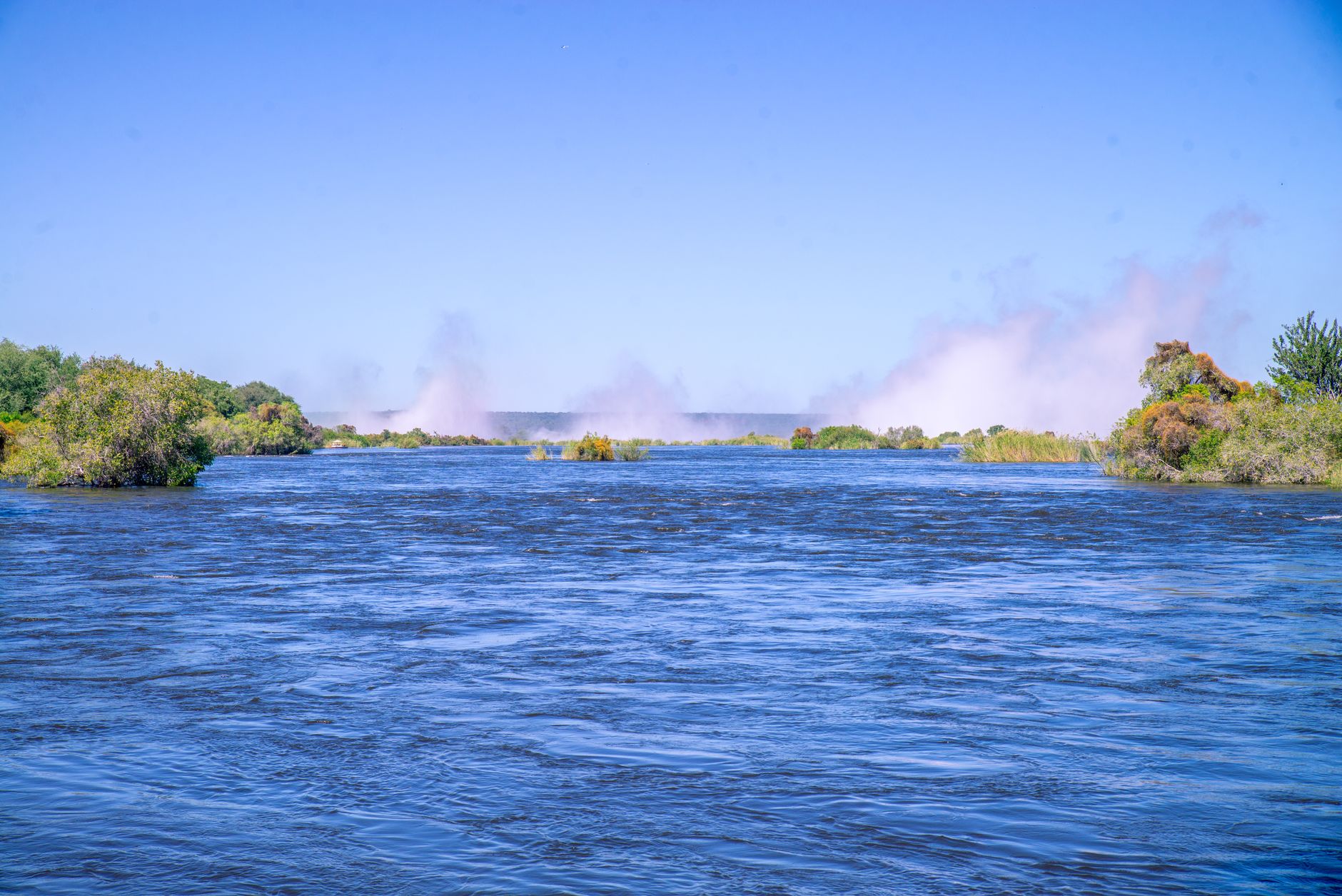
Livingstone gives you Zambia's side of Mosi-oa-Tunya, where 1,708 meters of water drop into basalt. Come in high-flow months for thunder and spray, or in the dry season for Devil's Pool and clearer views.
Zambia is where African travel gets its proportions right: one of the world's great waterfalls, safari country without convoy tourism, and a history far older than most itineraries admit.
 Zambia
EntryVisa-free for many nationalities; check entry stamp
ZA Zambia travel guide starts with a surprise: this landlocked country holds the world's biggest sheet of falling water and some of Africa's emptiest roads.
Zambia works best for travelers who want scale without spectacle. You come for Victoria Falls near Livingstone, of course, but the country gets more interesting once you notice the plateau itself: 900 to 1,500 meters high, cool enough to soften the heat, crossed by the Zambezi, the Kafue and the Luangwa. In Lusaka, English carries the transaction while Nyanja carries the mood; on the Copperbelt, Ndola and Kitwe still remember the years when copper paid for national ambition. The distances are real here. So is the reward.
The classic Zambia trip splits in two. One half belongs to water and wildlife: Livingstone for Mosi-oa-Tunya, Mfuwe for South Luangwa's walking safaris, Kafue for huge skies and long game drives, Bangweulu Wetlands for shoebills and floodplain light that turns every photographer quiet. The other half belongs to the country's older, stranger story. Kabwe gave the world one of Africa's most important early human fossils. Kalambo Falls drops 235 meters beside archaeological layers that push human fire use back hundreds of thousands of years. That is not brochure history. It changes the scale of the place.
Before the Kingdoms, c. 300000 BCE-900 CE
A skull lay in the earth at Kabwe for perhaps 300,000 years before miners pulled it into the light in 1921. Broken Hill Man, as the find was first called, did not arrive with a throne or a dynasty; he arrived with a face. That is what unsettles people still. In the museum story of Zambia, the oldest witness is not a pot or a spearhead but a human gaze.
Far to the north, at Kalambo Falls, another scene waits in the spray. Water drops 235 meters in one uninterrupted plunge, and archaeologists found worked wood there so old that it belongs to a world before farming, before metal, before writing. Ce que l'on ignore souvent, c'est que this is not only a waterfall on the road to today's Kalambo Falls. It is one of the rare places on earth where wood survived long enough to prove that very early people were shaping their world with intention, not merely surviving inside it.
Then came the slower revolution, the one without a single battle date. Bantu-speaking farmers and ironworkers moved across the plateau between the first centuries of the Common Era and the early medieval period, bringing crops, cattle, furnaces, and new settlement patterns. Rivers mattered more than kings. The Zambezi, the Kafue, the Luangwa, the Chambeshi: they fed, carried, divided, and connected.
Rock paintings in caves and overhangs, dugout fishing traditions around Bangweulu Wetlands, and early iron-smelting sites tell the same story from different angles. Zambia was never empty country waiting for history to begin. It was already full of memory, technique, and exchange. That matters because every later kingdom, caravan, and colonial boundary would rest on this older map of water, movement, and human skill.
Broken Hill Man is less a person than a presence: the oldest face in Zambia, and still the one that makes the deepest silence.
The wooden finds at Kalambo Falls are so ancient because the waterlogged ground protected them; in most places, wood of that age simply disappears.
Age of River Trade, c. 900-1500
Picture a burial near the meeting of the Zambezi and the Kafue: gold wire around fingers, glass beads from Gujarat and Egypt, cowries that began their journey in the Indian Ocean, and copper laid beside the dead as though wealth itself wished to accompany him. This was Ingombe Ilede, excavated in 1960, and it overturned a lazy old idea in one stroke. The interior was not isolated. It was connected, elegant, and rich.
The name means "the place where the cow lies down," which sounds almost pastoral, almost sleepy. Not even close. By the 11th and 12th centuries this site was tied into long-distance trade networks that linked central Africa to Great Zimbabwe, the Swahili coast, and markets far beyond the continent. Ce que l'on ignore souvent, c'est que medieval Zambia handled global goods before Europe had mapped half the routes involved.
Copper was the great seducer here. Not merely metal for tools, but status, exchange, and ceremony. The famous croisettes, copper crosses that served as currency across central Africa, suggest a commercial world built on trust, reputation, and repeated contact rather than a stamped coin from one emperor's mint. A monetary system without a single sovereign behind it. Rather elegant, really.
To the east, Maravi power grew through ivory, kinship, and ritual authority. Their political order crossed what are now Zambia, Malawi, and Mozambique, and their Nyau masked traditions carried religion, satire, and memory in one performance. By the time later states emerged more clearly in western and northern Zambia, the country already possessed what every durable history needs: trade routes, sacred forms, and people who knew the price of distance.
The nameless elite buried at Ingombe Ilede remains one of Zambia's most haunting protagonists: a merchant prince whose jewelry survived him better than his name.
Some of the beads found at Ingombe Ilede were made thousands of kilometers away, which means luxury goods reached inland Zambia through a chain of traders long before any European ship touched these rivers.
Kingdoms of Floodplain and Plateau, c. 1500-1890
In western Zambia the year still turns with water. When the floodplain rises, the Lozi king, the Litunga, leaves the plain in the royal barge called the Nalikwanda, black and white, crowned with an elephant. Drums sound, paddles strike in rhythm, and the court moves from Lealui to higher ground at Limulunga. It is one of Africa's grand political theatres, but theatre here is not decoration. It is government made visible.
The Lozi state understood hydraulics before colonial officials understood the country they hoped to rule. Canals, raised settlements, flood timing, tribute, redistribution: power rested on managing water and people together. The title Litunga is often translated as "keeper of the earth," and that is close enough to the truth to be revealing. A king on a floodplain could not pretend nature would obey him. He had to negotiate with it.
Then came the Kololo, driven north by the violence of the Mfecane in southern Africa. Their leader Sebetwane crossed impossible distances in the 1830s and seized the Barotse plain, imposing a new military order and leaving behind a language legacy that outlived his dynasty. One can almost see him: dust on the march, cattle, wives, children, armed men, a whole moving kingdom searching for survival and advantage.
What followed was not simple replacement. Lozi institutions bent, absorbed, and returned. That is the secret strength of many Zambian polities in this era: they survived by adaptation, not purity. And when Europeans finally appeared with maps, treaties, and missionary certainty, they encountered states that already knew how to manage outsiders, at least for a while.
Sebetwane was no armchair conqueror; he dragged a people across southern Africa and built power through movement before dying only weeks after meeting David Livingstone.
The Kuomboka ceremony is not a pageant invented for visitors; it began as a practical royal migration from flooded ground, which makes its grandeur all the more convincing.
Missionaries, Concessions, and Northern Rhodesia, 1851-1964
In November 1855 David Livingstone stood near the edge of Mosi-oa-Tunya and tried to describe what he had seen. He reached for grandeur, of course. Everyone does at Victoria Falls near today's Livingstone. Yet the more revealing moment came elsewhere, in his encounters with African rulers who understood negotiation better than missionaries liked to admit. Exploration was never just discovery. It was conversation, misreading, and ambition.
No figure embodies that tension more than Lewanika, Litunga of Barotseland. He sought British protection in the 1890s to shield his kingdom from rivals and raiders, only to find that protection arrives with clerks, concessions, and lawyers. The Lochner Concession of 1890 and the tangled deals around the British South Africa Company became a courtly tragedy in paperwork. One ruler, signing for survival, helped open the door to subordination.
Northern Rhodesia was then built through extraction. Rail lines pushed north. Towns grew around mines. The Copperbelt, with cities such as Ndola and Kitwe, turned mineral wealth into imperial revenue, while African laborers made the whole machine run under strict racial hierarchy. Ce que l'on ignore souvent, c'est que modern Zambia was shaped as much by payrolls and compounds as by governors' speeches.
And resistance grew in those same townships, churches, schools, and unions. The old royal politics did not vanish; they met wage labor, newspapers, and mass organization. By the time the Federation of Rhodesia and Nyasaland was imposed in 1953, many Zambians had already decided that company rule in a smarter suit was still rule from elsewhere. The road from concession to independence would run through protest, prison, and astonishing discipline.
Lewanika was a sophisticated strategist, not a gullible relic; his tragedy was that he believed imperial paperwork might honor the logic of diplomacy.
After inviting British protection, Lewanika is said to have realized he had been outmaneuvered and bitterly regretted the agreements made in his name.
Independence and the Long Republic, 1964-present
Independence came on 24 October 1964, and Kenneth Kaunda, handkerchief in hand, became the first president of Zambia. It is one of those details that sounds small until you see him in photographs. The white handkerchief became part of the man: gentle, theatrical, slightly schoolmasterly, always ready to wipe his face while carrying the burden of a new nation. Zambia inherited borders, railways, mines, and very little patience for chaos.
Kaunda chose humanism as his creed and nonalignment as his posture, while the region around him burned. White-minority Rhodesia lay to the south, apartheid South Africa further below, liberation wars on several frontiers. Lusaka became a capital of diplomacy and exile, hosting movements that wanted to break the old order across southern Africa. Noble, yes. Also expensive. Copper prices fell, debts rose, and the one-party state hardened in 1972 under the claim that unity required discipline.
Yet Zambia's story after independence is not simply one of disappointment. The country avoided the military coups and civil wars that scarred many neighbors. In 1991 voters removed Kaunda and brought Frederick Chiluba to power in a peaceful transition that mattered far beyond Lusaka. Democracies are not born spotless; they are born argumentative. That is healthier.
The later republic kept testing itself through debt crises, corruption scandals, constitutional fights, and generational change. One can stand in Kabwe, where one of humanity's oldest skulls was found, then travel to Lusaka, where one of Africa's youngest populations argues about jobs, dignity, and power in three languages before lunch. That bridge between deep time and impatient modern politics is Zambia's true drama. The next chapter, as ever, belongs to those who have inherited more history than cash and still insist on shaping the future.
Kenneth Kaunda could seem paternal, stubborn, moving, and exasperating within the same week, which is often the mark of a founding father rather than a saint.
Zambia changed presidents through the ballot box in 1991 without a coup or civil war, a fact so quietly remarkable that outsiders often miss how rare it was in the region at the time.
In Zambia, a greeting is not a preface. It is the event. In Lusaka, on Cairo Road, in a market lane in Chipata, at a fuel stop between Kafue and Livingstone, the exchange begins before the business and sometimes outlives it: how are you, how is home, how did you sleep, how is the heat treating you, and only then the price of tomatoes, the bus seat, the missing change.
English runs the state, the schools, the paperwork. The pulse lives elsewhere. Bemba in the Copperbelt, Nyanja in Lusaka and the east, Tonga in the south, Lozi on the floodplain: each one shifts the air in the mouth differently, as if the country kept several keys for the same locked room. A taxi driver will begin in English, tilt into Nyanja for mischief, then answer a call in Bemba with the ease of someone changing posture.
That is what strikes me most. Speech here behaves like kinship. You do not hurl words at a stranger and hope they land. You approach. You circle. You announce your humanity before your purpose. A country can be recognized by its table. Zambia can be recognized by its greeting.
Etiquette in Zambia does not puff itself up into doctrine. It enters through the body. A younger person lowers the gaze a fraction before an elder. A woman handing an object to an older man may soften at the knees, almost a curtsey, almost a memory of something more ancient. Respect here is grammatical. One sees it in wrists, in shoulders, in the angle of a head.
Visitors from hurried countries make the same error. They ask the useful question too early. Where is the bus? How much is the fish? Which road goes to Mfuwe? The answer often arrives, because kindness is abundant, but the skipped greeting leaves a little crack in the exchange. Zambia dislikes social violence, even in miniature.
Refusal has its own poetry. "I will try" can mean yes, no, later, perhaps, I do not want to shame you, or the gods have not signed the form yet. Listen to tone. Listen to timing. Words do not live alone here; they come with weather, pause, and face. That is civilization.
Nshima is not a side dish. It is the axle. The meal turns around that white, dense mound of mealie meal, pinched with the right hand, pressed with the thumb into a small scoop, then sent toward ifisashi, kapenta, beef stew, pumpkin leaves, dried fish, whatever the house has made with patience and oil. Cutlery looks almost comic beside it. Hands know better.
A Zambian table respects texture with near-religious seriousness. Ifisashi gives silk from groundnuts and greens. Kapenta gives salt and crackle. Chikanda, that orchid-tuber loaf with peanut flour, arrives looking like a private joke and tastes like a very old argument between earth and smoke. Then come vitumbuwa at dawn, a paper packet warm in the hand, and roasted maize at a roadside stop, the kernels blackened in patches because sugar prefers danger.
I admire cuisines that understand starch without apology. Zambia does. In Livingstone, a plate of nshima and ndiwo can say more about the country than a lecture on nationhood. Hunger becomes order. Sharing becomes syntax. A people reveals itself by what it expects your fingers to learn.
Zambia has writers who refuse to behave. That is already a recommendation. Namwali Serpell's novel "The Old Drift" begins near Livingstone and Mosi-oa-Tunya, then proceeds to make mosquitoes into a chorus and history into a fever dream with excellent manners. Such insolence pleases me. Nations are rarely understood by sober catalogues; they confess themselves when fiction starts laughing.
What I like in Zambian writing is the refusal of a single register. Colonial archive, family gossip, prophecy, bus-station wit, court speech, Pentecostal fervor, scientific notation: all of it can occupy the same page without asking permission. The country itself does this every day. Why should literature pretend to be tidier than the people who made it?
Read before you arrive, and the land alters. Kabwe stops being a dot on a map and begins murmuring about deep time and broken empires. The road to Kalambo Falls acquires the dignity of rumor. Even Bangweulu Wetlands, which already sound invented by a patient god, become legible as a place where silence has biography. Good books do not decorate travel. They contaminate it. Blessedly.
Zambia is formally Christian and openly so, yet the fact alone explains very little. One must hear the singing. One must watch a Sunday begin in Lusaka with pressed shirts, polished shoes, children held to impossible standards of cleanliness, women in dresses whose colors could rebuke a grey European capital into repentance. Faith here is not hidden in private corners. It walks the road in full daylight.
Churches range from Catholic brick parishes to Pentecostal halls with plastic chairs, microphones, keyboards, and a theology of amplification. The sermon may last. Nobody seems shocked by that. Religion in Zambia is communal time, disciplined listening, public hope, and sometimes theatrical force. A good choir can make corrugated metal feel like a cathedral.
Older cosmologies have not vanished because a constitution made a declaration in 1991. They remain in respect for elders, in funerary obligation, in masked societies among Chewa communities, in the persistent sense that the visible world is only the front office. I distrust countries that think belief must choose one costume. Zambia is less naive. It wears several.
Music in Zambia does not ask for a stage before it begins. It arrives from church speakers, minibuses, weddings, bars, political rallies, funerals, schoolyards. Rhythm is public property. The body is expected to understand before the mind finishes catching up.
Listen westward and the Lozi world gives you the long memory of water. Kuomboka, the ceremony of the Litunga's move from the flooded plain, is governance made audible: royal drums, paddles striking time, song carrying across the Barotse floodplain with the authority of weather. Elsewhere the Copperbelt brought kalindula, guitar lines with dust on their shoes, dancing music for townships built by mines and stubbornness.
Then gospel takes the room. Of course it does. Zambia sings belief with a force that turns hesitation into bad manners. Even recorded music seems to lean toward chorus, toward answer, toward company. Solitude exists here, but it is rarely the final form of emotion.
Livingstone gives you Zambia's side of Mosi-oa-Tunya, where 1,708 meters of water drop into basalt. Come in high-flow months for thunder and spray, or in the dry season for Devil's Pool and clearer views.
Mfuwe opens the door to South Luangwa, the valley that made Zambia famous among serious safari travelers. This is the place for dawn walks, leopard sightings and camps that still feel closer to bush life than stage set.
Bangweulu Wetlands and Kafue show Zambia at its least crowded and most convincing. One gives you shoebills and floodplain fishermen; the other delivers huge predator country with room to drive for an hour and meet almost nobody.
Kabwe and Kalambo Falls place Zambia inside the very long human story. One yielded the Broken Hill skull; the other preserves evidence of controlled fire and settlement beside Africa's second-highest uninterrupted waterfall.
Zambia still rewards travelers who enjoy the journey itself. You can fly between Lusaka, Livingstone and Mfuwe, take the old rail line toward Kitwe, or cross long stretches of plateau where the landscape does the talking.
12 cities — start with the ones we'd send you to first.
The colonial-era town that grew up around the spray of Mosi-oa-Tunya still runs on adrenaline — white-water rafting grade-five rapids at dawn, Devil's Pool at the lip of a 108-metre drop by afternoon.
A capital of roundabouts and roadside vendors where Nyanja and English collide in the same sentence and the Soweto Market sells dried kapenta next to Chinese mobile phones.
The dusty gateway to South Luangwa National Park, where elephants routinely walk through the lodge lobby and the walking safari was effectively invented by Norman Carr in 1950.
A small, privately managed park in the north that hosts the largest mammal migration on earth — ten million straw-coloured fruit bats darkening the sky each November, largely unknown outside Zambia.
The Copperbelt's commercial anchor, where the open-pit mines that financed Zambia's independence still operate and the Dag Hammarskjöld crash site sits in quiet woodland outside town.
Zambia's second-largest city proper, a grid of wide avenues built on copper money in the 1950s, now home to a young, entrepreneurial population rewriting what a mining town can become.
The eastern gateway to Zambia sits close enough to Malawi that Nyanja is the street language and Nyau masked dancers still appear at night ceremonies in the surrounding villages.
Capital of Barotseland on the edge of the Zambezi floodplain, where the annual Kuomboka ceremony — the Lozi king moving his court by royal barge as the plain floods — is one of Africa's great living rituals.
At 235 metres, Africa's second-highest uninterrupted waterfall drops into a gorge on the Tanzanian border where archaeologists in 2023 found 476,000-year-old evidence of deliberate fire use — the oldest known in the worl
Livingstone is Zambia's cleanest entry point for first-time travelers, but the town matters less than the river beside it. This is where the Zambezi narrows, drops, and then drifts into safari country, so days tend to split between spray, sunset boats, and the practical business of booking the next ride.
Lusaka and Kabwe show the country at working speed: bus stations, malls, ministries, freight routes, and the long plateau distances that make Zambia feel larger than maps suggest. You come here for logistics, markets, and a clearer sense of how people move, trade, and talk beyond the safari circuit.
Chipata is the practical hinge, Mfuwe the reward. Eastern Zambia feels more agricultural, more road-based, and then suddenly wild once you enter the Luangwa system, where dry riverbeds, oxbow lagoons, and walking safaris replace the usual lodge-to-lodge routine.
Ndola and Kitwe grew rich on copper, and that industrial history still shapes the mood: pragmatic, urban, less polished than tourism brochures would like. Move north toward Kasanka and the Bangweulu Wetlands and the country opens out into blackwater swamps, shoebill country, and one of Zambia's strangest seasonal spectacles.
Mongu sits on the edge of the Barotse floodplain, where water decides the calendar and the landscape looks almost horizontal until the light changes. Kalambo Falls is the opposite kind of drama: a 235-meter drop near Lake Tanganyika, archaeologically important and far enough away that getting there becomes part of the point.
Zambia's history moves through trade corridors, royal courts, copper towns, and the hard discipline of nation-building.
The famous Kabwe skull, found in 1921, points to very early human life in what is now Zambia. It remains one of the continent's most arresting prehistoric finds because the face looks unnervingly close to our own.
At Kalambo Falls, archaeologists uncovered worked wooden remains of extraordinary age. The site proved that early humans here shaped timber with intention, which changed the way scholars think about technological skill in deep prehistory.
Bantu-speaking farmers and metalworkers expanded through the region with crops, furnaces, and new settlement patterns. The shift was gradual, but it changed food, trade, and social organization for centuries to come.
The settlement near the Zambezi-Kafue confluence became part of a trading world that linked inland Africa to the Indian Ocean. Beads, copper, and prestige goods moved through the site, placing present-day Zambia inside a much wider commercial map.
The Maravi confederation expanded across parts of eastern Zambia, Malawi, and northern Mozambique. Power rested on trade, kinship, and ritual authority rather than a single rigid capital.
In western Zambia, Lozi political authority developed around the Barotse floodplain, where controlling water was as important as commanding soldiers. Court ceremony and practical flood management became inseparable parts of rule.
After a long migration north during the upheavals of southern Africa, Sebetwane's Kololo established rule over the Lozi heartland. Their conquest was dramatic, but their deepest legacy may have been linguistic and political rather than purely military.
The meeting brought missionary ambition and African statecraft into the same room. Livingstone admired Sebetwane's authority, but the encounter also opened a path for greater British involvement in the region.
David Livingstone saw the great falls on the Zambezi and named them Victoria Falls for his queen. The older local name, Mosi-oa-Tunya, endured because it describes the place better than any imperial dedication ever could.
Seeking protection and advantage, Lewanika entered into dealings tied to the British South Africa Company. The result was bitter: diplomacy on African terms gave way to imperial legal language that steadily narrowed Lozi autonomy.
British territories in the region were reorganized into Northern Rhodesia. The new colonial unit looked administrative on paper, but it laid the framework for the future state of Zambia.
Miners near Kabwe uncovered one of Africa's most famous prehistoric human remains. The discovery gave colonial Northern Rhodesia an unexpected link to humanity's far older story.
Large-scale copper production transformed towns such as Ndola and Kitwe into industrial centers. Wage labor, segregation, and trade union politics began to reshape society far beyond the mine compounds.
Britain joined Northern Rhodesia with Southern Rhodesia and Nyasaland in a federation designed to preserve regional control from above. Many African nationalists saw it for what it was: an attempt to delay majority rule behind bureaucratic architecture.
Excavations revealed rich burials with imported beads, gold, and copper, proving the medieval interior had been deeply connected to long-distance trade. Zambia's past suddenly looked more cosmopolitan than old colonial textbooks had allowed.
On 24 October 1964, Northern Rhodesia became Zambia and Kenneth Kaunda became its first president. The new republic inherited borders and mines, but also the harder task of turning many regions and languages into one political home.
Kaunda and UNIP turned Zambia into a one-party republic, arguing that unity and regional danger demanded tighter control. The measure brought stability of a kind, but it narrowed political life and stored up future frustration.
Frederick Chiluba defeated Kaunda in a peaceful transfer of power that stood out in the region. Zambia showed that an entrenched liberation-era ruler could leave office through ballots rather than barracks.
After years in opposition, Hichilema won the presidency in an election watched closely across Africa. The result reminded observers that Zambian politics can still surprise, and that the electorate remains more independent-minded than many ruling parties assume.
Before the Kingdoms
Broken Hill Man is less a person than a presence: the oldest face in Zambia, and still the one that makes the deepest silence.
A skull lay in the earth at Kabwe for perhaps 300,000 years before miners pulled it into the light in 1921. Broken Hill Man, as the find was first called, did not arrive with a throne or a dynasty; he arrived with a face. That is what unsettles people still. In the museum story of Zambia, the oldest witness is not a pot or a spearhead but a human gaze.
Far to the north, at Kalambo Falls, another scene waits in the spray. Water drops 235 meters in one uninterrupted plunge, and archaeologists found worked wood there so old that it belongs to a world before farming, before metal, before writing. Ce que l'on ignore souvent, c'est que this is not only a waterfall on the road to today's Kalambo Falls. It is one of the rare places on earth where wood survived long enough to prove that very early people were shaping their world with intention, not merely surviving inside it.
Then came the slower revolution, the one without a single battle date. Bantu-speaking farmers and ironworkers moved across the plateau between the first centuries of the Common Era and the early medieval period, bringing crops, cattle, furnaces, and new settlement patterns. Rivers mattered more than kings. The Zambezi, the Kafue, the Luangwa, the Chambeshi: they fed, carried, divided, and connected.
Rock paintings in caves and overhangs, dugout fishing traditions around Bangweulu Wetlands, and early iron-smelting sites tell the same story from different angles. Zambia was never empty country waiting for history to begin. It was already full of memory, technique, and exchange. That matters because every later kingdom, caravan, and colonial boundary would rest on this older map of water, movement, and human skill.
The wooden finds at Kalambo Falls are so ancient because the waterlogged ground protected them; in most places, wood of that age simply disappears.
Age of River Trade
The nameless elite buried at Ingombe Ilede remains one of Zambia's most haunting protagonists: a merchant prince whose jewelry survived him better than his name.
Picture a burial near the meeting of the Zambezi and the Kafue: gold wire around fingers, glass beads from Gujarat and Egypt, cowries that began their journey in the Indian Ocean, and copper laid beside the dead as though wealth itself wished to accompany him. This was Ingombe Ilede, excavated in 1960, and it overturned a lazy old idea in one stroke. The interior was not isolated. It was connected, elegant, and rich.
The name means "the place where the cow lies down," which sounds almost pastoral, almost sleepy. Not even close. By the 11th and 12th centuries this site was tied into long-distance trade networks that linked central Africa to Great Zimbabwe, the Swahili coast, and markets far beyond the continent. Ce que l'on ignore souvent, c'est que medieval Zambia handled global goods before Europe had mapped half the routes involved.
Copper was the great seducer here. Not merely metal for tools, but status, exchange, and ceremony. The famous croisettes, copper crosses that served as currency across central Africa, suggest a commercial world built on trust, reputation, and repeated contact rather than a stamped coin from one emperor's mint. A monetary system without a single sovereign behind it. Rather elegant, really.
To the east, Maravi power grew through ivory, kinship, and ritual authority. Their political order crossed what are now Zambia, Malawi, and Mozambique, and their Nyau masked traditions carried religion, satire, and memory in one performance. By the time later states emerged more clearly in western and northern Zambia, the country already possessed what every durable history needs: trade routes, sacred forms, and people who knew the price of distance.
Some of the beads found at Ingombe Ilede were made thousands of kilometers away, which means luxury goods reached inland Zambia through a chain of traders long before any European ship touched these rivers.
Kingdoms of Floodplain and Plateau
Sebetwane was no armchair conqueror; he dragged a people across southern Africa and built power through movement before dying only weeks after meeting David Livingstone.
In western Zambia the year still turns with water. When the floodplain rises, the Lozi king, the Litunga, leaves the plain in the royal barge called the Nalikwanda, black and white, crowned with an elephant. Drums sound, paddles strike in rhythm, and the court moves from Lealui to higher ground at Limulunga. It is one of Africa's grand political theatres, but theatre here is not decoration. It is government made visible.
The Lozi state understood hydraulics before colonial officials understood the country they hoped to rule. Canals, raised settlements, flood timing, tribute, redistribution: power rested on managing water and people together. The title Litunga is often translated as "keeper of the earth," and that is close enough to the truth to be revealing. A king on a floodplain could not pretend nature would obey him. He had to negotiate with it.
Then came the Kololo, driven north by the violence of the Mfecane in southern Africa. Their leader Sebetwane crossed impossible distances in the 1830s and seized the Barotse plain, imposing a new military order and leaving behind a language legacy that outlived his dynasty. One can almost see him: dust on the march, cattle, wives, children, armed men, a whole moving kingdom searching for survival and advantage.
What followed was not simple replacement. Lozi institutions bent, absorbed, and returned. That is the secret strength of many Zambian polities in this era: they survived by adaptation, not purity. And when Europeans finally appeared with maps, treaties, and missionary certainty, they encountered states that already knew how to manage outsiders, at least for a while.
The Kuomboka ceremony is not a pageant invented for visitors; it began as a practical royal migration from flooded ground, which makes its grandeur all the more convincing.
Missionaries, Concessions, and Northern Rhodesia
Lewanika was a sophisticated strategist, not a gullible relic; his tragedy was that he believed imperial paperwork might honor the logic of diplomacy.
In November 1855 David Livingstone stood near the edge of Mosi-oa-Tunya and tried to describe what he had seen. He reached for grandeur, of course. Everyone does at Victoria Falls near today's Livingstone. Yet the more revealing moment came elsewhere, in his encounters with African rulers who understood negotiation better than missionaries liked to admit. Exploration was never just discovery. It was conversation, misreading, and ambition.
No figure embodies that tension more than Lewanika, Litunga of Barotseland. He sought British protection in the 1890s to shield his kingdom from rivals and raiders, only to find that protection arrives with clerks, concessions, and lawyers. The Lochner Concession of 1890 and the tangled deals around the British South Africa Company became a courtly tragedy in paperwork. One ruler, signing for survival, helped open the door to subordination.
Northern Rhodesia was then built through extraction. Rail lines pushed north. Towns grew around mines. The Copperbelt, with cities such as Ndola and Kitwe, turned mineral wealth into imperial revenue, while African laborers made the whole machine run under strict racial hierarchy. Ce que l'on ignore souvent, c'est que modern Zambia was shaped as much by payrolls and compounds as by governors' speeches.
And resistance grew in those same townships, churches, schools, and unions. The old royal politics did not vanish; they met wage labor, newspapers, and mass organization. By the time the Federation of Rhodesia and Nyasaland was imposed in 1953, many Zambians had already decided that company rule in a smarter suit was still rule from elsewhere. The road from concession to independence would run through protest, prison, and astonishing discipline.
After inviting British protection, Lewanika is said to have realized he had been outmaneuvered and bitterly regretted the agreements made in his name.
Independence and the Long Republic
Kenneth Kaunda could seem paternal, stubborn, moving, and exasperating within the same week, which is often the mark of a founding father rather than a saint.
Independence came on 24 October 1964, and Kenneth Kaunda, handkerchief in hand, became the first president of Zambia. It is one of those details that sounds small until you see him in photographs. The white handkerchief became part of the man: gentle, theatrical, slightly schoolmasterly, always ready to wipe his face while carrying the burden of a new nation. Zambia inherited borders, railways, mines, and very little patience for chaos.
Kaunda chose humanism as his creed and nonalignment as his posture, while the region around him burned. White-minority Rhodesia lay to the south, apartheid South Africa further below, liberation wars on several frontiers. Lusaka became a capital of diplomacy and exile, hosting movements that wanted to break the old order across southern Africa. Noble, yes. Also expensive. Copper prices fell, debts rose, and the one-party state hardened in 1972 under the claim that unity required discipline.
Yet Zambia's story after independence is not simply one of disappointment. The country avoided the military coups and civil wars that scarred many neighbors. In 1991 voters removed Kaunda and brought Frederick Chiluba to power in a peaceful transition that mattered far beyond Lusaka. Democracies are not born spotless; they are born argumentative. That is healthier.
The later republic kept testing itself through debt crises, corruption scandals, constitutional fights, and generational change. One can stand in Kabwe, where one of humanity's oldest skulls was found, then travel to Lusaka, where one of Africa's youngest populations argues about jobs, dignity, and power in three languages before lunch. That bridge between deep time and impatient modern politics is Zambia's true drama. The next chapter, as ever, belongs to those who have inherited more history than cash and still insist on shaping the future.
Zambia changed presidents through the ballot box in 1991 without a coup or civil war, a fact so quietly remarkable that outsiders often miss how rare it was in the region at the time.
In Zambia, a greeting is not a preface. It is the event. In Lusaka, on Cairo Road, in a market lane in Chipata, at a fuel stop between Kafue and Livingstone, the exchange begins before the business and sometimes outlives it: how are you, how is home, how did you sleep, how is the heat treating you, and only then the price of tomatoes, the bus seat, the missing change.
English runs the state, the schools, the paperwork. The pulse lives elsewhere. Bemba in the Copperbelt, Nyanja in Lusaka and the east, Tonga in the south, Lozi on the floodplain: each one shifts the air in the mouth differently, as if the country kept several keys for the same locked room. A taxi driver will begin in English, tilt into Nyanja for mischief, then answer a call in Bemba with the ease of someone changing posture.
That is what strikes me most. Speech here behaves like kinship. You do not hurl words at a stranger and hope they land. You approach. You circle. You announce your humanity before your purpose. A country can be recognized by its table. Zambia can be recognized by its greeting.
Etiquette in Zambia does not puff itself up into doctrine. It enters through the body. A younger person lowers the gaze a fraction before an elder. A woman handing an object to an older man may soften at the knees, almost a curtsey, almost a memory of something more ancient. Respect here is grammatical. One sees it in wrists, in shoulders, in the angle of a head.
Visitors from hurried countries make the same error. They ask the useful question too early. Where is the bus? How much is the fish? Which road goes to Mfuwe? The answer often arrives, because kindness is abundant, but the skipped greeting leaves a little crack in the exchange. Zambia dislikes social violence, even in miniature.
Refusal has its own poetry. "I will try" can mean yes, no, later, perhaps, I do not want to shame you, or the gods have not signed the form yet. Listen to tone. Listen to timing. Words do not live alone here; they come with weather, pause, and face. That is civilization.
Nshima is not a side dish. It is the axle. The meal turns around that white, dense mound of mealie meal, pinched with the right hand, pressed with the thumb into a small scoop, then sent toward ifisashi, kapenta, beef stew, pumpkin leaves, dried fish, whatever the house has made with patience and oil. Cutlery looks almost comic beside it. Hands know better.
A Zambian table respects texture with near-religious seriousness. Ifisashi gives silk from groundnuts and greens. Kapenta gives salt and crackle. Chikanda, that orchid-tuber loaf with peanut flour, arrives looking like a private joke and tastes like a very old argument between earth and smoke. Then come vitumbuwa at dawn, a paper packet warm in the hand, and roasted maize at a roadside stop, the kernels blackened in patches because sugar prefers danger.
I admire cuisines that understand starch without apology. Zambia does. In Livingstone, a plate of nshima and ndiwo can say more about the country than a lecture on nationhood. Hunger becomes order. Sharing becomes syntax. A people reveals itself by what it expects your fingers to learn.
Zambia has writers who refuse to behave. That is already a recommendation. Namwali Serpell's novel "The Old Drift" begins near Livingstone and Mosi-oa-Tunya, then proceeds to make mosquitoes into a chorus and history into a fever dream with excellent manners. Such insolence pleases me. Nations are rarely understood by sober catalogues; they confess themselves when fiction starts laughing.
What I like in Zambian writing is the refusal of a single register. Colonial archive, family gossip, prophecy, bus-station wit, court speech, Pentecostal fervor, scientific notation: all of it can occupy the same page without asking permission. The country itself does this every day. Why should literature pretend to be tidier than the people who made it?
Read before you arrive, and the land alters. Kabwe stops being a dot on a map and begins murmuring about deep time and broken empires. The road to Kalambo Falls acquires the dignity of rumor. Even Bangweulu Wetlands, which already sound invented by a patient god, become legible as a place where silence has biography. Good books do not decorate travel. They contaminate it. Blessedly.
Zambia is formally Christian and openly so, yet the fact alone explains very little. One must hear the singing. One must watch a Sunday begin in Lusaka with pressed shirts, polished shoes, children held to impossible standards of cleanliness, women in dresses whose colors could rebuke a grey European capital into repentance. Faith here is not hidden in private corners. It walks the road in full daylight.
Churches range from Catholic brick parishes to Pentecostal halls with plastic chairs, microphones, keyboards, and a theology of amplification. The sermon may last. Nobody seems shocked by that. Religion in Zambia is communal time, disciplined listening, public hope, and sometimes theatrical force. A good choir can make corrugated metal feel like a cathedral.
Older cosmologies have not vanished because a constitution made a declaration in 1991. They remain in respect for elders, in funerary obligation, in masked societies among Chewa communities, in the persistent sense that the visible world is only the front office. I distrust countries that think belief must choose one costume. Zambia is less naive. It wears several.
Music in Zambia does not ask for a stage before it begins. It arrives from church speakers, minibuses, weddings, bars, political rallies, funerals, schoolyards. Rhythm is public property. The body is expected to understand before the mind finishes catching up.
Listen westward and the Lozi world gives you the long memory of water. Kuomboka, the ceremony of the Litunga's move from the flooded plain, is governance made audible: royal drums, paddles striking time, song carrying across the Barotse floodplain with the authority of weather. Elsewhere the Copperbelt brought kalindula, guitar lines with dust on their shoes, dancing music for townships built by mines and stubbornness.
Then gospel takes the room. Of course it does. Zambia sings belief with a force that turns hesitation into bad manners. Even recorded music seems to lean toward chorus, toward answer, toward company. Solitude exists here, but it is rarely the final form of emotion.
Kaunda gave Zambia its first national script after independence in 1964: humanism, discipline, and an almost clerical seriousness softened by that famous white handkerchief. He is remembered both for keeping the country intact in a brutal regional era and for tightening politics into one-party rule when he feared the republic might splinter.
Livingstone reached Mosi-oa-Tunya in 1855 and gave Europe the name Victoria Falls, though the older name, "the smoke that thunders," says far more. His journeys helped place the region in imperial imagination, which made him part witness, part herald of the trouble that followed.
Lewanika was a court politician of the old school: shrewd, ceremonial, and keenly aware that geography alone would not protect Barotseland. His appeal for British protection became one of the great ironies of Zambian history, because the treaties meant to secure his kingdom helped limit it instead.
Sebetwane arrived in what is now western Zambia after a punishing migration north, carrying a people rather than merely an army. He built authority through movement, discipline, and luck, then died soon after meeting Livingstone, leaving behind a conquest whose language traces outlasted its dynasty.
Called the "Mother of Zambia," Julia Chikamoneka turned market women, domestic networks, and public courage into political force. She did not wait for history to invite women into the room; she brought them in herself, and the independence movement was stronger for it.
Kapwepwe was one of the sharpest minds of the nationalist generation, admired for intellect, discipline, and a cool political instinct. His later break with Kaunda showed how quickly the fraternity of liberation could turn into rivalry once power had a capital, a cabinet, and succession at stake.
Moyo belongs to a later Zambia: urban, educated, international, impatient with pious development language. Her global arguments about aid and markets began with a Zambian vantage point, which gave her work a tone of lived skepticism rather than seminar-room abstraction.
Serpell's novel "The Old Drift" begins at Victoria Falls near Livingstone and treats Zambian history as family drama, political fable, and mosquito-chorused epic all at once. She did what good writers do for a country: she made its past strange again, then intimate.
This is the short, high-impact Zambia trip: start in Livingstone for the falls, then slow down in Kafue for river time and a first taste of safari country. It works best if you arrive by air and do not pretend Zambia is small.
Begin in Lusaka for logistics and a dose of modern Zambia, then head east through Chipata and on to Mfuwe for South Luangwa access. The route gets better as it gets quieter, trading traffic circles for game drives, walking safaris, and long dry-season light.
This route starts with the industrial edge of Ndola and Kitwe, then swings north into Kasanka and the Bangweulu Wetlands, where Zambia turns from mining belt to water, birds, and wide horizons. It makes sense for travelers who like their nature trips with context rather than isolation from day one.
Use Kabwe as your central stepping stone, cross west to Mongu for the Barotse floodplain, then commit to the long northern push toward Kalambo Falls. This is the overland Zambia most short itineraries cut out: slower, rougher, and far more revealing about scale.
Right hand pinch. Thumb press. Family table at lunch or dusk. Greens, fish, stew, talk.
Groundnut paste, leaves, slow pot. Shared with nshima. Weekday meal, mother, aunt, whoever reached the kitchen first.
Fry with onion and tomato. Eat with nshima at noon. Beer, cousins, lake stories at night.
Slice cold. Market snack, bus snack, funeral table, office break. Teeth work, tongue waits.
Buy at dawn in paper. Eat standing near a station, school gate, roadside. Tea, gossip, hurry.
Char on coals. Hold with both hands. Road junction, bus stop, rain pause, no ceremony.
Pour from bottle or calabash. Drink in rounds. Visit, reunion, shade, patience.




Many Western passports, including US, UK, Canadian, Australian, and most EU passports, are currently visa-free for short tourist stays in Zambia. Your passport should be valid for at least 6 months, and border officers decide the admitted stay by stamp, so read it before you leave the counter. If you plan to see both Livingstone and Victoria Falls in Zimbabwe, the KAZA Univisa at US$50 is often the cleaner option.
Zambia uses the Zambian kwacha (ZMW). Cards work in better hotels, supermarkets, and larger restaurants in Lusaka, Livingstone, Ndola, and Kitwe, but cash still covers minibuses, markets, tips, and almost anything rural. Restaurant tipping around 10% is normal when service is not included; taxis usually get a small round-up.
Most international arrivals come through Kenneth Kaunda International Airport in Lusaka or Harry Mwaanga Nkumbula International Airport in Livingstone. Ndola and Mfuwe also take international traffic, though Mfuwe is mainly a safari gateway. If you want an overland arrival from Tanzania, TAZARA passenger trains between New Kapiri Mposhi and Dar es Salaam resumed in February 2026, but this is a slow trip, not a quick transfer.
Domestic flights save the most time, especially for routes involving Mfuwe, Livingstone, or safari airstrips. Long-distance buses remain the budget backbone for Lusaka, Chipata, the Copperbelt, and Livingstone, while Zambia Railways is better treated as an atmospheric extra than a reliable timetable. Night driving is the weak point: avoid it outside main urban corridors.
Zambia runs on three seasons: cool dry from late May to mid-August, hot dry from mid-August to November, and wet from November to April. Wildlife viewing is strongest from June to October, but Victoria Falls near Livingstone is most dramatic from March to May, when the spray can be so heavy it soaks cameras and hides half the view. October is usually the hardest month for heat.
Mobile coverage is decent in Lusaka, Livingstone, Ndola, Kitwe, and along main roads, then thins fast in parks and remote districts. Airtel and MTN are the usual choices for local SIMs, and data is cheap by European standards. Hotel Wi-Fi exists, but outside business hotels and higher-end lodges, speed can drop from workable to symbolic.
Zambia is manageable for independent travelers, but petty theft, cash handling, and road safety deserve attention. Use hotel safes where available, withdraw cash in daylight, and keep intercity travel to daylight hours. If you arrive from a yellow-fever-risk country, you may need a vaccination certificate at entry.
Break larger notes in Lusaka, Livingstone, Ndola, or Kitwe before you head into parks or smaller towns. Remote fuel stops, market stalls, and minibus conductors are not built for change-making theatrics.
Fly when the route saves you a full day, especially for Mfuwe or a Livingstone entry. Save road or rail travel for one deliberate section rather than your entire trip unless you enjoy long hauls more than spare time.
June to October is when safari beds, good drivers, and the better-value rooms disappear first. Mfuwe and Livingstone can fill well ahead of peak dates, especially around school holidays and long weekends.
Get an Airtel or MTN SIM soon after arrival if your phone is unlocked. It is cheaper and usually more dependable than leaning on hotel Wi-Fi, particularly once you leave Lusaka.
Road conditions, livestock, unlit vehicles, and tired drivers make night travel the weakest link in Zambia. If a bus schedule or self-drive plan forces you onto rural roads after dark, rethink the plan.
Nshima lunches are filling and often cheaper than dinner plates aimed at tourists. In smaller places, breakfast can be limited and kitchens close early, so do not assume a late dinner exists just because a lodge has rooms.
Border rules may look simple online, but the entry stamp is the rule that actually governs your stay. Read the date and number of days at the desk, not from memory outside the terminal.
Explore Zambia with a personal guide in your pocket
Audio guides for 1,100+ cities across 96 countries. History, stories, and local insight — offline ready.

Usually no for tourism at present, but you should still verify before departure because entry policy has changed repeatedly in recent years. Your passport should be valid for 6 months, and border officers will stamp the period you are allowed to stay.
It can be cheap on buses and guesthouses, then suddenly expensive once you add safaris, park transfers, or fly-in lodges. A careful budget traveler can manage around US$45-70 a day, while park-heavy trips often jump well past US$300 a day.
There is no single perfect month because safari season and peak waterfall season pull in opposite directions. June to October is strongest for wildlife, especially around Mfuwe and Kafue, while March to May gives Livingstone the biggest Victoria Falls water volume.
Sometimes, but do not plan your trip around it. Tourist lodges may quote in dollars, yet day-to-day spending inside Zambia runs on kwacha, and cash in local currency is what you need for buses, markets, tips, and smaller hotels.
Yes in daylight on main corridors, no if your plan depends on rural night driving. Distances are longer than they look, road surfaces vary, and remote stretches between places like Chipata, Mongu, or Bangweulu Wetlands are less forgiving than the map suggests.
The fastest route is to fly to Mfuwe. The cheaper route is overland to Chipata and then onward by road, but it takes far longer and makes most sense only if you want to see eastern Zambia rather than simply reach the park.
Livingstone is better if your trip is short and you want immediate payoff. Lusaka is better if you are building a longer route, need domestic connections, or want to understand contemporary Zambia before heading out to parks or the Copperbelt.
Yes for atmosphere, not for precision. Zambia Railways and TAZARA can turn a journey into a story, but buses and flights are what you use when timing matters.
Last reviewed