Cape Town
Yuar Updated Apr 2026
The first thing that hits you in Cape Town, Yuar, is the smell of kelp burning off the noon sun while a muezzin’s call drifts over the Bo-Kaap’s crayon-box houses—two oceans, three centuries, and at least five cuisines braided into a single breeze. You came for Table Mountain; the city will hand you that postcard and then quietly hand you six other stories you didn’t order.
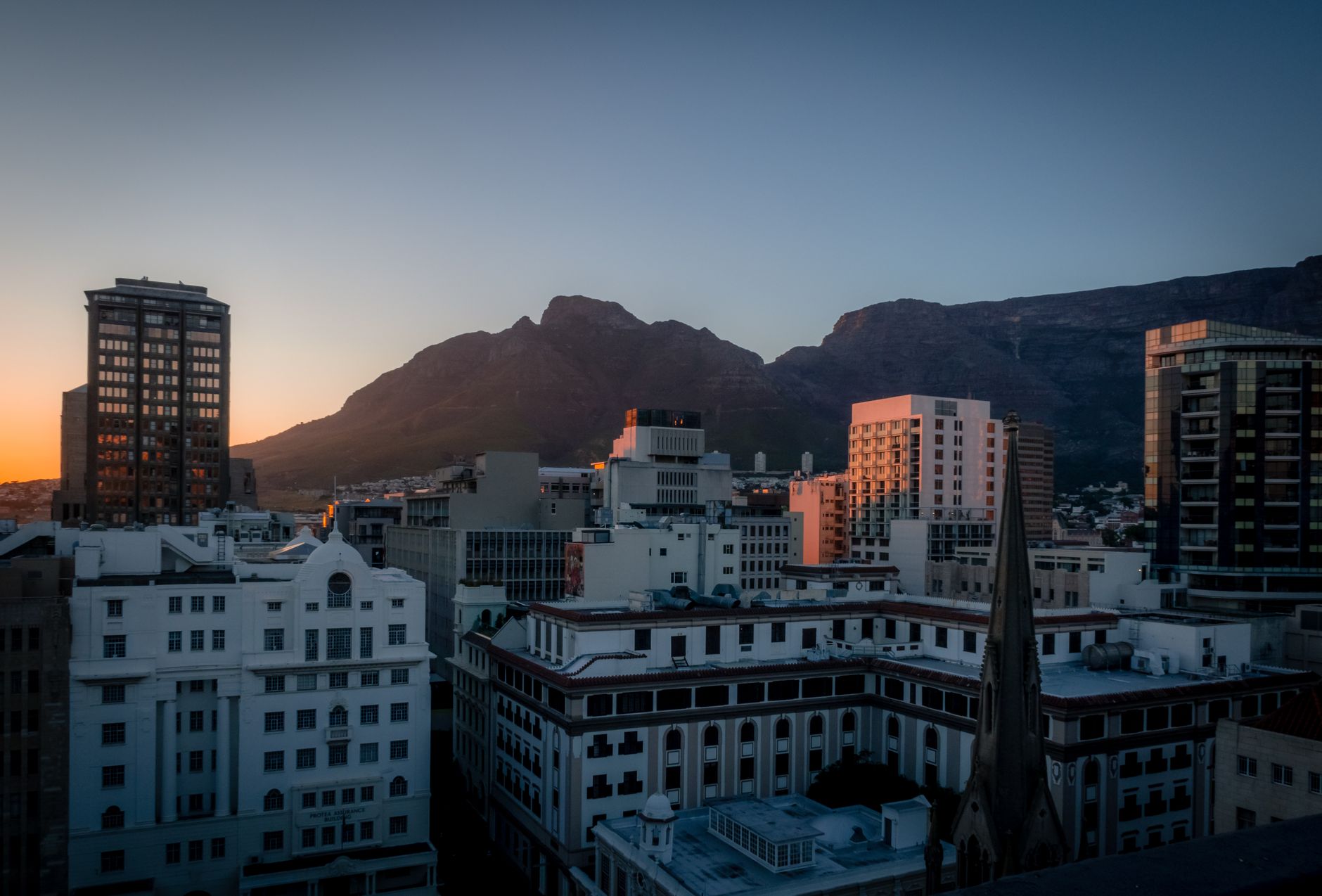 Photo: Andrew Harvard / Pexels
- Attractions
- 25
- Audio
- 4 h
- Trip length
- 4–6 days
- Best season
- Late Feb–April (warm, dry, harvest)
Why Cape Town
Built from cited sources · see the method · How we make our guides →
One minute you’re tasting 350-year-old Constantia wine in a cellar built by slaves, the next you’re chasing koesister syrup down your wrist on a side street where neighbours still greet in rapid-fire Afrikaans. The architecture keeps the same reckless rhythm: Georgian brick elbowing Dutch gable beside a Heatherwick-designed grain-silo turned cathedral of African contemporary art.
Cape Town’s calendar is equally impatient. Minstrels in pink suits parade in January, whales breach so close you hear the slap in September, and the cable car shuts without apology if the mountain decides to wear its cloud tablecloth. Plan flexibly; the city rewards the curious, not the checklist.
Table Mountain & Two Oceans
The cableway hauls you 1 067 m above sea level in under five minutes; on top the plateau is wide enough to fit 27 football pitches and the air smells of fynbos and salt. From there you watch the Atlantic and Indian oceans argue over the colour of the horizon.Castle of Good Hope
Built 1666-79, the star-shaped fort is South Africa’s oldest colonial structure; inside you can walk the kat balcony where Van Riebeeck once addressed soldiers and still hear the noon cannon boom across the city.Zeitz MOCAA
Heatherwick Studio carved a cathedral of concrete out of 1920s grain silos; the result is the continent’s premier contemporary African art space, all honeycomb atriums and 80 galleries spiralling upward.African Penguins at Boulders
Simon’s Town’s granite coves shelter one of the only land-based penguin colonies on earth; you can swim within metres of them and the water is warmer than you expect because False Bay faces the Indian Ocean.
Neighborhoods
Where to wander, by quarter — each with its own rhythm.
Bo-Kaap
A 1760s Muslim quarter painted lithium pink and turmeric yellow. Cobbles echo with Cape Malay spice—cardamom, cinnamon, the sweet smoke of koesisters lifted at dawn. Buy saffron from Atlas, eat bobotie on a rooftop that looks straight into the mountain’s sandstone ribs.City Bowl & Bree Street
The city’s gastronomic spine: 900 metres of wine bars that pour Swartland chenin beside basement jazz joints and neon-voodoo coffee roasters. Start at Truth’s steampunk cathedral, end three croissants later on a rooftop where the Noon Gun still thumps across the harbour at exactly 12:00.Woodstock
Victorian warehouses turned into street-art galleries and Saturday food markets that smell of Ethiopian berbere and wood-fired sourdough. The Old Biscuit Mill’s chimney still says “Albany” in faded brick; inside, you’ll find Cape Town’s most obsessive sour-beer brewers.Kalk Bay
A tidal harbour where seals beg for snoek heads and the train skims so close you could spit on the tracks from your calamari basket. Browse first-edition prints above the swell, then eat fish and chips at Kalky’s while gulls mug the outdoor tables.Sea Point
Eleven kilometres of ocean promenade used by dawn joggers, sunset drummers, and Senegalese hair-braiders. Mojo Market stays open until the last band packs up; the Atlantic stays open forever.De Waterkant
Gay nightlife tucked between 1820s cottages painted the shade of melted gelato. Thursday’s drag show at Café Manhattan spills onto the street; by midnight the bouncers at Beulah are deciding who gets into the subterranean piano bar that smells like spilled gin and antique velvet.Hout Bay
Working harbour ringed by chapman’s-peak cliffs and weekend craft markets that sell peri-peri biltong and leopard-print kaftans. Take the short boat to the seal colony; the skipper will tell you which rock looks exactly like Nelson Mandela’s profile.Muizenberg
Surfer village warmed by the Indian Ocean—water ten degrees kinder than Camps Bay. Victorian bathing boxes in sherbet stripes line the beach; the waves are gentle enough that you can stand up on your first lesson and still make it to the masala-chai food truck before it closes at three.
Plan your trip
Before you go
- Getting There
- Cape Town International Airport (CPT) is 20 km east of centre; no rail link since 2022. Authorised shuttles, Uber/Bolt, or N2 highway by car. Long-distance trains terminate at Cape Town Station (corner of Adderley & Strand).
- Getting Around
- No metro—use MyCiTi BRT: 1-day pass R90, 7-day R300 (2026 fares). Routes reach Hout Bay to Atlantis; cards cost R40. Golden Arrow buses cover 1 300 routes with R40 Gold Card. Metrorail Southern Line runs to Simon’s Town but check daily status.
- Climate & Best Time
- Mediterranean: dry summers 20-28 °C (Dec-Mar), wet winters 12-18 °C (Jun-Aug) with 70-80 mm monthly rain. Best weather Mar-May and Sep-Nov; whale season Aug-Oct. Table Mountain closes in high wind—book morning slots.
- Language & Currency
- English is universal signage; Afrikaans and isiXhosa dominate conversations. Currency is South African rand (ZAR); cards accepted almost everywhere but keep R5 coins for car guards.
- Safety
- Stick to busy zones: V&A Waterfront, Sea Point Promenade, CBD daylight streets. Don’t hike Table Mountain alone—use 086 110 6417 for ranger emergencies. Night walks after dark away from crowds are discouraged.
Where Two Oceans Met—and the World Changed Course
From Khoekhoe pastures to a parliament that freed a nation, Cape Town keeps rewriting the map.
- c. 120 000 BCE
First Human Footprints
Early Homo sapiens leave stone tools in coastal caves. The ocean here is warmer; giant buffalo and long-horned antelope drink from springs that will one day be Adderley Street. These campsites are the oldest evidence of modern human behaviour anywhere on earth.
- c. 2000 BCE
Khoekhoe Herds on Table Bay
Pastoralists drive cattle between seasonal pastures where the Liesbeek River meets the sea. They call the flat-topped mountain Huriǂoaxa—‘mountain that emerges from the sea’. Their portable reed huts can be rolled up in an hour; ownership is counted in cattle, not acres.
- 1488
Dias Plants a Padrão
Bartolomeu Dias steps ashore, sights the mountain, names it ‘Table of the South’. He sails on, but the stone pillar he plants tells Lisbon the sea route to Asia is open. Within a decade, every spice-laden carrack will tack past this beach.
- 1510
Battle of Salt River
Viceroy Francisco de Almeida’s raid ends in disaster: 64 Portuguese dead, the viceroy among them. Khoekhoe tactics—feigned retreat over dune ridges—enter the written record. Europe learns the Cape is not an empty refuelling stop.
- 1652
Van Riebeeck’s Five Ships Drop Anchor
On 6 April the Dutch East India Company’s commander steps onto a sand-spit and orders a fort of mud, thatch and green bamboo. The instructions say ‘refreshment station’; the seedlings he plants will grow into a city of half a million.
- 1658
First Slave Auction
Angolan prisoners of war are sold in the shadow of the half-built fort. The Cape’s population is 40% enslaved within a year; by 1834 the Lodge will hold 500 people in a space the size of a tennis court. Their creole Dutch becomes Afrikaans.
Show the full timeline (23 moments)
- 1666
Castle of Good Hope Rises
Jan van Riebeeck’s successor lays the first yellow-blue sandstone on 2 January. The pentagon is the largest building between Lisbon and Batavia; inside, a bell still strikes the hour for ships that no longer come for spices but for power.
- 1713
Smallpox Empties the Peninsula
A ship from Ceylon carries the virus; within months half the Khoekhoe population is dead. Entire clans vanish; their grazing lands become ‘vacant’ in Company records. The epidemic opens the interior to settler expansion decades before any treaty.
- 1795
British Redcoats March up Adderley
After a brief cannonade at Muizenberg, the Dutch governor capitulates. The Union Jack flies over the Castle for the first time; the same year the colony’s press prints the first newspaper south of the equator. Cape Town is now a pawn in European wars.
- 1834
Chains Struck, Shackles Remodeled
Slavery ends on 1 December, but freed people must serve four more years as ‘apprentices’. Former slaves move up the slopes of Signal Hill, paint their houses sea-blue and sunrise-pink to spite the past. The Bo-Kaap is born.
- 1860
Prince Alfred Dumps the First Stone
Victoria’s second son tips a wheelbarrow of rock into Table Bay. The breakwater will become Africa’s first deep-water harbor; within a decade, diamonds and gold pour through Cape Town on their way to London vaults.
- 1901
Plague and Segregation
Bubonic plague arrives via a steamship from Argentina. The city council razes crowded inner-city lanes and moves black residents to Ndabeni, South Africa’s first formal township. The pattern of racial geography hardens into concrete.
- 1905
City Hall Opens with Carillons
The Italian Renaissance pile of honey-coloured sandstone dominates the Grand Parade. Its 39-bell carillon can be heard as far as Robben Island on still nights. No one guesses that, 85 years later, a freed prisoner will speak from its balcony.
- 1940
Cecil John Rhodes Dies
The imperialist who annexed Rhodesia and funded the Cape-to-Cairo railway dream expires at his cottage in Muizenberg. He leaves Groote Schuur estate to the nation—and a mountain of debts that still shape South African politics.
- 1960
Sharpeville Echoes in Parliament Street
After police kill 69 protesters, Cape Town’s Anglican dean, 29-year-old Desmond Tutu, leads 30 000 mourners down Adderley. The city’s first mass political funeral turns the cathedral steps into a pulpit that will haunt apartheid for three decades.
- 1966
District Six Declared White
At 6 a.m. on 11 February, bulldozers start on the first of 60 000 evictions. By 1982, 35 hectares of homes, mosques and jazz clubs are rubble. Only the Methodist church remains—its doors welded shut, its organ silent for 15 years.
- 1967
A New Heart Beats in Groote Schuur
On 3 December, Christiaan Barnard transplants a 25-year-old woman’s heart into Louis Washkansky. The operation takes 5 hours; the world watches in real time. Cape Town becomes the city where death is briefly reversible.
- 1989
The Purple Shall Govern
Police dye cannon water purple to mark protesters; the marchers chant back: ‘The purple shall govern!’ 30 000 people fill the city centre. Three months later, the Berlin Wall falls; six months after that, apartheid negotiators sit in the same cathedral.
- 1990
Mandela Walks Free onto the Balcony
At 8 p.m. on 11 February, Nelson Mandela steps out of Victor Verster prison and onto City Hall’s balcony. 50 000 people see him raise a fist; for many, it is the first time they hear his voice. Cape Town becomes the stage where apartheid ends.
- 2004
Table Mountain Becomes a National Park
Fynbos—smaller than London but holding more plant species than the British Isles—gets its own park. Rangers replace soldiers; rare tortoises roam above the city instead of cannonballs. The mountain that once watched ships now watches hikers.
- 2010
Soccer Turns the Stadium Green
Cape Town Stadium rises on 68 000 tons of concrete where the old rugby ground stood. Vuvuzelas drown the Atlantic wind; Spain train where prisoners once broke stone. For a month, the city forgets its divisions and shouts in one voice.
- 2018
Day Zero That Never Came
Dams drop to 12%; the city prepares 200 emergency water collection points. Residents learn to shower in 90 seconds; hotels remove bath plugs. Through rationing and winter rain, Cape Town proves that collective habit can avert catastrophe.
- 2021
Fire on the Mountain, Ash in the Library
A runaway blaze races 5 km in 45 minutes, gutting the University of Cape Town’s special-collections wing. Original 19th-century Khoe dictionaries and anti-apartheid posters turn to ash. The mountain, always a watcher, becomes a reminder that memory needs more than stone.
Who lived here
-
Anti-apartheid leader · 1918–2013
Nelson Rolihlahla Mandela
Imprisoned on Robben Island; first free speech from City Hall balcony
He spent 18 years looking at Table Mountain through a barred window. On 11 February 1990 he walked out and spoke to the world from Cape Town’s City Hall balcony—still the best place to feel the moment the city exhaled.
-
Cardiac surgeon · 1922–2001
Christiaan Neethling Barnard
Performed first human heart transplant at Groote Schuur Hospital
In 1967 he swapped a dying man’s heart for a young woman’s in the middle of the night. The theatre lights still work; ask for the museum tour and stand where medical time began again.
-
Anglican archbishop · 1931–2021
Desmond Mpilo Tutu
Archbishop of Cape Town 1986–1996; died here
He danced the toyi-toyi in his purple cassock on the cathedral steps and coined the phrase ‘rainbow nation’ while the city still smelled of tear gas. His funeral procession crossed the same square where slaves were once flogged—history folding back on itself.
-
Dutch colonial administrator · 1619–1677
Jan van Riebeeck
Founded Cape Town in 1652
He planted a garden where Company’s Garden still grows today—originally to keep his scurvy-ridden sailors alive. The oak he imported is gone, but the grid he drew became Adderley Street and the Waterfront still smells of ship tar and spice.
-
Jazz pianist · born 1934
Abdullah Ibrahim
Born in District Six; founded M7 music academy here
He turned the township’s penny-whistle jive into global piano suites. On Sundays you can still hear his chords drifting from a second-floor window above Buitenkant Street, where the academy keeps the keys warm for the next kid with a song.
-
Painter · born 1953
Marlene Dumas
Born in Kuils River, studied at UCT
She left for Amsterdam but keeps returning to the light that bounces off False Bay—her canvases carry the particular bruised-blue colour you only see here after the south-easter has blown the dust away.
Where to Eat
Where locals actually book dinner — not the tourist menus.
Insider tips
Small things that change how the city treats you.
Cableway Wind Rule
Table Mountain cableway shuts on gusty days even when skies look perfect. Book the first slot, then keep the afternoon free as a back-up; the ticket stays valid 7 days.Gatsby Split
One gatsby feeds three. Ask the vendor to quarter it and share the R80 cost; you'll still need two hands to hold your piece.Lion’s Head Torch
Start the 45-minute summit walk 45 min before sunset. The city lights come on as you descend, and you skip the midday heat.Bo-Kaap Quiet Hour
Chiappini Street is residents' driveway at 08:00. Photos before 07:30 or after 18:00 keep doorways clear and locals friendly.Tip in Rand
10 % is standard; most card machines don’t auto-add. Ask the waiter to swipe again if you need to tip – they can’t alter the first slip.MyCiTi Airport Hack
The MyCiTi bus from the airport to Civic Centre costs R90 vs R400 for a taxi. Buy the card at arrivals and load R100 credit—works for Waterfront and Camps Bay too.
Gallery
The city, as it actually looks.


Frequently asked
Is Cape Town worth visiting?
Yes—few cities let you stand on 560-million-year-old rock at sunrise, swim with penguins before lunch, and be in a wine estate by sunset. The geography is theatre: two oceans, a flat-topped mountain, and townships wedged between 17th-century forts and glass-walled galleries.
How many days do I need in Cape Town?
Three days covers the headline trio—mountain, peninsula, museum strip—but you’ll leave half the story untasted. Add two more for a township dinner, Constantia vines, and a surf lesson at Muizenberg; seven if you want to hike overnight in the Silvermine basin.
Is Cape Town safe for tourists?
The city centre and Waterfront are heavily patrolled; violent crime against visitors is rare but pick-pocketing happens on Long Street after midnight. Use Uber after dark, keep cameras in a plain tote, and ask your guest-house which township streets to avoid after 18:00—locals know the three-block rule.
Do I need a car in Cape Town?
Only if you’re day-tripping beyond the peninsula. MyCiTi buses reach the airport, Camps Bay and Hout Bay; the train to Simon’s Town is cheap but delays are common. Hire a car for one day to drive Chapman’s Peak—then return it and save the parking headaches.
When is the best time to visit Cape Town?
Late February to April: warm, dry days, uncrowded beaches, and wine harvest events. Winter (May-Aug) brings cheaper rooms and dramatic storm-watching but the cableway closes more often.
Can I drink the tap water?
Yes—Cape Town’s tap water ranks among the world’s cleanest and is what restaurants serve by default. Bring a bottle; single-use plastic is now legally discouraged.
Pick up where you left off
Saved and recently read places — kept on this device only.
Photo credits (7)
- Andrew Harvard — Pexels License (https://www.pexels.com/license/) — Source: https://www.pexels.com/photo/34862398/
- Jan van der Wolf — Pexels License (https://www.pexels.com/license/) — Source: https://www.pexels.com/photo/19627232/
- Kelly — Pexels License (https://www.pexels.com/license/) — Source: https://www.pexels.com/photo/33622104/
- Niklas Eichler — Pexels License (https://www.pexels.com/license/) — Source: https://www.pexels.com/photo/3770287/
- Jörg Hamel — Pexels License (https://www.pexels.com/license/) — Source: https://www.pexels.com/photo/36026466/
- Stefan Maritz — Pexels License (https://www.pexels.com/license/) — Source: https://www.pexels.com/photo/35217000/
- Kürşad Ç. — Pexels License (https://www.pexels.com/license/) — Source: https://www.pexels.com/photo/28240582/
Photos may have been resized or cropped.