Introduction
Why would the most powerful institution in Christendom spend five centuries collecting pagan statues of naked gods? The Vatican Museums in Vatican City hold over 70,000 works across 54 galleries — one of the densest concentrations of art on Earth — and the answer to that question transforms every room you walk through, from the Laocoön's frozen scream to the Sistine Chapel's ceiling.
The popes didn't collect classical antiquity out of aesthetic weakness. They considered themselves the legitimate heirs of the Roman Empire. Pagan Rome had become Christian Rome; the imperium of Augustus had flowed into the imperium of the Catholic Church. Every marble Apollo, every writhing satyr, every fragment of imperial portraiture was a claim to universal sovereignty dressed in beauty. When you see the Apollo Belvedere standing in its niche, you're not looking at decoration. You're looking at a political argument carved in stone.
Today the experience is overwhelming by design. The route stretches roughly 7 kilometres — longer than a walk from Trafalgar Square to the Tower of London — through corridors where 16th-century maps cover entire walls and ceilings drip with gold leaf. The air changes as you move: cool and echoing in the sculpture galleries, warm and compressed in the Raphael Rooms, then suddenly silent and vast in the Sistine Chapel, where 300-odd bodies painted by Michelangelo float overhead in a space built not as a gallery but as the Pope's private chapel, still used to elect his successors.
Six million visitors pass through each year, most of them funnelled along a one-way route that ends beneath Michelangelo's Last Judgment. The crowds are real, the fatigue is real, and the temptation to rush is constant. Resist it. The Vatican Museums reward the slow gaze — the person who stops to notice a 2,000-year-old floor mosaic underfoot while everyone else stares at the ceiling.
What to See
The Sistine Chapel
You hear it before you understand it. A low collective hum — thousands of whispered voices reverberating off stone — punctuated every few minutes by a guard's sharp "Silenzio! No photo!" that bounces off the barrel vault and returns as a softened echo, briefly stunning the room into stillness. Then the murmur rebuilds. This unintentional acoustic cycle is itself a kind of performance art, and it plays out beneath what may be the most ambitious painting project in Western history.
Michelangelo worked on the ceiling from 1508 to 1512, standing upright on scaffolding (not lying on his back, despite the myth) to paint over 500 square metres of surface — roughly the area of three tennis courts. He returned nearly three decades later to complete The Last Judgement on the altar wall in 1541, a churning mass of 300-plus figures in deep lapis blue and raw flesh tones that shocked contemporaries with its nudity. The side walls, often ignored entirely, hold masterworks by Botticelli, Perugino, and Ghirlandaio that in any other building would be the main attraction.
Wooden benches line the perimeter. Sit down. Tilt your head back and let the ceiling's illusionistic architecture pull your eye from panel to panel — the narrative reads from the altar wall outward, Genesis unfolding above you. The restored frescoes, cleaned between 1980 and 1999, are startlingly vivid under the clerestory light, their colours so saturated they still provoke debate among art historians about whether Michelangelo intended them this bright. He did.


The Raphael Rooms & Gallery of Maps
Four interconnected rooms frescoed by Raphael and his workshop between 1509 and 1524 form the intellectual heart of the museums. The Stanza della Segnatura — originally Pope Julius II's private library — contains The School of Athens, that grand philosophical parliament where Plato points skyward and Aristotle gestures toward the earth. Look for the brooding figure slumped on the steps in the foreground: that's Michelangelo, added by Raphael after sneaking a look at the Sistine ceiling next door. And in the far right cluster of figures, Raphael painted himself as the ancient artist Apelles of Kos, staring directly at you. These rooms were the Pope's daily living quarters, which means Raphael's frescoes weren't gallery art — they were wallpaper for a man who ran the Catholic world.
From here, the one-way route channels you into the Gallery of Maps, and nothing quite prepares you for it. A 120-metre corridor — longer than a football pitch — lined with 40 enormous topographical frescoes of Italian regions, painted between 1580 and 1585 by the Dominican friar-cartographer Ignazio Danti. The maps on the left wall show Italy's Tyrrhenian coast; those on the right show the Adriatic, oriented so that walking south-to-north through the gallery replicates a journey from Rome toward the Alps. Above the maps, the vaulted ceiling erupts in gilded stucco and painted panels so densely decorated that first-time visitors often stop dead, causing a gentle human traffic jam. The marble floor beneath your feet is worn to a glassy smoothness along the centre line — polished by five centuries of footsteps, rougher at the edges where fewer people walk.
The Pinacoteca & Borgia Apartments — the rooms most visitors skip
Here's what happens: the one-way route herds 25,000 daily visitors through the galleries toward the Sistine Chapel, and almost everyone exits straight into Saint Peter's Basilica without doubling back. Which means the Pinacoteca Vaticana — the Vatican's dedicated painting gallery, housed in a separate 1932 building by architect Luca Beltrami — is often half-empty. Inside, Caravaggio's Deposition hangs in a room you might share with a dozen people instead of a thousand. Raphael's Transfiguration, his final painting left unfinished at his death in 1520, glows in relative quiet. The contrast with the crush of the main route is almost disorienting.
The Borgia Apartments deserve the same deliberate detour. These were the private rooms of Pope Alexander VI, frescoed by Pinturicchio over three years in the 1490s. Scholars have identified what may be the first pictorial representations of Native Americans in European art here, painted circa 1494 — just two years after Columbus returned. Look low on the walls and door frames for scratched names and dates: 16th-century graffiti left by soldiers and visitors who carved their presence into the plaster while Pinturicchio's saints gazed down from above. Most people walk past staring at the ceilings. The real history is at knee height.
Photo Gallery
Explore Vatican Museums in Pictures

The Vatican Museums rise behind a green courtyard in bright midday light, with visitors gathered beneath the monumental classical facade.
Regan Dsouza on Pexels · Pexels License

The Gallery of Maps draws visitors through one of the Vatican Museums' most ornate corridors, where painted cartography lines the walls beneath a gilded barrel vault.
imren tutuncu on Pexels · Pexels License

Stone figures and the papal crest rise above the Latin inscription on the Vatican Museums facade. Warm light sharpens the sculpture against a clear Roman sky.
Fred Souza on Pexels · Pexels License

Gilded frames, painted panels, and sculpted figures cover the vaulted ceiling inside the Vatican Museums. The warm light pulls out the gold, red, and green details overhead.
SlimMars 13 on Pexels · Pexels License

A long vaulted corridor in the Vatican Museums pulls the eye through painted ceilings, gilded ornament, and historic wall maps. The scale feels almost theatrical, even before the galleries fill with visitors.
Alina Rossoshanska on Pexels · Pexels License

The Vatican Museums' famous spiral staircase curls downward in a precise sweep of stone steps and ornate metalwork. Cool interior light gives the view its almost theatrical depth.
Dmitry Voronov on Pexels · Pexels License

The Vatican Museums' spiral staircase coils downward in elegant rings of stone, bronze, and carved detail. Visitors appear almost miniature against the sweep of the architecture.
Francisco Ortiz on Pexels · Pexels License

A richly decorated ceiling in the Vatican Museums layers frescoes, gilded frames, painted panels, and sculptural details overhead. The warm light brings out the reds, blues, greens, and golds of the vaulted interior.
SlimMars 13 on Pexels · Pexels License
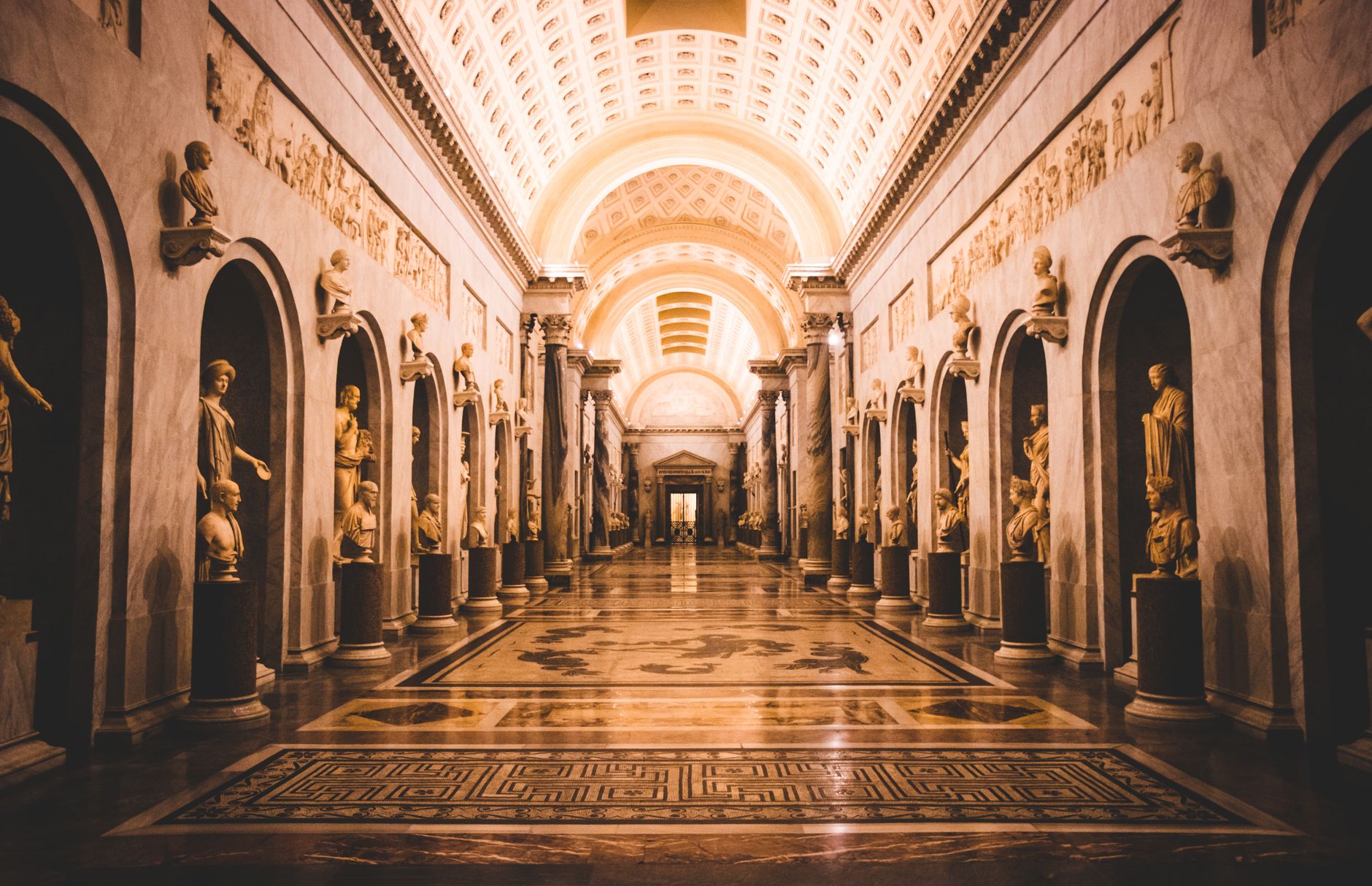
A long marble gallery inside the Vatican Museums glows under warm ceiling light, lined with classical busts, statues, and reliefs.
Jeswin Thomas on Pexels · Pexels License

Gilded frescoes, sculpted figures, and painted panels cover a vaulted gallery ceiling inside the Vatican Museums. The warm interior light brings out the dense decoration and papal symbolism.
Alina Rossoshanska on Pexels · Pexels License
In the Gallery of Maps (Galleria delle Carte Geografiche), look at the 40 painted map panels along the walls instead of craning up at the gilded ceiling. Maps on the left wall face west, maps on the right face east, so both sides orient toward the central corridor. Stand at the midpoint and notice how Italy appears to flip depending on which wall you're reading.
Visitor Logistics
Getting There
The entrance is on Viale Vaticano — not at St. Peter's Square, which catches many people off guard. Take Metro Line A to Cipro (8-minute walk south) or Ottaviano (10-minute walk west along Via Ottaviano). Bus 49 stops closest; buses 32, 81, and 982 stop at Piazza del Risorgimento, about a 10-minute walk. If you're coming from Saint Peter's Basilica, walk counter-clockwise around the Vatican walls — it's roughly 15 minutes on foot. Don't drive; the surrounding ZTL zone and nonexistent parking will ruin your morning.
Opening Hours
As of 2026, the standard schedule runs Monday–Saturday 8:00–20:00 (last entry 18:00), with galleries clearing 30 minutes before closing. Closed every Sunday except the last Sunday of each month (free entry 9:00–14:00, last entry 12:30). Wednesdays can mean late openings or closures due to the Papal Audience — check before you go. The schedule shifts dramatically throughout the year: Holy Week, summer months, and mid-August all bring reduced hours, sometimes as short as 9:00–14:30. Always verify against the official PDF calendar at museivaticani.va, because the 2026 timetable has more variations than a Baroque fugue.
Time Needed
The standard route covers roughly 7 km of corridors — longer than most people's morning run. A focused sprint through the highlights (Gallery of Maps, Raphael Rooms, Sistine Chapel) takes 2.5–3 hours. A proper visit that includes the Pinacoteca, Egyptian Museum, and Etruscan collection demands 5–6 hours. Completists should plan a full day. Factor in 10–30 minutes for security screening even with pre-booked tickets, and know that the one-way route system makes backtracking nearly impossible.
Accessibility
Ramps at the main entrance, elevators between floors, and a dedicated accessible route mean wheelchair users can reach most major galleries including the Sistine Chapel. Ask at the Welcome Desk for the map showing all lifts and ramps — the standard visitor route involves several flights of stairs that the accessible path bypasses entirely. Visitors with certified disability of 67% or higher get free entry plus priority access (with one free companion if needed), but these tickets can't be booked online — present your European Disability Card or certification at the Special Permits counter. The 7 km distance on smooth marble floors is the real challenge; pace yourself.
Cost & Tickets
As of 2026, full adult entry is €20 at the door or €25 online (€20 + €5 booking fee). Reduced tickets for students and pilgrims: €10/€15. Children under 7 enter free. Online tickets are timed-entry, non-refundable, and sell out roughly 10 days ahead during peak season — book early. Third-party guided tours run €40–€119 and use a separate entrance, cutting your wait to under 10 minutes. The free last Sunday of each month sounds tempting, but it generates apocalyptic queues of 2–3 hours; most Romans actively avoid it.
Tips for Visitors
Dress Code Is Enforced
No bare shoulders, no shorts or skirts above the knee, no low-cut tops. Guards will turn you away at the entrance — no exceptions. Carry a light scarf or shawl to throw over shoulders if you're visiting in summer heat. Hats must come off inside, particularly in the Sistine Chapel.
Sistine Chapel Photo Ban
Photography and video are completely banned inside the Sistine Chapel — guards shout "Silenzio! No photo!" on a loop. Flash, tripods, selfie sticks, and drones are prohibited throughout the entire museum complex. In all other galleries, quiet phone or camera shots without flash are fine.
Pickpocket Hotspots
The queue along Viale Vaticano and Metro A stations (Ottaviano and Cipro) are among Rome's most targeted pickpocketing zones — Italian newspapers report incidents regularly, even inside the Sistine Chapel itself. Use a cross-body bag worn in front and avoid back pockets. Booking tickets online eliminates the most vulnerable window: standing in a slow-moving outdoor line for hours.
Ignore Street Ticket Sellers
Unauthorized vendors near the museum walls will approach you offering "skip the line" access at inflated prices. Some are reselling legitimate guided tour spots at a markup; many are outright scams. Book only through the official portal (tickets.museivaticani.va) or established tour operators. Also watch for the rose-in-your-hand trick and clipboard petition scam near the entrance.
Eat Away From the Walls
Restaurants within sight of the Vatican walls charge tourist-trap prices for mediocre food. Walk 3–4 blocks into the Prati neighborhood instead. Mercato Trionfale (Via Andrea Doria) is a sprawling local food market perfect for picnic supplies — cured meats, fresh mozzarella, supplì. For a sit-down Roman lunch, head to Via Cola di Rienzo or the quieter streets around Via Candia for honest cacio e pepe at mid-range prices.
Book Early Morning Slots
The 8:00 AM time slot puts you ahead of the 20,000–30,000 daily visitors who peak between 10:00 and 14:00. By midday in summer, the Sistine Chapel feels like a crowded sauna. Alternatively, the museums have historically offered Friday evening openings (roughly 7–11 PM, April–October) with dramatically thinner crowds and softer light — check the current year's calendar.
Exit Through St. Peter's
When open, a passage from the Sistine Chapel leads directly into Saint Peter's Basilica, letting you skip the basilica's separate security line — a genuine time-saver that can shave 30–60 minutes off your day. This exit isn't always available, so ask a guard inside the chapel. If it's closed, you'll exit via the famous Bramante spiral staircase instead.
Don't Skip the Pinacoteca
Most visitors stampede toward the Sistine Chapel and ignore the Pinacoteca (Picture Gallery), which sits slightly off the main route. It holds Raphael's Transfiguration, Caravaggio's Entombment, and an unfinished Leonardo — with a fraction of the crowds. Art insiders and Romans who actually visit consider it the best room-for-room collection in the entire complex.
History
A Farmer's Spade and Five Centuries of Power
The Vatican Museums were not planned. They were triggered by an accident — a vineyard worker's shovel striking marble on a January morning in 1506. From that single excavation grew a collection that now spans Egyptian mummies, Etruscan gold, Raphael's frescoes, and a Dalí crucifixion, all housed within the walls of a sovereign city-state smaller than most golf courses.
For their first 265 years, these collections were not public at all. Pope Julius II opened his sculpture courtyard only to artists, nobles, and scholars — a princely display of power, not a democratic institution. The museums as ordinary visitors know them date only to 1771, when Pope Clement XIV finally opened the doors. Everything before that was invitation-only.
The Sculptor Who Saved the Collection from Napoleon
Most visitors assume the Vatican's masterpieces have always stood where they stand now. They haven't. In 1797, Napoleon forced the Papal States to sign the Treaty of Tolentino, and approximately 100 of the greatest works — the Apollo Belvedere, the Laocoön, paintings from the Pinacoteca — were crated up and shipped to Paris as war trophies. The pedestals stood empty. The galleries echoed.
But one detail doesn't fit the story of total loss. Walk into the Cortile Ottagono today and you'll find a marble Perseus by Antonio Canova standing on one of those pedestals. Pope Pius VII purchased it specifically to fill the gap left by the stolen Apollo — a defiant statement that Rome could still produce sculpture to rival antiquity. Canova was then Europe's most celebrated living sculptor, and the Pope was about to ask him to do something far riskier than carve marble.
After Waterloo in 1815, Pius VII appointed Canova — an artist, not a diplomat — as his personal envoy to Paris to negotiate the return of the looted art. Everything was at stake for Canova personally: his reputation, his standing across European courts, his relationships with French patrons. The French argued the works had been legally ceded by treaty. Canova argued they belonged to civilization. With crucial support from the Duke of Wellington, he won. He personally supervised the packing and return of the masterpieces to Rome, recovering the vast majority — though some manuscripts never came back.
Knowing this changes what you see. The Laocoön in its niche isn't simply ancient. It's a sculpture that was carried to Paris and carried home again, fought over by empires, and restored to its pedestal by a man who risked his career on the conviction that art belongs where it was made. Canova's own Perseus still stands nearby — the placeholder that became permanent, the artist's answer to an emperor's theft.
The Day the Pope Locked the Doors Against Hitler
In May 1938, Adolf Hitler arrived in Rome as the guest of King Victor Emmanuel III and Benito Mussolini. Pope Pius XI refused to receive him. He relocated to Castel Gandolfo and, according to contemporary accounts, ordered the Vatican Museums and Saint Peter's Basilica closed to all visitors — the only such extraordinary closure in the museums' history. The message was unambiguous: the Führer would not set foot on Vatican soil, not even as a tourist. The empty galleries and locked doors were themselves a statement, silence deployed as protest.
From Private Courtyard to 7-Kilometre Route
The museums grew in layers, each pope adding rooms like geological strata. Clement XIV and Pius VI built the Museo Pio-Clementino in the 1770s–1790s for Greek and Roman sculpture. Gregory XVI opened the Etruscan Museum in 1837 and the Egyptian Museum in 1839. Pius XI inaugurated Luca Beltrami's purpose-built Pinacoteca on 27 October 1932, housing some 460 paintings spanning the 11th to 19th centuries. Then in 1973, Paul VI opened the Collection of Modern Religious Art in the long-abandoned Borgia Apartment — rooms decorated by Pinturicchio in 1494 for Pope Alexander VI, sealed shut after his death, and forgotten for nearly four centuries. The result is a museum where you can walk from a 1st-century Roman sarcophagus to a Chagall in under twenty minutes.
Several manuscripts and artworks seized by Napoleon under the 1797 Treaty of Tolentino were never recovered by Canova and remain in French collections to this day; scholars continue to debate whether the Vatican has a legal or moral claim to their return, and the question resurfaces periodically in diplomatic and academic circles without resolution.
If you were standing on this exact spot on 14 January 1506, you would be in a muddy vineyard on the Esquiline Hill, watching workers drop their shovels and scramble into a pit where white marble has begun to emerge from the Roman clay. As they brush away soil, three contorted figures take shape — a father and two sons, their limbs wrapped in the coils of enormous serpents, mouths open in silent agony. Word has already been sent to the Vatican. Within hours, Giuliano da Sangallo arrives with his young son and a stocky, paint-stained companion — Michelangelo. Sangallo peers into the hole and says, almost to himself: 'This is the Laocoön mentioned by Pliny.' The vineyard owner, Felice de Fredis, stands at the edge, not yet knowing that the Pope will buy this sculpture from him and that this moment — a spade hitting stone — will create one of the greatest museums on Earth.
Listen to the full story in the app
Your Personal Curator, in Your Pocket.
Audio guides for 1,100+ cities across 96 countries. History, stories, and local insight — offline ready.
Audiala App
Available on iOS & Android
Join 50k+ Curators
Frequently Asked
How long do you need at the Vatican Museums? add
Plan at least 3–4 hours for the major highlights, though a serious visit demands a full day. The standard route covers roughly 7 km of corridors — that's longer than a 10K race course folded into marble hallways — and the collection displays around 70,000 works. Most guidebooks suggest 2–3 hours, which is wildly optimistic unless you're practically jogging past Raphael. Factor in the one-way route system: you can't easily backtrack, so if you blow past the Pinacoteca or the Etruscan Museum, they're gone.
Can you visit the Vatican Museums for free? add
Yes — on the last Sunday of every month, admission is free from 9:00 to 14:00, with last entry at 12:30. Children under 7 always enter free, as do ICOM/ICOMOS cardholders and visitors with certified disability of 67% or greater. A warning locals would give you: that free Sunday draws apocalyptic crowds. Lines stretch hundreds of metres along Viale Vaticano, and the experience inside is shoulder-to-shoulder in every gallery. Unless budget is your absolute top priority, the €20 standard ticket buys you a vastly better day.
How do I get to the Vatican Museums from Rome Termini? add
Take Metro Line A (the red line) toward Battistini and get off at either Ottaviano or Cipro — both are about a 10-minute walk to the museum entrance on Viale Vaticano. Cipro is slightly closer to the entrance itself, while Ottaviano drops you nearer to Saint Peter's Basilica. Bus 49 also serves the area. One crucial distinction: the museum entrance is on the north side of Vatican City along Viale Vaticano, not at St. Peter's Square — a 15-minute walk separates the two, and first-time visitors routinely confuse them.
What is the best time to visit the Vatican Museums? add
Early morning on a weekday in November through February gives you the thinnest crowds and the shortest security wait. During peak season (April–October), the museums receive 20,000–30,000 visitors per day, and on-site ticket queues stretch 1.5–3 hours. If you're visiting in summer, book a timed-entry slot online at least 10 days ahead — popular slots sell out fast. Wednesday mornings can also be quieter because many tourists attend the Papal Audience in St. Peter's Square, though the museums sometimes open late or close entirely on Wednesdays.
What should I not miss at the Vatican Museums? add
Beyond the obvious Sistine Chapel and Raphael Rooms, don't skip the Pinacoteca — it's physically separate from the main route, so many visitors never find it, yet it holds Caravaggio's Deposition and Raphael's final painting, the Transfiguration. The Gallery of Maps is 120 metres of 16th-century cartographic frescoes by Ignazio Danti, with a deliberately papal-centric geographic orientation that rewards close reading. In the Pio-Clementino Museum, seek out Nero's porphyry bathtub — an enormous basin carved from deep red-purple stone quarried exclusively from a single Egyptian mountain. And in the Gallery of Tapestries, pause at the Resurrection: Christ's eyes appear to follow you across the room.
Do you need to book Vatican Museums tickets in advance? add
You don't technically need to, but showing up without a booking is a gamble that usually costs you hours. Pre-booked timed-entry tickets (€20 plus a €5 booking fee) reduce your wait to roughly 10–25 minutes for security screening alone. Without them, expect 1.5–3 hours in the outdoor queue during peak season. Book through the official portal at tickets.museivaticani.va — third-party resellers charge €29–€60 for essentially the same access with markup. Tickets are non-refundable and valid only on the date of issue, so commit to your day.
Is there a dress code for the Vatican Museums? add
Yes, and it's strictly enforced — no bare shoulders, no shorts or skirts above the knee, no low-cut tops. Guards will turn you away at the entrance. You don't need formal wear; a t-shirt with sleeves and trousers or a knee-length skirt is fine. Carry a light scarf or shawl in your bag if you're visiting in summer and wearing a tank top — you'll need to cover up before entering, and the same rules apply if you exit through Saint Peter's Basilica.
Is the Vatican Museums wheelchair accessible? add
The museums are well-equipped for wheelchair users, with ramps, elevators, and smooth marble flooring throughout most galleries. A dedicated accessible route bypasses the stairways on the standard visitor path and reaches all major sections including the Sistine Chapel. Visitors with certified disability of 67% or greater receive free entry and priority access — but these tickets cannot be booked online; you must present documentation at the Special Permits counter in the entrance hall. Ask for the accessibility map at the Welcome Desk, as the complex spans multiple levels across 7 km of corridors.
Sources
-
verified
Vatican Museums Official Site — Tickets & Prices
Official ticket prices, free entry policy, reduced rates, disability access details, and online booking information
-
verified
Vatican Museums Official Site — Visitor Tips
Photography rules, dress code, behavioral expectations, and practical visitor guidance
-
verified
Vatican Museums Official Booking Portal
Official timed-entry ticket booking system
-
verified
Vatican Museums Calendar PDF
Detailed annual calendar with period-by-period opening hours and closure dates
-
verified
The Vatican Tickets — Timings
Seasonal opening hours, Wednesday closures for Papal Audiences, and free Sunday details
-
verified
The Vatican Tickets — Getting There
Metro, bus, and walking directions to the museum entrance on Viale Vaticano
-
verified
The Vatican Tickets — Skip the Line
Queue wait time estimates, third-party ticket pricing, and crowd management advice
-
verified
Museum Vatican — Opening Hours
2026 closure dates and standard opening hours
-
verified
Disabled Accessible Travel — Vatican Museums
Wheelchair access details, ramp and elevator locations, accessible route information
-
verified
Vatican Museums Rome — Dress Code
Dress code requirements and enforcement details
-
verified
UNESCO World Heritage Centre — Vatican City
UNESCO inscription details, cultural significance, and description of Vatican City as a World Heritage Site
-
verified
Sage Traveling — Sistine Chapel Disabled Access
Accessibility details for wheelchair users visiting the Sistine Chapel
-
verified
Blocal Travel — Prati Neighborhood Guide
Description of the Prati neighborhood surrounding the Vatican Museums
-
verified
Mama Loves Rome — Where to Eat Near the Vatican
Local food recommendations near the Vatican Museums
Last reviewed: