An introduction.
Researched by the Audiala editorial team from historical records, architectural archives, and local expertise.
HHow does the smallest country on earth end up feeling larger than empires? Vatican City, in Vatican City, Vatican City, makes that paradox visible at once: you come for the shock of standing where Roman graves, papal power, and daily worship still occupy the same few hundred meters, and for the rare chance to watch history remain busy rather than sealed behind glass. Step through the security line and the place resolves into sound and stone: bells carrying over the square, the smell of wax and old marble, Swiss Guards in striped uniforms, and the long human tide flowing toward Saint Peter's Basilica.
Most capitals announce themselves with width. Vatican City works by concentration. Its 44 hectares, smaller than many urban parks, hold a basilica the size of a railway terminal, palaces layered over a Roman necropolis, and the galleries of the Vatican Museums, where corridors seem to unspool for kilometers.
What stays with you here is continuity, not scale alone. Records show this hill was already a place of burial in the 1st century CE; nearly two thousand years later, people still come for prayer, argument, spectacle, confession, and the odd sensation that one grave may have reordered world history.
And the place still works as a state, which is part of its strangeness. Postmen sort Vatican stamps, clerics hurry to offices, pilgrims stare upward, and sunlight slides across travertine so bright it can feel like standing inside reflected water.
01 What to see.
St. Peter’s Basilica
The first shock inside Saint Peter's Basilica is scale: Michelangelo’s dome rises 136.6 meters, roughly the height of a 40-story tower, yet the light feels soft enough to belong to a chapel. Records and tradition place the church above Peter’s tomb, and the whole interior keeps pulling your eye toward it through Bernini’s bronze baldachin, where dark metal glows like warmed honey against marble the color of cream, ash, and old roses.
Most people rush to the obvious masterpieces and miss the human traces. Don’t. Stand a moment by the bronze seated Saint Peter, whose right foot has been worn smooth by centuries of hands and kisses, then look for the odd little sequence on the baldachin’s bases that seems to show a face moving through pregnancy and birth; suddenly this colossal church stops being an imperial symbol and becomes a building full of private acts of belief.
Vatican Museums and the Sistine Chapel
The Vatican Museums work best when you stop pretending they are one sight and accept them as a procession: polished floors, painted corridors, flashes of courtyard light, then rooms that tighten the air around you. The Gallery of Maps stretches 120 meters, longer than a football field, with 40 painted regions of Italy marching down the walls while the ceiling keeps throwing back gold and blue above your head; half the crowd never looks up, which is their loss.
Then comes the Sistine Chapel, and yes, it is crowded, watched, and far less serene than the myth suggests. But Michelangelo’s ceiling still lands because the room makes your body feel it first: craned neck, shuffling feet, the hush that breaks and reforms, and a burst of color that seems almost too bright to be 16th century after the long restoration finished in 1999.
The Square, the Dome, and the Trick of Seeing
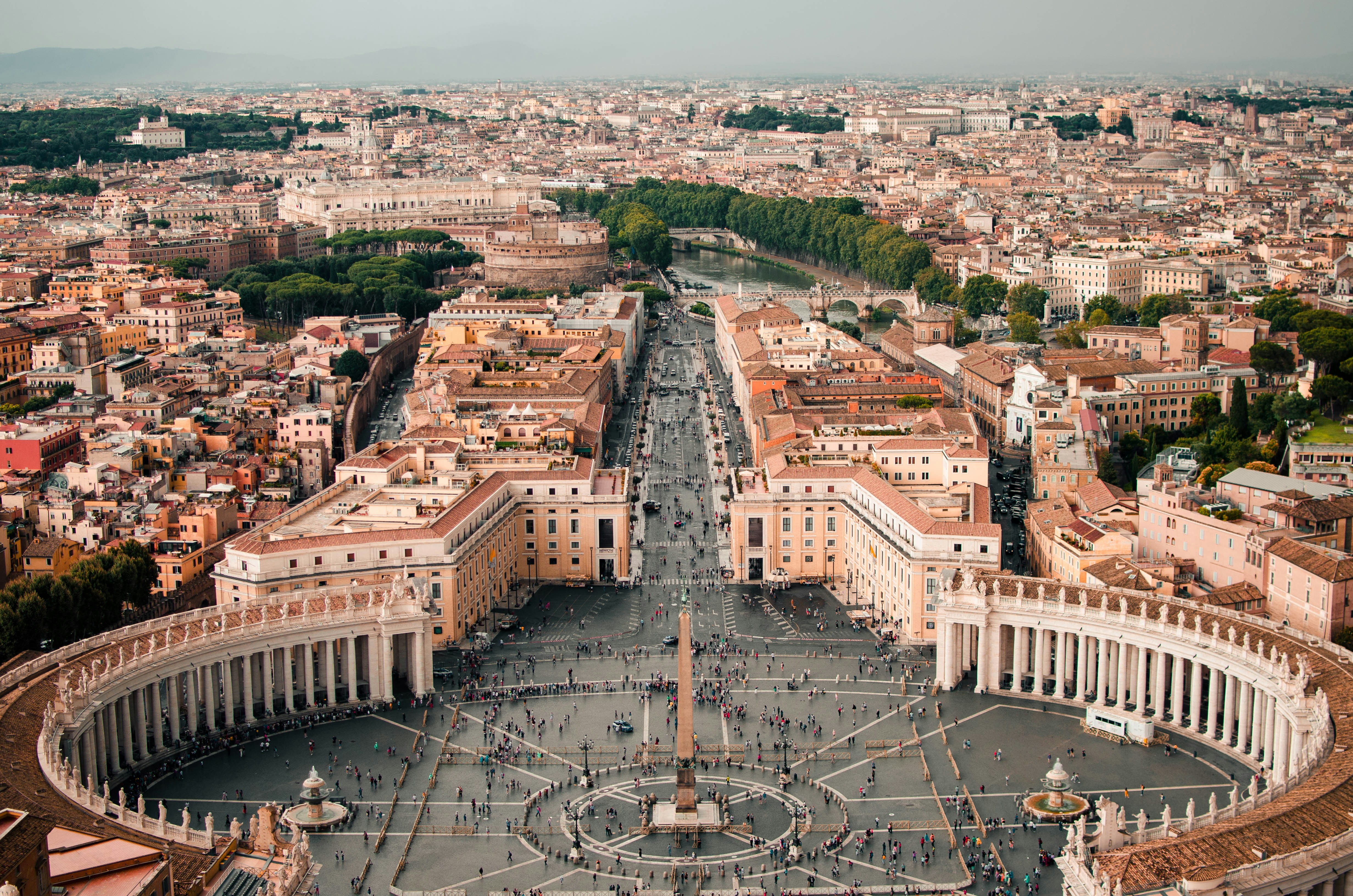
Start in St. Peter’s Square before the stone begins to glare. Bernini shaped the piazza as an ellipse wrapped by 284 columns in four rows, and the best secret is built into the pavement: stand on one of the marble focus discs and those four ranks collapse into one, a baroque magic trick made of geometry rather than mirrors.
From there, climb the dome if tight stairways don’t bother you. The passage leans, narrows, and heats up, then the roof opens and Vatican City suddenly makes sense at a glance: the square below like open arms, the gardens spreading across 22 hectares, about the size of 30 football pitches, and Rome beyond in a haze of terracotta and bell towers. That sequence changes the place. What looked absolute from ground level starts to feel designed, theatrical, and strangely intimate.
02 In pictures.

Plan and listen to Vatican City with Audiala.
Audio guide in your pocket, itinerary in your browser. Built for the way you actually visit.
03 Visitor logistics.
The practical scaffolding for a good visit — kept short.
Getting There
Metro Line A is the cleanest approach: get off at Ottaviano or Cipro for the Vatican Museums, or walk from Ottaviano to Saint Peter's Basilica via Via Ottaviano, Piazza del Risorgimento, and Via di Porta Angelica in about 10 to 15 minutes. Bus 49 stops right in front of the Museums, buses 32, 81, and 982 stop at Piazza del Risorgimento, and the walk from St. Peter's Square to the Museums along Viale Vaticano takes 15 to 20 minutes, longer than it looks from the map because the wall just keeps going.
Opening Hours
As of 2026, the Vatican Museums open Monday to Saturday from 08:00 to 20:00, with last entry at 18:00, and on the last Sunday of the month from 09:00 to 14:00 with last entry at 12:30; most other Sundays are closed, and official closure dates in 2026 include 1 and 6 January, 11 February, 19 March, 6 April, 1 May, 29 June, 14 and 15 August, 1 November, 8, 25, and 26 December. St. Peter's Basilica keeps longer hours, 07:00 to 19:10 year-round, while the dome runs 07:00 to 18:00 in summer and 07:30 to 17:00 in winter; Wednesdays and Sundays draw the heaviest crowds because papal events pull people in by the squareful.
Time Needed
Give Saint Peter's Basilica 1.5 to 2.5 hours if you want the basilica and square without the dome, then add about 1 more hour for the climb itself, plus whatever the security line demands. The Vatican Museums and Sistine Chapel need 2.5 to 3 hours at a minimum, and a full Vatican day with museums, basilica, and dome can easily swallow 6 to 8 hours, which is why splitting it across two days is the saner move.
Accessibility
The Vatican Museums handle mobility needs better than many Roman sites: disabled visitors with certified invalidity of at least 67 percent enter free, a companion also enters free when needed, wheelchairs are available from the cloakroom, and staff can direct you along a barrier-free route. St. Peter's Basilica has ramps and elevators, but the dome is another matter entirely; the lift only reaches the terrace, and the final ascent still means 320 steps, or 551 if you take the whole climb on foot, a vertical squeeze more like a bell tower than a modern lookout.
Cost & Tickets
As of 2026, Vatican Museums tickets cost EUR20 full and EUR10 reduced, with an extra EUR5 for official online booking; entry is free for children under 7 and for eligible disabled visitors, and the last Sunday of the month is usually free, though major feast-day exceptions apply. General entry to Saint Peter's Basilica is free, while official timed products currently list EUR7 for the basilica with digital audio guide, EUR17 for the dome by stairs, and EUR22 for the dome with lift; pay only through the official Vatican portals unless you enjoy funding a stranger's lunch.
05 Tips for visitors.
Small things that change the day.
Dress Seriously
Guards do turn people away for bare shoulders, shorts above the knee, miniskirts, and hats inside sacred spaces. Rome's summer heat tempts bad decisions; carry a light scarf or overshirt so you do not lose an hour to a doorway argument.
Camera Rules
Photos are allowed in most museum galleries and in St. Peter's Basilica if you keep the flash off, but the Sistine Chapel is a hard no for both photos and video. Tripods, drones, and professional gear need authorization, and guards enforce the chapel rule with the patience of men who have repeated the same sentence for years.
Queue Street Smarts
Pickpockets work the museum queue, St. Peter's Square, and Metro A stops like Ottaviano and Cipro, so keep phones out of back pockets and zip every bag before you reach the line. Ignore street sellers offering skip-the-line tickets or costumed photo ops; the official Museums site says its only valid ticket portal is tickets.museivaticani.va.
Eat Outside Walls
Skip the menu-photo places facing the square and walk a few blocks into Prati or Borgo instead. Pizzarium Bonci on Via della Meloria 38 is the budget move for pizza by weight, Hostaria da Nerone on Viale dei Bastioni di Michelangelo 11/12 does dependable mid-range Roman pasta, and Il Sorpasso on Via Properzio 7 is the sharper stop for aperitivo and a longer lunch.
Best Timing
Early morning works best for the basilica, when the stone still holds a bit of night cool and the square has not yet turned into a slow-moving human tide. Avoid Wednesdays if basilica access matters and think twice about Sundays near noon, when the Angelus crowd can fill the colonnade like a stadium funnel.
Pair The Day
If you are doing both Vatican Museums and Saint Peter's Basilica, treat them as separate efforts even though the map makes them look shoulder to shoulder. The walk from St. Peter's Square to the Museums entrance takes 15 to 20 minutes along the wall, and the dome climb after three museum hours can feel less spiritual than punitive.
Bag Strategy
The Museums have a free cloakroom for large bags, umbrellas, and tripods, but staff advise against leaving luggage there if you plan to continue on to St. Peter's Basilica. The basilica has no luggage storage inside, so the smart move is to travel light from the start rather than discover the rule at the security barrier.
04 A history of reinvention.
One Grave, Still Running the Place
Vatican City's story looks, at first glance, like one of reinvention: Roman circus, imperial basilica, Renaissance construction site, baroque theater, then a sovereign microstate created by treaty in 1929. But the stronger thread is continuity. This hill has kept the same basic function for centuries: it gathers people around the memory of Peter, around papal ritual, and around the public performance of authority.
That continuity survives odd interruptions. The old basilica stood for roughly 1,200 years, the popes left Rome for Avignon between 1309 and 1377, unpaid imperial troops sacked the Vatican in 1527, and the papacy lost the Papal States in 1870. The crowds still come. So do the ceremonies, the chants, the Wednesday audiences, the Sunday blessing from the palace window, and the slow shuffle toward the apostle's supposed tomb below the altar.
The Building That Changed Everything by Refusing to Move
Vatican City can seem like a Renaissance power statement in marble: Bramante's plan, Michelangelo's dome, Bernini's square, a place designed to overwhelm visitors into silence. That reading is partly true. Pope Julius II wanted exactly that, and a lot rested on it personally. After the Avignon exile and the damage of the Western Schism, he needed the papacy to look unshakable, and he wanted his own reign to be the turning point.
But one detail doesn't fit the easy story. If Julius II was rebuilding for grandeur alone, why did the new Saint Peter's Basilica have to stay pinned to one awkward spot on the Vatican Hill, over terrain already packed with older burials and structures? Why preserve the line of the high altar when a cleaner plan would have been simpler and cheaper?
The revelation is that the whole project had to protect continuity even while pretending to begin anew. UNESCO records confirm a 1st-century Roman necropolis beneath the basilica, and tradition from late antiquity onward identified this as Peter's burial place after Nero's persecution, around 64-67 CE. Julius II laid the foundation stone on 18 April 1506, but he could not simply move the spiritual center a few meters to suit an architect's ego; the claim of Rome depended on this exact grave, or at least on the conviction that it was this exact grave. The surface story says Renaissance genius built the Vatican. The deeper truth is that one dead apostle dictated the geometry.
Once you know that, the place changes. The obelisk in the square stops looking like decoration and starts reading as an axis; the baldachin stops being baroque theater and becomes a marker pin driven into sacred memory. Even the queues make more sense. People are not only coming to see art. They are still circling the same point Constantine's builders circled in the 4th century.
What Changed
What Endured
Listen to the full story in the app
The whole Vatican City,
told well.
Audio guides for 1,100+ cities across 96 countries. History, stories, and local insight — offline ready.

06 Frequently asked.
The questions travellers send us most about Vatican City.
Is Vatican City worth visiting?
Yes, but only if you treat it as a layered architectural timeline rather than a simple checklist. Stand on the bronze focus disc in the piazza and watch Bernini's 284 columns, arranged in four concentric rows like a stone ribcage, snap into a single optical illusion that tricks the eye into seeing only one rank of stone instead of four. Look closer.
How long do you need at Vatican City?
Plan for two separate visits if you want to actually see the walls instead of just surviving the queues. The Vatican Museums and Saint Peter's Basilica each demand a minimum of three hours, longer than a full-length symphony, and rushing through the 120-meter Gallery of Maps, wide as a bowling lane but twice as long, will leave you breathless. Take your time.
What is the best time to visit Vatican City?
Arrive at 07:00 when the summer sun hits the travertine at a shallow angle and the piazza still holds its morning chill. Avoid Wednesdays entirely if you value personal space, since the Papal Audience draws crowds that swell the security line past two hours, longer than a standard opera. Go early.
What should I not miss at Vatican City?
Skip the crowded central aisle and walk directly to the bronze statue of Saint Peter near the right transept, where five centuries of pilgrim kisses have worn the right foot to a polished mirror. Beneath the marble floor, archaeologists confirm the 1940 Scavi excavations expose a first-century Roman street that anchors the entire complex to actual earth. Touch the stone.
Can you visit Vatican City for free?
You can enter Saint Peter's Basilica without paying a single euro, though the security checkpoint will still demand your patience. The Vatican Museums open free on the last Sunday of each month between 09:00 and 14:00, though the Sistine Chapel will feel like a packed subway car during those hours. Pay nothing.
How do I get to Vatican City from Rome?
Take Metro Line A to Ottaviano and walk south until the travertine colonnade suddenly fills your vision. The 15-minute stroll from Piazza del Risorgimento, covering roughly the length of three football pitches end-to-end, lets city noise fade into the distinct acoustic dampening of the papal walls. Walk slowly.
Verified, and shown.
Researched and written by the Audiala editorial team from historical records, architectural archives, and local expertise.
Historical overview, construction dates, and architectural significance of the Vatican complex and its inscription as a sovereign World Heritage Site.
Official opening hours, ticket pricing, free entry schedules, and detailed route information for the museum galleries and Sistine Chapel.
Verified opening times for the basilica and dome, seasonal climbing schedules, step counts, and accessibility guidelines.
Practical walking routes, transit connections from Metro Line A, and local navigation tips for approaching the Vatican walls from central Rome.
Last reviewed